What the Film Was Showing You
Every Locked Door Is Meant to Keep Them Safe
Grace Stewart has organised her home around a danger most people welcome: daylight. Her children cannot tolerate it, so curtains remain drawn, doors stay locked, and moving between rooms requires care. When something begins disturbing this controlled household, she faces an impossible problem. How can she protect her family against a presence she cannot reliably see?
Written and directed by Alejandro Amenábar, The Others (2001) places Nicole Kidman inside a haunted-house story where ordinary domestic decisions become frightening. A curtain opening, a child speaking or footsteps upstairs can threaten the fragile order Grace maintains. The mystery develops through what she notices, what she refuses to believe and what her children struggle to tell her.
Three Servants Arrive at an Already Troubled House
The story takes place on Jersey in 1945, after the Second World War. Grace lives in an isolated country house with her children, Anne and Nicholas. Her husband, Charles, left to fight, and his continuing absence leaves her managing the household alone.
The immediate disruption is the disappearance of the servants. They have left without notice or collecting their wages. Grace needs replacements, but the unexplained departure has also damaged her confidence that the house can function according to familiar rules.
Three people arrive seeking work: the housekeeper Bertha Mills, gardener Edmund Tuttle and young maid Lydia, who cannot speak. Mrs Mills explains that they previously worked at the property. Their familiarity initially appears useful. In a large house with unusual requirements, experienced staff should make life easier.
Grace introduces the most important requirement at once. Anne and Nicholas suffer from severe sensitivity to light. Before one door opens, another must close, preventing sunlight from travelling between rooms. Keys and curtains therefore become essential equipment.
These arrangements establish a distinctive source of suspense. In many horror films, darkness leaves people vulnerable. Here, Grace insists that darkness protects them. Opening the house to daylight could be an act of carelessness with fatal consequences.
The rules also make every disturbance personal. An unexplained open door suggests that someone has ignored her instructions. A moved curtain threatens her children. Grace cannot treat unusual activity as an amusing feature of an old building because the household’s safety depends on controlling precisely these objects.
Yet the servants’ arrival contains an early inconsistency. Grace discovers that her letter advertising for help has not been collected. They cannot have responded to the advertisement she assumes brought them.
Their explanation allows the arrangement to continue, but it leaves an uncomfortable possibility: these strangers have arrived for reasons Grace does not understand.
Anne Describes a Boy Nobody Else Can See
Anne begins talking about a boy named Victor. She says he moves through the house and behaves as though he belongs there.
Grace treats these claims as lies or misbehaviour. Anne is argumentative, enjoys frightening Nicholas and does not always make herself easy to believe. Her confidence can sound like deliberate provocation, especially beside her brother’s nervousness.
The film uses that sibling relationship carefully. Nicholas’s fear makes him susceptible to teasing, while Anne’s teasing provides a convenient explanation for events that otherwise demand investigation. Grace can initially dismiss an alarming encounter as another childish performance.
However, the children’s disagreement also reveals how little they understand about what they are experiencing. Anne has a fixed picture of ghosts involving white sheets and chains. Since Victor does not resemble that picture, she resists identifying him as one.
Her reasoning resembles Grace’s in miniature. Both possess an explanation of how the world works, then reject evidence that does not fit it.
Anne’s conversations with Victor involve competing claims to the same space. What she regards as her room, he regards as his. What seems to her like an invasion may therefore have another explanation, although the film withholds it.
This gives the disturbances a practical character. Someone is using the rooms, interfering with the curtains and resisting the family’s presence. Grace’s household appears to have become occupied without her consent.
There is another, more troubling subject Anne raises: a previous occasion when their mother behaved frighteningly. References to Grace having gone mad introduce a gap in the family’s recent history.
At this stage, those remarks do not explain the mystery. They establish that the children remember something their mother cannot comfortably discuss. The house contains an unresolved family event alongside its apparently supernatural intrusions.
Grace’s Search Turns Ordinary Objects into Threats
As Grace hears disturbances herself, she becomes less able to dismiss Anne’s account. Footsteps and voices suggest people moving through rooms where nobody should be.
She begins searching for intruders. Her response is active and recognisable: establish where everyone is, inspect the building and identify whoever has breached its boundaries.
The difficulty is that the house repeatedly refuses to provide the visible person who should explain the sound.
This gap between hearing and seeing does much of the film’s work. Footsteps are frightening because they imply weight, movement and intention. Someone appears to occupy a nearby room, yet searching it produces no reassuring confrontation.
Grace’s demand for silence makes these sounds more intrusive. A household without the usual background noise offers little distraction. Each unexplained movement seems to announce itself directly to her.
The investigation brings her to photographs of dead people. The images are disturbing because the bodies have been preserved as portraits: recognisable people remain visible after life has ended.
Within the story, the photographs establish a way to identify death that does not depend on monstrous appearance. A person can look composed, familiar and almost ordinary while being unmistakably dead.
They also place documentary evidence beside Grace’s uncertain perceptions. A noise vanishes. A glimpse can be doubted. A photograph can be held and examined.
Meanwhile, Mrs Mills responds to the disturbances with a composure Grace finds increasingly suspicious. The housekeeper seems to recognise a pattern without explaining it fully.
That withholding has a real cost. From Grace’s perspective, the servants know something relevant to her children’s safety and refuse to tell her. Even if their intentions eventually prove less threatening than she imagines, her distrust has an understandable basis.
The film sustains suspense by allowing apparently sensible actions to deepen the misunderstanding. Searching for former residents, investigating graves and questioning the servants all produce information. Grace’s problem is deciding which explanation that information supports.
Charles Returns Without Bringing the World Back
Grace eventually leaves the house to seek help, entering the thick fog surrounding the property. Outside, the space becomes difficult to navigate rather than liberating.
She encounters Charles and brings him home.
His return seems capable of resolving several problems at once. Grace has been isolated, exhausted and uncertain about her husband’s fate. Another parent could share responsibility for the children and provide a familiar presence against the strangers now surrounding her.
Instead, Charles is withdrawn and distant. His physical return does not restore their former relationship.
Their conversation reveals tension extending beyond his absence. Grace resents his decision to leave for the war. She feels that his responsibilities lay with his wife and children, while he appears unable to settle back into the life she wants restored.
The scene prevents the missing husband from functioning as an easy solution. Waiting for Charles has allowed Grace to imagine that the household might recover once its absent member returns. His arrival exposes how much cannot be repaired by simply bringing everyone into the same room.
He also refers to what has happened at home, bringing the family’s unspoken crisis closer to the surface. Grace’s assurances about loving the children become uneasy because they answer a concern the audience does not yet fully understand.
Charles then leaves again, speaking of returning to the front even though Grace insists that the war has ended.
His behaviour is one of the story’s strongest signs that ordinary time and experience are no longer reliable guides. The war can be over in public history while remaining immediate to someone who cannot move beyond it.
The film does not explain every aspect of his journey. That uncertainty should survive an explanation of the ending: Charles matters because of his separation from the family, but the story never supplies a complete map of where he has come from or where he goes.
The Veil, the Curtains and the Servants’ Secret
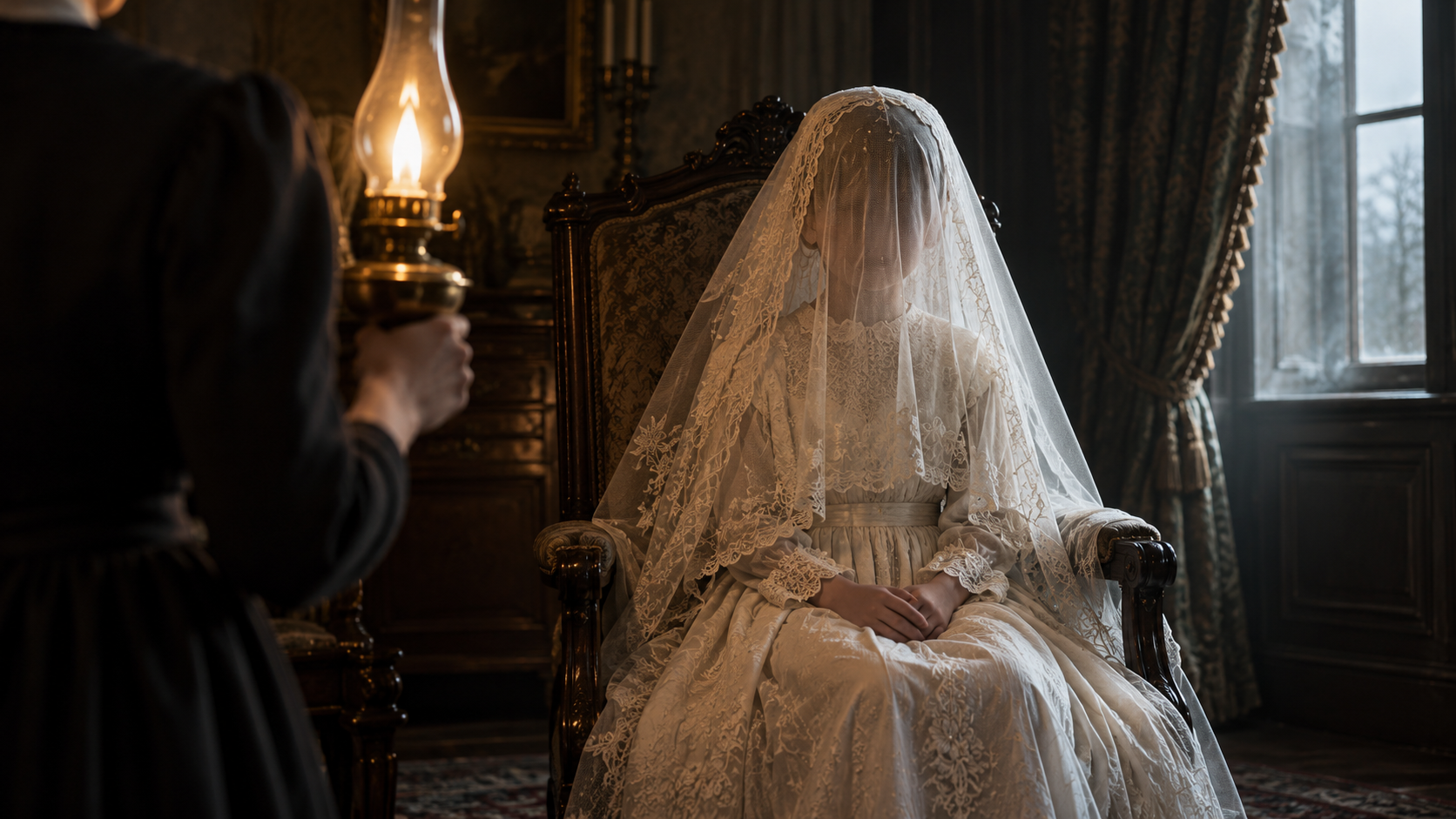
One of Grace’s most frightening encounters involves Anne wearing a veil. Where she expects her daughter, she perceives an elderly woman, while the voice insists that the person before her is Anne.
Grace reacts violently, believing something has replaced or taken possession of her child. When the encounter resolves, she has attacked Anne.
The scene makes her protective instinct dangerous. She acts because she believes her daughter is threatened, yet the action harms the very person she intends to save.
It also presents a precise identity problem. The voice and appearance seem to contradict each other, leaving Grace unable to decide which evidence deserves trust. Her response is to force the threatening image away.
The household crisis escalates when the curtains disappear. For Grace, this amounts to an attempt on the children’s lives. The house’s protective system has been dismantled.
Mrs Mills suggests that their condition may have changed. Grace hears an intolerable dismissal of a danger she has organised her entire life around. She blames the servants and orders them out.
The children subsequently discover gravestones bearing the servants’ names. Grace also finds a photograph showing the three as dead bodies. The evidence converges: Mrs Mills, Tuttle and Lydia died in 1891.
The servants acknowledge that tuberculosis killed them more than half a century earlier.
This revelation appears to identify the haunting. The apparently helpful newcomers are ghosts, and their secrecy now seems explained.
But it leaves Victor and the other intruders unresolved.
Mrs Mills urges Grace to recognise a changed situation involving the living and the dead. Grace continues trying to defend the house against an external threat, while the servants insist that she must confront what is happening inside.
The discovery answers who the servants are. It has not yet answered who Grace is.
What Happens at the End of The Others?
Grace discovers a séance involving the people she has understood as intruders. An elderly medium communicates with Anne and Nicholas, and the encounter reveals the central truth: Grace and her children are dead. The supposed intruders are living people occupying the house.
Before the main events of the film, Grace smothered Anne and Nicholas with a pillow, then killed herself with a firearm. Her account confirms the deaths rather than leaving them as an accusation made by the living.
The séance changes the audience’s position. Until now, Grace’s family has provided the familiar centre of the house, with unexplained people disturbing its routines. The living occupants have experienced the same conflict from the opposite side.
Victor is a living boy frightened by the children whose rooms overlap with his own. His parents, the Marlishes, have sought help because their home appears haunted.
The elderly woman is a medium. Her disturbing connection with Anne belongs to an attempt to communicate across that divide. The earlier image beneath the veil becomes understandable as part of that contact, rather than proof that an evil entity has replaced the child.
Grace remembers finding the children motionless and recognising what she had done. After shooting herself, she heard them playing again. Their apparent return allowed her to believe that she had received another chance to be their mother.
All three had continued as ghosts.
This is why the ending involves more than discovering an unexpected supernatural identity. Grace must recover responsibility for a specific act. The danger she has imagined outside the family cannot account for the violence already committed within it.
The Marlishes decide to leave. Their departure allows Grace and the children to remain, but Mrs Mills warns that other living occupants may follow.
The children discover that sunlight no longer hurts them. Grace acknowledges that she cannot answer their questions about the afterlife with her former certainty, and the family asserts its attachment to the house.
The immediate struggle ends. Their continued existence remains unexplained.
The Clues Hidden in Plain Sight
The twist works because earlier details retain their factual meaning while acquiring a different context. The film has shown disturbances, disagreements and missing information; the ending changes who has misunderstood them.
The Advertisement Never Reached Its Readers
The undelivered letter undermines the servants’ apparently ordinary entrance.
On a first viewing, it suggests manipulation: the newcomers have appeared under suspicious circumstances. Afterwards, it identifies a false assumption Grace supplied herself. She welcomed them as applicants before establishing how they knew she needed help.
The clue trains the viewer to notice that her explanations sometimes precede the evidence.
The Family Lives Beyond Ordinary Contact
The absent servants, uncollected post and difficulty obtaining outside assistance place Grace’s household at a distance from everyday life.
Individually, such details can fit an isolated property after wartime disruption. Together, they suggest a more fundamental break.
The film benefits from that plausible setting. The audience accepts a degree of disrupted communication because Grace’s circumstances already make it understandable.
However, the exact departure of every previous servant is not reconstructed. It is more accurate to identify the disappearance as part of the household’s separation from ordinary life than invent a detailed account of who saw what.
Victor Disputes Ownership Rather Than Announcing a Haunting
Victor’s behaviour fits a frightened child defending his own room.
Anne interprets his resistance as an intruder’s stubbornness because she assumes the house belongs exclusively to her family. The ending supplies his equally understandable perspective.
The dispute is especially effective because neither child needs to be pretending. Each can report a real encounter while misunderstanding the other’s position.
Anne’s Memory Reaches Further Than Grace’s Account
References to their mother’s frightening behaviour point towards an event that has been suppressed within the household.
Anne is not necessarily carrying a complete, orderly explanation throughout the film. Her remarks establish fragments of knowledge, discomfort and accusation.
That makes them more convincing than a child simply withholding the entire solution for dramatic convenience. The family has experienced something it cannot yet describe coherently.
The Photographs Separate Death from Appearance
The post-mortem images prepare the viewer to accept that a familiar human face does not establish life.
They also give the servants’ revelation physical support. Their deaths are recorded outside Grace’s immediate experience, preventing her from dismissing the discovery as another fleeting apparition.
Their narrative role is comparable to the search for dependable evidence in The Thing: appearance alone cannot settle identity, so characters need a different way to test what stands before them.
The Missing Curtains Have a Different Purpose
The curtains are removed by the living intruders, as the servants explain.
Grace understands the removal through the children’s medical vulnerability and therefore sees an attempted killing. From the living family’s position, opening the house to daylight has an ordinary domestic purpose.
The same action can be reasonable to one household and terrifying to the other.
The children’s eventual ability to tolerate sunlight confirms that Grace has continued enforcing a restriction whose original physical basis no longer governs them.
The Servants Know More Because They Have Accepted More
Mrs Mills and Tuttle behave as though the situation is familiar because they already know they are dead. Their discussions concern how to help Grace understand, rather than how to carry out an attack.
Lydia’s silence receives a particularly sad explanation: Mrs Mills says she stopped speaking after learning that the three servants had died.
The household therefore contains different responses to the same discovery. Experience has made Mrs Mills practical; it has left Lydia unable to speak. Grace’s eventual recognition does not guarantee a uniform or easy adjustment.
Is Charles Dead, and Is the House Purgatory?
Charles is presented as having died in the war. Near the end, Nicholas asks whether his father died there, and Grace answers yes.
His brief return is therefore best understood as an encounter with his spirit. It would be misleading to claim that the film offers no answer at all about his death.
What remains uncertain is the nature of his continuing existence. His references to the front suggest that the war still defines his experience, but the film does not establish that he literally repeats his death or must relive combat forever.
Those are possible extensions of the idea, rather than events the story confirms.
His departure also shows that being dead does not automatically reunite a family. Grace and the children remain attached to the house, while Charles cannot remain with them. Death has preserved separation alongside affection.
The house can similarly be interpreted as a kind of purgatory or limbo, but neither label is established as its official supernatural function.
Grace has taught the children confident religious explanations of what follows death. Their actual experience provides no clear confirmation of those lessons.
In his contemporary interview about the film, Amenábar explained that Grace needed to recognise the limits of her knowledge. Her change is visible when she stops treating uncertainty as something the children must be punished for expressing.
This gives the ending an emotional development independent of solving the haunting. Grace becomes capable of admitting that she does not know.
The fog supports the impression of an existence without clear boundaries. It obscures routes beyond the property and leaves the familiar house as the family’s main point of orientation. Reading it as a physical expression of confusion is persuasive; treating it as proof of a detailed afterlife system goes beyond what the film supplies.
There is a useful distinction between the central mystery and the wider supernatural setting. The film answers who died and who occupies the house. It leaves the ultimate nature of their world open.
Why the Ending Offers Comfort Without Erasing the Horror
Grace’s confession creates a difficult emotional position for the audience. We have followed her fear, recognised her exhaustion and watched her efforts to protect the children. We must then hold those experiences alongside the knowledge that she killed them.
Understanding her distress cannot turn the killings into an act of protection.
The story places the tragedy within isolation, loss and a breakdown whose full causes remain incompletely explained. It does not offer enough evidence for a neat retrospective diagnosis, and assigning one would simplify a character the film leaves painfully contradictory.
Her love matters because it makes the crime harder to absorb. A straightforwardly hateful parent would allow the audience to classify the danger immediately. Grace’s tenderness and her violence exist within the same person.
The final embrace consequently offers reassurance with a limit. Anne and Nicholas still seek comfort from their mother, and the family now shares knowledge it previously could not face. But the children cannot regain the lives she ended.
Their attachment to the house is equally mixed. Remaining together gives them continuity and a place they recognise. Insisting on exclusive ownership also suggests that the conflict with future occupants may continue.
Mrs Mills provides the more practical position: the living and the dead will have to share the property, sometimes sensing one another and sometimes not.
Grace can therefore learn what she is without immediately learning how to live with everyone else. Her recognition is substantial, but it does not complete every necessary change.
That is why The Others survives knowledge of its twist. On a second viewing, the suspense moves towards the moment Grace must understand herself. The familiar rooms contain clues to a tragedy already committed, and every attempt to secure them delays that reckoning. The ending gives the family a chance to face the truth together. Whether they can build a gentler existence from it remains the final, unsettling question.
Sources
The Others — The Criterion Collection: verified credits, release year, runtime and official synopsis.
The Others — dialogue transcript: checked dialogue concerning the curtains, séance, Grace’s confession, Lydia and Charles.
The Others — Filmsite: corroboration of the principal revelations, photograph and veil encounter.
The Others — Horror Guys: corroboration of the narrative progression and household disturbances.
Filmmaker Alejandro Amenábar — Fresh Air Archive: the director discusses restricted perspective, sound and Grace’s religious certainty.
The Others: Something in This House — The Criterion Collection: critical context for the film’s domestic setting, performances and Gothic methods.
