

The Prestige Ending Explained: How The Film Makes You Part Of The Trick
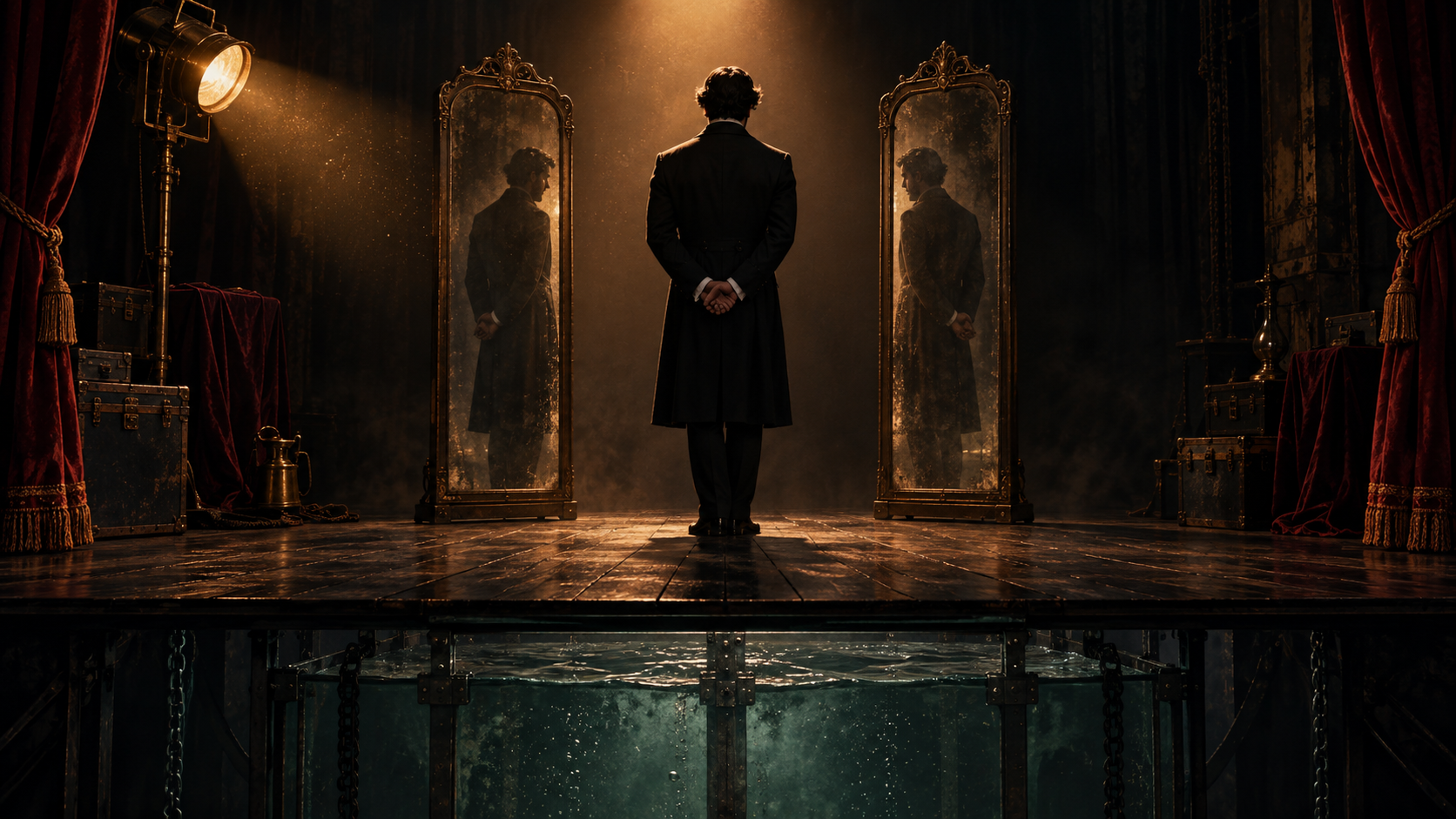
Sacrifice, Disposal And The Price Of Applause
The Secret Was In Front Of You
The Prestige hides its secrets in plain sight, then asks why the audience preferred an impossible answer to an ordinary sacrifice.
Christopher Nolan’s The Prestige (2006) tells the story of two rival stage magicians, Robert Angier and Alfred Borden, in Victorian London. Each wants to perform the perfect version of the Transported Man. Each becomes willing to destroy lives to keep or steal its secret.
The film is famous for its ending, but the final revelations are not separate decorations added to the plot. Its structure behaves like the magic routine described at the beginning: the pledge establishes something ordinary, the turn makes it disappear, and the prestige returns it in apparently impossible form. The viewer is not outside that performance. The viewer is its volunteer.
The opening sections are spoiler-light. The full explanation begins after a clear warning.
Two Magicians Who Want Different Things
Borden understands the engineering of illusion. He can recognise a method, invent a trick and live inside a secret. Angier understands the audience. He knows how to enter a room, build expectation and give spectators a satisfying moment of astonishment.
Neither man is complete. Borden’s dedication damages his ability to live honestly with the people closest to him. Angier’s showmanship is hollowed out by envy because applause cannot satisfy him while Borden possesses a method he cannot explain. Their rivalry turns complementary talents into mutual destruction.
This difference matters more than the question of who is the “better” magician. Borden believes the secret is the life built around the trick. Angier wants the effect and the recognition attached to it. When ordinary theatrical methods fail to give him both, he begins to demand an impossible solution.
The Film Tells You How It Will Deceive You
John Cutter explains the three-part structure of a magic trick. The pledge shows the audience an apparently ordinary object. The turn changes it. The prestige restores it or reveals the impossible result.
The film repeats those stages at several levels. Individual tricks follow them. Angier and Borden’s stories follow them. The editing follows them, moving through diaries, trials and memories that appear to provide access to the truth while carefully controlling what can be seen.
Most importantly, the explanation itself becomes misdirection. Once viewers are told to expect a three-part trick, they begin hunting for a clever mechanism. The film encourages this search while presenting the human cost as background detail. We look for the method and overlook the life required to sustain it.
Spoiler Warning: The Secrets And Ending Explained
The remainder reveals Borden’s identity, Fallon’s role, the truth of Tesla’s machine, Angier’s final act and the meaning of the water tanks.
Borden’s Transported Man Explained
“Alfred Borden” is not one man. Identical twins share the identities of Borden and his disguised assistant Fallon, exchanging roles so completely that each lives only part of a public life. Together they can appear at opposite sides of the stage without mechanical transport. One twin enters; the other receives the applause.
Their commitment reaches beyond performance. They share a career, a home and relationships. One loves Sarah; the other loves Olivia. Sarah senses that her husband’s love changes from day to day because, in a literal sense, it does. When one twin loses fingers, the other sacrifices the same fingers to preserve the disguise.
The trick’s method is simple enough to disappoint Angier: use a double. Its achievement lies in refusing to stop performing when the curtain falls. Borden’s secret is not a machine but a divided life.
This also explains Borden’s uncertainty about the knot tied before Julia’s fatal accident. The twins do not possess identical memories. One may have tied the knot while the other is later asked to account for it. “Borden” cannot answer because the person being questioned may genuinely not know.
Angier’s Transported Man Explained
Angier initially rejects a double because the method requires someone else to receive the applause. He eventually travels to Nikola Tesla, misled partly by Borden’s encoded diary, and obtains a machine that duplicates whatever is placed within it.
The machine does not offer safe transportation. It creates another Angier at a distance. Each performance therefore produces two conscious claimants to the same identity. The man on the stage drops through a trapdoor into a locked water tank and drowns, while the duplicate appears elsewhere and accepts the ovation.
The film deliberately leaves one metaphysical question unanswered: does the original drown while the copy survives, or does the original appear across the theatre while the copy falls? From the perspective of each newly created Angier, there is no reliable way to know before the machine operates. Angier enters the device accepting that one version of him will die and one will continue.
That uncertainty is more disturbing than a clean answer. Angier performs courage and murder at the same time, with himself as both possible victim and beneficiary. He repeatedly creates a person who believes he is Robert Angier, then arranges for one Robert Angier to die.
Why Borden Is Hanged Yet Returns
Angier designs the final version of his act to frame Borden. He allows Borden to enter below the stage and discover the drowning figure. Borden is convicted of Angier’s murder and executed, while the surviving Angier lives under his aristocratic identity, Lord Caldlow.
Only one Borden twin is hanged. The surviving twin has been appearing as Fallon. He confronts Angier, reveals the shared-life method and shoots him. The ending then exposes the rows of water tanks containing bodies produced by Angier’s performances.
The final exchange restores what the film appeared to remove: Borden returns, Angier’s deaths become visible, and the Transported Man is explained twice. This is the prestige of the film itself.
The Real Contrast Is Sacrifice Versus Disposal
Both men sacrifice, but not in the same way. The Borden twins surrender wholeness. Each gives up a complete identity, a complete relationship and uncontested ownership of achievement. Their arrangement is cruel to Sarah and destructive to themselves, but the sacrifice is mutual and sustained.
Angier increasingly treats people as replaceable parts of an effect. He uses a double, manipulates Olivia and finally turns successive versions of himself into disposable bodies. His method avoids sharing the applause only by manufacturing someone who can be denied a future.
This is why “both men are equally obsessed” is true but incomplete. The film draws a moral difference between living a sacrifice and outsourcing its cost. Borden’s life is divided to sustain the illusion. Angier’s victims are hidden so that his public identity can remain whole.
Why The Audience Misses Borden’s Secret
The film places clues throughout the story. Fallon is constantly present. Sarah describes inconsistent love. Borden’s knowledge and behaviour vary. The Chinese magician Chung Ling Soo demonstrates that a great trick can depend on carrying a performance into ordinary life.
Yet viewers are encouraged to reject the simplest answer for the same reason Angier rejects it: a double feels too ordinary. We want a mechanism worthy of the effect. The film then supplies Tesla’s genuinely impossible machine, and that spectacular explanation draws attention away from the more human one.
This is the central act of complicity. The audience claims to want the secret, but secrets are often disappointing. What we actually want is the sensation that no ordinary explanation could account for what we saw. The Prestige gives us a supernatural device, then reveals that our appetite for impossibility helped conceal a pair of men standing in front of us.
The Diaries Are Tricks Inside The Trick
Borden and Angier both read diaries written partly for the other man to find. A diary normally promises private access: the reader expects thoughts that were not designed for an audience. Here that promise is false. The documents are performances, built to delay, provoke and redirect.
The film’s non-linear form makes the viewer repeat the rivals’ mistake. We read with them, believing that one more page will deliver mastery. Instead, each text controls its reader. The apparent evidence is real as an object but deceptive in purpose.
This has a wider implication for the film. Information is not the same as understanding. Angier can learn a method and still fail to grasp the sacrifice beneath it. Borden can understand machinery and still refuse to understand the emotional harm caused by his commitment. Knowledge arrives, but wisdom does not automatically follow.
Tesla Is More Than A Plot Device
The film uses a fictionalised Nikola Tesla as the point where stage illusion becomes science fiction. His machine literalises what magic normally simulates: one person appears in two places. That change in genre is risky, but purposeful.
Before Tesla, the rivalry concerns what performers can persuade an audience to believe. After Tesla, Angier possesses a real impossibility and uses it in the most theatrical way imaginable. Genuine wonder does not cure his obsession. It gives the obsession a larger weapon.
The machine therefore tests Angier’s stated desire. If he wanted only a perfect trick, he could stop once the impossible had been achieved. Instead, he builds a repeated public performance around death. The applause, and the victory over Borden, remain essential.
The Women See The Cost First
Julia, Sarah and Olivia are often pushed to the edge of a story dominated by male rivalry, but their experiences reveal what the magicians refuse to count. Julia’s death begins the feud. Sarah recognises that the man she loves is not emotionally continuous. Olivia becomes an instrument passed between the rivals’ schemes.
The film’s limitation is that it gives these women less interior space than the men whose obsessions injure them. Yet their treatment is not incidental to the theme. Magic depends on directing attention, and the rivals repeatedly direct their attention away from the people paying for their acts.
Sarah’s tragedy is the clearest indictment of Borden’s supposedly purer sacrifice. The twins may accept the cost of half a life, but she never knowingly agrees to share a husband assembled from two men. Their devotion to the secret turns her perception of inconsistency into isolation.
What The Final Shot Means
The last view of the tanks is not merely confirmation that Angier duplicated himself many times. It is the return of everything the performance concealed. On stage, disappearance is clean because the apparatus and body are hidden below. The final shot forces the audience to look beneath the theatre.
Cutter’s narration suggests that spectators want to be fooled. The line is sometimes taken as a playful compliment to cinema. In context, it is darker. Wanting wonder can become a willingness not to inspect its cost. The applause depends on accepting the visible prestige and ignoring the trapped body.
The Prestige endures because its twists do more than reorder the plot. They expose the viewer’s priorities. We noticed the machine, the code and the rivalries. We were less attentive to the double, the assistant, the wife and the bodies under the stage. The film does not simply reveal how the trick works. It reveals what we were willing not to see.
