What Did the Real Prime Time Gunman Want to Say on Air?
The Real Hostage Crisis Began On An Ordinary Sunday In Warsaw.
Shortly after eight o’clock on the evening of 21 September 2003, a young man entered the headquarters of Polish public television, got past the security barriers and threatened a guard with a pistol. He wanted someone to take him to a studio. Once inside, he asked for a camera operator and a mobile phone. He wanted to know that the pictures would go out live.
Eighteen years later, audiences watching the Polish thriller Prime Time saw Bartosz Bielenia make much the same demand. His character, Sebastian, has chosen New Year’s Eve 1999. A television presenter and a security guard are at his mercy. He has a piece of paper in his pocket and an apparently simple request. Give him the country’s attention for long enough to say what he came to say.
The Warsaw incident was one of several real events that inspired director Jakub Piątek and co-writer Łukasz Czapski. They invented Sebastian, moved the action to the eve of the millennium and put a familiar television personality beside the guard. When the film reached Netflix in 2021, the man involved in the real incident publicly objected. He had declined to participate, he said, and people who knew him could make the connection anyway.
There is also a clue in the Polish press from 2003 that complicates the film’s central mystery. The real man appears to have offered at least one explanation for wanting a national audience. It was a surprisingly intimate thing to want to do on television.
What Happened Inside Polish Television’s Studio 7?
The broadcaster was Telewizja Polska, usually known as TVP. The building stood on Woronicza Street in Warsaw. Early reports from that Sunday evening estimated the intruder’s age at about 30 and raised the possibility that he was carrying a conventional firearm. By the following morning, police had identified him as a 22-year-old, named in the Polish press as Adrian M. They described his weapon as a gas pistol.
That correction sounds reassuring from a distance. It meant very little to the guard at the time. Police explained afterwards that firing the weapon at such close range could have killed him. A photograph published in the Polish weekly Przekrój, taken from footage shown by police, gives an idea of the distance involved. The guard is seated. Adrian stands immediately behind him with the pistol. Whatever people elsewhere in the building knew about the weapon, the man in the chair had to take the threat seriously.
Television staff said Adrian reached Studio 7 and confined several people in its control room. He subsequently let those employees out. The guard remained behind. This is where the familiar description of a lone hostage needs a little care. Several people had already lost the freedom to leave before the confrontation narrowed to the young man and the person he continued to hold at gunpoint.
Police negotiators came to the building, along with armed officers and an ambulance. According to the broadcaster’s account that evening, its president set up a crisis team at about nine. Inside the studio, Adrian continued to press for a live appearance. One employee explained that people were too frightened to come in. It was an extraordinary difficulty of Adrian’s own making. The people he needed to operate the equipment had good reason to keep their distance.
Police took him into custody after eleven that night. A contemporary account said officers secured the weapon when he moved it away from the guard. Neither the guard nor the other television employees suffered a reported physical injury. The weekly’s account added a detail easily lost in that fortunate outcome. The guard was receiving psychological support.
Some later accounts connected with the film give the confrontation a duration of six hours. The timings reported immediately afterwards place Adrian’s arrival after eight and his arrest after eleven. Roughly three hours is the better-supported description of the standoff. The distinction matters in a story that has acquired a fictional countdown, an invented date and a second principal hostage in the retelling.
What Did Adrian M. Want to Say on Television?
One of the most revealing details comes from Warsaw’s police commander at the time, Ryszard Siewierski. In its coverage of the incident, Przekrój attributed to him an account in which Adrian said he wanted to apologise to his family for his behaviour. The same item reported that Adrian subsequently gave other reasons during questioning. Police did not disclose those reasons.
That leaves us with a possible purpose for the broadcast and no reliable way to reconstruct the speech. An apology was something the commander said Adrian had mentioned. It could have been all he intended to offer, one part of a longer statement or the explanation he was able to give during an encounter that lasted hours. The public record cited here cannot decide among those possibilities. There is no authenticated address to read alongside Sebastian’s piece of paper.
The detail is nevertheless worth preserving. Imagine the difference between hearing that an armed stranger wants to address the nation and learning that the people he most wants to reach may be members of his own family. The first sounds like the beginning of a political crisis. The second raises the painful question of why a private exchange might need witnesses. Either could make a compelling film. Only one was reported as something Adrian actually said, and even that comes to us through a police officer.
Later, Piątek spoke about the uncertainty surrounding the young man’s purpose and how much it interested him as a writer. His observation makes sense as an account of the film’s origins. A filmmaker looking for the definitive reason behind the incident would come away empty-handed. A reader looking for anything contemporaries knew about it can get a little further. That is the distance between the historical mystery and the one the screenplay constructs.
How a Story About Music Videos Led the Writers to Warsaw
The writers’ search began with an interest in rebellion. Piątek had been drawn to Jakub Szela, associated with the Galician peasant uprising of 1846, and had gone looking for Szela’s house in southern Poland. It is a long way from a nineteenth-century peasant revolt to a television game show. The connection was the director’s interest in what might drive someone to do something conspicuous and irreversible.
One of the stories that caught the writers’ attention concerned two young men in the United States. In the version Piątek encountered, they gained control of a local television station and used the opportunity to play music videos. A request for pizza featured in his recollection. The filmmakers found accounts of other incursions into broadcasters in several countries. Eventually they came across the Polish case, with its security guard and the unresolved question of what the intruder expected to accomplish on air.
The music videos help explain what was distinctive about Warsaw. In the American anecdote, the choice of programming supplied an answer. Whatever larger ambitions the pair may have had, someone watching could see what they had wanted to put on television. Warsaw supplied the demand for transmission without a corresponding public performance. The gap gave the writers room to invent a character whose conduct could be watched closely without his beliefs ever becoming entirely clear.
The screenplay went through 22 versions. During its development, people repeatedly wanted to know what Sebastian had written down. The obvious commercial choice would have been to give him a revelation capable of justifying the wait. Yet a revelation would also have determined what kind of film the writers were making. An exposé would require a wrongdoer and evidence. A political appeal would invite viewers to judge its argument. A family confession would move the centre of the drama towards the people hearing it at home. The finished film leaves the camera in the studio with the people who have to survive his demand.
Why Prime Time Changed the Date to New Year’s Eve 1999
On 21 September 2003, Adrian selected a television building. In Prime Time, Sebastian also selects an occasion. The difference gives his plan a logic an audience can grasp before it knows anything else about him. On the last evening of 1999, people who might ordinarily watch different programmes, go out or turn in early have a reason to gather around a screen. A young man looking for an audience has picked a date when the broadcaster has already assembled one for him.
Piątek was 15 that New Year’s Eve. One of his most vivid recollections concerned his mother, who went to the bank to obtain proof of her balance in case the millennium computer bug caused trouble. It is a better guide to the period than a general claim that everyone feared the end of the world. A person could buy food for a party, expect the lights to stay on and still decide it was worth getting a piece of paper from the bank. Celebration and ordinary caution fitted comfortably into the same afternoon.
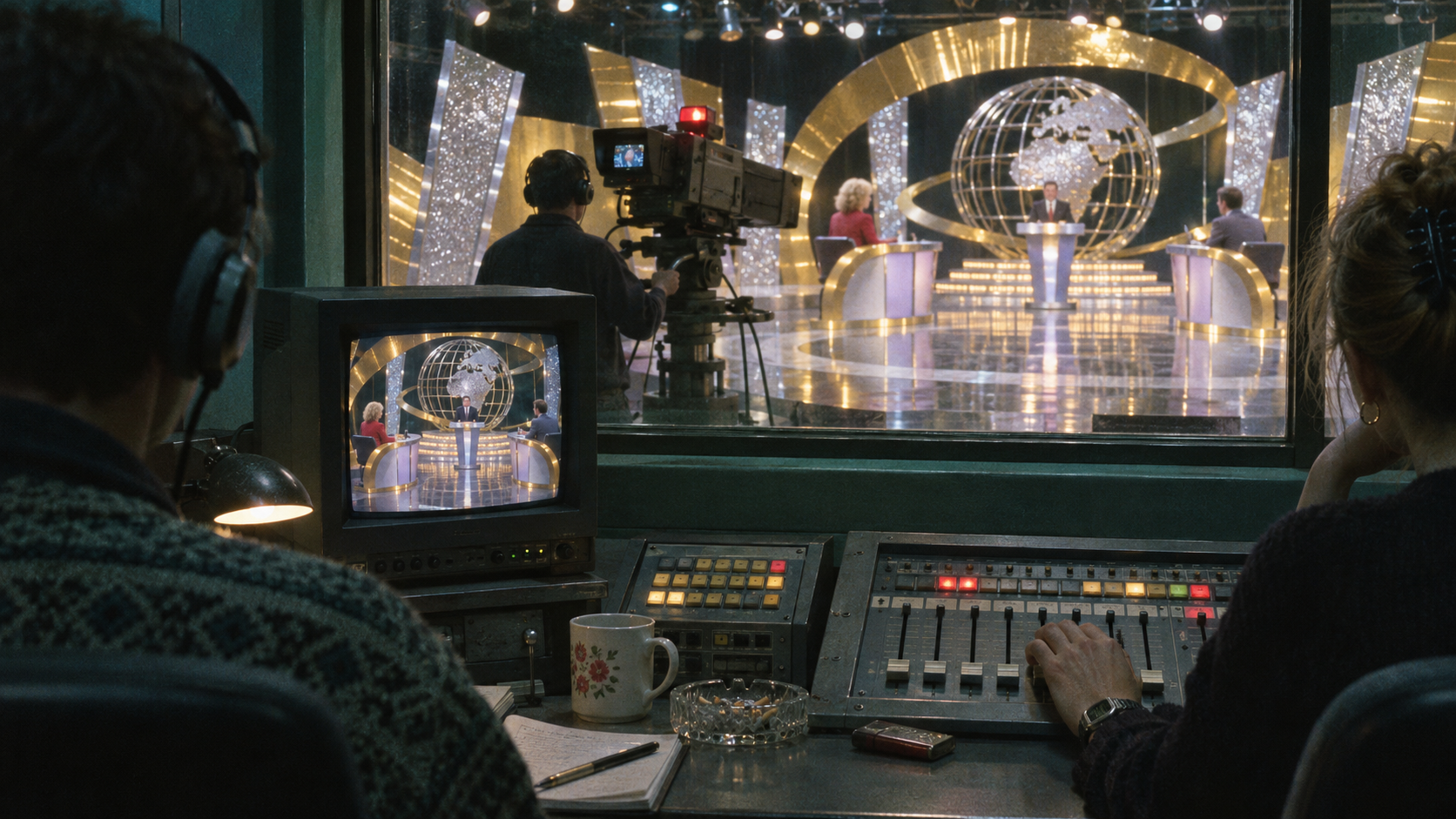
The filmmakers looked through television archives from 1999 and used material from the period. Piątek remembered the peculiar company that television could keep on a night like that, with star performances and a papal blessing belonging to the same broad public occasion. The archive gives the fictional night a world beyond the walls. Somewhere outside Sebastian’s immediate predicament, performers still have audiences and a year is still coming to an end. Real footage lends the date its texture, which also helps explain how easily a viewer could mistake the invented siege for something recorded that night.
There was a practical reason for winding the clock back, too. Piątek pointed out that a contemporary Sebastian could have a smartphone in his pocket. He could begin transmitting before anybody in the control room had decided how to respond. He might attract very few viewers, but getting the first pictures out would be within his own power. In 1999, the characters tending the cameras and deciding what went on air could keep him waiting. Much of the film happens during that wait.
The Presenter Was One of the Film’s Most Consequential Inventions
In the film, Sebastian takes presenter Mira, played by Magdalena Popławska, and security guard Grzegorz, played by Andrzej Kłak, hostage. The real accounts describe a guard and employees confined in a control room. They establish no equivalent scene in which a recognisable game-show presenter shares the guard’s captivity. Putting Mira there changes the balance of knowledge inside the room.
Consider what each of the three can do. Sebastian can issue a threat. Grzegorz understands what it means, in immediate physical terms, to be the person against whom that threat might be carried out. Mira knows how someone becomes a familiar presence in other people’s homes. It is her job to look into a lens and make a remote audience feel that it is being addressed directly. Sebastian has come to the studio because he wants, for a few minutes, something she does for a living.
From a sofa at home, Mira might look like the person who commands the whole operation. The studio gives a less glamorous account of her authority. Someone has to select the picture. Someone has to keep the sound open. A decision elsewhere can render the most accomplished performance invisible. Mira’s professional experience makes her valuable to Sebastian precisely as her inability to grant his demand becomes apparent.
Grzegorz has a different claim on our attention. The public is unlikely to know a television security guard’s face. Most viewers would have no particular reason to see him in the course of his work. Yet in both the history and the fiction, the broadcaster’s decisions suddenly turn on what happens to a man its audience would seldom consider. The contemporary report that the Warsaw guard needed support afterwards carries particular weight here. A television schedule could resume that night. For the person who had sat beneath the pistol, an arrest marked only the earliest point at which recovery could begin.
Why Sebastian’s Speech Remains a Mystery
Sebastian keeps returning to the sheet of paper he has brought with him. It gives the audience a fair reason to expect an answer. A man improvising a demand might have little idea what he would say if it were granted. A man who has prepared a text appears to know. Every glimpse of the paper renews the possibility that the film will eventually let us hear the words.
Piątek recalled discussing the mysterious case in Pulp Fiction when people challenged the decision to leave Sebastian’s message unresolved. An audience can understand what an object means to the people pursuing it without being told exactly what it contains. The piece of paper in Prime Time makes a more personal demand on the viewer. Most of us could imagine writing down something important before a difficult conversation. The physical gesture is familiar even when the circumstances are far beyond ordinary experience.
There is a fair objection to the choice. The content of a speech would affect how people judged its speaker. A warning about an immediate danger would place different obligations on a broadcaster from a desire to air a private grievance. Withholding the words prevents viewers from settling a question they have spent the film weighing. Piątek acknowledged that some people experienced this as the film’s principal weakness. Anyone who feels the story has withheld a promised answer has understood the promise perfectly well.
Yet the people making decisions in the studio have to act before they can hear a complete speech. They must judge the danger to Mira and Grzegorz while Sebastian still has the weapon. Granting airtime would mean committing to an action whose consequences they could discover only afterwards. The withheld message leaves viewers with the same uncomfortable disadvantage. We can favour giving him the microphone or keeping him off air. We cannot first listen to a finished address and then congratulate ourselves on having chosen wisely.
Why the Real Man Objected to Prime Time
In April 2021, after the film became available on Netflix in Poland, Adrian published an open letter. He said Piątek had contacted him in 2018 about collaborating and that he had declined. He also said he had given no consent to the production or distribution of a film telling his story. In his own account, mental illness had been central to the original incident. He objected to that episode being brought back into public view and described consequences for his family when local coverage linked him to the film.
Watchout Studio, the production company, answered publicly. It described Prime Time as fiction drawing loosely on publicly known events and maintained that Sebastian’s story was an invention. The director had identified incidents in several countries as sources of inspiration before the film’s Netflix release. The differences are there on screen in the date, the presenter, the millennium celebrations and the entire arrangement of the evening.
Adrian’s objection concerned something those changes could do little to prevent. A viewer abroad could meet Sebastian as a complete stranger. Somebody who remembered the Polish headlines could recognise the conjunction of a young man, a television studio, a guard held at gunpoint and a request to go live. Somebody who knew Adrian personally could make that association more readily still. The same scene could feel wholly invented to one audience and uncomfortably identifiable to another.
His letter records his objections. The studio’s answer records how the producers understood their work. Neither gives viewers a basis for assigning Sebastian’s private thoughts, family relations or conduct to Adrian. The film offers a sustained performance by Bartosz Bielenia. The real man spoke for himself years later, in quite different circumstances, when the choice of whether to publish his words was finally his own.
The Image That Survived the Real Standoff
There is an irony in the photograph published after the Warsaw incident. Adrian entered TVP because he wanted control over what appeared on a screen. A picture of him did reach the public. It came from footage shown by the police, and it depicted the danger facing the guard. The authorities could choose which moment people saw. A newspaper could supply the caption. The man who had asked for live television had no comparable control over the image through which readers came to know the event.
That photograph supplies the clearest answer to what Prime Time borrowed. The gun, the guard, the studio and the demand for airtime all have counterparts in Warsaw on that September Sunday. The millennium game show and the people waiting for Sebastian to speak belong to the filmmakers. Between them lies a detail more affecting than an invented manifesto. A police commander recalled a young man talking about apologising to his family. Eighteen years later, when the film drew strangers back to that night, his family was among the reasons he gave for wishing the story had been left alone.
Sources
Culture.pl — How Jakub Piątek and Łukasz Czapski developed Prime Time
Cineuropa — Jakub Piątek on the millennium setting and Sebastian’s undisclosed message
Wirtualna Polska — Piątek on Polish television in 1999 and why a smartphone would change the story
Onet Kultura — Adrian M.’s public objection and Watchout Studio’s response
