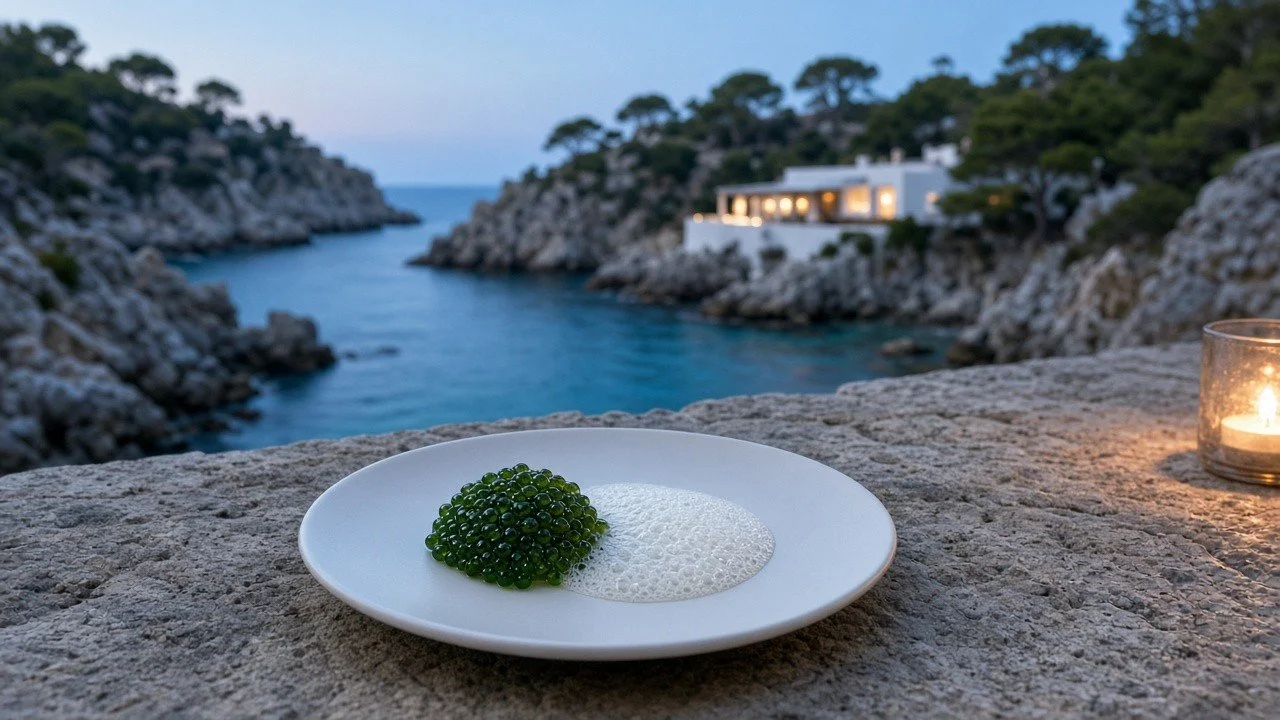
Foams and spherification became elBulli's signatures on a remote cove near Roses.
Two Million Requests For 8,000 Seats, Then They Closed The Doors: The Real Story Behind Welcome To El Bulli
For a few years in the 2000s, the hardest table in the world to get was at a restaurant on a remote cove in Catalonia that had started life as a beach bar. elBulli was open for only part of the year, served around 8,000 diners a season and received more than two million requests for them. Then, at the peak of its fame, its chef closed it.
Netflix's Welcome to El Bulli, released on Friday 20 November 2026, dramatises how that happened. The six-part Catalan series follows Ferran Adrià, his business partner Juli Soler and his brother Albert Adrià through the years that turned a small restaurant on the Costa Brava into the most influential kitchen of its age.
It is a drama, not a documentary, and part of it is invented outright. This guide sets out who is in it, what the real history of elBulli was, and which parts of the series are fact and which are fiction.
Welcome To El Bulli: Cast, Creators And Release Date
The series was made in Catalonia under the title Gènesi and first shown at the San Sebastián International Film Festival, where its opening two episodes premiered on 21 September 2026, the same day it launched on the Catalan broadcaster 3Cat. Netflix then picked it up for international release, with all six episodes arriving on 20 November in territories including the UK and the US.
It was created by Eva Mor, David Pujol and Albert Val, and directed by Pujol. It is produced by Fishcorb and Minoria Absoluta with 3Cat.
Miquel Fernández plays Ferran Adrià, Iván Massagué plays Juli Soler and Carlos Cuevas plays Albert Adrià. Mònica López plays Glòria Canabach, a food critic, and Joana Vilapuig plays her niece, Lola. Xavi Caudevilla, Daniel Bayona, Alex Brull, Alberto Díaz, Pere Arquillué and Mario Gas are also in the cast.
Netflix says the actors worked closely with the real people behind the story, and the elBullifoundation says Adrià and his team played an active role, particularly in the food. More than 70 original elBulli dishes were recreated for the series with the help of former members of the kitchen.
The Real elBulli: A Bar Named After Bulldogs
elBulli began long before Ferran Adrià. In 1961, a German man, Hans Schilling, and his wife Marketa chose a plot of land above Cala Montjoi, a bay near the town of Roses on the Costa Brava, for a planned holiday resort. A small beach bar opened there, and the name came from a colloquial word for the French bulldogs the couple owned. The first restaurant opened in 1964.
Under a series of French chefs it became a serious restaurant, winning its first Michelin star in 1976. In 1981, the Schillings hired Juli Soler, a hospitality professional who had started as an assistant waiter at 13, as general manager.
How Ferran Adrià Arrived
Ferran Adrià, born in 1962 near Barcelona, did not set out to be a chef. He began washing dishes at a hotel in Castelldefels in 1980 and learned traditional Spanish cooking there, then cooked during his military service.
In 1984, aged 22, he joined the kitchen at elBulli as a line cook. Netflix's own description captures the spirit of what happened next: he arrived "almost by chance", and what began as a temporary job became something else. Within about 18 months he was running the kitchen, and by 1987 he was in sole charge.
His younger brother, Albert, joined him and went on to become one of the most admired pastry chefs in the world.
The Revolution In The Kitchen
Adrià's cooking was built on a simple, disruptive idea: take something familiar and transform its texture, form or temperature until it surprises you. He called it "deconstruction" and rejected the popular label "molecular gastronomy". His stated aim was "to provoke, surprise and delight the diner".
The techniques he developed or popularised, including culinary foams made from a single flavoured liquid and the "spherification" that turned liquids into caviar-like beads, spread through restaurant kitchens worldwide.
The business grew alongside the cooking. In 1990, Soler and Adrià bought the restaurant from the Schillings. In 1994 they sold a 20 per cent stake to a businessman, Miquel Horta, and used the money to expand the kitchen. The third Michelin star followed in 1997.
elBulli also worked unlike any other top restaurant. It opened for roughly six months of the year, and Adrià spent the rest of it developing new dishes in a workshop in Barcelona, elBullitaller. Bookings for the following season were taken on a single day.
The World's Best Restaurant, Five Times
Between 2002 and 2009, elBulli was named the best restaurant in the world five times on Restaurant magazine's World's 50 Best list, in 2002, 2006, 2007, 2008 and 2009, a record. A generation of chefs passed through its kitchen, including José Andrés, René Redzepi of Noma and Massimo Bottura of Osteria Francescana.
The fame did not make it rich. The restaurant itself ran at a loss from 2000, with the business supported by books, lectures and other projects linked to Adrià.
Why elBulli Closed
In 2010, Adrià announced that elBulli would close, and after some confusion over whether it would reopen as a restaurant, it served its last dinner on 30 July 2011. It was relaunched as the elBullifoundation, a centre for culinary creativity.
The question of why a restaurant at the height of its success would shut is central to the series. Pujol has said it is framed as a mystery, but that the answer is revealed "as it was in real life".
Adrià himself has said there was no single reason. "We felt we had reached the limits of what a gastronomic experience could be at that time," he said around the festival premiere. "There was also Juli's situation, as we sensed he was becoming ill, while Albert was developing projects of his own. We didn't close because El Bulli was failing. Quite the opposite."
Juli Soler died on 6 July 2015, aged 66. Albert Adrià went on to open his own restaurants. elBulli's former home in Cala Montjoi reopened in 2023 as a museum, elBulli1846.
What Is True And What Is Invented
The series runs on two timelines, and they are very different in kind.
The 1980s timeline is based on real people and events. Ferran Adrià, Albert Adrià and Juli Soler are real, the restaurant is real, and the milestones the series builds on, from Adrià's arrival to the closure, are documented. The dishes on screen were chosen and recreated by Adrià's own team. "The dishes you see in the series are exactly the ones you could have tasted at elBulli," Pujol said at San Sebastián.
The 2025 timeline is fiction. Glòria Canabach, a critic who returns from the United States after her father's death, her niece Lola and their family restaurant, Can Canabach, are not part of elBulli's documented history. Pujol has said the series mixes actors playing real people with others who are "purely fictional", and that the Canabach storyline was developed to show elBulli's legacy through a new generation. He has described it as "a mirror effect of what Ferran and Juli did".
The dialogue is reconstructed. Pujol has been candid that private conversations cannot be reproduced exactly, "because not even the people who lived through them remember them". The series chose what it saw as the key moments in elBulli's history and dramatised them.
The kitchen may be louder than the real one. One British critic who saw the opening episodes at San Sebastián noted that some cooking scenes were "oddly frantic", given that Adrià "was not a shouty chef à la Gordon Ramsay". Expect some heightened drama in the service scenes.
What To Watch For
Ferran's arrival. Netflix describes him arriving "almost by chance". The documented record is that he joined as a line cook in 1984, and quickly rose to run the kitchen. Watch how far the series compresses that rise.
Juli Soler. Soler is widely credited with giving Adrià the freedom to experiment, and with shaping the dining room as much as Adrià shaped the kitchen. When Soler died, Adrià said: "Without Juli, elBulli would have not happened." Watch how much space the series gives him.
The money. The series focuses on creativity and friendship. The real story also involved selling part of the business, running the restaurant at a loss and building a brand around books and products. Watch whether that side appears.
The closure. Adrià's own explanation combines creative exhaustion, Soler's health and Albert's ambitions. If the series offers a single dramatic reason, treat it as interpretation.
Welcome to El Bulli is an affectionate portrait made with the cooperation of its subject, which shapes how it sees him. The history it draws on is remarkable enough: a beach bar named after two bulldogs became, for a while, the most influential restaurant in the world, and then chose to stop. For another Netflix drama built on a real case, read our guide to the true story behind Fjord.
Next Reads
Fjord True Story: The Bodnariu Case And Norway's Child Protection Service Explained
A Talent For Murder Explained: Is It A True Story? Patricia Highsmith, Ripley And What's Real
The Platform Explained: The Levels, The Food And The Meaning Of The Ending
Sources
Netflix Releases 'Welcome to El Bulli' on November 20, Netflix
Gènesi: The Story of a Gastronomic Revolution, elBullifoundation
3-Michelin Star Restaurant El Bulli Gets a 3Cat Dramatic Series, Variety
Festival diary: Gènesi premiere, San Sebastián International Film Festival (Spanish)
David Pujol: "Queríamos resucitar El Bulli", Hule y Mantel (Spanish)
The Story of the World's Most Famous Restaurant Is Coming to Netflix, What's on Netflix
Juli Soler, the El Bulli Restaurateur Who Changed Dining, Dies at 66, The New York Times
Influential Restaurateur, elBulli Co-Owner Juli Soler Dies at 66, Eater
