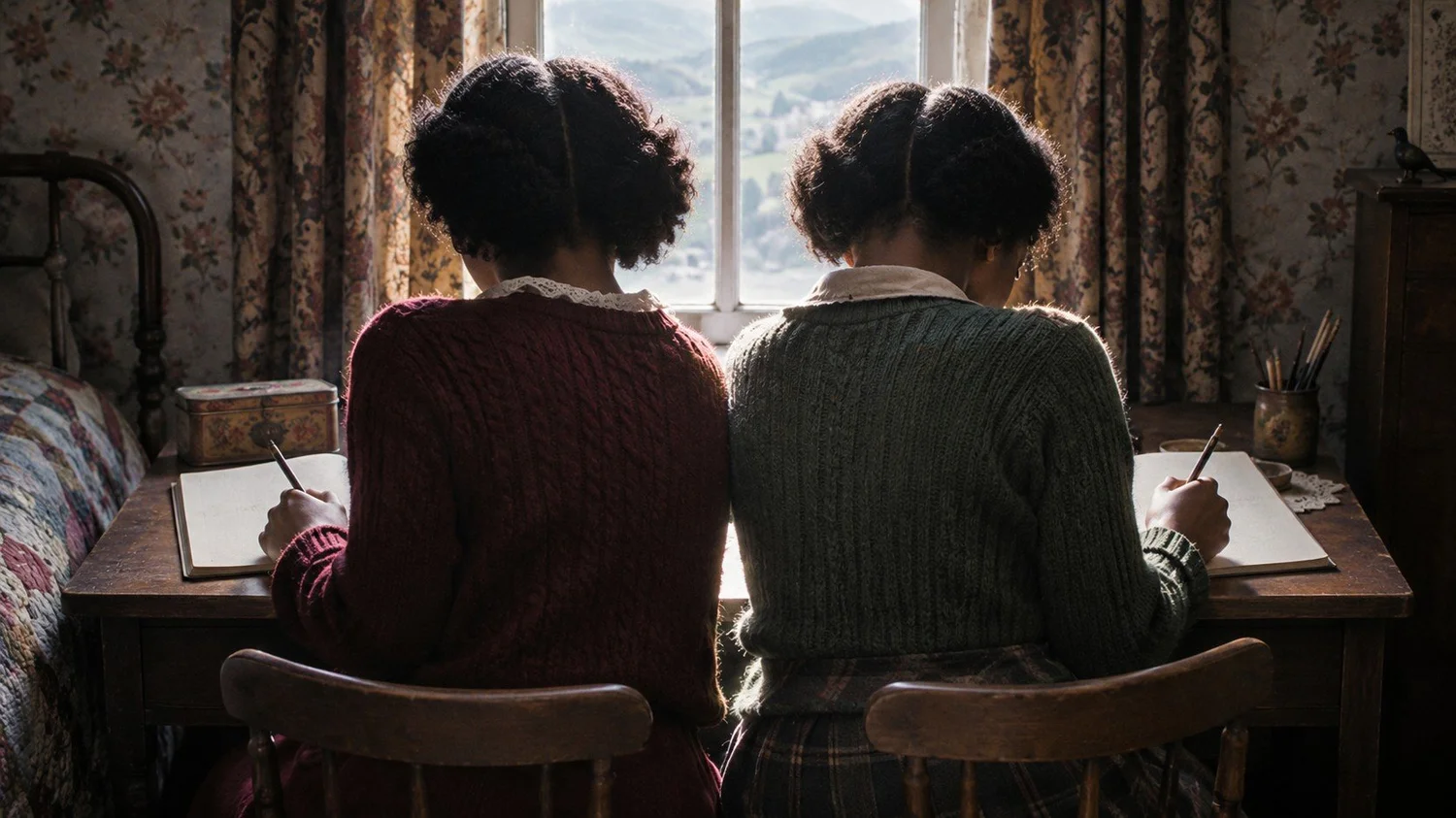
Two Girls Have Plenty To Say When The Adults Leave The Room.
The surprise in Agnieszka Smoczyńska's The Silent Twins is how much noise two famously quiet girls can make. June and Jennifer Gibbons put on voices, invent lives and keep one another entertained. An adult crossing the threshold can bring the whole performance to a halt. From one side of that door the girls seem unreachable. From the other, a perfectly intelligible conversation has been interrupted.
The 2022 film draws on Marjorie Wallace's book about the real sisters, whose childhood in Wales, years as writers and confinement at Broadmoor became entangled in a powerful story about twinship. Letitia Wright plays the adult June and Tamara Lawrance plays Jennifer. The fact that there are two performances to follow matters. Even people trying to help the sisters sometimes found it easier to talk about a single mysterious bond than to ask what each woman wanted.
Spoilers follow for the film and for the events surrounding the sisters' transfer from Broadmoor in 1993.
Whose Silence Is It?
The Gibbons family came from Barbados, part of the Windrush generation. The twins were born in 1963 at a military hospital in Aden, where their father was serving with the RAF, and grew up in Britain. In 1974 the family moved to Haverfordwest, where theirs was the only Black family in town and the girls were bullied at school. It is possible to state those facts without claiming to know the precise moment or single reason two children retreated into one another's company. What the context establishes is that speaking to people outside the family was never quite the neutral, cost-free exercise some adults imagined it ought to be.
At school a child can be asked a simple question in circumstances where any answer will attract attention to her accent, her appearance or her sister. Refusing to supply an answer can give her some immediate control. Tomorrow it may make the same room much harder to enter. The film is interested in that reversal. Something two girls can do for each other, offering refuge from an unkind audience, can gradually become something each has to do to keep faith with the other.
Adults use the word silent because it describes the experience of addressing the sisters and receiving little or no reply. It is much less satisfactory as a description of the sisters' experience of a day. They talked to each other, made recordings and eventually filled pages with writing. The film lets us share the discrepancy before it introduces anyone equipped to explain it. A teacher who reports a lack of imagination and a viewer who has just seen a private performance are effectively describing two different samples of the children's lives.
Accounts of the real sisters often refer to a private language. June herself has disputed that description. Speaking in 2023, she said the twins had a speech impediment, and that people mistook their rapid English, shaped by their Barbadian background and distinctive pronunciation, for an invented tongue. There was a great deal an unfamiliar listener might miss. That is a different proposition from a claim that the girls inhabited a language nobody else could ever understand. Changing the conditions under which someone listened could make a difference.
Smoczyńska uses younger performers before handing the roles to Wright and Lawrance. The casting asks for continuity of relationship rather than a technical trick in which one actress is duplicated. The filmmakers considered using visual effects so that one actor could play both sisters, and decided the relationship needed two real people. The girls can move in concert, but one performer always has another real person to watch, wait for or compete against. Moments of hesitation register. A viewer can begin to see how much work it takes for two distinct people to produce the appearance of complete agreement.
What Happens When Adults Try Separation?
Specialists and educators attempted to reach the sisters, including by sending them to separate boarding schools. From outside, the logic has an obvious attraction. If being together seems to prevent either child from speaking freely, perhaps time apart will let each find her voice. That argument depends on an assumption about what is holding the girls up. Removing a constraint and removing someone's principal source of support can look identical to the person making the arrangements.
Their distress in separation made the practical difficulty unmistakable. Parted, both became withdrawn to the point of near-catatonia. A pattern can be damaging while also supplying the only means two people have yet found of getting through a day. An adult can correctly identify a difficulty and still have no workable replacement for the arrangement that sustains it. For the girls, the results of the experiment join the growing body of evidence that outside interventions have consequences over which they have little say.
It would be easy at this point to cast every adult who tried to help as an impatient intruder. The real accounts are less convenient. Adults differed in their willingness and ability to find another way of listening. There is an important difference between someone who asks an unfamiliar child to repeat herself and someone who concludes that failure to get an answer settles the question of what she understands.
That distinction runs through the family's position too. The parents had other children, responsibilities and their own relationship with British institutions. Agreeing to expert help did not give them access to everything that happened when the twins were alone, any more than living under the same roof made them specialists in what their daughters experienced at school. The film's private world is a privilege extended to the audience. It would be unfair to assume that everybody in the girls' real lives could see what we can.
Two Writers In One Bedroom
In private the sisters created families of dolls, stories and imaginative versions of America. The geographical distance is part of the pleasure. A girl in west Wales can put a character in Malibu without obtaining anybody's permission, finding a fare or explaining how she will manage the journey. Her American teenager can sustain an entire conversation in front of strangers. A writer gets to give a character abilities other people have decided the writer herself lacks.
A pair of diaries, given as Christmas presents in 1979, set them writing in earnest. They sent away for a mail-order course in creative writing, and each kept her own diary and produced her own stories, poems and novels. The arrangement is a good clue to the ambiguity of their partnership. They worked side by side, in the same room, towards the same ambition. Yet each was writing her own book, and that would become more painful when a publisher had to decide whose name appeared on a cover.
June wrote The Pepsi-Cola Addict. Jennifer wrote fiction including The Pugilist and Discomania. The film turns some of their imaginative work into stop-motion animation. A doll performing an action on screen may describe an event in a sister's fiction rather than an incident in the Gibbons household. That distinction matters especially when the invention is violent or outlandish. A spectator accustomed to treating every unusual image as evidence of a condition might overlook the simpler fact that two teenagers had discovered the pleasures of genre.
Animation also lets a reader's experience enter a film about people who wrote. Watching an actress sit over a page could establish that she spent time writing. Following the creation into a world of its own tells us that a stranger might want to know what happens next. The sisters' work acquires an audience independent of the attention paid to their behaviour. For a while the question is what kind of minds designed these stories, and what else they might have made with enough encouragement and time.
The sisters pooled their unemployment benefit so that a vanity press would publish June's novel in 1982. Jennifer's attempts to get her own work into print were unsuccessful. Neither outcome can be explained merely by saying the twins dreamed of becoming authors. One could hold a printed book bearing her name. The other could be proud to have helped and still know that her own work had not reached the same destination. The closer two people are, the harder it may be to find somewhere private in which to experience a disappointment like that.
Publication introduces a stranger into the sisters' most private arrangement. A reader can encounter June's American teenager without Jennifer beside her to explain what June intended. Equally, a manuscript by Jennifer need not be understood as a response to June's success. The public has usually encountered their names joined together. Writing gave each sister the possibility, however difficult it was to realise in practice, of meeting a reader alone.
Their diaries make the same point by different means. Two diaries leave two accounts, even where lives are lived at extremely close quarters. The sisters revised writing and took their aspirations seriously. An intimate passage can be truthful without being a transparent clinical record. A young writer deciding how to describe the worst fight of her week is selecting language and imagining a reader. Wallace drew on those pages, and the film in turn draws on Wallace. Attention to that chain helps preserve the sisters as authors with decisions of their own.
When The World Outside Becomes Available
The film follows the sisters into encounters with American boys, sex and drugs. The drawn or invented America of their bedroom had allowed them to decide how people spoke and what they wanted. An actual encounter introduces people who can pick favourites, withhold affection and go away. It is one thing to imagine the possibility of a private relationship. It is another to pursue one while knowing your sister will see what you gain and what it costs her.
There was real conflict between June and Jennifer, and the film retains it. Neither the picture of perfect unity nor a simple account of one sister tyrannising the other can explain why their loyalties persisted when they were angry. A wish for independence can coexist with terror of abandonment. To turn one woman into an oppressor and the other into a permanently willing victim would reproduce the very simplification the two separate performances work to resist.
In 1981 the sisters committed a series of offences, and they were later convicted of burglary, theft and arson. It matters to distinguish the reality of those acts from the ingenuity of their fiction. Taking their imaginative lives seriously means allowing a story to be a story. Taking their public conduct seriously means acknowledging that fires and burglaries put other people and property at risk. Understanding the conditions in which teenagers acted does not oblige the people affected to experience those acts as harmless expressions of frustration.
The decisive public intervention came when the sisters were nineteen. In 1982 they were sent to Broadmoor, the high-security psychiatric hospital in England, under orders that gave them no fixed release date. A young person serving a specified term can count down to its end, even when the months are hard to bear. For June and Jennifer, leaving depended on future assessments, institutional decisions and the availability of a place willing to receive them. That uncertainty would consume a considerable part of their adult lives.
What Marjorie Wallace Could Hear
Wallace, a Sunday Times journalist who followed their case, took an interest in the writing. A person who arrives knowing that you wrote a novel can conduct a different conversation from somebody waiting for you to display a symptom. There are characters to discuss and pages to show. Silence in one kind of interview need no longer settle the issue of whether a relationship is possible.
Her 1986 book remains a major source for the film. That gives it proximity and limits. Wallace knew the sisters, read their work and campaigned for them. She later said she had challenged the Broadmoor psychiatrists' view of the twins, arguing that nothing they wrote was psychotic. She could report what they said to her and give an account of how she interpreted it. Friendship did not give her direct access to a private agreement until somebody chose to describe it. A feature film has still greater freedom to let a look or a cut between images suggest what one woman means to the other.
The sisters spent eleven years at Broadmoor. It is worth dwelling on that duration in ordinary terms. A nineteen-year-old may have only the beginnings of a profession and little experience of choosing where to live. By the time a person approaches thirty, friends outside may have had years in which to change jobs, abandon bad relationships, establish households or decide to start writing again after an early failure. The sisters had to negotiate adulthood within an institution that had enormous authority over where they could go.
Finding a less restrictive placement proved difficult. Wallace has said that, although she campaigned for their release, no psychiatrists were willing to accept them, and their relationship made it hard for them to be either together or apart. Institutional responsibility can become particularly hard to shift in a case like that. Accepting someone involves assuming a risk. Keeping them where they already are can look administratively safer even when the cost of another year falls almost entirely on the people waiting.
What Happened To Jennifer On The Journey To Wales?
A move to the Caswell Clinic in Bridgend was finally arranged for March 1993. It was a transfer to a more open hospital. The sisters were leaving Broadmoor, and their prospects had changed markedly, but they were not simply being dropped at their family home to resume the lives interrupted eleven years before. Holding those two facts together gives the journey its proper mixture of relief and uncertainty.
In the weeks before the transfer, Jennifer told Wallace that she was going to die. Wallace later described an understanding between the sisters that one of them had to die if the other was to live freely. The film allows that expectation to hang over the journey. After so much time spent waiting for permission to leave, the possibility that both might get out and yet never share the life afterwards becomes almost unbearable to consider.
On 9 March 1993, Jennifer could not be roused when the sisters arrived, and she died that evening, aged twenty-nine. The medical finding was acute myocarditis, an inflammation of the heart muscle. No drugs or poison were found in her system, and why the inflammation developed was not established. There is no medical evidence that Jennifer caused it by deciding to die, or that June caused her death. A prediction made before the journey and a physical finding after it are both part of the record. Joining them with the word “because” would add something that record cannot supply.
The film gives the event emotional shape through the women's attachment and the imaginative language it has used throughout. June's understanding that her sister made a sacrifice belongs to her experience of bereavement. Wallace reported it as an account of what the separation meant. Respect for that meaning is entirely compatible with care about the limits of the evidence. Someone can live the rest of her life in the light of what she believes her sister gave her without that belief becoming an explanation of how her sister's heart failed.
What Happened To June?
The closing acknowledgements give the sisters credit for the poems, stories and other writing used in the film. It is a quiet correction to the impression their nickname has left on popular memory. Some of what an audience has spent the evening listening to came from the two people identified on the poster by their supposed silence.
June survived, eventually returned to life outside hospital and went on to live quietly and independently in west Wales. She gave the film her blessing, and in a 2023 BBC podcast she spoke at length about Jennifer, their childhood and the years at Broadmoor on her own terms. Her writing also found new readers. The Pepsi-Cola Addict was reprinted in 2022 in a limited edition with a new introduction by June, and an author-approved paperback followed in 2023. Jennifer's Discomania has since followed her sister's novel into print. Work that once required the sisters to pool their money to reach a reader can finally circulate to people who might first encounter its authors as novelists. That is a more substantial answer to the question of what happened than the easy observation that a once-silent woman learned to talk.
The ending can look like the fulfilment of the sisters' belief that only one could be free. Their writing suggests a more generous way to think about what survived. Long before Broadmoor, they had found a means by which two different accounts of the same small room could exist at once. Jennifer's life ended on the day of the transfer. The circumstances of her death did not cancel her authorship, and June's life afterwards was larger than the explanation others wanted her to give for being the twin who lived.
Sources
- 'Silent Twins' true story: What's fact, fiction in Letitia Wright drama – Los Angeles Times
- June and Jennifer Gibbons – Wikipedia
- The Pepsi Cola Addict by June-Alison Gibbons – Penguin Random House
- We Two Made One – The New Yorker
- The Artist Behind The Silent Twins' Stop-Motion Animation – Focus Features
- The Silent Twins (2022) – Journal of the American Academy of Psychiatry and the Law
Next Reads
- The Wonder Ending Explained: What Happens to Anna, and Was She Based on a Real Fasting Girl?
- The Unthinkable Daughter True Story: Suzane von Richthofen, Her Parents' Murder and Where She Is Now
- Is Gentle Monster Based on a True Story? The Investigation That Inspired Marie Kreutzer
- Little Women Ending Explained: Why Jo Says No to Laurie, What Happens to Beth and Who Jo Marries
- Reminders of Him Ending Explained: How Kenna Finally Meets Diem
