Why Would a Killer Want an Art Expert to Read the Crime Scene?
Most murderers try to leave as little behind as possible. The killer in Netflix's ChiaroScuro does the opposite. Each body is arranged to echo a painting, and the arrangement is so deliberate that it reads like a message addressed to someone who knows art well enough to decode it. For most of the season the obvious candidate for that reader is Cosmo Speranza, the Roman art expert who can spot a forgery from a single brushstroke. The finale reveals that he was never just the reader. He was meant to be the signature on the whole collection.
ChiaroScuro is an eight-episode Italian series produced by Lux Vide for Netflix, directed by Jan Maria Michelini and written by Umberto Gnoli, Michela Straniero, Francesco Arlanch, Elena Bucaccio and Silvia Leuzzi. It premiered on Netflix on 11 November 2026 after a presentation at the Rome Film Festival, and in the week of 16 to 22 November it sat sixth in Netflix's global non-English TV top 10 with 2.4 million views. Pierpaolo Spollon plays Cosmo and Andrea Lattanzi plays Inspector Angelo Tiberi, with Matilde Gioli, Romana Maggiora Vergano, Aurora Giovinazzo, Paz Vega and Alessandro Preziosi in the wider cast.
This guide sets out the premise first, then explains the two mysteries the finale resolves: who killed Cosmo's father, Rufo, and who has been staging the present-day murders. Where published recaps of the final episode disagree on a detail, we say so rather than pick a version.
Spoiler warning: everything after the next section reveals the identity of the killer and the ending of all eight episodes.
What Is ChiaroScuro About?
The series opens with a death at a museum in Rome. Lux Vide's announcement places the first murder against the backdrop of the Galleria Nazionale, and the victim, a curator, has been posed in a way that mirrors a painting. Cosmo, who has no business being at the scene, notices the reference before the police do. The same painting turns out to be missing, and when it is recovered it proves to be a fake.
That is the moment the case stops being a professional curiosity for Cosmo. He recognises the forgery as the work of his own father. Rufo Speranza, played by Preziosi, was an art professor who secretly produced copies good enough to pass as originals. He died years earlier in what was officially recorded as a suicide. Cosmo has never fully believed that version.
Cosmo's interference at the crime scene could have landed him in legal trouble. According to Moviedelic's recap, the police commissioner, who has a history with the Speranza family, offers him an alternative: six months as a special consultant to the police. He accepts once he understands that the new murders and his father's past are connected. Comicbasics' review adds that the series is loosely inspired by the thrillers of the Italian novelist Mirko Zilahy, though Netflix and Lux Vide do not describe it as an adaptation of a specific book.
The main characters
- Cosmo Speranza (Pierpaolo Spollon): a brilliant, chaotic art authenticator who refuses to carry a phone and has a talent for stumbling into trouble.
- Inspector Angelo Tiberi (Andrea Lattanzi): a procedure-minded officer who initially wants nothing to do with an amateur.
- Leda (Matilde Gioli): Cosmo's half-sister, a lawyer, and Rufo's daughter from his other family.
- Eleonora (Romana Maggiora Vergano): the medical examiner, the former partner of Angelo's best friend, a police officer killed in the line of duty.
- Mia (Aurora Giovinazzo): an art professional who works with Cosmo.
- Beatrice Keller (Paz Vega): Mia's mother, a powerful figure in the art trade.
- Rufo Speranza (Alessandro Preziosi): Cosmo and Leda's father, seen in flashbacks.
How the Season Builds Its Puzzle
ChiaroScuro runs on two tracks. Some episodes are self-contained cases in which Cosmo's eye for detail solves a crime ordinary police work would miss. Running underneath them is the serial-killer story, which grows each time another person tied to Rufo's old operation turns up dead and staged after a work of art.
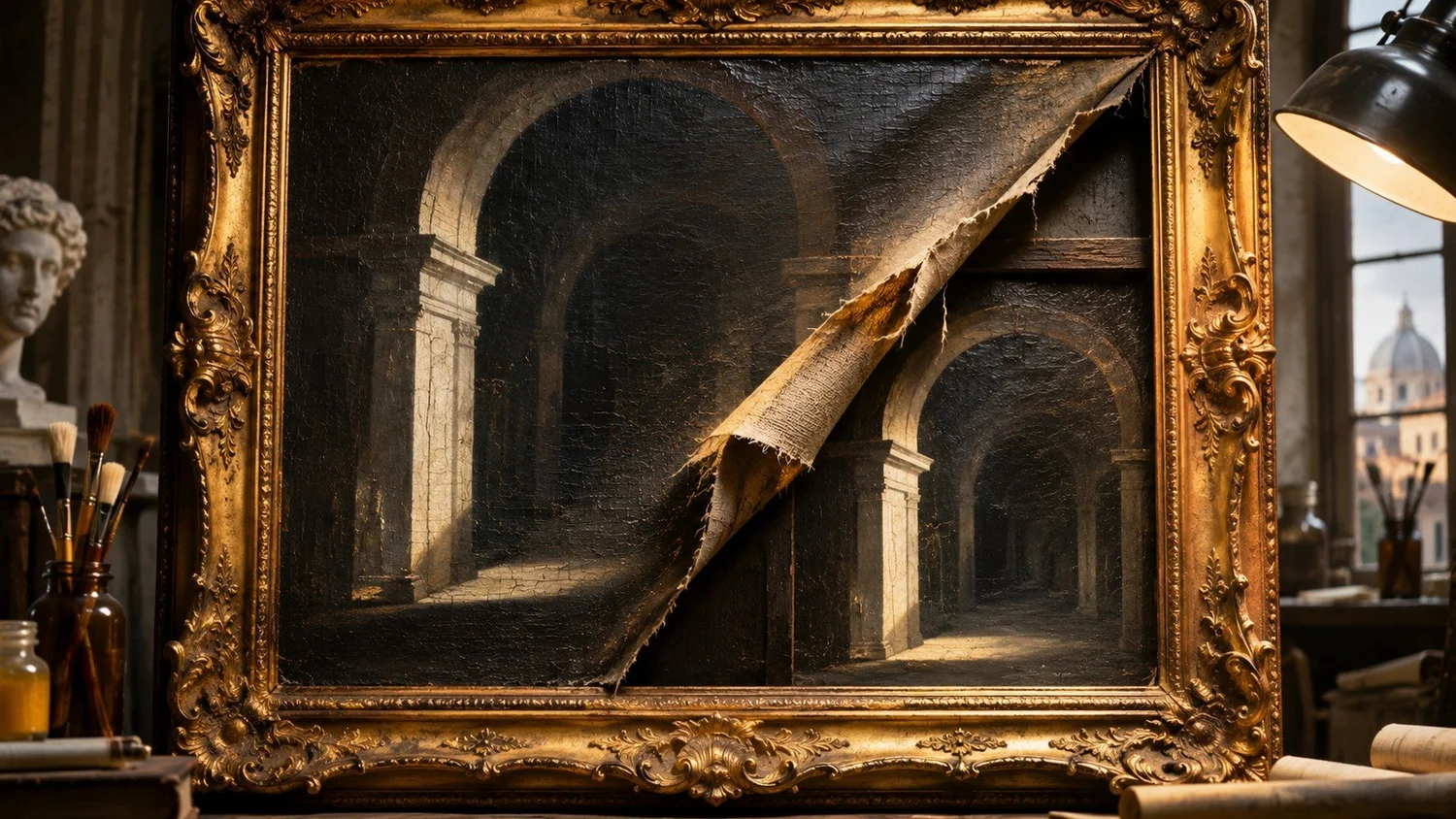
The title is the key to the show's design. In painting, chiaroscuro means the handling of light and shadow to model form. Auralcrave's analysis reads it as a statement about the characters: every one of them has a lit side that the audience sees first and a darker side the plot gradually exposes. That applies to Rufo, the respected professor who was also a forger and the father of two families. It applies to Beatrice, the respected dealer. And it applies, most of all, to the person nobody looks at closely enough.
The family history is the second key. Rufo lived two lives. In Rome he was a professor with a wife and a daughter, Leda. Outside the city, in Bomarzo, he kept the studio where the forgeries were made and raised Cosmo. Moviedelic's recap says it was Rufo's death that exposed the two households to each other. Cosmo grew up inside the secret and adored his father. Leda learned about it only when her life fell apart, and she has resented the man ever since.
Over the season, Cosmo and Angelo establish who the victims were. Moviedelic identifies the curator as a man who sold Rufo's fakes to museums as genuine, the art dealer Cecilia as someone who handled such sales, and Professor Antonelli as a close friend and collaborator of Rufo's. Beatrice is linked to Rufo too, though for most of the season the nature of that link is unclear. The investigation also finds that the gun used in Rufo's death had been stolen from police custody, which makes the suicide verdict much harder to sustain.
Who Killed Rufo Speranza?
The answer to the older mystery arrives at the end of episode seven, in a flashback. Beatrice Keller shot Rufo.
The recaps agree on her reason. Rufo had grown tired of the double life and wanted to stop forging, confess and bring his two families together. Moviedelic and Leisurebyte both say he felt he owed the truth to his children. A confession would have exposed everyone who had profited from his work. Beatrice, who had a young daughter, asked him what would happen to the rest of them. He promised to keep her name out of it. She was not reassured.
According to Moviedelic, the circle first arranged for Rufo to look as though he was about to be caught over a forged painting, which made a suicide seem plausible. Beatrice then killed him with a gun Antonelli had supplied and placed it in his hand. Cosmo, who heard the shot, found the body. The arrangement held for years because it told a believable story: a cornered forger had taken his own life.
This is the first of the finale's two reversals. Cosmo spends much of the season convinced that Beatrice is guilty of something, and in the final episode he is sure she murdered his father. He is right about that. He is wrong to assume that her guilt explains the new killings.
Who Is the Serial Killer in ChiaroScuro?
The present-day killer is Leda, Cosmo's half-sister. She killed the people connected to Rufo's forgery ring and staged each death after a painting. She also planted evidence to make Cosmo look guilty.
The final episode opens with Beatrice missing. Cosmo half expects that she has simply fled. Mia knows better: her mother has a heart condition and would not have left without her medication, so someone must have taken her. Mia also tells Cosmo that Beatrice had come to suspect him of being the killer and was frightened of him.
The evidence then turns on Cosmo with alarming speed. The Viewer's Perspective lists what the police find: his hairs in Beatrice's car, and, in a search of his home, evidence tied to the murder of Cecilia Landi and boots whose prints match those found near Antonelli's body. His alibi for one of the killings is Eleonora, but she had been asleep. He is arrested.
Leda arrives as his lawyer and engineers an escape. She slips him a scalpel taken from Eleonora's bag, and Cosmo pretends to take her hostage so he can walk out of the station. It plays as an act of loyalty. The audience then learns that Leda has Beatrice, and that she is keeping her alive with the medication only so she can kill her on her own terms.
Cosmo works it out in Leda's flat, where he finds Beatrice's pills while looking for a bandage. Rather than confront her, he quietly alerts Angelo and plays along, gambling that Leda will lead him to Beatrice. Eleonora, meanwhile, has found the proof that would clear him: a painting Cosmo made of her asleep on his sofa on the night of one of the murders. She takes it to Leda, not knowing who Leda is. Leda drugs her.
Why Does Leda Do It?
The easy assumption, and the one the killer wanted the police to make, is that the murders are revenge for Rufo. The victims were the people who used him and then got rid of him, and his son is an artist with the skills to stage a painting. Cosmo looks like the perfect suspect because he looks like the perfect avenger.
Leda's confession dismantles that. When Cosmo asks why she would avenge a father she hated, she tells him she is not doing it for Rufo. She is doing it for herself. The recaps describe her as someone who has never been happy since his death, which ended the life she knew and replaced it with a family history built on lies. When Rufo's old forgeries began to resurface, she realised a group of people had been involved, and she decided to punish all of them.
Cosmo is part of that reckoning. Moviedelic puts it bluntly: Leda blames her brother for her father's deception simply because he exists. He was the child of the hidden household, the one Rufo shared his secret world with. In her plan he is both the final victim and the fall guy. His death, staged as a suicide, would close the case with every murder pinned on him.
That gives the finale its sharpest irony. The show has spent eight episodes telling us that Cosmo can always tell the real thing from the fake. The one forgery he fails to see is the sister standing next to him: the protective lawyer, the ally who helped him escape, the person whose loyalty looked authentic in every detail.
How Does ChiaroScuro End?
Leda takes Cosmo and the unconscious Eleonora to Cosmo's own apartment, where Beatrice is already being held. Angelo's first instinct is that she will go to Bomarzo, to Rufo's old house, where the story began. On the road he realises he is heading the wrong way.
The Viewer's Perspective describes how he gets there. Angelo remembers a painting he saw earlier, The Death of Seneca, and understands the tableau Leda is building. Beatrice is to die posed as a Vestal Virgin. Cosmo is to die as Seneca, the Roman philosopher ordered to take his own life, which is exactly the suicide Leda needs the police to believe. The killer's method, staging death as a work of art, becomes the clue that undoes her. Angelo has learned to read a scene the way Cosmo does.
Who does Angelo save?
Angelo arrives as Leda is about to fire and puts himself in the line of the shot. The published recaps disagree about who he is shielding. The Viewer's Perspective says Leda was about to shoot Eleonora and Angelo stepped between them; Moviedelic and Leisurebyte say he took a bullet meant for Cosmo. They agree on the outcome. Angelo is wounded but survives. Leda is stopped: The Viewer's Perspective says the police shoot and wound her, and every account has her arrested. Cosmo, Beatrice and Eleonora all survive.
What happens to Beatrice?
Being Leda's captive does not make Beatrice innocent. The finale confirms that she murdered Rufo, and by the end, according to The Viewer's Perspective, both women are in prison: Leda for the present-day killings and Beatrice for the killing that started everything. Cosmo's name is cleared.
The final scenes
Angelo recovers in hospital. He and Eleonora finally get a chance to talk, but his large family arrives and interrupts them, leaving the relationship unresolved. Cosmo goes back to working with Mia, even though her mother is now in prison for killing his father, and the show hints that something more could develop between them. He promises to be punctual from now on, unless he is busy with a murder.
The closing image belongs to the partnership. Cosmo and Angelo eat ice cream together, and Cosmo reveals that although his compulsory six months are over, he has become a permanent consultant to the police.
What the Ending Means
ChiaroScuro is a light crime show, closer in tone to a buddy comedy than to a bleak Nordic thriller, and the ending is tidier than its premise might suggest. Both mysteries are solved, the hero is cleared and the partnership is formalised. Underneath that neatness, though, the finale makes a pointed argument about inheritance.
Rufo's forgeries are the poison that runs through the whole family. They made money for his circle, they got him killed, and years later they set off a second wave of killing. The two children respond to the same buried secret in opposite ways. Cosmo turns his father's eye into a gift for detecting fakes and, eventually, for solving crimes. Leda turns her pain into a counterfeit of justice, a series of crimes made to look like someone else's work. Both are their father's children. One authenticates, the other forges.
The paintings matter for the same reason. Throughout the series, a work of art at a crime scene can carry two kinds of evidence: what happened to the victim, and what the person who arranged it wanted us to think. Leda's final tableau, with Cosmo as Seneca, is the purest example. It was designed to tell a lie about who killed whom. Angelo's breakthrough is to read the composition for what it was trying to make him believe, rather than accepting what it showed.
There is also something quietly sad about the resolution of the Rufo mystery. Cosmo spent years trying to prove that his father did not kill himself. He was right, and the truth brings no comfort. The person who shot Rufo is the mother of the woman he works with, and the person avenging that killing tried to murder him. Being right about the past does not give Cosmo back the family he lost. It gives him a new one built from colleagues and friends.
Will There Be a ChiaroScuro Season 2?
Netflix has not announced a second season. As of the reviews and recaps read for this article, there is no renewal and no cancellation.
The ending leaves the door open. The serial-killer arc is closed, but the format is partly a case-of-the-week procedural, so a second season would not need to reopen Rufo's story. Cosmo is now a permanent police consultant, his partnership with Angelo is official, and both romantic threads, Angelo and Eleonora, Cosmo and Mia, are left unresolved. Auralcrave reports that the series became the most-watched show in Italy after launch. That claim comes from a single outlet; what Netflix's own figures confirm is a place in the global non-English top 10.
The Verdict
ChiaroScuro's finale works because it plays fair with its central idea. A show about a man who can tell an original from a copy hides its killer in plain sight, inside the family and inside the act of helping him. The clues were there: the motive no one examined, the access to Cosmo's home, the convenient escape. The audience, like Cosmo, was looking at the wrong canvas.
For viewers, the answers are simple. Beatrice Keller killed Rufo Speranza to stop him confessing. Leda, Rufo's daughter, killed his former associates and tried to frame and then kill her half-brother. Angelo saves the day by learning to read a crime scene like an art expert, and Cosmo ends the season as a full-time partner rather than a reluctant consultant.
Sources
- Lux Vide is working on ChiaroScuro: a new light crime series coming soon to Netflix – Lux Vide
- Netflix Top 10s, 16–22 November 2026 – What's on Netflix
- 'Chiaroscuro' Review: Netflix's Italian Mystery Series Turns Art Forgery Into Murder – What's on Netflix
- ChiaroScuro Trailer Introduces Netflix's Art-Crime Duo – Pixel Twelve
- Chiaroscuro Season 1 Recap and Ending Explained – The Viewer's Perspective
- ChiaroScuro Ending Explained: Who is the Serial Killer? – Moviedelic
- ChiaroScuro Ending Explained – Leisurebyte
- ChiaroScuro Explained: The Killer, the Ending and Season 2 – Auralcrave
- 'ChiaroScuro' Season 1 Review – Comicbasics
Next Reads
- The Body Ending Explained: Grace's Final Words, Lisbeth's Lie and What Netflix's Finale Really Means
- Lupin Part 4 Explained: The Heist, Betrayal and Ending
- Wake Up Dead Man Ending Explained: Who Killed Monsignor Wicks?
- Murder in Galicia True Story: The Real Isabel Fuentes Case
- Is The Blue Road a True Story? The 2002 Comic Explained
