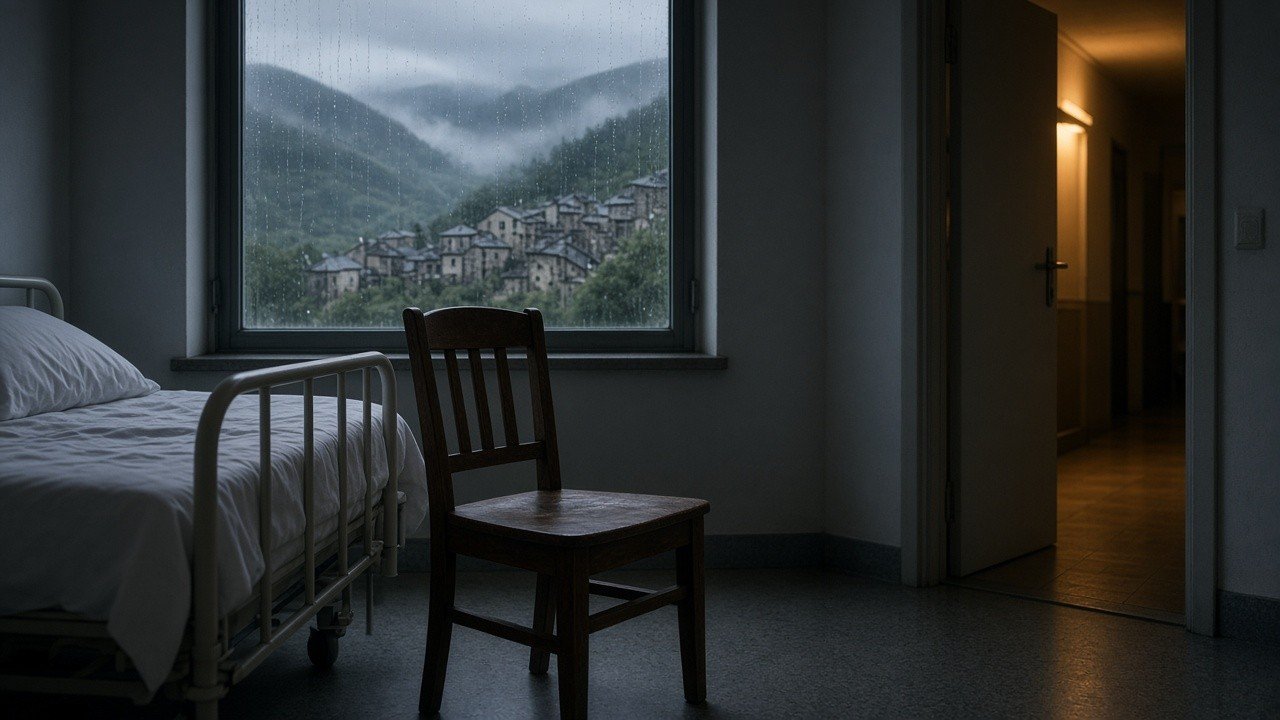
Isabel Fuentes was killed in her hospital bed in Ourense in May 2015 while recovering from an earlier attack.
She Survived The Hammer, Was Recovering In Hospital, And Her Husband Was Still Allowed At Her Bedside: The Real Case Behind Murder In Galicia
Netflix's Murder in Galicia arrives on Friday 13 November 2026, and it comes with a warning built into its premise. A woman is attacked at home in a quiet Galician village. Her husband says it was a robbery. A Civil Guard sergeant does not believe him. While the woman fights for her life in hospital, the sergeant tries to make the system listen.
Every part of that summary is drawn from a real case. In 2015, Isabel Fuentes was attacked with a hammer at her home in Pazos, near Verín, in the province of Ourense. Five weeks later she was killed in her hospital bed by her husband, Aniceto Rodríguez Caneiro, who was later convicted of both attacks.
The series is a dramatisation, not a documentary, and Netflix describes it as "inspired by true events". Some of what it changes has already been confirmed by Netflix and the people who made it. Other differences will only become clear once viewers can watch it. This guide separates the two: what the real case established, what the series is confirmed to have altered, and what to watch for when the three episodes drop.
The Series: Title, Cast, Creators And Episodes
Murder in Galicia is a three-part limited series from Bambú Producciones, the Spanish company behind The Asunta Case. In Spain it is titled El crimen de Pazos. Netflix announced on 8 October 2026 that it would premiere on 13 November.
Tristán Ulloa, who also starred in The Asunta Case, plays Elías, the Civil Guard sergeant at the centre of the story. Miguel Borines plays Aniceto. The cast also includes Carlos Blanco and Fer Fraga as fellow officers, with special appearances by Verónica Sánchez and Edu Soto.
Netflix credits Ramón Campos, Gema R. Neira and David Orea as creators. The series is written by Ramón Campos, David Orea Arribas, Curro Serrano and Gema R. Neira, directed by Carlos Sedes and executive produced by Campos, with Carlos Garcés as director of photography. Campos and Sedes were also behind The Asunta Case and Cocaine Coast.
The drama has a companion piece. A week earlier, on 6 November, Netflix released Unprotected: Murder in Galicia, a feature-length documentary about the real case, written and directed by Jorge Laplace and produced by True Crime Factory. Its Spanish title is Desprotexida: El crimen de Pazos. If you want the facts before the fiction, the documentary is the place to start.
What Happened To Isabel Fuentes
Isabel Fuentes was in her sixties and lived with her husband, Aniceto Rodríguez Caneiro, a former butcher, in the village of Pazos in the municipality of Verín. Neighbours and relatives described the couple as getting on well.
During the night of 1 to 2 April 2015, Isabel was attacked at home while on the sofa. She was struck repeatedly on the head with a hammer. Her husband went to the neighbours for help and told the Civil Guard that intruders had broken in and attacked her during a robbery. Nothing was taken.
Isabel was taken to the university hospital complex in Ourense, known locally as the CHUO, with catastrophic head injuries. She underwent surgery, spent weeks in intensive care and, against the odds, began to improve. On 29 April she was moved from intensive care to a ward. She could not speak or give investigators an account of the attack, but hospital staff later testified that she was becoming more alert.
From the start, investigators from the Civil Guard's judicial police unit in Verín doubted the robbery story. Later court testimony described their concerns about the scene, including the lack of a forced entry. A hammer was recovered from the house, and Isabel's blood was found on it. The husband became their main suspect.
The Warnings That Went Unheeded
This is the part of the story the series is built around, and it is the part that still provokes anger in Galicia.
Investigators asked the investigating judge in Verín for measures that might have protected Isabel. The requests, later examined in a disciplinary case, included tapping the husband's phone and asking the hospital to keep Isabel in a more closely supervised unit. On 28 April 2015, the day before her move to a ward, the judge rejected those requests, describing the investigators' case in her ruling as "mere conjectures" rather than clear evidence. No restraining order was imposed on the husband, and he continued to visit his wife in hospital.
Ourense's chief prosecutor at the time, Florentino Delgado, confirmed in May 2015 that a senior Civil Guard officer had contacted him days before 8 May with doubts about the robbery account. No protective measure was in place when the next attack came.
In the early hours of 8 May 2015, Aniceto Rodríguez entered his wife's hospital room and stabbed her to death in her bed. He then injured himself with the knife and suffered a stroke.
What The Courts Decided
The case came to trial at the Provincial Court of Ourense in June 2017. Rodríguez denied the killing and said he could not remember what had happened; his defence argued that his mental state should reduce his responsibility. The specialists who examined him found him fit to stand trial, and the court rejected the defence case.
In July 2017, he was convicted of two counts of murder, one attempted and one completed. He was sentenced to 12 years for the hammer attack at home and 19 years for killing Isabel in hospital, a total of 31 years. During a reconstruction of events in June 2016, he had acknowledged attacking her at home.
In December 2017, Spain's Supreme Court upheld the sentence, rejecting appeals from both the defence and Isabel's family. Rodríguez died in prison in September 2018, having served only a fraction of his sentence. Why he wanted to kill his wife has never been established.
The Fight Over The Judge
For Isabel's family, the conviction was never the whole story. They brought a complaint over the investigating judge's handling of the five weeks between the two attacks, arguing that a protective order might have saved her life.
The disciplinary inquiry was first closed in October 2015. After the family appealed, Spain's Supreme Court ordered it to be reopened. In June 2019 it was closed again. The official responsible for judicial discipline concluded that the judge had not committed the very serious failing alleged, finding that she had ruled "promptly, in a reasoned manner and, above all, on the basis of the facts presented to her at the time". The decision also noted that prosecutors had not requested protective measures either.
The family did not accept that outcome. The documentary does not name the judge, and neither do we: she was not found to have committed misconduct, and the dispute was about whether the evidence then available justified restricting the husband's freedom, not about a proven failure.
That tension is exactly what makes the case dramatic, and it is also where a drama has the most room to shape how viewers feel.
What Netflix Has Confirmed It Changed
Several differences between the real case and the series are confirmed by Netflix's own announcement or by the people who made it.
The victim has a different name. In the series she is called Irene, not Isabel. Netflix's official synopsis describes "Aniceto (Miguel Borines) and his wife Irene" in "the quiet village of Pazos". Notably, the husband keeps the real first name of the man convicted of the killing, while the woman he killed is renamed.
The sergeant is a fictionalised version of a real officer. Tristán Ulloa's character is Sergeant Elías Lago. Ramón Campos has said the series grew out of his meeting with the real Civil Guard officer, named Eduardo, who investigated the case and "tried to save Isabel's life". Campos first heard about the case in 2017 while writing a series of articles about gender-based violence, and said the officer "told me everything that had happened". The real investigator was Sergeant Eduardo Novoa of the Civil Guard's judicial police in Verín. The change of name signals that what Elías says and does on screen is a dramatic portrait, not a verbatim record.
The story is told from the investigator's point of view. Netflix's synopsis centres the series on Elías, "convinced that Aniceto is the perpetrator", who "faces a system he perceives as unwilling to heed his warnings or protect the victim". That framing is a choice. The real case also involved Isabel's relatives, her neighbours, hospital staff, prosecutors and a judge who was later cleared of misconduct.
It was not filmed where the crime happened. Campos has said the series was shot around Verín but deliberately not in the village of Pazos itself, out of respect for the families involved, with some scenes filmed in Mugardos, on the coast near Ferrol. "We avoided working at the scene of the crime," he said.
The real officer has seen it. Campos has said that Eduardo has already watched the series and was deeply moved, and that the officer was candid about mistakes, "even his own". Carlos Blanco, who plays one of Elías's colleagues, has said his character is based on a real officer.
The makers say it is not an attack on the system. Campos has said the team did not set out to portray Spain's victim-protection system as a disaster: "It works most of the time, and thanks to that many lives are protected, but sometimes there can be a failure." Blanco has described the series as "an absolute plea against gender-based violence".
What To Watch For When The Series Drops
The full series has not been released at the time of writing, so the following are not confirmed changes. They are the points where the real record is precise, disputed or simply unknown, and where any dramatisation will have to make choices.
How the judge is portrayed. The series' official synopsis describes a "system" rather than any individual. In reality, the judge's decisions were examined twice and she was cleared of the very serious failing alleged; the disciplinary decision said the evidence presented to her was not enough to justify restricting the husband's fundamental rights, and that prosecutors had not asked for protective measures. At the time, the president of Ourense's Provincial Court, Antonio Piña, also argued that the Civil Guard "could have arrested him and did not, because indications are one thing and mere suspicions another". Watch whether the drama gives that side of the argument any weight, or whether the judge becomes a simple obstacle.
How certain the investigators seem. The real investigators suspected the husband early, but the evidence was largely circumstantial at the time. The hammer carried Isabel's blood, but forensic analysis did not identify another person's traces on it. A drama told from the sergeant's point of view may make his certainty feel like proof. The courts only established guilt in 2017.
The timeline. Reports variously describe the gap between the attacks as 36 days, 37 days or "a month". The key fixed dates are the night of 1 to 2 April 2015, the judge's ruling on 28 April, Isabel's move to a ward on 29 April and the killing on 8 May. Compressed timelines are normal in drama; watch whether these milestones survive.
What Isabel could communicate. She was recovering, but she never regained the ability to tell investigators what had happened. Any scene suggesting she was about to name her attacker should be treated as dramatic licence unless it is clearly sourced.
The hospital night itself. The real killing happened in the early hours, when no one was keeping watch on the ward. Look at how the series stages that moment, and whether it adds warnings, alarms or near misses that do not appear in the court record.
The motive. No court or investigation established why Aniceto Rodríguez attacked his wife. If the series supplies a clear motive, it is invention.
The ending. The real story did not end with the conviction. It continued through the husband's death in prison in 2018 and the family's long fight over the judge. Watch whether the drama acknowledges the disciplinary outcome, or stops at the moment of greatest outrage.
Fact Versus Fiction At A Glance
The village, the hammer attack, the robbery story, the hospital, the investigators' suspicions, the rejected requests and the killing on 8 May are all real, and all appear in Netflix's description of the series.
The victim's name, the sergeant's name and the decision to tell the story through his eyes are confirmed changes. The husband's first name is unchanged.
The filming locations are not the real village, by design.
The portrayal of the judge, the exact sequence of warnings, any dialogue in the hospital and any explanation of motive are matters to judge for yourself once the series is available, using the documentary and the court record as a guide.
For the full forensic and legal detail, including the hospital testimony and the disciplinary decisions, read our in-depth guide to Isabel Fuentes: the attack, the hospital and the warnings.
Why This Case Still Matters
The most unsettling thing about the Isabel Fuentes case is not that a killer lied. It is that the danger was identified, written down and passed up the chain, and she was still killed in a hospital bed while she was recovering.
The question her family has asked for more than a decade is whether that could have been prevented. The official answer, delivered in 2019, was that the judge acted reasonably on what she had. The family's answer was that it was not enough. Murder in Galicia will put that argument in front of a global audience. The best way to watch it is with the real record close at hand, and with Isabel, not Irene, at the centre of the story.
If you have been affected by domestic abuse, the National Domestic Abuse Helpline in the UK is available free, 24 hours a day, on 0808 2000 247.
Next Reads
The Flores Massacre: The Fire, The Warnings And The Sole Survivor
Richard Jewell: The True Story, The FBI Investigation And What The Film Changes
Sources
About Netflix: 'Murder in Galicia' Comes to Netflix on 13 November
El Periódico: Llega la serie 'El crimen de Pazos' y su creador destaca
León 24 Horas: La jueza leonesa que Netflix omite en 'Desprotexida, el crimen de Pazos'
ABC: El crimen machista de Pazos, la mujer a la que «mataron dos veces»
La Región: La fiscalía evaluaba cómo proteger a Isabel Fuentes a petición de la Guardia Civil
La Voz de Galicia: Condenan a Aniceto Rodríguez a 31 años de cárcel
La Voz de Galicia: El Supremo confirma la pena de 31 años de cárcel
La Voz de Galicia: Fallece en la cárcel el hombre que asesinó a su mujer en el hospital de Ourense
Europa Press: Archivado de nuevo el expediente contra la jueza de Verín
