Netflix's The Murder of JonBenét Ramsey arrives on 10 December 2026, 30 years after the unsolved case began.
How Do You Dramatise A Murder That No One Has Ever Been Charged With?
On 10 December 2026, Netflix releases The Murder of JonBenét Ramsey, a limited series starring Melissa McCarthy as Patsy Ramsey and Clive Owen as John Ramsey, with Richard LaGravenese as showrunner. It lands a fortnight before the 30th anniversary of the night six-year-old JonBenét was killed in her family's home in Boulder, Colorado. The central facts behind it are not in doubt. The murder is unsolved. No one has ever been charged with it. And in July 2008, Boulder's district attorney formally cleared JonBenét's parents and brother, telling John Ramsey in writing that his immediate family was not "under any suspicion".
A drama can show grief, suspicion and a broken investigation. It cannot supply an answer that the evidence has never produced. The series had not been released when this guide was written, so this is not a scene-by-scene fact check. It sets out the documented record the drama is built on, and the points where any retelling has to choose what to show.
What Netflix Has Confirmed About the Series
Netflix describes the series as exploring how the murder "captivated — and divided — the nation". It says the story is "told from multiple angles" and unravels "the speculation and unresolved grief". The scripts are co-written by Harrison Query and Tommy Wallach, and Anne Sewitsky is among the directors. The finished series was made by 101 Studios and bought by Netflix after Paramount+, its original home, decided not to go ahead with it.
The cast list shows how wide the lens is. Emily Mitchell plays JonBenét and Angus Caldwell plays her brother, Burke. The investigators are well represented: Garrett Hedlund plays Detective Steve Thomas, Alison Pill plays Detective Linda Arndt, Will Patton plays the veteran investigator Lou Smit, Rory Cochrane plays police commander John Eller, and Chris Bauer plays police chief Tom Koby. Shea Whigham plays the district attorney Alex Hunter, Tzi Ma plays the forensic scientist Henry Lee, and Margo Martindale plays Patsy's mother, Nedra Paugh.
John Billingsley plays Bill McReynolds, a University of Colorado professor who played Santa Claus at the Ramseys' Christmas party three nights before the murder. He was one of the people whose names were raised as possible suspects in the early years. Like everyone else connected to the case, he was never charged. He died in 2002, and his inclusion shows the series is likely to cover the theories that pointed away from the family as well as those that pointed towards it.
Netflix has not said which characters, if any, are composites, or how much dialogue is invented. That matters, because the people at the centre of this story are real. Several have died, but others, including John Ramsey and Burke Ramsey, are alive.
Why the Case Became a National Obsession
Part of the answer lies in how JonBenét was first seen by the public. She had competed in children's beauty pageants, and photographs and video of her performing were shown again and again after her death. Those images turned a local murder inquiry into a national fixation, and they framed the family in ways that had nothing to do with evidence.
The timing mattered too. The case broke as round-the-clock cable news and tabloid television were expanding, and both had airtime to fill. Leaks from inside the investigation, and counter-briefings from people close to the family, gave each new theory a public outlet before it could be tested. By the time the grand jury met, millions of people had already reached a verdict of their own.
That is the background a drama inherits. Many viewers will come to the series with firm opinions formed by years of coverage, and some of those opinions rest on claims that were never established. The wider story of why the case still grips America begins with that saturation coverage.
What Happened on 26 December 1996
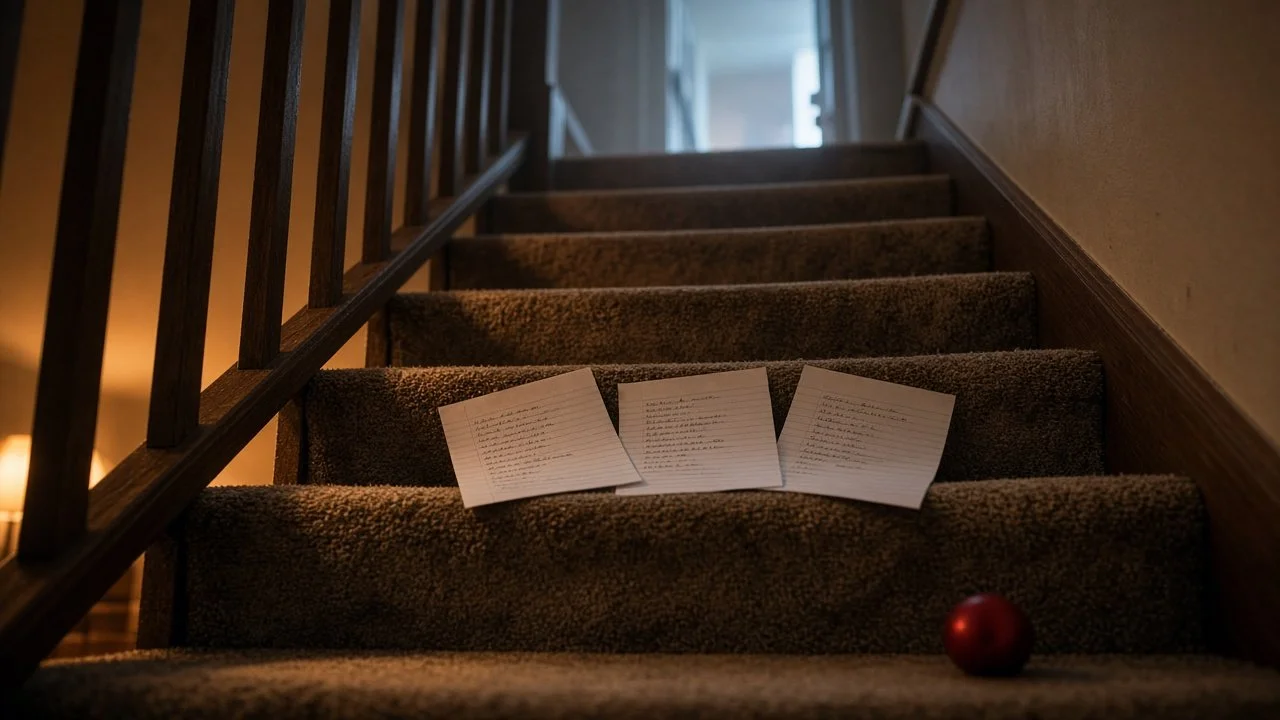
JonBenét was born on 6 August 1990. Early on 26 December 1996, the morning after Christmas, Patsy Ramsey found a handwritten note of about two and a half pages on the stairs of the family home. It said her daughter had been kidnapped and demanded $118,000. Patsy called the emergency line at 5.52am.
Police officers and family friends came to the house. The call the note promised never came. Early that afternoon, after Detective Linda Arndt asked John Ramsey and a family friend to search the house, John found his daughter's body in a small room in the basement. He carried her upstairs.
The autopsy recorded that JonBenét died from "asphyxia by strangulation associated with craniocerebral trauma". She had been struck on the head and strangled with a garrotte made from nylon cord and part of a broken paintbrush, which probably came from her mother's art supplies in the basement. The autopsy also found evidence that she had been sexually assaulted.
Those are the facts on which every version of the case agrees. Almost everything that followed became a matter of dispute.
Why the First Hours Shaped Everything
The house was not treated as a crime scene in the way investigators would now expect. Friends moved through rooms while police waited for a kidnapper's call, and the body was moved before forensic examination. Investigators have since described the case as riddled with problems from the start, including a compromised scene, leaks to the media from both investigators and people close to the family, and deep discord between police and prosecutors.
Those early decisions created the conditions for 30 years of argument. Every theory, whether it points to an intruder or to someone inside the house, relies partly on evidence that was disturbed, contaminated or never collected. A drama that shows the morning of 26 December is showing the moment the case became hard to solve, whatever one thinks of who was responsible.
The family's own conduct also became part of the public story. John and Patsy Ramsey initially refused to give formal police interviews, and later, through their lawyers, pointed investigators towards other potential suspects. They did later give formal interviews, including questioning in Atlanta in August 2000. Behaviour after a death has never been evidence of guilt, and a drama that dwells on how grieving parents looked or acted on television is dramatising public perception, not proof.
Two Investigators, Two Opposing Conclusions
Two of the characters in the series represent the split that still runs through the case. In August 1998, Detective Steve Thomas resigned from Boulder Police with a long letter accusing the district attorney's office of mishandling the investigation. Weeks later, in September 1998, Lou Smit resigned from the district attorney's team, saying the investigation was pursuing the wrong theory and that the evidence pointed to an intruder.
Smit never wavered in his belief that John and Patsy Ramsey were innocent, and he held that view until his death in 2010. Thomas went on to argue publicly for a very different reading of the evidence. Casting both men gives the drama a way to stage the argument rather than settle it. Viewers should treat each man's view as exactly that: the conclusion of one investigator, not a finding by any court.
What the Grand Jury Did, and What It Did Not Do
The most legally sensitive part of the story is the grand jury. On 13 October 1999, a Boulder grand jury of 23 people voted to indict John and Patsy Ramsey on counts of child abuse resulting in death and of being an accessory to a crime. The documents were sealed and only released in 2013, after a court ordered it.
Alex Hunter, the district attorney, refused to sign the indictment, and no charges were ever filed. He took the view that the evidence was not strong enough to bring a case, partly because he expected the DNA evidence to be a problem at trial. A grand jury vote is not a trial and not a finding of guilt. It was never tested in court, and it came nine years before the DNA testing that led prosecutors to clear the family. Hunter died in November 2025.
Any drama that shows the grand jury will have to decide how much of this context to include. Without it, the vote can look far more conclusive than it was.
The DNA and the 2008 Clearance
The physical evidence most often described as the key to the case is DNA from an unknown male. A small bloodstain in JonBenét's underwear contained her DNA mixed with that of a man who has never been identified. The profile was uploaded to the FBI's national DNA database, known as CODIS. It does not match anyone in her family, any of the dozens of people investigated, or any profile in that database.
In 2008, prosecutors under district attorney Mary Lacy had a laboratory use a newer method known as touch DNA. It tested the waistband of the long johns JonBenét was wearing and recovered male DNA that the laboratory and Lacy said matched the profile from the underwear. Unknown male DNA has also been found under her fingernails, and the samples from her right and left hands appear to come from two different men. Those samples are a reminder of how much of the evidence is mixed, limited or hard to interpret.
On 9 July 2008, Lacy wrote to John Ramsey. She said the new evidence convinced her office "that it is appropriate, given the circumstances of this case, to state that we do not consider your immediate family including you, your wife, Patsy, and your son, Burke, to be under any suspicion in the commission of this crime". She added: "I wish we could have done so before Mrs. Ramsey died." Patsy Ramsey had died of ovarian cancer in 2006. Lacy also apologised for any part her office had played in the public belief that the family were involved.
That letter remains the formal position of the prosecutor's office that issued it, and it is the fact a responsible retelling has to include. Lacy herself acknowledged that some would "continue to differ" with her conclusion. The current district attorney, Michael Dougherty, has also stressed that the unknown DNA may not turn out to belong to the killer. Both points can be true: the family were formally cleared, and the case against anyone else remains unproven.
The False Confession That Proved Nothing
Two years before the clearance, the case produced its strangest episode. In August 2006, a man named John Mark Karr was arrested in Bangkok, Thailand, after claiming responsibility for JonBenét's death. Within days, DNA testing showed he did not match the crime-scene profile, and prosecutors dropped the case without charging him with the murder.
The Karr episode is a useful warning for viewers. A confident story, however detailed, is not evidence. The DNA ruled out a man who had confessed, and it has also ruled out every suspect investigators have tested since.
Where the Case Stands in 2026
Thirty years on, the investigation is still open. On 10 November 2026, Boulder police chief Stephen Redfearn and Michael Dougherty held an hour-long briefing with reporters. "DNA is our biggest hope," Redfearn said. They are re-examining items tested decades ago and speaking with outside laboratories about forensic investigative genetic genealogy, a technique that combines DNA analysis with family-tree research. It is the method that identified the Golden State Killer, and the way genetic genealogy solves cold cases depends heavily on the quality of the sample, which is exactly the problem here.
They have not yet sent the key sample for that kind of testing, and they explained why. The stain is three decades old, it is a mixture in roughly equal parts of JonBenét's DNA and the unknown man's, and the supply is limited. Testing could use it up. "If you get one shot, you have to do it right," Dougherty said. Specialists in the field have said the science for separating such an even mixture is close, but not yet reliable enough. Redfearn added that he wants to be certain any laboratory's technology works as claimed, and that it is offering to test the sample for the right reasons rather than for publicity.
The family's patience is visibly thinning. Officials last met the Ramseys on 27 February 2026. JonBenét's half-brother, John Andrew Ramsey, said after the latest briefing: "I'm happy they're hopeful, but I'd like for them to prove it out."
The investigation's own history explains some of that frustration. Over three decades the case has passed through five police chiefs and four district attorneys. Only one of the detectives first assigned to it is still with Boulder Police. Every change of leadership brought a fresh review, and none has produced a charge.
The cast of real people has also thinned. Henry Lee died in March 2026, and several grand jurors have died. According to Netflix, investigators have received more than 21,016 tips, letters and emails over the years, and the killer has still not been found.
What to Keep in Mind While Watching
Dramatisation always compresses time, merges minor characters and invents private conversations that no record captures. That is a normal part of the form. It is also what separates this series from the documentaries that came before it. In November 2024, Netflix released Cold Case: Who Killed JonBenét Ramsey, a docuseries directed by Joe Berlinger that re-examined the investigation, including the Karr confession. A documentary can show its sources. A drama asks viewers to trust its choices, and it can put words into the mouths of real people that no one ever recorded.
The risk with this case goes further. For years, much of the coverage treated speculation about the family as if it were evidence, and the people at the centre lived with the consequences. Burke Ramsey sued CBS for defamation over a 2016 documentary series, saying it had falsely accused him. The case was settled in 2019 on confidential terms. The same lesson runs through other real cases, including the security guard wrongly suspected of the 1996 Atlanta Olympic bombing, which is why the story of Richard Jewell remains such a useful comparison.
So the most useful questions to ask while watching are about how the drama handles evidence. Does it make clear that no one has been charged? Does it show the grand jury vote together with the decision not to prosecute and the later DNA findings? Does it include the 2008 letter clearing the family? And when characters voice theories, does the series frame them as theories?
The one development that would change the story is the identification of the man whose DNA was found on JonBenét's clothing. Even that would only be a start: investigators would still have to show how he came to be there, and prosecutors would have to prove it in court. Until then, the true story is an unsolved murder, a family the prosecutor cleared, and an investigation still waiting on its best evidence.
Next Reads
True Crime: Why the JonBenét Ramsey Case Still Haunts America: the wider story of the case and why it still holds public attention three decades on.
How Does Genetic Genealogy Solve Cold Cases? DNA, Family Trees And The Limits Of The Evidence: how the technique Boulder investigators are weighing actually works, and where it fails.
Richard Jewell: The True Story, FBI Investigation and What the Film Changes: another real case in which public suspicion of an innocent person ran far ahead of the evidence.
Sources
Netflix Tudum: The Murder of JonBenét Ramsey, Cast, Release Date, Photos
Deadline: The Murder of JonBenét Ramsey Release Date on Netflix and First Look
USA Today (Associated Press): Text of the District Attorney's Letter to JonBenét Ramsey's Father
CNN: JonBenét Ramsey Case, Court to Release Indictment That Went Nowhere
AP News: Brother of JonBenét Ramsey Reaches Settlement With CBS
