What Judges Listen For in a Victim Personal Statement
What Happens When A Victim Wants The Judge To Understand Something The Verdict Cannot Say?
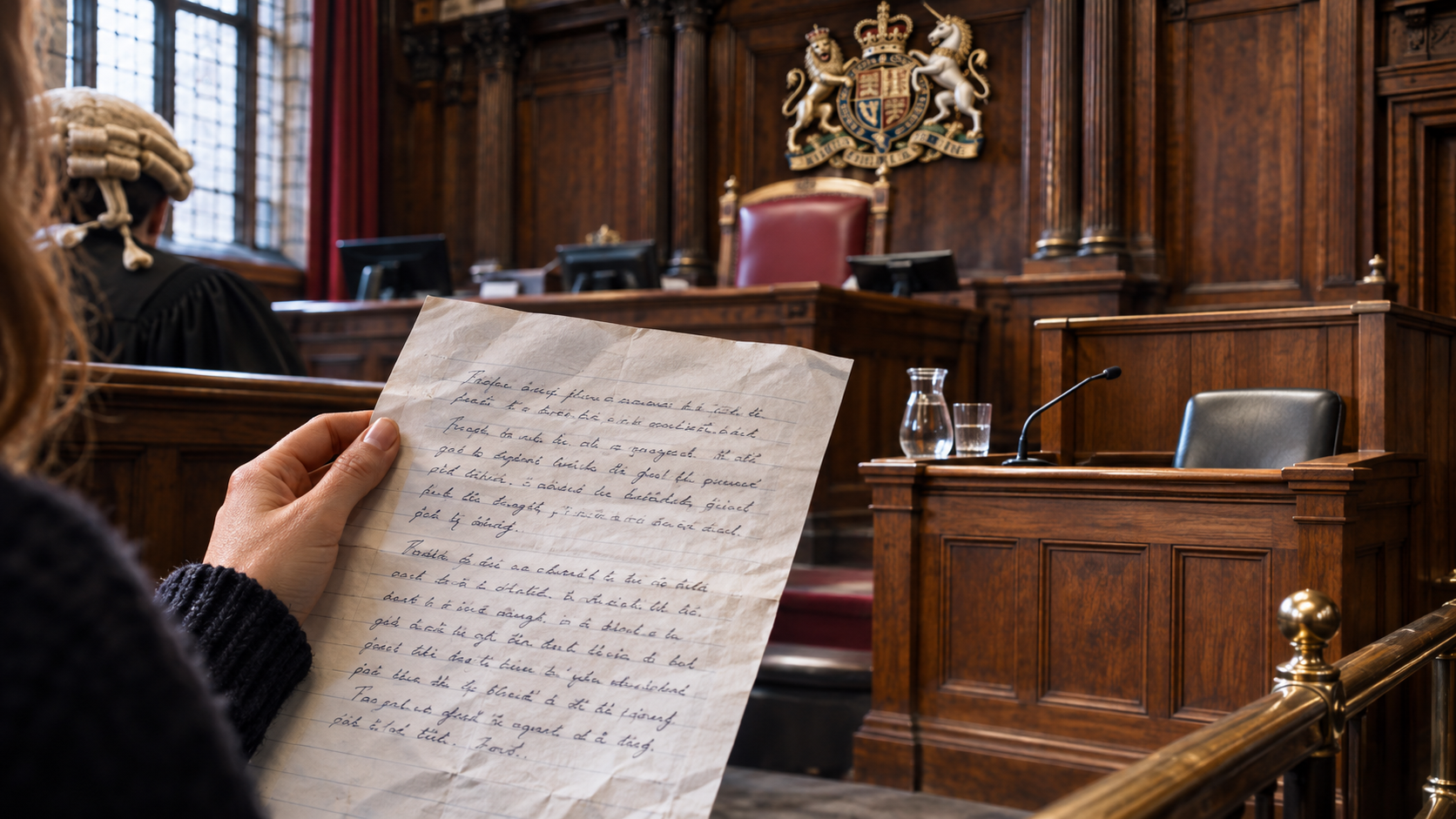
A verdict can establish that an offence occurred. It cannot tell a court that someone now leaves a light on, that a parent gave up work to provide care or that the route to a railway station has become impossible to face. In England and Wales, a Victim Personal Statement gives a victim an opportunity to explain the effects of an offence in their own words.
A victim can have strong views about punishment. The decision about the length and type of sentence belongs to the court. A personal statement can provide relevant evidence of harm that informs that decision. A request for a particular number of years does not supply a sentencing rule. Understanding the difference explains why a judge can listen carefully to a statement and still impose a sentence the speaker would never have chosen.
Why There Are Two Kinds Of Statement
A witness statement records evidence about the offence. Who was present? What did the witness see, hear or experience? Details may be challenged and tested in the process by which the court decides what happened. A Victim Personal Statement has a different purpose. It explains what living with the consequences has involved.
The same person can supply both. A description of an injury on the night can help establish facts about an assault. A later account of learning to use stairs again can explain the consequences of that injury. Confusing those purposes risks giving victims the impression that they must describe the worst moments of their private lives in order for an allegation to be taken seriously. Making the personal statement is a choice.
Physical injury is one form of harm. Victims can describe emotional and financial consequences, the effects on family life and work, and changes in their sense of safety. An account can be especially informative when it identifies an ordinary activity and explains the change. A person who stopped driving after an offence may have lost the means of reaching a job. The lost income may then affect other people in the household. The statement can make that sequence intelligible.
What A Judge Can Do With Evidence Of Harm
Sentencing involves the offence, applicable law and guidelines, culpability, harm and the relevant circumstances of the offender. A personal statement contributes to the picture. It does not replace findings of fact or authorise punishment for an offence of which the defendant was acquitted. Facts material to the sentence must have a sound basis.
Imagine two victims describe comparable injuries. One gives an eloquent statement in court. The other would rather have no further contact with the process and provides none. It would be profoundly unfair to conclude that the second person suffered less simply because they exercised a choice. Courts should not infer an absence of harm from the absence of a personal statement. Nor should a person’s ability to speak persuasively determine the legal value of their life.
A statement can reveal a consequence the papers otherwise fail to capture. It can also confirm harm already apparent from medical evidence or the facts of the offence. When sentencing guidelines already take a level of harm into account, the same feature should not simply be counted twice. Hearing a new description and discovering a new consequence are different events.
Who Gets To Read It?
Victims can indicate whether they would like to read the statement aloud, have it read on their behalf or have the court consider it without a public reading. The court decides how the statement will be presented. Choosing against reading it personally does not mean the written account is worthless. For some people the ability to leave their words on paper is what makes participation possible.
Anyone preparing a statement should understand that it can be seen by the defence and that material read or referred to in open court may enter public reporting, subject to applicable restrictions. A statutory right to anonymity in a sexual offence case protects against identification. It does not turn everything said at a sentencing hearing into confidential correspondence with the judge. A victim concerned about names, addresses or the consequences of particular details can raise that concern with their police contact or support service before submitting the statement.
The rules also allow the evidence in a statement to be challenged where appropriate. The personal nature of an account is a reason to handle it sensitively. It does not remove the defendant’s right to a fair determination of disputed matters affecting sentence.
Can You Change Your Mind?
The CPS explains that once a statement is made it cannot simply be withdrawn or rewritten. A further statement can provide an update. That distinction allows a person to explain that circumstances have changed without erasing what they truthfully reported earlier. An injury may heal more slowly than expected. A victim who initially lost work may have returned with adjustments. A later account can bring the court up to date.
It is worth distinguishing an update from a demand to attend again. A person can ask the relevant officer or contact how the statement will reach the court, what choices are available about reading it and who to tell if circumstances change. They need not guess the hearing date or use social media to try to draw a judge’s attention.
Why Two Sentences Can Differ Even When Both Victims Speak
Suppose two people describe similar financial losses after different offences. In one case the offender planned the conduct for months and abused a position of trust. In the other, the degree of planning and responsibility proved at trial was different. A judge can accept both victims’ accounts entirely and still reach different sentences. The statement speaks to part of the calculation. It cannot make the other parts disappear.
The same principle applies to mitigation. A court may have to consider a guilty plea, a defendant’s age or other matters relevant under applicable law. Giving effect to one of those features is not a judicial finding that a victim exaggerated. It may explain why a person listening only for some arithmetical reflection of their distress hears a different outcome from the one they expected.
Conversely, a long sentence cannot tell an outsider exactly what a victim said. The seriousness of the offence, other counts, previous convictions and the rules for concurrent or consecutive terms can all affect the headline total. Reading the sentencing remarks, where they are available, is more reliable than trying to work backwards from the length of imprisonment to an imagined description of private harm.
What An Additional Statement Might Say
Take a fictional victim who reports persistent pain soon after an offence. At that point the prognosis is unclear. Several months later they return to work, but only for short shifts and with a colleague taking on lifting duties. The original statement remains a truthful account of what was known when it was given. An additional statement can describe the partial recovery and its continuing cost.
That kind of update is often more informative than repeating the strongest words in the earlier account. It distinguishes what a person feared from what actually occurred. It can also document an improvement. The purpose of the statement is an accurate account, not a requirement that every consequence continue to grow more severe as the hearing approaches.
It can help to separate direct experience from things somebody else reported. A person knows they now wake repeatedly in the night. A partner may be better placed to describe how that has affected their own sleep or caring responsibilities. A clinician may be needed to address a medical prognosis. Different forms of evidence can complement one another without asking a victim to act as their own doctor, lawyer and expert witness.
Why The Public Sometimes Hears Only A Few Lines
The words chosen for a news report may be the passages a journalist had time to record, those a victim chose to read aloud or those the judge referred to in sentencing remarks. None of those selections necessarily represents the entire statement. A public report can accurately reproduce a particular consequence while leaving a reader with an incomplete impression of what else the court considered.
It follows that a reader should be wary of a familiar argument about publicity: if a sentence seems low, the judge must have ignored the passages printed in the newspaper. The judge may have explicitly accepted those consequences and still had to apply a different legal limit from the one a reader imagines. Conversely, the absence of a passage from the report tells us little about whether it was in the papers.
Victims can ask for information about developments in their case through the official contacts and arrangements available to them. For members of the public wanting to understand the decision, published sentencing remarks or a reliable account of the hearing can supply context that extracts alone cannot. A personal statement and judicial reasons serve different readers. The former gives an individual room to describe consequences. The latter should explain how the court reached a lawful decision.
Keeping those purposes distinct protects the speaker too. It allows a person to describe grief, relief, anger or a mixture of all three without being recruited into an argument for a particular tariff. Someone who agrees to tell a court what an offence took from them has not thereby agreed to become the public author of the sentence.
What If A Victim Wants A Harsher Or More Lenient Outcome?
Victims’ wishes can differ profoundly, including among people affected by the same defendant. Giving each person the power to specify punishment would make the sentence depend on incompatible preferences. A victim who forgives an offender should not be made responsible for sending them to prison. A victim who is angry should not have to carry responsibility for the length of a sentence either.
Where the unduly lenient sentence scheme applies, the route after sentence is separate. A member of the public can ask the Law Officers to consider an eligible Crown Court sentence, subject to a strict deadline. The legal question is whether the sentence was unduly lenient. A victim's personal disagreement with the outcome and a successful reference to the Court of Appeal are different things.
The most meaningful contribution of the statement is often the one only the victim can make. A judge can look up the available sentences and consult the guideline. What the judge cannot look up is how an ordinary Tuesday changed in a particular home. The statement gives that experience a place in the court’s reasoning while leaving responsibility for punishment with the court.
Sources
Going to court to give evidence as a victim or witness: Your statement - GOV.UK
Code of Practice for Victims of Crime in England and Wales (Victims' Code) - GOV.UK
