Why Finding the Well Fails in The Ring
The Person Who Solves The Mystery Still Has A Copy To Make.
Hideo Nakata's Ring, the 1998 Japanese film often called Ringu, and Gore Verbinski's 2002 American remake, The Ring. Both films encourage the viewer to believe that finding a dead girl's body will lift a curse. A mother survives the time at which she was supposed to die. Then the man who helped her find the body dies on his own timetable. Whatever the mother did to save herself, helping the girl cannot be the whole answer.
The crucial difference is the copy. Reiko in the Japanese film, and Rachel in the American film, duplicate the recording and involve another viewer. The men who watch it fail to continue the chain. The endings frame reproduction and transmission as the route to survival. Neither film conducts an experiment in which a spare cassette sits unwatched on a shelf. Treating a backup copy as a guaranteed technical loophole would miss what each mother is being asked to do to somebody else.
The First Victim Gives The Investigation Its Clock
Ringu starts with young people talking about a tape that can kill its viewer after a week. A frightening story told by one teenager to another becomes an immediate possibility when the listener knows rather more about the recording than her companion expected. Tomoko's death draws in her aunt Reiko, a reporter. Several young people have died in connection with the same trip. A shared place and a shared time give a rumour the beginnings of a pattern.
The American version gives Rachel Keller a similar point of entry through the death of her niece Katie. Rachel's professional instincts matter because they make her the sort of person likely to seek out evidence other people would leave alone. Her family connection explains why a handful of disturbing coincidences deserve more than a routine enquiry. By the time she finds the recording, looking at it seems like the next sensible step in a reporter's investigation.
Watching changes her position. A reporter can ordinarily control when to stop investigating, whom to tell and whether a lead is worth pursuing. The seven-day deadline turns the person doing the research into another subject of it. Decisions that might otherwise wait for corroboration acquire urgency. Sharing the tape with somebody who has technical knowledge or an independent eye seems an entirely understandable response. That professional instinct is exactly what the curse can exploit.
The staggered deadlines are essential. If everyone who saw the images fell dead at the same instant, there would be little evidence to distinguish personal actions from a collective reprieve. Each new viewer starts another interval. A mother can survive her own deadline and still be wrong about what will happen to the next person. The later death is what converts an apparently solved haunting into a comparison between two viewers.
Why Finding The Well Feels Like An Answer
The images on the recording invite investigation. Their strange juxtapositions resemble fragments of a life and a place that once had ordinary connections. A researcher can pause them, replay them and ask where they came from. Following those clues leads each pair of investigators towards women whose experiences others have misunderstood, concealed or treated as dangerous. The investigation gradually supplies a history for pictures that began as an assault on the senses.
In the Japanese film Reiko works with her former husband Ryūji. Sadako Yamamura's history is entangled with that of her mother Shizuko and with psychic phenomena. The investigators' ability to perceive things extends beyond ordinary reporting. In the American film Rachel works with Noah, Aidan's father, and follows the history of Samara Morgan and her adoptive family. The remake supplies its own images, island setting and account of what happened. Samara and Sadako occupy related roles in different stories.
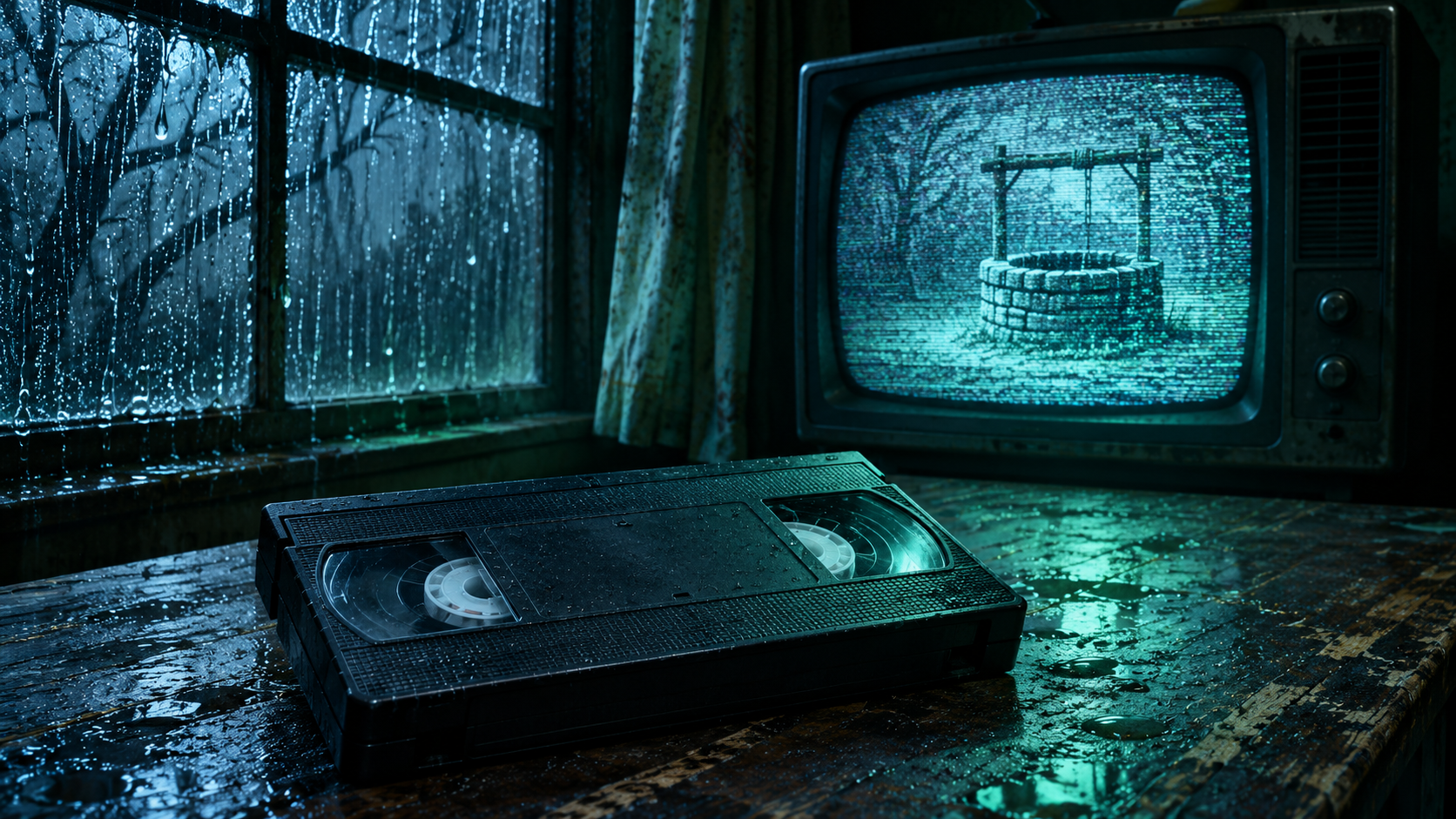
The shared destination is a well. Finding it brings together the images, the site of the recording's discovery and the history of a girl whose body has been hidden. Reiko's physical effort to reach Sadako gives the Japanese sequence a tangible cost. The investigators have to descend, work against the water and continue as the deadline approaches. A solution that required so much effort can feel earned before anyone has actually established that it worked.
Verbinski stages Rachel's encounter with Samara's remains as an intensely personal act of recognition. The story has encouraged Rachel and the audience to understand a child from whom other people recoiled. A mother finally staying close to her body offers just the sort of emotional resolution a viewer may hope for. Once Rachel survives, the timing seems to confirm the interpretation. The audience has seen an act that ought to matter and a result that seems to follow from it.
This is where a very ordinary mistake does exceptionally effective work for both films. Several things happened before the mother's deadline. She watched, investigated, copied, shared and found the girl. The act nearest the apparent reprieve is also the most moving. There is every reason to remember it and almost no reason yet to dwell on the routine business of duplicating a cassette earlier in the investigation.
Why Ryūji And Noah Die
Ryūji and Noah each took the recording seriously enough to help investigate it. Each contributed to the discovery that appeared to release the girl. What neither has done for his own survival is reproduce the tape and pass the danger onwards before his time expires. His television becomes the site where the comforting interpretation falls apart.
In Ringu, Sadako approaches through the image of the well and crosses from the television into Ryūji's space. Nakata lets the distance between a figure in a picture and a person in a room collapse by degrees. A spectator has been trained for the entire film to look at recorded images for clues about events elsewhere. The image can now come out and act on the observer. Pausing to get a better look was always a more dangerous activity than it appeared.
Noah's encounter in the remake makes greater use of interference and abrupt changes in the figure's position. The picture behaves like unstable video even after normal physical distance appears to have been breached. The effect belongs to a film fascinated by what it means for an image to be impressed on a surface or a mind. Noah understands image technology well enough to be a useful investigator. That expertise cannot protect the person standing in front of his own screen.
Their deaths answer one question decisively. Recovering the body does not neutralise the recording for all its viewers. Each man dies after participating in the supposed solution. What the deaths do not establish is that kindness caused them or that the girl imposed an extra penalty on the person who cared. Both men were already facing a deadline. The simplest account is that their allotted time ran out while the mothers had, without realising its significance, taken a different action.
Aidan grasps something Rachel has been unwilling to consider. He reacts with alarm to the idea that she helped Samara. His response breaks the emotional connection between discovering what happened to a child and assuming that the discovery makes everyone safe. Someone can have suffered a terrible wrong and still be terrifying to approach. Knowing a ghost's history gives Rachel understanding. It gives her no authority over what the ghost will do next.
Does The Next Person Have To Watch?
The practical rule conveyed by the films is to copy and pass on the tape. Another viewer is central to the moral choice with which both endings leave us. It is tempting to demand a more exact specification. Could someone make a copy, post it to an empty house and live? Would playing it in a room with no audience count? Could two people take turns watching duplicates indefinitely? Neither original film supplies enough cases to settle those edge conditions.
There is an important distinction between an inferred rule and a condition tested in isolation. Reiko's explanation arises from comparing her own conduct with Ryūji's. Rachel makes a similar connection after Noah's death. In both cases copying and sharing belong together in what the surviving protagonist did. No controlled comparison separates the moment a duplicate is created from the moment new eyes see the images. The conclusion the characters act on is stronger dramatically than an instruction manual would have been.
This also answers the question of why the mother's child needs a separate intervention. Yoichi in Japan and Aidan in America have watched the recording themselves. A mother's survival demonstrates at most that she has escaped the immediate consequence for her own viewing. It does not reset the child's deadline. The adult has to help the child continue the chain, with all that implies for a recipient who may have no idea what is being offered.
Destroying the cassette is an attractive answer only if the danger resides in that one physical object. By the time either mother understands what matters, the images have made the journey from one carrier to another. Smashing the original would not remove a recording from every duplicate or erase the act of having watched. The curse has turned the very property that made a videotape convenient into a means of surviving damage to its first container.
The Grandfather In Ringu And The Unnamed Viewer In The Ring
The Japanese ending gives the next possible recipient a family relationship. Reiko sets off to see her father, taking the means of making a copy. Her words about needing a favour take on their terrible significance from what she has just understood. Saving Yoichi could involve exposing his grandfather. The film ends on the implication of that decision. A viewer describing the first film should keep the journey it shows distinct from an on-screen account of a completed transfer.
The family relationship changes the nature of the choice. An anonymous recipient could be tricked. A father might agree to an awful request because he understands who would benefit. The first film leaves room for the viewer to imagine how much Reiko will say and how her father might respond. Generosity becomes frightening because an act of love by one generation can make it possible for the danger to reach another.
The American ending shows Rachel guiding Aidan through the copying process. He raises the question of what will happen to the person they show it to. The recipient remains unidentified. Aidan has understood the moral cost before an adult has offered him a comforting account of it. The uncomfortable silence belongs as much to the viewer as to Rachel. We can understand why she is using the equipment without being able to give her son a satisfactory answer.
That is a more substantial difference than changing the language on the cassette label. Nakata sends a mother towards a particular relationship and lets the audience imagine the request. Verbinski stays with the immediate practical task while the child asks about someone outside the frame. In one ending a named place within a family sharpens the danger. In the other almost anyone could be waiting at the far end of the recording.
The Phone Call And The Rule Are Different Clues
A ringing telephone gives the films another device capable of bringing something frightening into a familiar room. The American version makes the warning of seven days an immediately recognisable part of watching the tape. The Japanese film handles the association with the call and the cabin more particularly. A scene remembered from one version can easily harden into a supposedly universal law about how a curse must announce itself.
The warning and the means of survival also reach the characters by different routes. Learning that one is in danger requires very little interpretation once people have died on schedule. Working out how to survive requires an untidy comparison of choices made by several viewers. A message saying how long you have is no promise that the sender will tell you what to do with the time. The films can therefore deliver their deadline early while keeping the final inference out of reach.
Watch the investigations again with that difference in mind and the tape changes character long before anybody makes a conscious choice to endanger someone else. The moment one protagonist asks another person to look at it is both a perfectly sensible request for help and a possible act of transmission. On a first viewing it is easy to notice only the generosity of the person agreeing to help. On a second, the cost of answering that request is already visible.
Why It Had To Be Something You Could Copy
A cursed statue might endanger the person who possesses it. To pass it on, that person must relinquish the object. A videocassette can be duplicated while its owner keeps the original. The number of possible points of exposure can increase. The films need no universal broadcast or conspiracy to distribute the images. They need one frightened person with a strong reason to involve somebody else.
The technology also imposes a revealing inconvenience. Copying analogue video requires equipment, time and access to another carrier. The final act is visible and deliberate. We can watch a parent teach a child to do it. A single click on a modern screen could accomplish an analogous transfer so quickly that the hesitation might be harder to dramatise. Here waiting for the machine gives the characters time to understand what their hands are doing.
There is an uneasy resemblance to a chain letter. An alarming promise encourages the recipient to recruit another recipient. The important difference inside the films is that the threat has killed people. Ignoring the instructions would require a parent to gamble with a child's life on evidence neither parent has the luxury to dismiss. The apparent way out is precisely tailored to make even an ethically troubled viewer see why somebody might take it.
Both films allow their investigators something more painful than ignorance. They learn who the girl was, what was done to her and where her remains can be found. They can answer questions the dead child's family or community failed to answer. Then, with that knowledge in hand, they do the one thing that ensures another person will have to begin the story again.
Sources
British Film Institute — Ring: BFI Southbank Programme Notes — The Japanese film’s chain of transmission and its cultural setting.
Rahel Sixta Schmitz — The Supernatural Media Virus — Comparative analysis of the recording and the staging of the American ending.
University of Kent — Research on Ring and Its Adaptations — The distinction between Reiko’s implied request and events shown in later material.
Next Reads
The Mist Explained: Stephen King’s Monsters, Mrs. Carmody and the Book and Film Endings — Another adaptation in which the final outcome changes the story.
The Butterfly Effect: All Four Endings Explained — How a change in the final scene alters the moral meaning of a film.
The Ritual Explained: The Forest, the Monster and the Meaning of the Ending — A different horror film that turns investigation into a reckoning.
