The Screen Test Behind 007
A Man Walks Out Of A Bathroom And Has A Few Seconds To Become James Bond.
The woman in the bed is a stranger. She knows who Bond is. He has an excellent professional reason to wonder how she got into his room and a rather different reason to hear what she has to say. For several actors who have tested for James Bond, the encounter with Tatiana Romanova from From Russia with Love has been the examination. There is very little in it that a stunt double could do for them.
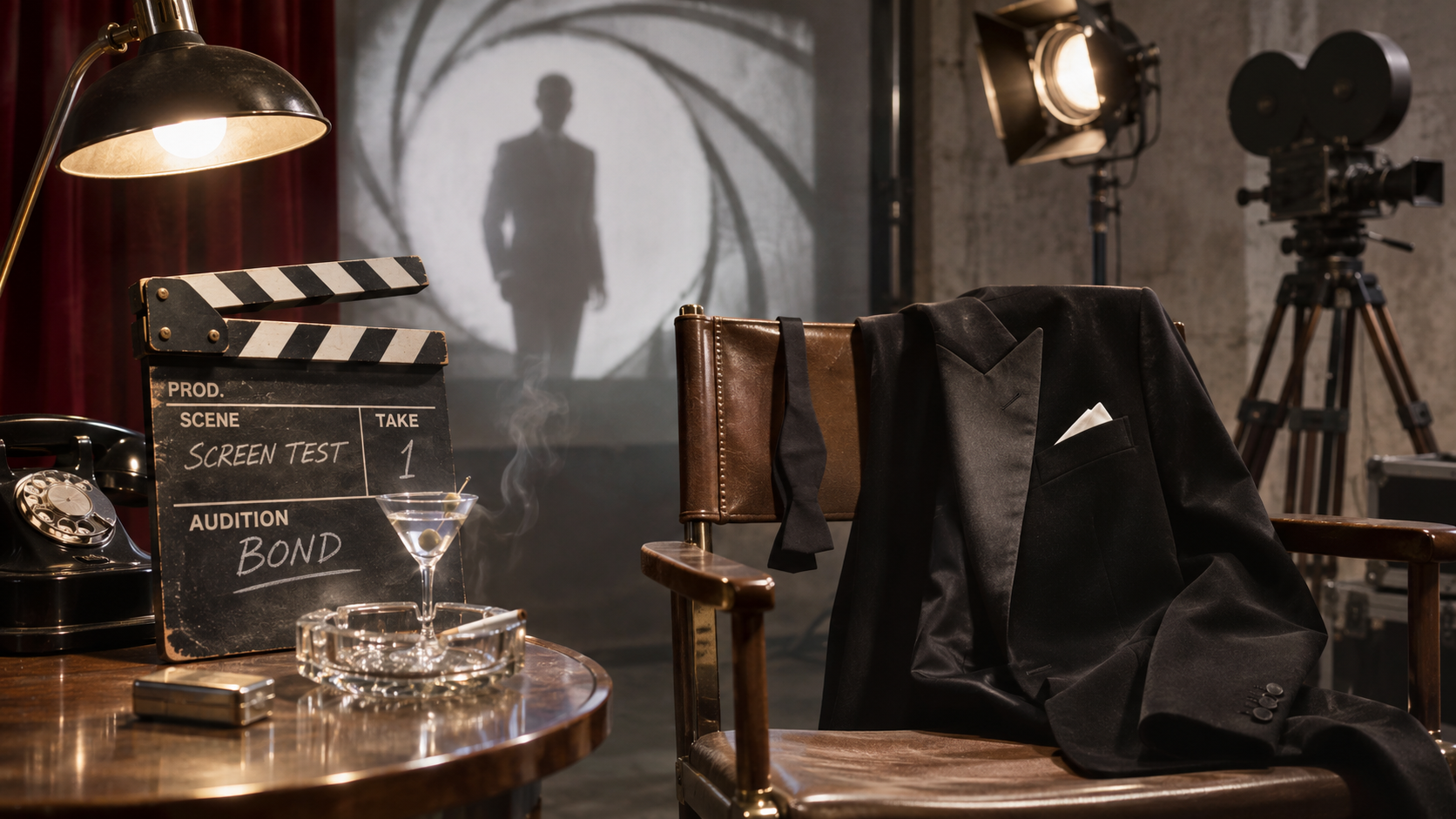
A Bond screen test puts a candidate on camera playing the actual character, often opposite another performer in a scene the filmmakers already know. Directors can compare how different actors handle suspicion, attraction, danger and humour without changing the problem set before them. The surviving tests reveal more about the job than a list of favourites ever could. They also reveal how little an audition tells us about who will ultimately sign a contract.
What Bond Knows When He Enters The Room
In From Russia with Love, Tatiana is a Soviet cipher clerk whose apparent defection is bound up with a trap. By the bedroom encounter, Bond has good reason to keep his wits about him. Sean Connery's original performance benefits from a tension built into the writing. A man interested only in national security would handle the meeting one way. A man interested only in the woman would handle it another. Whoever plays Bond has to keep both possibilities alive.
A candidate can enter briskly, assess the room and take command of the exchange. Another can let the surprise register and recover with a joke. The difference can be as small as a second spent looking at Tatiana before speaking. Too long and the trained observer seems to have forgotten why he is there. Too little and the woman becomes furniture, which deprives the scene of both erotic tension and intelligence.
This is one advantage of a scene with a partner. A photograph can establish whether someone looks convincing in evening dress. It cannot establish whether they can listen. A reaction shot can tell the audience that Bond has revised his opinion of a stranger without requiring a line explaining the revision. It may be the other actor who speaks while the casting decision is being made.
There is a period problem too. A literal reproduction of Connery's timing would show that a candidate had studied Connery. The producers need to know what happens when a new performer occupies the same situation. The test works particularly well when the audience can recognise a thoroughly familiar man doing something it has never seen him do quite that way before.
What A Filmed Test Adds To An Ordinary Audition
Film changes the scale of a performance. A gesture legible from the back of a rehearsal room can look enormous in close-up. A slight hesitation before a smile can be almost invisible to the people beside the camera and unmistakable on screen. Casting a character whose principal currency is composure makes these differences especially valuable. The person present on the day and the person who appears in the edited footage need not make exactly the same impression.
A shot also fixes the other variables. Costume, lighting, the distance of the lens and the actor opposite can be held relatively constant across different tests. The result is closer to a comparison than watching two striking but unrelated performances from previous films. One candidate's reel may have been carefully built around comedy, another's around action. Neither reel was designed to answer what happens when Bond opens the bathroom door.
The test still has limits. A candidate plays a handful of minutes under circumstances in which everyone knows the purpose of the exercise. A feature requires sustained relationships, physical work, dialogue under pressure and months of collaboration. A series requires someone who can return to the part after other writers and directors have made different demands of it. A test can make the argument for going further. It cannot supply the missing years of evidence in advance.
The Actors Whose Tests Outlived Their Bids
Footage of Sam Neill testing in the 1980s illustrates what a strange historical object an unsuccessful audition becomes. Neill is recognisably performing Bond. Timothy Dalton got the role in The Living Daylights. Seeing Neill today means watching a possible Bond through the knowledge of the career he actually went on to have. A viewer deciding he would have been excellent has learned something about a performance. They have not discovered the private reason the part went elsewhere.
James Brolin also tested during uncertainty about whether Roger Moore would return for Octopussy. Moore did return. That distinction matters. An actor can test for a role that the incumbent eventually keeps. The test may be perfectly serious while the vacancy remains conditional. Years later a clip circulating without its production history looks like evidence of a simple head-to-head contest that never quite existed in that form.
Pierce Brosnan's history supplies a different complication. Interest in him for The Living Daylights ran up against his commitment to the television series Remington Steele. He eventually made his Bond debut in GoldenEye in 1995. A casting decision belongs to a particular production calendar. The right person can be unavailable for the film that first brings them into contention and available when the next vacancy comes along.
Henry Cavill auditioned for Casino Royale before Daniel Craig was chosen. Director Martin Campbell's later comments placed Cavill in the context of a young actor being considered for a specific interpretation of the character. Casino Royale had to introduce Bond early in his double-O career while persuading audiences he could carry the violence and emotional damage of that story. Passing some general threshold of Bond-like charm could never settle which actor was best suited to that particular film.
What A Reported Audition Actually Establishes
Reports in November 2026 linking Robert Pattinson to an audition revived interest in the process. The distinction to keep is between a reported approach or test, a decision by the filmmakers and an official casting announcement. A candidate may have met a director, discussed the part, read a scene or completed a filmed test. Those are different stages, and a report confirming one is poor evidence for asserting the others.
Current reports also cannot establish that the next production has used the traditional Tatiana scene. It is a documented piece of Bond casting history. There is no obligation on the next director to repeat it. A filmmaker interested in a different side of Bond could choose a confrontation with a superior, a scene in which an ally dies, or a moment when a lie has to be maintained in plain sight. Knowing the older tests helps us understand the kinds of questions worth asking about a new one.
The public argument generally runs in the opposite direction. Start with a familiar actor, collect images of them in the right suit and ask whether they look like the character. A screen test makes the actor start with an unfamiliar person waiting on the other side of a door. What they notice, how they respond and whether we want to watch them make the next decision are harder questions. They are also much closer to the work.
Sources
James Bond: the 007 questions fans want answered about its future
JAMES BOND: Watch The 007 Screen Tests For James Brolin, Roger Green & Sam Neill - Movies In Focus
