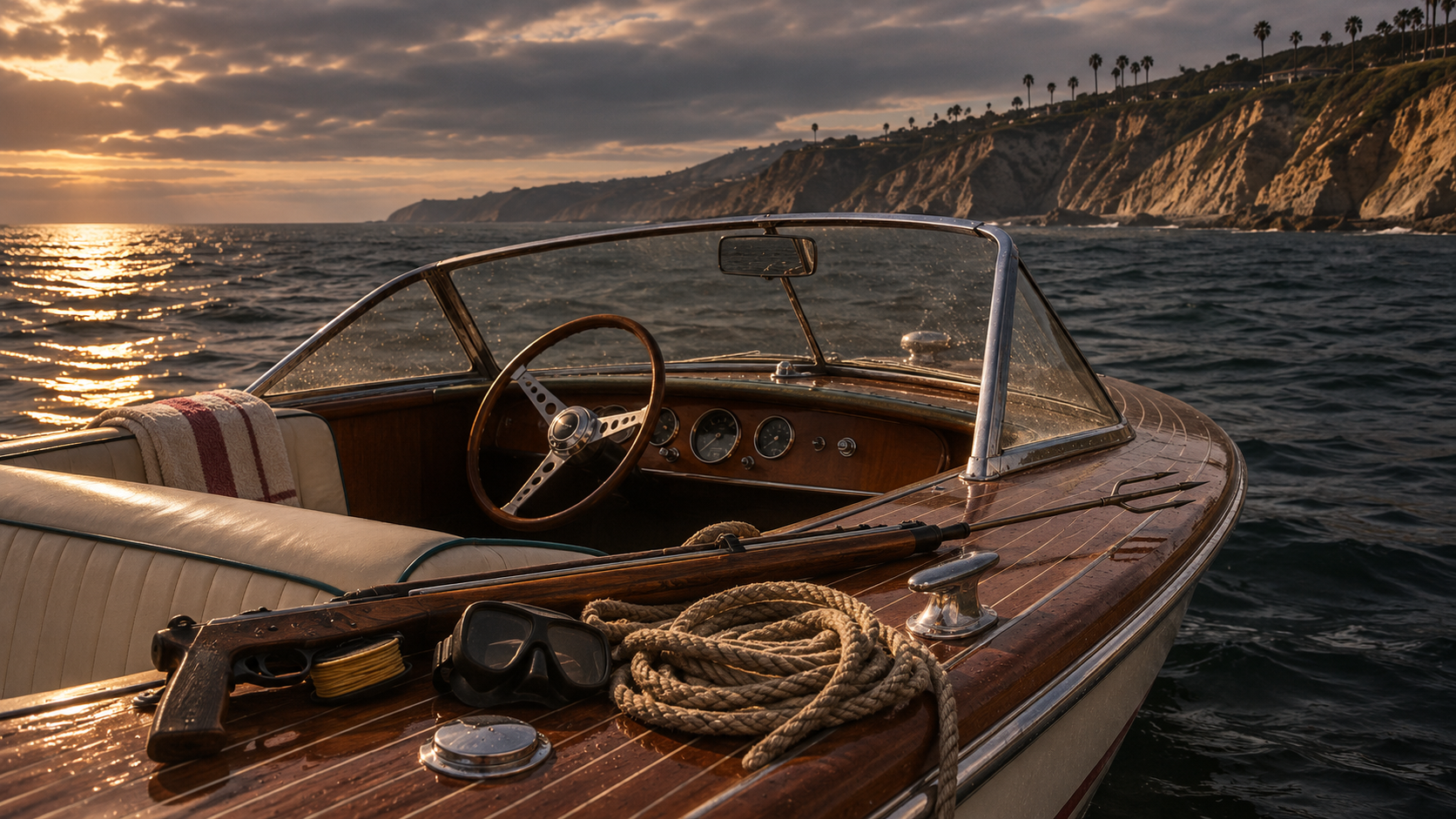
A boat, a speargun and an unfinished flashback left viewers arguing about Cliff Booth.
The Camera Leaves The Boat Before Cliff Has To Answer For What Happens There.
Spoilers follow for Quentin Tarantino's Once Upon a Time… in Hollywood and his subsequent novel of the same name. In the 2019 film, Cliff Booth sits aboard a boat listening to his wife Billie while a shark gun points in her direction. Tarantino cuts away before the decisive act. In the 2021 novel, Cliff fires the gun and kills her. The book settles responsibility while preserving an uncomfortable distinction between a deliberate plan and a violent impulse acted upon in an instant.
That distinction changes what the boat scene is for. On a first viewing it asks whether the rumour keeping a stuntman out of work can be trusted. After the novel, it asks how readily an audience will continue enjoying the company of a man once it knows what he did. Brad Pitt's charm is extraordinarily well deployed in the film. The book makes the reader account for what that charm helped keep out of view.
How We Hear The Accusation
The story of Billie's death reaches the audience through the working world of Hollywood. Rick Dalton wants to find work for Cliff, his stunt double, driver and friend. People who have the power to hire him have reasons to resist. The suspicion that Cliff got away with killing his wife is one of them. Long before there is a private image of the couple aboard the boat, there is a professional consequence.
That order matters. A workplace rumour rarely comes with an orderly sequence of exhibits. People decide whom to employ, avoid or invite home with information that may be incomplete and with motives of their own. Rick has an interest in a version of Cliff he can continue to rely on. A colleague who would rather keep Cliff away from a set has a different set of calculations to make. The audience learns the accusation in circumstances where it can plausibly be either a warning or a story that has hardened through repetition.
Tarantino then grants a brief look at the couple. Billie is talking and Cliff has the weapon. The film gives viewers the material to imagine the incident while withholding the action that would prove it. The position of the gun looks terrible. It does not supply a frame in which the trigger is pulled. Remembering having seen that frame is itself a tribute to how efficiently a cut can persuade viewers to finish an action in their heads.
There is an additional complication. The film spends far more time with Cliff carrying out everyday tasks than it spends with Billie alive. We see his patience with Rick, his affection for his dog and his capacity to make a friend feel steadier. Billie gets a tiny fraction of that time. Our familiarity with him feels like knowledge of his character. Our comparative ignorance of her has been produced by the same allocation of screen time.
What The Novel Adds To The Boat Scene
In Tarantino's prose treatment the shot is real. The gun does terrible damage and Cliff immediately regrets what he has done. The narration presents the movement leading to the shot as instinctive rather than the execution of a carefully considered decision. That makes the killing sudden. It does not absolve the person who fired or turn Billie's death into a convenient accident for the reader.
The sequence also gives Cliff a period in which he must reckon with an irreversible act while Billie is still there. His wish to undo what has happened follows almost at once. Regret is psychologically possible even for the person responsible. What he feels after firing can tell us something about him without changing what happened to her. The uncomfortable part is having to hold both facts together for longer than the film permits.
It would be an error to retrofit every word of the novel into the film as though the audience in 2019 had missed a crucial subtitle. The filmmakers made a scene that ends early. Its uncertainty was a genuine formal choice. The later author, who also happened to be the director, wrote a version with access to actions and thoughts the film had withheld. People who watched only the film and came away unsure were responding accurately to what the film offered.
There is a useful distinction between an answer about a character and an answer about a work. If the question is whether Tarantino ever supplied a resolution, the novel is decisive. If the question is whether the original film demonstrates the killing, the cut remains exactly where it was. Knowing what the same creator wrote later changes a second viewing without changing a single shot.
Why Rick Needs A Particular Kind Of Friend
Rick's career is uncertain. He can read every new role as an indication of how far he has fallen from television stardom. Cliff's work includes absorbing the insecurity that accompanies that decline. He drives, listens, deals with practical problems and helps Rick move between self-doubt and the next thing that has to be done. The friendship has genuine warmth and a financial structure underneath it. One man needs assistance and the other needs the job.
Cliff has the competence Rick often wishes he possessed. His occupation has involved performing physical actions so that another man's body can receive the credit on screen. This is a film about who gets seen doing what. It is entirely appropriate that the most important unresolved question about the stuntman's own life should concern a physical action that happens outside the frame.
Rick can value loyalty without being a reliable judge of how Cliff treated a woman aboard a boat. Most people know a friend in a restricted set of circumstances. Watching Cliff be unusually considerate towards one insecure man can make us feel we have seen him respond to every kind of vulnerability. The novel tests that assumption by putting another person in the room, or rather on the deck, and refusing to cut away.
The way Cliff recounts or remembers conflict elsewhere in the movie complicates matters further. He can be funny, physically graceful and alarming within seconds. He understands precisely how much damage a capable person can do. The film plays those qualities for entertainment in some scenes and for apprehension in others. No separate transformation is required before a man with a gift for violence becomes dangerous.
Spahn Ranch And The Pleasure Of Having Cliff On Our Side
At Spahn Ranch, Cliff suspects that something may have happened to an elderly man he once knew. He is prepared to walk into a hostile setting to check. The sequence encourages the audience to want him to proceed, even when doing so looks unwise. Knowing the historical associations of the ranch makes the people around him seem more threatening than their immediate actions alone might establish.
In that scene Cliff's willingness to confront people others would avoid is a source of relief. We want someone in the frame capable of pushing back. The suspicion surrounding Billie's death uses the same capacity differently. The person with physical command of a situation is only reassuring if we trust the purpose to which he will put it. At the ranch we share his purpose. On the boat we know almost nothing about the person at the other end of the gun.
The film's climactic home invasion makes this alignment unusually powerful. People enter a home intending to commit violence. The audience has excellent reason to want them stopped. Cliff and his dog become instruments of that reversal. An audience cheering for a particular outcome is doing what the scene was built to encourage. The moral question is how readily it carries approval of that action backwards into an unrelated death.
A good act in one emergency can establish courage, skill or loyalty on that occasion. It cannot serve as an alibi for a private act committed years earlier. Tarantino's rewriting of the fate of Sharon Tate makes the distinction especially sharp. The fantasy supplies a world in which one real woman can live beyond a night the audience knows too well. The invented woman on the boat has very little chance of being remembered amid the satisfaction of that ending.
What Changes Before The Next Cliff Booth Film
David Fincher's The Further Mis-Adventures of Cliff Booth, written by Tarantino, returns to the character in 1977, eight years after the events of the earlier film. Netflix has announced an IMAX run beginning on 25 November 2026 and a streaming release on 23 December. Its setting gives audiences a reason to revisit Cliff. An announced premise cannot tell us whether the new film adopts every detail of the novel or resolves the boat scene on screen.
A viewer returning to the original can conduct a smaller experiment without waiting for a sequel. Watch what happens immediately before the flashback, who wants Cliff to work and who would prefer him elsewhere. Then watch how quickly the film returns to the rhythms of his day. The scene is disturbing partly because the movie proves how easily both its industry and its audience can carry on.
That is what the most literal answer leaves out. Yes, the novel says he killed Billie. The more revealing achievement of the film is that it can leave the accusation sitting in plain sight while giving us so many other reasons to keep looking at Cliff Booth.
