

New Year’s Superstitions Around the World for 2026: The Rituals People Trust When the Clock Turns
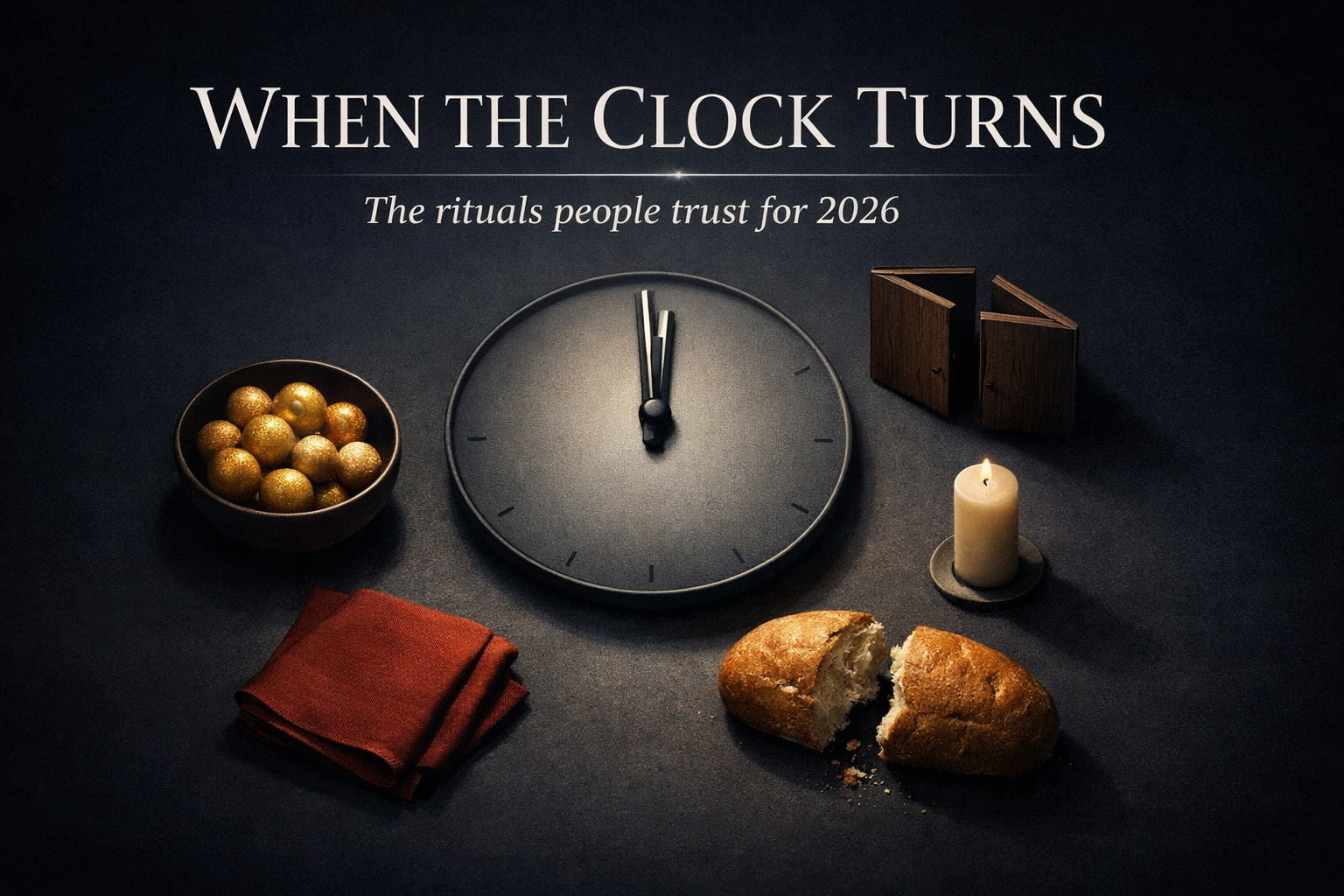
As of December 28, 2025, the world is in its most ritual-heavy week. The calendars are almost out, the champagne is on standby, and millions of people are quietly deciding which small, symbolic act might make 2026 feel safer, brighter, and more “on track”.
That is the strange power of New Year’s superstitions. They are not laws. They do not promise guarantees. Yet they keep returning—across religions, languages, and political borders—because they do something practical: they turn uncertainty into a simple script.
This piece maps the most enduring New Year’s superstitions around the world, what they are meant to “do”, and why they still work on modern minds. It also looks at what changes when these rituals move from kitchens and doorsteps onto global platforms.
The narrative explores whether superstition is merely a gimmick or a subtle tool for coping with fear in the midst of uncertainty.
Key Points
New Year’s superstitions tend to cluster around a few themes: abundance, cleansing, protection, love, and travel.
Many of the best-known rituals are built on physical metaphors—coins, seeds, thresholds, waves, bells—because tangible actions feel more “real” than vague resolutions.
Some customs are deeply local and tied to place, religion, or family structure; others have spread fast through tourism and social media.
Food rituals dominate because eating is communal, repeatable, and symbol-rich. “Lucky” foods often resemble money, longevity, or fertility.
Public rituals can have real downstream effects: sales spikes for specific foods, crowd-control planning, and safety debates around fireworks and bonfires.
The fastest-growing layer is digital: people now copy rituals they have never seen in real life, which can flatten meaning—or create new, hybrid traditions.
Background: New Year’s superstitions around the world
A superstition is a belief that a specific action can influence luck or fate, even without a clear causal link. People naturally gravitate towards this type of thinking during New Year's because it creates a clear narrative in their own minds. One year ends. Another begins. The brain likes sharp edges.
Across cultures, these rituals often concentrate in the same places: the doorway, the table, the street, and the shoreline. They also focus on the same times: just before midnight, the first minutes after, and New Year's Day. That timing matters. It turns a vague wish (“I want a better year”) into a timed behavior (“I do this at the turning, therefore I started right”).
The modern twist is distribution. A ritual that once lived in a town square, a church hall, or a family kitchen can now be learnt in 10 seconds on a phone. That speeds up sharing, but it also changes ownership. Traditions become “content,” and content becomes a checklist.
Analysis
Social and Cultural Fallout
Some superstitions are built on a simple idea: how you enter the year shapes the year.
In Scotland’s Hogmanay tradition of “first-footing”, the first person to cross your threshold after midnight is treated as a signal for the months ahead. The visitor often brings symbolic items—something to eat, something to drink, something to warm the home—because the message is not mystical. It is practical. May you have food, comfort, and company.
In Spain, the midnight ritual is famously fast: twelve grapes, eaten in time with the clock’s chimes. Each grape stands for a month. The action is playful, but the structure is serious. It is a year in miniature. One bite at a time, in order, with no skipping.
In Japan, the mood can be quieter. Many Buddhist temples ring bells 108 times at year’s end, a ritual aimed at clearing away the mental clutter people carry. Even without accepting the theology, the effect is recognizable: repetition, sound, and a shared pause create a sense of reset.
Elsewhere, the symbolism is physical abundance. In parts of the Philippines, families lean into roundness—round fruits, polka dots, coins—because circles look like money and “fullness” reads as prosperity. Greece has a similar visual language in some households: a pomegranate smashed at the threshold, seeds scattering like a promise of plenty, or a New Year’s cake with a hidden coin that turns a normal slice into a lottery of luck.
The common thread is not naivety. It is coordination. Superstitions provide groups a reason to gather and a script to follow when words feel too big.
Economic and Market Impact
These rituals move markets in small, predictable waves—especially in food, clothing, and travel.
A superstition that requires a specific item creates seasonal demand. Grapes are the obvious example, but the same logic appears in lentils for prosperity in Italy, black-eyed peas and greens in parts of the United States, and specialized cakes that include a hidden coin in Greek households. When the ritual is widely known, the item becomes a product category, not just an ingredient.
Clothing superstitions also show this effect. The color white in Brazilian beach celebrations signals peace for many participants, while other color choices can represent different hopes. Red underwear as a “luck” symbol in parts of Europe works the same way: it turns an abstract desire into a purchase with a story attached.
Travel rituals create a different kind of market signal. In parts of Latin America, people walk with an empty suitcase to “invite” travel in the coming year. Whether anyone truly believes the suitcase causes flights is almost beside the point. The ritual keeps travel in mind, which can nudge planning, saving, and commitment.
This is why superstitions endure in consumer societies. They are easy to monetize because they are easy to repeat.
Technological and Security Implications
The biggest change in the last decade is not the rituals themselves. It is the delivery system.
Platforms reward short, repeatable actions. That favors superstitions over explanations. A 10-second ritual can be copied instantly, while its cultural context takes time. The result is a new category: “viral superstition,” where the instruction travels faster than the meaning.
That has two consequences. First, traditions can flatten into a global checklist. People who have never been to Spain still try the grapes. People who have never seen a Brazilian beach celebration still jump “seven waves” in a pool or bathtub. The ritual becomes portable but thinner.
Second, safety gets messy when rituals go public. Fireworks, bonfires, street gatherings, and alcohol are already high-risk combinations. Add copycat behavior, crowd pressure, and “do it for the camera” incentives, and cities face a real planning challenge. Even harmless-seeming rituals can become hazards when scaled—running in the street with luggage, lighting effigies, or throwing objects.
For 2026, the likely direction is more hybrid celebration: traditional acts performed with a phone in hand, aimed at both family and audience.
Political and Geopolitical Dimensions
Superstitions can look apolitical, but they often ride on identity.
A public celebration is also a statement about who belongs in the story of a nation. City-run countdowns, security planning, and public rituals are forms of civic theatre. They create “the people” for a night, even in divided societies.
Diaspora communities add another layer. A family might keep a New Year’s food ritual thousands of miles from where it began, not because they believe it controls fate, but because it keeps a line to home. In those cases, superstition is less about luck than continuity.
There is also a quiet geopolitical reality: tourism spreads rituals. When millions visit a place during holiday season, they bring home souvenirs and behaviors. Some become affectionate borrowings. Some become distortions. Either way, tradition becomes part of soft power—an export of atmosphere.
What Most Coverage Misses
Most coverage treats New Year’s superstitions as “quirky customs.”. This perspective overlooks the underlying mechanism that contributes to the durability of these superstitions.
A good superstition is a behavioral shortcut. It converts intention into action at a precise time. Psychologically, that is powerful because it reduces decision fatigue. You do not have to invent a new self at midnight. You just follow the script.
It also gives people a socially acceptable way to hope. In many cultures, openly demanding a better life can feel arrogant or risky. A small ritual is safer. It lets you express desire without making a grand claim.
That is why these traditions survive modern skepticism. They are not competing with science. They are competing with chaos—and they often win because they are simple.
Why This Matters
In the short term, New Year’s superstitions affect how people spend the final hours of December 31, 2025, and the first day of January 1, 2026. They shape shopping lists, travel routes, and the emotional tone inside homes.
In the longer term, they show how culture adapts under pressure. When economic anxiety rises, prosperity rituals tend to feel louder. When people feel isolated, rituals that force contact—visiting a neighbor, opening a door, sharing food—gain extra weight.
Concrete dates to watch are baked into the rituals themselves: the midnight transition into January 1, 2026, and in some places, follow-on observances that run into early January. The broader signal is whether 2026 becomes another year where private rituals stay private—or whether public celebrations and online trends push people into more performative versions of luck.
Real-World Impact
A family in Madrid buys grapes early because the store runs low close to New Year’s Eve. The children practice keeping pace with the chimes. The ritual is silly until midnight, when everyone suddenly gets serious about finishing the twelve.
A building manager in Athens reminds tenants to keep the entryway clear. More people will be coming and going right after midnight, and a crowded threshold can become an accident risk even before anyone adds a pomegranate to the mix.
A retail worker in Manila spends the last week of December fielding the same requests: round fruit, coin purses, and polka-dot clothing. The superstition is not just belief. It is seasonal logistics.
A street vendor near a beach in Rio sets up earlier than usual. White clothing and small offerings sell because the ritual is both personal and public—something worn for meaning and seen by others.
What’s Next?
New Year’s superstition will not disappear in 2026. If anything, it will keep splitting into two versions: the inherited ritual that carries family memory and the viral ritual that travels as a template.
The fork in the road is not “belief versus disbelief.” It is depth versus speed. A tradition can be shared widely and remain respectful, but it takes care: naming origins, avoiding mockery, and not turning every ritual into a stunt.
The clearest signs of where this is heading will show up in the first hours of January 1, 2026. Watch what people keep doing once the cameras drop. The rituals that remain, even without an audience, are the ones that still do real work.
