

Taiwan 7.0 offshore earthquake: what the early numbers say about damage, aftershocks, and tsunami risk
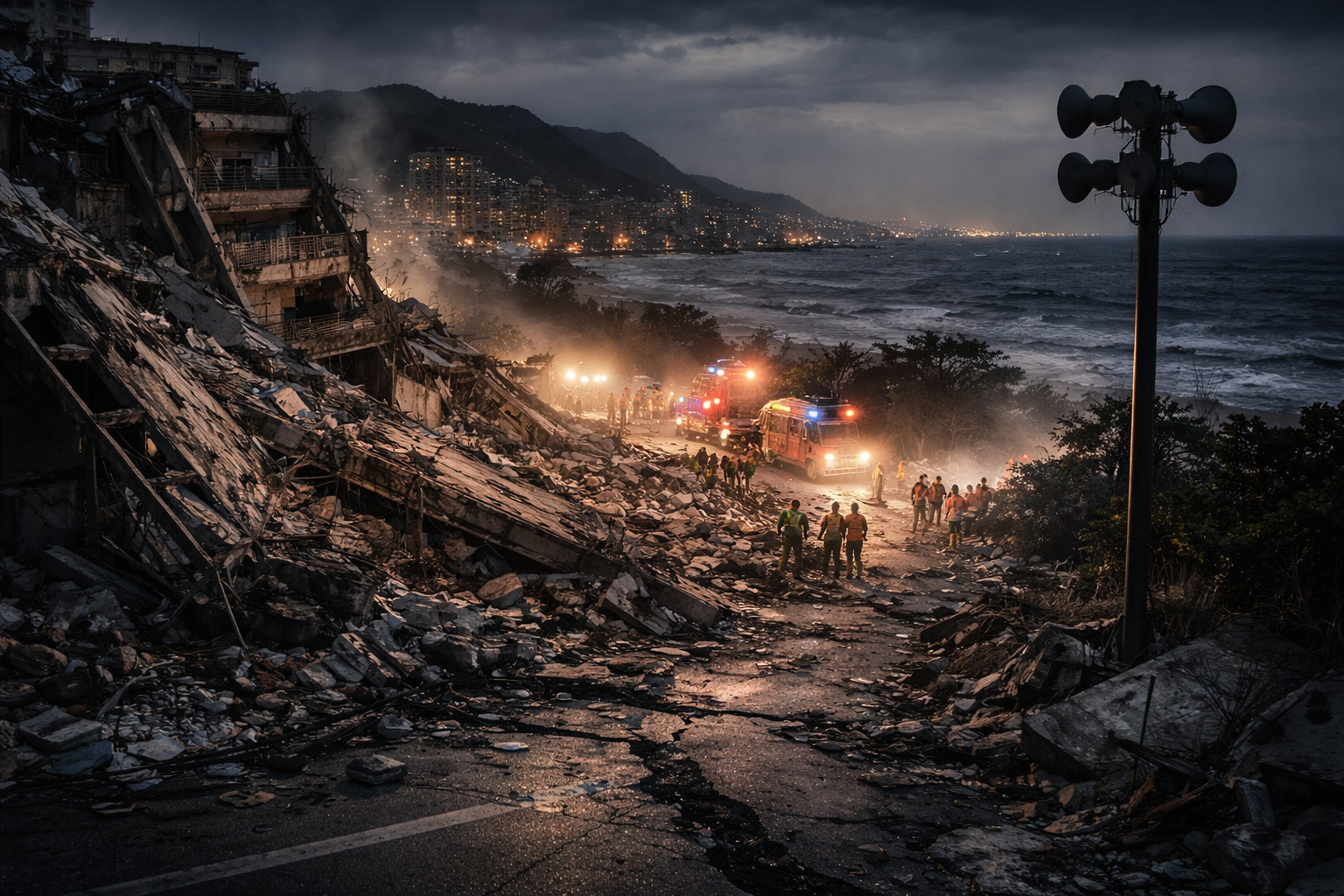
As of December 28, 2025, Taiwan is assessing a strong offshore earthquake that struck late Saturday night local time, with initial readings putting it around magnitude 7.0 on Taiwan’s scale and about mid-6s on international moment-magnitude reporting. The epicenter was offshore, east-southeast of Yilan, and the quake’s depth was in the “intermediate” range.
That combination—big energy release, offshore location, and a deeper focus—creates a familiar first-day dilemma. The shaking can spread widely, alarms can travel faster than facts, and the most important decisions are made before the full damage picture is clear.
This piece explains where it hit, what magnitude and depth really imply, what the aftershock window usually looks like, what gets checked first, and how to separate real risk from viral noise in the first 24 hours.
The story turns on whether Taiwan’s depth-buffered offshore quake becomes a brief systems test—or the start of a more disruptive aftershock sequence.
Key Points
The quake struck offshore east of Yilan late on December 27, 2025, Taiwan time, and was felt across a wide area because the source was relatively deep.
Taiwan’s agency reported a magnitude of 7.0 and a focal depth around 70+ km; international feeds reported a mid-6s moment magnitude with a similar depth range.
Reported shaking intensity reached level 4 in multiple areas, a level that often aligns with minor damage and localized disruptions rather than widespread structural failure.
The first 24–72 hours matter most for aftershocks; officials warned that aftershocks in the mid-5s to around 6 are plausible in the coming days.
Although a significant tsunami threat was not expected, coastal caution was still advised, especially for strong offshore quakes.
The practical story is continuity: rapid inspections of transport links, utilities, and key industrial sites—especially facilities with high sensitivity to vibration and power interruption.
Background
Taiwan sits on a complex plate boundary where the Philippine Sea Plate and the Eurasian Plate interact. Frequent earthquakes, including offshore events that strongly affect land, are a result of this setting.
Early reporting often looks contradictory because different agencies use different magnitude scales. Taiwan’s local magnitude reporting is designed for regional conditions and rapid public communication. International agencies often publish moment magnitude, which is better for comparing large events globally. A “7.0” in one system and a “6.6–6.7” in another can describe the same earthquake without either being “wrong”.
Depth is the other key number. A shallow quake tends to concentrate damaging shaking near the epicenter. An intermediate-depth quake can spread felt shaking over a wider area, sometimes with less concentrated surface damage near the source, but still capable of causing disruption—especially in older buildings, on soft soils, and in systems that depend on precise alignment.
Analysis
Political and Geopolitical Dimensions
In the first day, the politics are mostly operational. Government credibility comes from speed, clarity, and calm repetition of what is known and unknown. Over-reassurance backfires if a strong aftershock hits. Over-drama fuels rumor and crowd panic.
Offshore earthquakes also trigger a regional reflex. Even when there is no meaningful tsunami threat, neighboring jurisdictions and shipping operators watch for bulletins because the cost of missing a real tsunami is catastrophic. The “geopolitical” layer here is less about diplomacy and more about communications discipline across borders: consistent messages, consistent thresholds, and fast correction of misinformation.
There is also a governance test at home: how quickly municipalities can inspect schools, hospitals, and high-occupancy buildings; how transparent utility companies are about outages; and how effectively transport agencies communicate closures and reopenings.
Economic and Market Impact
The first-order economic risk is not “the economy”; it is continuity. What gets checked first is predictable:
Road and rail: bridges, tunnels, elevated sections, and any segment with known landslide exposure.
Power: transmission stability, substation alarms, and localized outages.
Water and gas: leaks, pressure drops, and building-level shutoffs.
Telecom: cell tower power backup and fibre route redundancy.
Even brief outages are relevant for sensitive manufacturing. Taiwan’s semiconductor ecosystem is engineered for seismic reality, with automatic thresholds, evacuation protocols, and controlled shutdown processes. But a controlled stop still has costs: scrapped wafers, requalification time, and throughput loss if restarts are staggered.
In the next session, the market signal typically reflects questions rather than panic. Did any high-value facility pause production? How fast did staff return? Were there any cleanroom incidents? Were ports or freight corridors affected? If the answers stay boring, the risk premium fades quickly.
Social and Cultural Fallout
Offshore quakes still matter because “offshore” does not mean “far away.” The energy still travels, and when the focus is deeper, more people can feel it across the island. Wide-area shaking is socially disruptive even when structural damage is limited. People lose sleep, replay the movement in their heads, and scan for aftershock notifications.
The first-day information environment can be worse than the quake. The usual pattern looks like this: a handful of real clips, a flood of old videos mislabeled as “today,” and confident claims about a bigger quake being “guaranteed.” The practical response is simple:
Trust official seismic updates for the numbers.
Trust utilities and transport agencies for outages and closures.
Treat viral “predictions” as entertainment, not guidance.
If a clip has no location, no timestamp, and no corroboration, assume it is miscaptioned.
A calm public message is not “everything is fine”. It is “Here is what is being checked, here is what we know so far, and here is what to do if an aftershock hits.”
Technological and Security Implications
Magnitude tells you the energy release. Depth tells you how that energy is likely to translate into surface shaking. Together, they shape the risk profile:
A deeper event often reduces the probability of catastrophic near-epicentre building collapse compared with a similar-magnitude shallow quake, but it can increase the footprint of “felt” shaking and amplify the need for widespread inspection.
Tsunami risk depends less on magnitude alone and more on whether the seafloor moved vertically in a way that displaces water. Depth, fault geometry, and location matter. For this event, bulletins indicated no active tsunami threat, which fits the depth profile, but coastal caution remains sensible in the hours immediately after any strong offshore quake.
Technology also changes the timeline. Taiwan’s alerting systems can push warnings quickly, and industrial sites can trigger automatic safety actions within seconds. That saves lives and reduces chaos, but it also means the public can see an alert before they feel shaking, which can increase anxiety if messaging is not clear.
What Most Coverage Misses
The overlooked number is intensity, not magnitude. Magnitude is one value for the whole event. Intensity is what people and buildings actually experienced in specific places. In this case, reported intensities clustered around a mid-range level across multiple regions, which is a strong clue that the real story is scattered minor damage and system checks—not widespread structural failure.
The second missed point is the aftershock window. Aftershocks are normal, and the biggest aftershocks often arrive when attention drops—hours later, or overnight. The goal is not to “predict” aftershocks, but to normalize the pattern: expect more shaking, expect false alarms online, and focus on practical readiness.
Why This Matters
For households, the short-term impact is safety and routine: brief outages, disrupted commutes, and anxiety around aftershocks. For businesses, it is uptime and verification: inspecting premises, restarting machinery safely, and validating supply commitments.
In the near term, the most important developments to watch are:
Official aftershock updates through the next 72 hours, and continued advisories into early January if activity persists.
Inspection and reopening notices for rail lines, highways, and major public buildings.
Utility reporting on localized power loss and any gas or water leakage incidents.
Major industrial parks and manufacturers provide operational updates.
Longer term, the quake is another reminder of a reality Taiwan already plans for: resilience is not a slogan, it is a workflow. The speed of inspection, repair prioritization, and clear public communication determines whether an event becomes a footnote or a disruption.
Real-World Impact
A night-shift nurse in Taipei feels the building sway and spends the next hours checking aftershock notices between patient rounds. The hospital stays open, but staff are stretched by anxiety and disrupted sleep.
A small guesthouse operator in Yilan deals with cancelled bookings after dramatic social media clips circulate. The building is fine, but the business takes a hit until verified local updates calm visitors.
A logistics coordinator for an electronics exporter waits for confirmation that a key highway tunnel and rail segment have reopened. One delayed shipment is manageable. Three days of staggered transport starts to cascade.
A procurement manager at a U.S. hardware firm checks whether any wafer fabs paused production and whether lead times will shift. Even if supply remains stable, the risk conversation returns to boardrooms immediately.
What’s Next?
The next day is about staying boring. If inspections confirm only minor damage, if utilities remain stable, and if key industrial sites are operating normally, the quake becomes a resilience story rather than a disruption story.
The fork in the road is the aftershock sequence. A quiet taper supports rapid normalization. A strong aftershock in a vulnerable location changes the damage picture and the public mood quickly.
The signs that matter are concrete: intensity maps for aftershocks, official reports of structural damage, transport reopening timelines, and operational updates from critical facilities. If those stay steady through the next 72 hours, the risk window narrows fast
