Almost Half the World’s Oil Now Comes From Conflict-Hit Countries — And the Risk Is Spreading
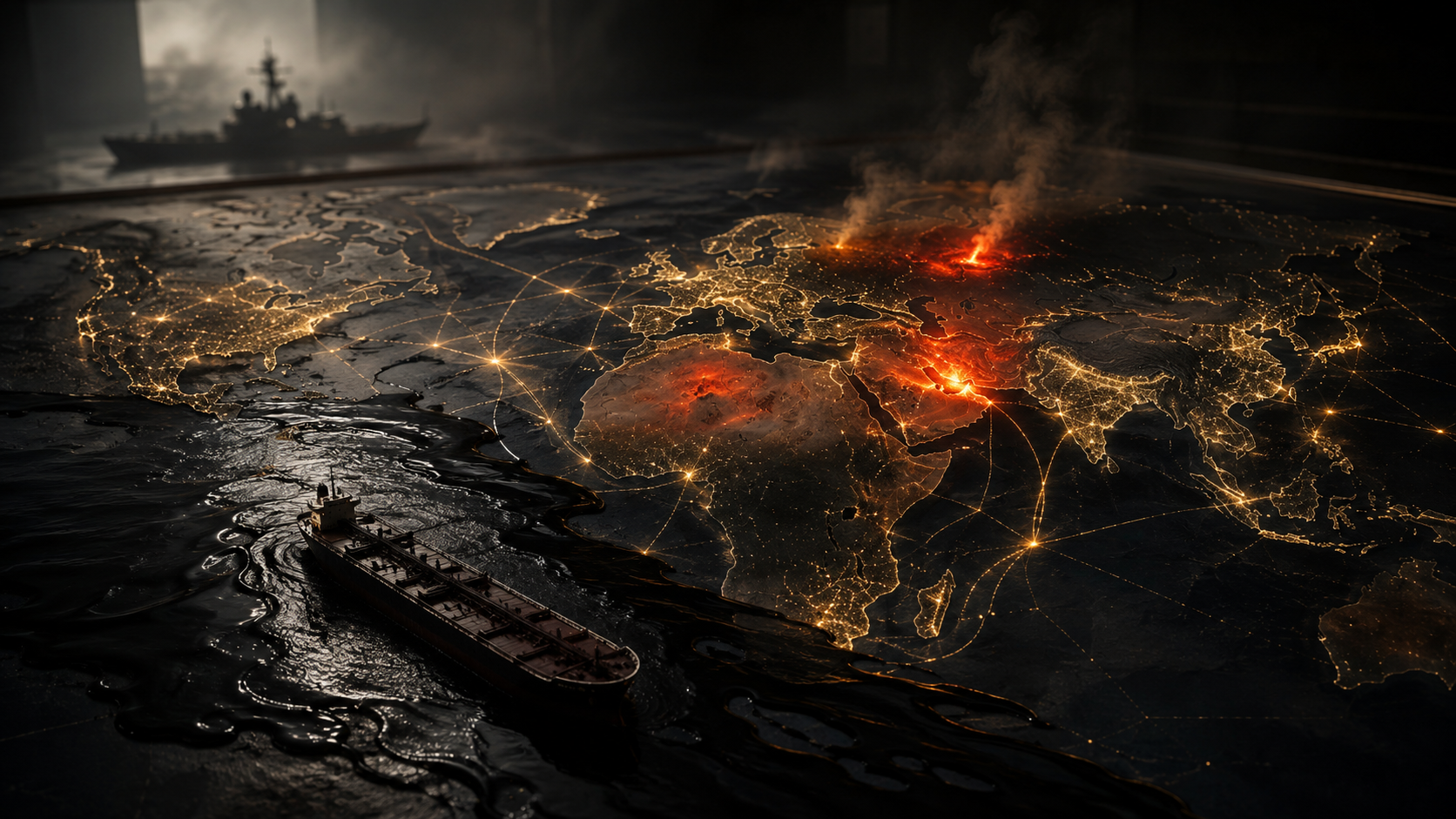
War Now Shadows Almost Half of the World’s Oil Supply
The World’s Oil Map Is Turning Into a War Map
The global oil market has crossed an extraordinary threshold. Countries affected by wars and related geopolitical disruption accounted for roughly 45 million barrels a day of oil production based on 2025 output — more than 43% of global supply. What once looked like a series of separate regional crises is increasingly becoming one interconnected threat to the energy system that powers the world economy.
The scale matters because the system has already lost much of its safety margin. The International Energy Agency said global oil supply reached 101.5 million barrels a day in July 2026, but remained 6.3 million barrels a day below the level recorded a year earlier. Gulf production alone was still 8.3 million barrels a day below pre-war levels.
The World’s Oil Map Is Becoming a Conflict Map
The pressure is no longer concentrated in one country. The Iran war has disrupted production and shipping across the Persian Gulf, Russia remains locked in its war against Ukraine, Kazakhstan has suffered disruption linked to the wider regional conflict, and instability continues to affect Libya. Restrictions and disruption surrounding Venezuelan exports have added another layer of uncertainty.
That distinction is important. It does not mean 43% of the world's oil has disappeared, nor does it mean every barrel from those countries is currently unavailable. It means an extraordinary share of the global petroleum system is now being produced inside countries where war, military attacks, sanctions, shipping disruption or associated geopolitical pressure can interfere with production, refining or exports.
Oil markets have always lived with political risk. What is different in 2026 is the concentration of that risk across several major producers at the same time.
Russia remains one of the largest oil producers on Earth. Iran and Iraq sit within the Gulf production system. Saudi Arabia is the world's dominant holder of spare crude capacity. Kazakhstan is an important exporter whose routes are intertwined with Russian infrastructure. Libya has repeatedly shown how quickly political instability can affect its output.
When disturbances hit several parts of that network together, spare capacity in one country can no longer be viewed in isolation from pipelines, refineries, ports and shipping lanes elsewhere.
The Iran War Changed the Calculation
The decisive shock came from the Middle East. The IEA describes the conflict that began on February 28 as creating the largest oil-supply disruption in the history of the global market. In March, it said flows of crude and petroleum products through the Strait of Hormuz had fallen from roughly 20 million barrels a day before the war to a fraction of normal levels, forcing Gulf producers to slash output because they could not move enough oil out.
The crisis has since changed shape rather than disappeared. Gulf production recovered to 23.9 million barrels a day in July, according to the IEA, but was still 8.3 million barrels a day below pre-war levels. Regional oil exports fell again after renewed hostilities and maritime disruption, leaving one of the world's most important energy-producing regions operating well below its normal potential.
That is what makes the Strait of Hormuz so important. In normal conditions, roughly 20 million barrels a day of crude oil and petroleum products can move through the narrow passage linking the Persian Gulf with the open ocean. Pipelines across Saudi Arabia and the United Arab Emirates can bypass part of that traffic, but they cannot simply replace the strait at full scale.
Saudi Arabia has responded by pushing more crude westward through its East–West pipeline towards the Red Sea. Other Gulf exporters have searched for ways to keep cargoes moving despite the danger around Hormuz. Yet alternative routes reduce the damage rather than erase it.
The uncomfortable reality is geographical. Some of the world's largest oil reserves sit behind a maritime chokepoint vulnerable to missiles, drones, naval confrontation, insurance withdrawal and political brinkmanship.
Russia Creates a Second Energy Front
At the same time, the Russia-Ukraine war continues to exert pressure on another giant section of the petroleum system. Russia produced 8.76 million barrels a day of crude in July under IEA estimates, leaving it among the world's most important producers even after years of sanctions and wartime disruption.
The pressure is increasingly visible downstream. Ukrainian attacks have repeatedly targeted Russian refining and energy infrastructure, while Moscow has faced restrictions around exports and growing strain within its domestic fuel system. The significance goes beyond the amount of crude Russia can pump from the ground: crude oil is only useful to consumers once it can be transported, refined and turned into petrol, diesel, aviation fuel and other products.
That helps explain why fuel markets can tighten even when headline crude production remains relatively high. A damaged refinery does not necessarily remove crude oil from the ground, but it can remove usable fuel from the market.
Russia and the Gulf therefore create two different versions of the same problem. In the Gulf, enormous production capacity can become trapped behind dangerous shipping routes. In Russia, oil can exist while the infrastructure needed to process and distribute it comes under sustained pressure.
Emergency Reserves Have Bought the World Time
Governments responded to the initial Middle East shock with an intervention unprecedented in the history of the International Energy Agency. Its 32 member countries agreed in March to make 400 million barrels of emergency oil available — the largest coordinated stock release the organisation has ever undertaken.
The comparison with previous crises is striking. The IEA was created after the 1973 oil shock and had previously coordinated emergency action during the 1991 Gulf War, after hurricanes Katrina and Rita in 2005, during disruption to Libyan production in 2011 and twice during the energy upheaval of 2022. The 2026 response surpassed all of them.
Those reserves did exactly what emergency reserves are designed to do: they bought time. They prevented a sudden physical shortage from becoming even more severe while producers, refiners and shipping companies reorganised supply.
But emergency inventories are finite.
By the end of July, the IEA estimated that observed global oil stocks had fallen below 7.9 billion barrels for the first time since April 2025. Stocks had declined by around 410 million barrels since the start of the Middle East war, equivalent to an average draw of about 2.7 million barrels a day.
That is the deeper danger. The longer a crisis continues, the less protection remains against the next one.
America Is Becoming More Important
One major producer sits outside the central war zones: the United States. American crude production averaged a record 13.6 million barrels a day in 2025, making the country the world's largest crude producer for another year.
The shale revolution has therefore created a strategic buffer that did not exist during the great oil crises of the 1970s. A world heavily dependent on Gulf and Russian crude now also has an enormous supply base across Texas, New Mexico, North Dakota and other producing regions.
But America cannot make every other vulnerability disappear. Oil markets are global. Refinery configurations differ. Shipping distances matter. Different grades of crude cannot always be substituted instantly, and American production itself remains exposed to hurricanes, infrastructure constraints and the economics of drilling.
The more production is lost elsewhere, the more important every incremental American barrel becomes.
That gives Washington extraordinary energy leverage, but it also increases the consequences when US output cannot grow quickly enough to replace lost supply.
This Is Already Bigger Than Previous Oil Crises
History provides uncomfortable comparisons. During the 1973 Arab oil embargo and Arab-Israeli war, peak global supply losses were estimated at about 4.3 million barrels a day. The Iranian Revolution removed roughly 5.6 million barrels a day at its peak, while the opening phase of the Iran-Iraq War caused losses of about 4.1 million barrels a day.
The modern crisis is structurally different because several disruptions overlap. The Middle East war affects production and the world's most important oil shipping chokepoint. Ukraine can strike refining infrastructure deep inside Russia. Sanctions reshape trade routes. Tankers travel further. Emergency stocks are drawn down. Refiners elsewhere have to work harder to compensate.
The IEA expects global oil supply to decline by an average 4.3 million barrels a day during 2026. Its August forecast also projected a third-quarter deficit of around 1.8 million barrels a day, more than twice the level it had expected only a month earlier.
Oil prices have reflected that nervousness. North Sea crude ended July near $96.80 a barrel after trading across an unusually wide range, including a spike to around $105 as diplomacy broke down and hostilities resumed. By mid-August it was trading closer to $92, showing how rapidly expectations of war or peace can now move the market.
The Danger Is Bigger Than the Oil Price
An oil crisis reaches far beyond petrol stations. Petroleum feeds aviation, shipping, road freight, agriculture, chemicals, plastics and industrial production. Diesel prices flow into the cost of moving almost every physical product through an economy.
Higher transport and production costs can feed inflation. Persistent inflation can keep interest rates higher. Higher rates raise borrowing costs for governments, businesses and households.
That is why a tanker incident thousands of miles from Europe or North America can eventually affect supermarket prices, airline fares, business margins and mortgage calculations.
The transmission mechanism is rarely immediate or perfectly proportional. But the connection between energy costs and the wider economy has not disappeared simply because developed countries use oil more efficiently than they did in the 1970s.
The Next Shock Is the Real Threat
The most disturbing number may not be 43%. It may be 410 million — the approximate number of barrels already drained from observed global inventories since the Middle East war began.
Inventories are the shock absorbers of the petroleum system. When supply suddenly disappears, stored oil gives governments and companies time to respond. Every prolonged draw reduces that margin.
The IEA currently expects conditions to improve later in the year and projects a substantial rebound in global supply during 2027. That outcome, however, depends heavily on disrupted Gulf production returning and shipping routes becoming more reliable.
A diplomatic settlement in the Gulf could therefore change the market quickly. Reopening Hormuz reliably would allow enormous volumes of shut-in production to return, reduce pressure on emergency stocks and help restore inventories.
The opposite scenario is much darker. Another major refinery attack, escalation in the Gulf, serious damage to export infrastructure or prolonged disruption at Hormuz would hit a market that has already spent months consuming its buffers.
That is what makes 2026 different from a conventional oil shock. The danger no longer sits in one country, one pipeline or one war.
Almost half of global oil production now originates in countries touched by conflict or associated geopolitical disruption. The system is still functioning, but it is being asked to absorb several crises simultaneously — and each month of instability leaves it with less room to absorb the next one.
