Ukraine’s Clock Is Ticking: Zelenskyy Says America May Have Until Summer 2027 to End the War
Why Zelenskyy Thinks America’s Best Chance to End the War Is Coming
A Ceasefire, Donbas Deal And a Deadline: Zelenskyy Reveals Ukraine’s Emerging Endgame
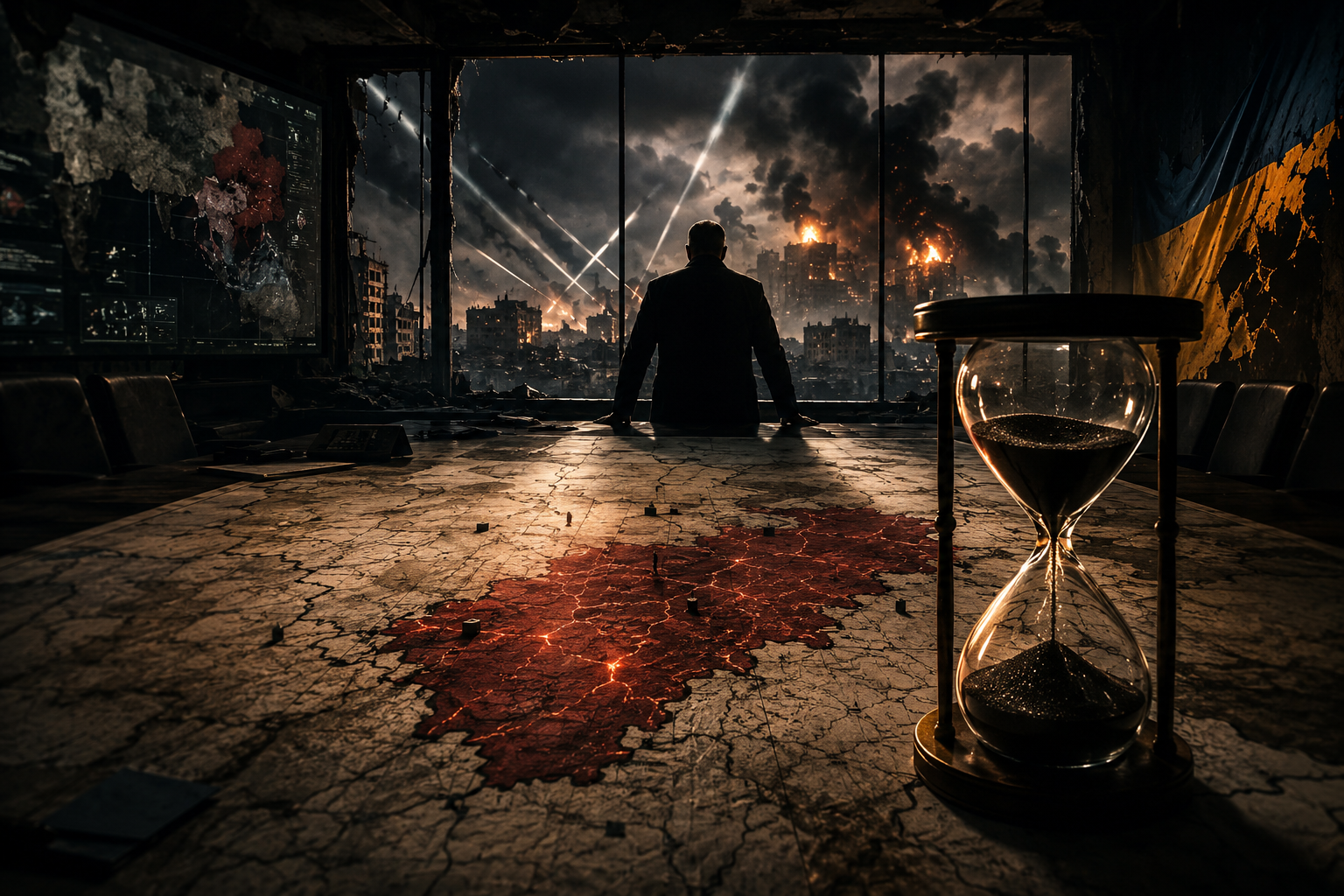
Volodymyr Zelenskyy has put a political clock on one of the biggest diplomatic questions of the war in Ukraine. The Ukrainian president believes the strongest opportunity for American-led diplomacy could run from the US-hosted G20 summit in December 2026 until the end of summer 2027, before America’s 2028 presidential campaign begins consuming Washington’s attention.
That makes his warning more significant than another call for negotiations. Ukraine, the United States and European officials have also assembled a one-page set of ideas to put before Moscow, including a ceasefire, a possible free economic zone in Donbas administered by a third party and questions surrounding the future roles of the European Union and NATO. For perhaps the first time in months, there is both a proposed timetable and the beginnings of a possible negotiating architecture.
Why Zelenskyy Thinks the Clock Is Running
The crucial date is not being dictated by the battlefield alone. Zelenskyy is looking towards the American political calendar.
His argument is that diplomacy could become considerably harder once campaigning for the November 2028 US presidential election begins in earnest. Foreign policy does not stop during an American election, but the political incentives change, attention shifts and major international agreements can become entangled with domestic campaigning. Zelenskyy therefore sees the period between late 2026 and the end of summer 2027 as an unusually valuable opportunity.
That assessment also reflects how indispensable Washington remains. Europe has become increasingly important to Ukraine’s military and financial survival, but the United States retains a combination of military power, diplomatic influence and potential leverage over both Kyiv and Moscow that European states individually cannot reproduce.
Zelenskyy was already making a similar argument earlier in 2026. In May, he said greater economic pressure on Vladimir Putin could help force Russia towards negotiations and described a format involving Ukraine, Russia, the United States and Europe as potentially the strongest diplomatic configuration. He also acknowledged that Washington’s attention had been diverted towards the Middle East, illustrating exactly why Kyiv fears losing America’s focus.
The deadline is therefore not a claim that peace becomes impossible in September 2027. It is a warning that the political conditions for securing one may become substantially less favourable.
The One-Page Plan Changes the Story
More important than the deadline itself may be what Ukraine says is now being discussed behind it.
Zelenskyy says Ukrainian, American and European officials have produced a one-page document containing several ideas for Moscow. The first is a ceasefire. The second concerns an American proposal for a free economic zone in eastern Donbas that could be administered by a third party. A third element deals with the roles of NATO and the European Union and what Ukraine itself could do as part of an agreement.
That does not amount to a peace treaty. There is no evidence that Moscow has accepted the framework, many details remain undisclosed and some of the hardest questions appear unresolved.
Yet the existence of a compact proposal matters because the diplomatic challenge has always been larger than persuading the two sides to stop shooting. Any durable arrangement would have to address territory, security guarantees, military positioning, sanctions, economic reconstruction and the risk that a ceasefire simply becomes an opportunity to rearm.
That is the same problem sitting beneath the wider question of who is actually winning the Ukraine war. Military advantage matters because every kilometre taken or lost can alter what each side believes it should accept at a negotiating table.
Donbas Could Decide Whether the Plan Survives
The proposed economic zone exposes the central contradiction almost immediately.
Russia claims Donbas as Russian territory. Ukraine and most of the international community regard the Ukrainian regions Moscow claims to have annexed as part of Ukraine. Those positions cannot simply be reconciled by changing the economic rules governing the territory.
Kremlin spokesman Dmitry Peskov made Moscow’s objection explicit on August 25. He argued that Donbas was part of the Russian Federation and said it was therefore difficult to imagine a third country administering what Moscow regards as Russian territory.
That response is important because it demonstrates why apparently creative compromises repeatedly collide with the sovereignty question.
A free economic zone could theoretically provide an arrangement in which final legal status is left unresolved while military and economic control is handled differently. Variations of that principle have appeared in frozen conflicts and disputed territories elsewhere in the world.
But it only works if both sides are willing to separate practical administration from sovereign ownership. At present there is little evidence Russia and Ukraine are prepared to interpret Donbas in the same way.
Moscow has instead continued to insist that any settlement must recognise what it calls the realities on the ground. Ukraine sees accepting conquest as the basis for a settlement as potentially rewarding the invasion and creating the conditions for another war.
That contradiction is why Russia’s willingness to consider new peace proposals should not be confused with Russian willingness to accept Ukraine’s preferred settlement.
America Is Becoming Part of the Deadline
There is another uncomfortable implication in Zelenskyy’s warning.
Ukraine increasingly has to think not only about how long its own army can sustain the war or how long Russia can absorb enormous losses, but how long the geopolitical coalition surrounding the conflict will remain aligned.
American administrations change. Congressional priorities change. Wars elsewhere compete for weapons, money and political attention. Elections can radically change foreign policy.
Ukraine has already experienced that vulnerability.
Earlier US-led diplomatic efforts stalled as the territorial gap between Moscow and Kyiv remained enormous and Washington became increasingly preoccupied by the conflict involving Iran. American negotiators Steve Witkoff and Jared Kushner had travelled to Moscow but had still not visited Kyiv by the time Zelenskyy discussed the new proposal.
That helps explain why Zelenskyy is trying to turn a vague aspiration for peace into a schedule.
The calculation appears to be that the end of 2026 and the first eight or nine months of 2027 may provide the point at which American diplomatic power, European urgency, battlefield exhaustion and political necessity overlap most favourably.
If that moment passes, the war does not automatically continue indefinitely. But one of the few actors potentially capable of exerting enormous simultaneous pressure on the diplomatic process could become much harder to mobilise.
The Battlefield Has Not Stopped Negotiating
None of this means diplomacy has replaced the war.
Russia continues trying to improve its position in eastern Ukraine. Moscow’s military objective includes taking the remainder of Donbas, including Ukrainian-held territory protecting strategically important eastern cities.
Ukraine, meanwhile, continues fighting to deny Russia the stronger negotiating position that further territorial gains would create.
That relationship between military pressure and diplomacy is crucial. Negotiations do not take place in a separate world from the battlefield. Each side looks at what it might gain by continuing to fight and compares that with what it could obtain through compromise.
Zelenskyy has previously argued that Russian losses and battlefield difficulties could eventually increase the pressure on Putin to negotiate. In May he said sanctions, military pressure and growing Russian losses could combine to make dialogue more attractive to Moscow.
Russia appears to make the opposite calculation whenever its forces advance: that time may allow it to demand more rather than accept less.
That is why the broader failure of previous attempts to bring Putin and Zelenskyy closer to direct negotiations matters. The obstacle has never simply been finding a meeting room. It is convincing both governments that continuing the war offers less than ending it.
Summer 2027 Could Become a Political Turning Point
Zelenskyy’s timetable should therefore be understood as a window rather than an ultimatum.
There is no fixed mechanism that suddenly makes diplomacy impossible at the end of summer 2027. The significance is political: once the American presidential campaign accelerates, Ukraine risks competing with domestic politics for the sustained White House attention necessary to push an exceptionally complicated settlement through.
Even before then, enormous obstacles remain. Moscow has already challenged one of the most distinctive elements of the emerging plan. Territorial sovereignty remains unresolved. The future security relationship between Ukraine, NATO and Europe remains unresolved. The military front remains active.
But something has changed.
Ukraine is no longer speaking only about the abstract possibility of negotiations. Zelenskyy is describing elements that could potentially form part of a settlement and identifying the period in which he believes the United States has its best chance of turning them into one.
That creates an extraordinary possibility for 2027. After years in which each new season brought another offensive, another mobilisation and another round of long-range attacks, next summer could instead become the point at which Washington discovers whether it has enough leverage to move Russia and Ukraine towards an agreement neither side currently finds comfortable.
If it fails, the consequence may be larger than another abandoned peace initiative. America could enter its next presidential election with the war still raging, the territorial dispute still unresolved and both Moscow and Kyiv calculating that the battlefield remains a better place to determine Ukraine’s future than the negotiating table.
