America Owes $40 Trillion — Who Actually Owns The Debt And Can It Ever Be Repaid?
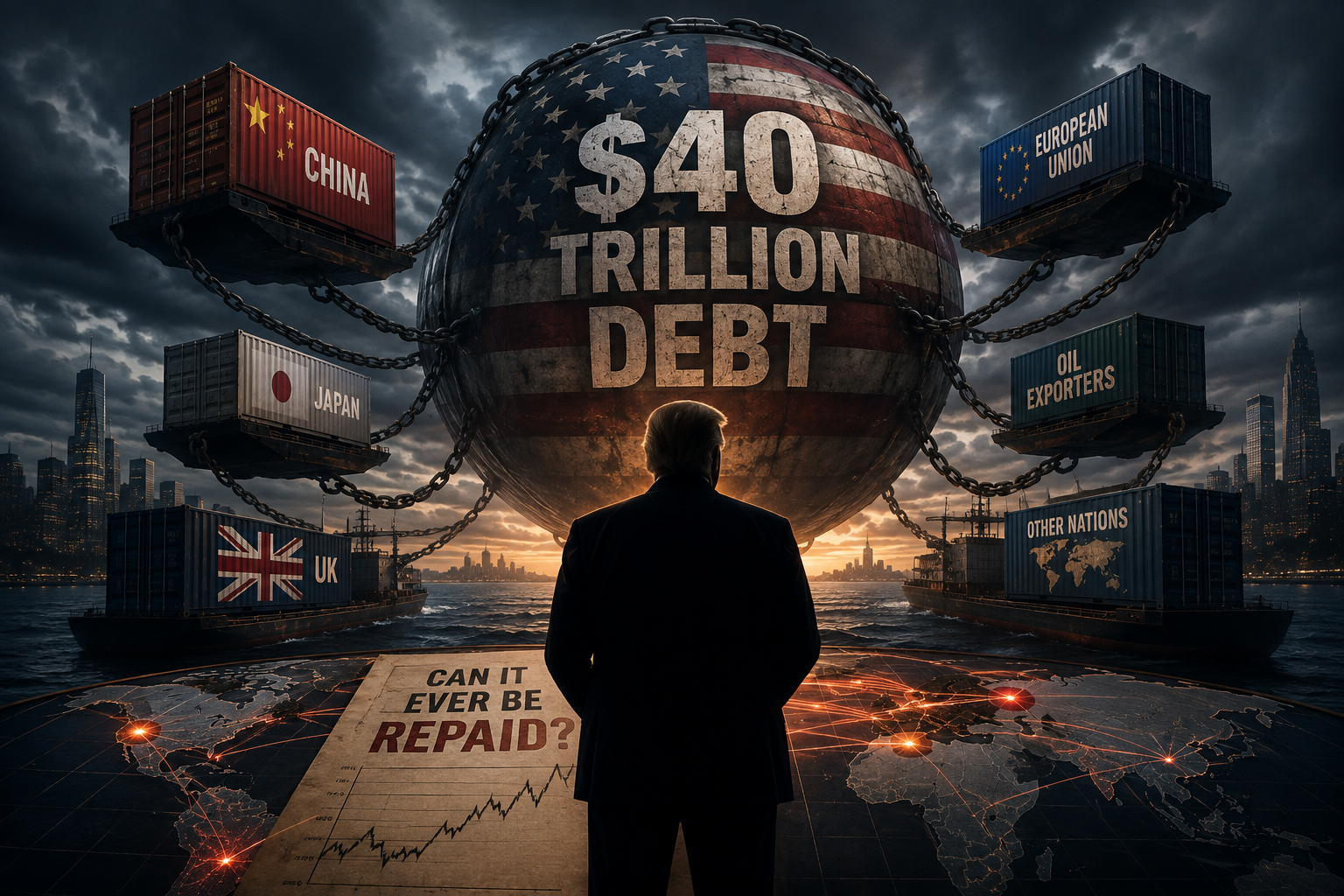
Why America’s $40 Trillion National Debt Matters To The Entire World
The World Runs On US Debt — What Happens If Investors Stop Trusting It?
America has crossed a financial threshold that would once have been almost unimaginable. Gross US federal debt has passed $40 trillion, while renewed pressure in the Treasury market has forced Washington to take unusual action to support trading in some of its longest-dated government bonds.
The intervention does not mean the United States is bankrupt, nor does it mean a sovereign debt crisis is imminent. But it exposes an increasingly important contradiction at the centre of the global financial system: the asset treated around the world as the benchmark for safety is being issued in ever greater quantities by a government that continues to spend substantially more than it collects.
Why The Treasury Suddenly Stepped In
US Treasury bonds sit at the heart of global finance. Their yields influence American mortgages, corporate borrowing, government finances, asset valuations and borrowing costs far beyond the United States.
That is why a violent increase in long-term Treasury yields matters. In August 2026, the 30-year yield moved above 5% and reached levels not seen since before the global financial crisis. The Treasury responded by increasing its planned purchases of older long-term government securities, with buyback amounts for relevant maturities rising from previous levels.
Treasury buybacks are not the same as simply cancelling America's national debt. The government buys selected outstanding securities before maturity partly to improve liquidity and the functioning of the market, while continuing to issue new securities elsewhere to finance itself. Treasury itself describes buybacks as a tool for supporting market liquidity, managing cash and potentially reducing borrowing costs over time.
The immediate intervention helped bring yields down, but it did not alter the underlying arithmetic. America still has an enormous stock of debt, continues to run large fiscal deficits and must refinance enormous quantities of securities as older debt matures.
What Does America's $40 Trillion Debt Actually Mean?
The headline number is commonly misunderstood.
The United States does not owe $40 trillion to one bank, one country or even one group of international creditors. Gross federal debt consists of two broad categories: debt held by the public and intragovernmental debt.
When the $40 trillion threshold was crossed, roughly $32.3 trillion was debt held by the public while approximately $7.8 trillion represented intragovernmental holdings.
Debt held by the public includes Treasury securities owned by American households, pension funds, banks, investment funds, insurance companies, the Federal Reserve, state and local institutions, businesses and foreign investors. Treasury defines it as federal debt held outside the federal government's own accounts, including holdings of Federal Reserve Banks.
Intragovernmental debt is different. Federal trust funds and other government accounts sometimes receive more money than they currently need to spend and invest the excess in special Treasury securities. The Treasury therefore owes money to another part of the US government.
Social Security trust funds are a familiar example of this broader mechanism. Economically, those obligations still matter because the government will eventually need resources to honour them, but they are not equivalent to an independent foreign creditor demanding repayment.
Who Actually Owns US Debt?
Foreign governments are important creditors, but the popular idea that America essentially owes its national debt to China is wrong.
Treasury's comprehensive survey showed foreign investors holding about $9.1 trillion of Treasury securities at the end of June 2025, equivalent to roughly one-third of the Treasury securities covered by that ownership measure. Domestic investors therefore remained the larger group.
Among foreign holders, Japan has historically been one of the largest. The June 2025 survey attributed approximately $1.15 trillion to Japan, around $853 billion to the United Kingdom and about $731 billion to mainland China. Treasury also warns that country-by-country figures are imperfect because securities can be held through custodians and financial centres on behalf of investors elsewhere.
China's position is particularly interesting. Its holdings have fallen substantially from their earlier peak, but that does not mean Beijing can simply "dump America's debt" and destroy the US economy without consequences to itself.
A mass sale would push Treasury prices lower and yields higher, but it could also reduce the value of China's remaining holdings, disrupt global markets and leave Beijing needing another enormous, liquid reserve asset in which to place its money. There are alternatives, including gold, euros and other sovereign bonds, but none currently reproduces the combination of size, liquidity and institutional infrastructure available in the US Treasury market.
Can America Just Print More Money?
Technically, the United States has an enormous advantage: its debt is overwhelmingly denominated in a currency that the United States itself issues.
That makes America fundamentally different from a country that has borrowed heavily in somebody else's currency. The US government is not required to somehow obtain euros, gold or Chinese renminbi before servicing ordinary dollar-denominated Treasury securities.
But "just print the money" is not a free solution.
The Treasury itself does not simply order unlimited dollars into existence to eliminate government debt. Monetary policy is conducted by the Federal Reserve, which can create central-bank money and purchase financial assets, including Treasury securities. Large-scale purchases can therefore make government financing easier, but permanently using monetary creation to absorb uncontrolled fiscal deficits would carry potentially enormous consequences.
If investors concluded that dollars were being created primarily to finance government spending rather than maintain monetary stability, inflation expectations could rise. Bondholders might demand higher interest rates as compensation for expected losses in purchasing power. The dollar could weaken, and confidence in the independence of the Federal Reserve could deteriorate.
The government might then discover the fundamental limitation of money creation: it can manufacture nominal dollars, but it cannot manufacture equivalent quantities of real economic resources.
Printing twice as many dollars does not automatically produce twice as many houses, barrels of oil, factories, doctors, computer chips or hours of labour. If money expands much faster than the economy's ability to produce goods and services, the adjustment can arrive through higher prices.
America therefore has far greater protection against an involuntary currency shortage than many indebted nations. It does not have protection against inflation, currency depreciation or collapsing investor confidence.
How Did America Reach $40 Trillion?
The debt was not created by one president, one war or one political party.
For decades, the United States has repeatedly spent more than it collects in federal revenue. Each annual deficit must ultimately be financed, predominantly through additional borrowing.
The financial crisis, tax decisions, military spending, ageing-related programmes and rising healthcare commitments all contributed over time. Then COVID-19 produced an extraordinary fiscal shock as Washington financed stimulus payments, emergency programmes, unemployment support, healthcare measures and assistance to businesses and state governments.
The pandemic explains part of the acceleration, but the debt continued climbing after the emergency ended.
This is the more difficult structural problem. Social Security, Medicare, defence, healthcare, other mandatory programmes and interest payments consume enormous portions of federal resources. At the same time, politicians face strong resistance to both substantial tax increases and substantial reductions in popular programmes.
America has consequently normalised deficits even during periods when the economy is not experiencing a major recession.
The problem then begins feeding on itself. More debt creates more interest expense. Higher interest expense increases federal spending. That can require still more borrowing.
By the first ten months of the 2026 fiscal year, net federal interest expenditure had reached approximately $963 billion.
That is the number that increasingly matters more than the theatrical $40 trillion headline. A government can carry enormous debt for decades if investors remain willing to refinance it cheaply. Trouble becomes much harder to manage when the interest bill consumes an increasing share of tax revenue.
How America Compares With Other Countries
Absolute national debt is not the best international comparison because America also has one of the world's largest economies.
Debt relative to GDP gives a more meaningful indication of scale.
The IMF estimates US general government gross debt at approximately 125.8% of GDP in 2026. That is much higher than Germany's estimated 64.6% and the European Union's approximately 83.5%. Britain's equivalent figure is estimated at around 103.6%.
Yet America is not the most indebted major advanced economy. Japan's gross government debt is estimated at approximately 204.4% of GDP, while Italy is around 138.4%.
This demonstrates why debt thresholds cannot be treated mechanically.
Japan has sustained extraordinarily high government debt partly because of its domestic savings base, institutional structure and long history of low interest rates. Other countries have experienced serious fiscal crises at much lower debt ratios because investors lost confidence or because the debts were denominated in currencies those governments could not control.
The critical variables are therefore not merely how much a country owes, but who owns the debt, the currency in which it is issued, the interest rate being paid, the maturity profile, economic growth, tax capacity and whether markets expect the political system to remain capable of managing the burden.
America's Greatest Financial Weapon Is The Dollar
The US debt problem cannot be understood separately from the dollar's role in the world.
The dollar remains the dominant reserve currency. IMF data showed it representing 57.13% of allocated global foreign-exchange reserves in the first quarter of 2026.
That creates what has often been described as an extraordinary privilege.
Central banks need dollar reserves. Global banks need dollar liquidity. Companies conduct international trade in dollars. Commodities are frequently priced in dollars. Investors facing crises often move money into dollar assets, and the enormous Treasury market provides a place capable of absorbing amounts of capital that smaller sovereign markets cannot easily accommodate.
This structural demand helps the United States borrow at a scale that would be far more difficult for most countries.
Paradoxically, geopolitical uncertainty can therefore benefit the issuer of the world's largest government debt market. When investors become frightened, many still buy Treasuries.
That relationship is one reason America's debt can continue increasing for much longer than simple household-budget comparisons would suggest.
But reserve-currency status is not an unlimited licence.
Why America Abandoned The Gold Standard
The modern system became possible partly because the dollar is no longer directly redeemable for a fixed amount of gold.
Under the post-war Bretton Woods framework, major currencies were linked to the dollar while the United States promised foreign monetary authorities that dollars could ultimately be converted into gold at a fixed official price.
The arrangement became increasingly difficult to maintain.
America was supplying dollars to a growing global economy while simultaneously promising that those dollars were backed by a finite stock of gold. Rising US inflation, persistent external deficits and growing foreign dollar holdings created doubts about whether America possessed enough gold to honour widespread conversion requests.
This was an example of the fundamental tension later associated with the Triffin dilemma: the world needs the reserve-currency country to supply its currency, yet supplying ever larger quantities can eventually undermine confidence in the promise supporting that currency.
On August 15, 1971, President Richard Nixon closed the "gold window", ending the ability of foreign central banks to convert dollars into US gold at the official rate. That decision helped dismantle the Bretton Woods monetary system and eventually produced the modern era of largely floating fiat currencies.
Since then, a dollar's value has ultimately depended not on a statutory claim on a quantity of gold but on the productive capacity of the American economy, monetary credibility, government institutions, financial markets, taxation power and the willingness of people worldwide to accept dollars.
That system gives Washington significantly greater monetary flexibility. It also means confidence itself has become part of the foundation.
Could The Dollar Lose Its Reserve-Currency Status?
Yes, but reserve-currency systems do not usually disappear because a debt counter passes one dramatic number.
They weaken when alternatives become sufficiently attractive and when confidence in the incumbent deteriorates over sustained periods.
Countries including China and Russia have sought to reduce dependence on the dollar, while central banks have increased interest in gold and some governments increasingly explore settling trade outside the US currency system.
Yet the dollar remains dominant because replacing it requires far more than political ambition.
A reserve currency needs enormous investable markets, legal predictability, currency convertibility, deep banking infrastructure, confidence in property rights and enough safe assets to store trillions of dollars.
China possesses the scale to challenge elements of the system, but capital controls and the structure of its financial system complicate the renminbi's ability to replace the dollar globally. The euro is a major reserve currency but lacks a single federal sovereign bond market equivalent in scale and institutional simplicity to US Treasuries.
The greater danger to the dollar may therefore be gradual erosion rather than sudden abandonment.
If reserve managers steadily diversify towards gold and other currencies, Washington could eventually lose some of the structural demand that has allowed it to finance deficits so easily. That would probably mean higher borrowing costs and less freedom to use financial sanctions without encouraging alternatives.
For now, the evidence points to pressure rather than collapse. Indeed, the dollar's share of allocated reserves actually rose to 57.13% in the first quarter of 2026, though longer-term diversification remains an important trend to watch.
What Can America Actually Do About The Debt?
There is no painless solution because the mathematics ultimately involve only a few major variables.
Washington can spend less, collect more revenue, grow the economy faster, reduce the effective interest burden, tolerate somewhat higher inflation, or combine several of those approaches.
Economic growth is the least politically painful answer. If nominal GDP grows faster than government debt for a sustained period, the debt-to-GDP ratio can fall even without paying off the nominal debt itself.
That is an important point: the United States does not actually need to reduce federal debt to zero.
Governments are not households approaching retirement. Treasury securities are also fundamental financial assets used by banks, pension funds, central banks and markets around the world. Eliminating Treasury debt entirely would not necessarily be economically desirable.
The realistic objective is sustainability.
That means preventing debt and interest costs from growing persistently faster than the economy and government revenue.
Meaningful spending restraint would almost certainly require confronting politically sensitive programmes rather than focusing entirely on comparatively small discretionary budgets. Significant tax increases could raise revenue but would involve economic and political trade-offs. Faster productivity growth through technology and investment could improve the denominator, but governments cannot simply legislate permanently higher growth.
Financial repression — policies that encourage domestic institutions to hold government debt at yields below nominal economic growth — has historically helped countries reduce debt burdens after major wars. Inflation can also reduce the real value of fixed-rate debt, but deliberately using high inflation as a fiscal strategy would damage savers, destabilise markets and risk destroying monetary credibility.
Default would be the most destructive option.
Because the United States issues debt in dollars and possesses enormous taxation and monetary capacity, a conventional inability to obtain the currency needed for repayment is fundamentally different from that facing countries borrowing in foreign currency. A US default would be much more likely to arise from political dysfunction or a deliberate refusal to honour obligations than from literally running out of dollars.
That distinction would offer little comfort to markets if it happened.
Why The Geopolitical Consequences Could Be Enormous
US financial power and US geopolitical power are deeply connected.
The Treasury market gives governments, companies and central banks somewhere to store huge quantities of reserves. The dollar gives Washington exceptional influence over the global financial system. American banks and payment networks sit across international commerce, while dollar-based sanctions can inflict consequences far beyond US borders.
But that power relies on trust.
If persistent deficits forced Treasury yields structurally higher, Washington would face increasingly difficult choices between servicing debt and funding defence, social programmes, infrastructure and international commitments.
Higher borrowing costs could therefore eventually reduce America's geopolitical room for manoeuvre.
There is another risk. The heavier foreign governments' reliance on dollar assets, the more exposure they have to American financial policy. The use of sanctions and frozen reserves has already given strategic rivals an incentive to build alternative payment mechanisms and accumulate other reserve assets.
America therefore faces an unusual balancing act.
The dollar system allows Washington to borrow enormous amounts partly because the rest of the world needs dollar assets. Yet using that privilege too aggressively — through uncontrolled borrowing, sustained inflation or repeated weaponisation of financial infrastructure — could encourage countries to reduce their dependence on the system that provides America with that privilege.
None of this means a collapse is around the corner. The IMF's latest reserve data still show a monetary system overwhelmingly centred on the dollar compared with any individual competitor, and the Treasury market remains unmatched in scale.
But $40 trillion changes the margin for error.
The greatest threat is not that America wakes up one morning and receives a bill demanding immediate repayment of every dollar it owes. Sovereign debt continuously matures, is repaid and refinanced.
The danger is slower and more powerful: investors gradually demanding more compensation to lend, interest consuming more federal revenue, politicians losing fiscal flexibility, and America's exceptional ability to finance itself becoming slightly less exceptional.
The Treasury can intervene when markets become disorderly. The Federal Reserve can supply liquidity in a crisis. Washington can tax, cut spending, refinance debt and issue the world's reserve currency.
What neither institution can manufacture is permanent confidence.
For decades, confidence in the United States allowed Washington to build the deepest government bond market on Earth and turned Treasury securities into the foundation of international finance. The real significance of $40 trillion is not that the number itself represents a point of no return. It is that America's future increasingly depends on ensuring the world continues to believe that lending to the United States remains worth the risk.
