“Arrested for Tweets: Graham Linehan Tells U.S. Congress How UK Police Acted Over Speech Made in America”
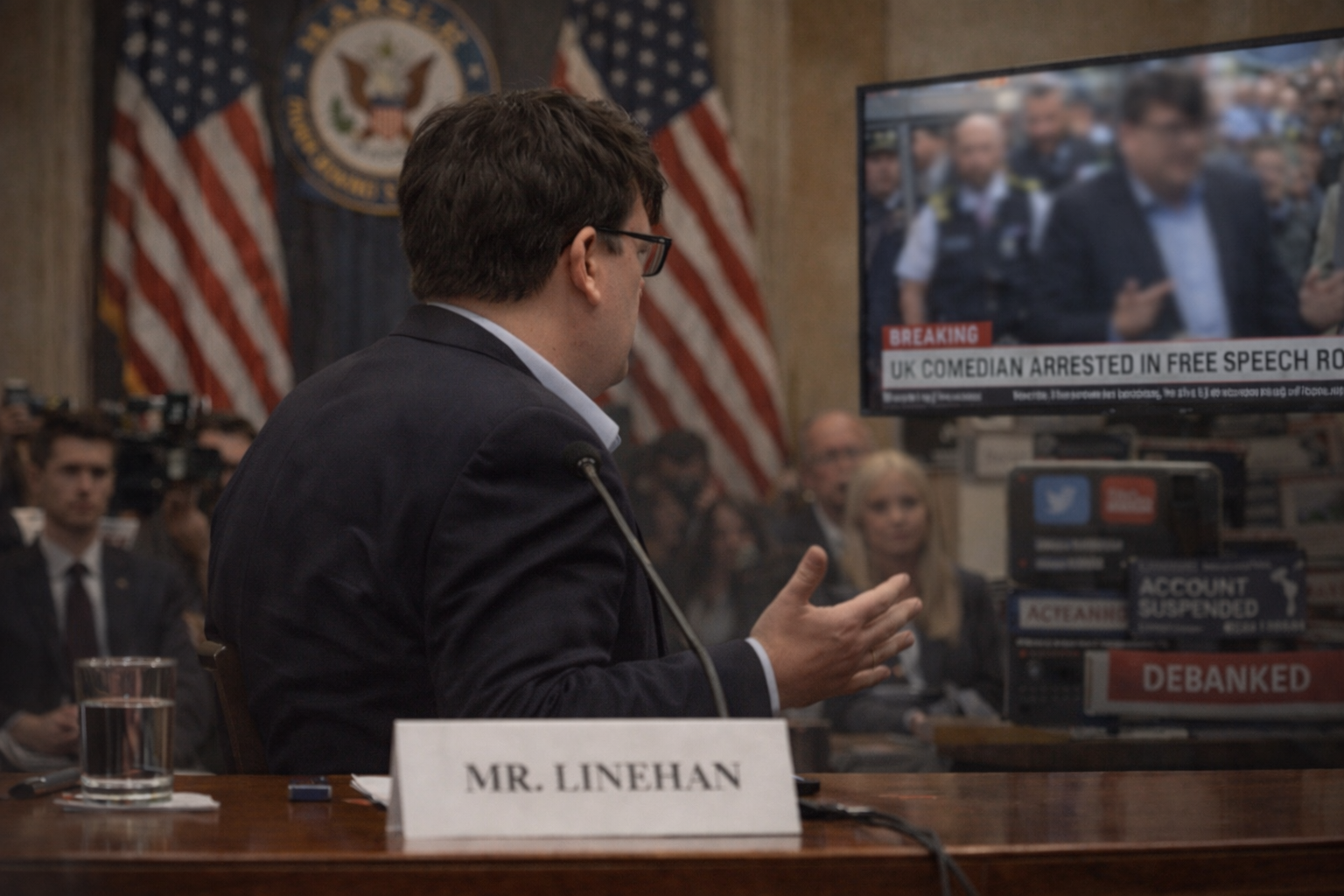
Linehan tells U.S. lawmakers he was arrested in the UK over posts made in America. The case ended without charge—what that signals now.
From Twitter Posts to Handcuffs: Graham Linehan’s UK Arrest Reaches Washington
British-Irish comedy writer Graham Linehan has testified before the U.S. House Judiciary Committee about his September 2025 arrest in the United Kingdom on suspicion of inciting violence, an investigation tied to social media posts that he said were made while he was in the United States. He claims that after his release, he received no charges related to the matter.
Linehan’s appearance is not just a culture-war export. It is a live demonstration of how speech disputes are now routed through institutions that do not share the same constitutional assumptions: U.S. lawmakers, U.K. policing practice, prosecutors’ thresholds, and platform rules that can change across borders.
One detail matters more than the personality clash. Linehan’s account frames the core dispute as jurisdictional: whether a European-style enforcement environment can still reach you when the speech, the platform, and the audience are partly outside Europe.
The story turns on whether cross-border enforcement pressure is becoming the real “speech regulator,” even when prosecutions fail.
Key Points
Linehan told U.S. lawmakers he was arrested in the U.K. in September 2025 on suspicion of inciting violence linked to posts on X and that he was later released with no charge pursued.
The arrest occurred at Heathrow Airport after a return flight from the United States, and he was taken to the hospital after officers became concerned about his health during detention.
Later, the Crown Prosecution Service confirmed that they would not pursue any further action in the incitement investigation.
Linehan used the hearing to argue that his “gender-critical” views ended his mainstream career and led to deplatforming and other consequences; some of these claims are his personal account and are disputed in the wider debate.
The hearing itself is part of a broader U.S. political push arguing European online safety and platform rules can “spill over” onto American speech and American companies.
The practical fight is less about a single arrest and more about the incentives created when people believe they may be detained on arrival, even if prosecutors ultimately decline to charge.
Background
Linehan is best known as a co-creator of “Father Ted” and “The IT Crowd.” Over several years he became a prominent voice in arguments about sex-based rights, gender identity, and the boundaries of lawful speech. In 2020, his Twitter account was permanently suspended under the platform’s rules at the time.
In September 2025, the Metropolitan Police said a man in his 50s was arrested at Heathrow on suspicion of inciting violence in relation to posts on X. Press coverage and Linehan’s own public statements identified him as the individual arrested. He was questioned for hours and then taken to the hospital after police became concerned about his health, and he was later released while the case remained under investigation.
On October 20, 2025, prosecutors confirmed they would take no further action on the incitement investigation.
On February 4, 2026, Linehan appeared as a witness at a House Judiciary Committee hearing titled “Europe’s Threat to American Speech and Innovation: Part II,” which focuses on European regulation and its claimed effects on U.S. speech and U.S. technology platforms.
Analysis
What Linehan Is Trying to Prove to U.S. Lawmakers
Linehan’s central objective is to turn a personal episode into a policy artifact: a concrete story that lawmakers can hold up as evidence that “Europe” (including the U.K.) can punish or chill speech that would be more protected in the United States.
That framing matters because hearings like this tend to be less about adjudicating the underlying facts than about building a record. If a witness can credibly say, “I was detained for speech,” that can be used to justify pressure on regulators, platforms, and even trade or diplomatic posture.
The constraint is obvious: a declined prosecution does not prove speech norms are lawful or unlawful. The situation lies in the ambiguous area where policing discretion and prosecutorial thresholds intersect.
The U.K. Enforcement Reality: Arrest First, Charging Later
Prosecutors later decide whether to charge based on evidence and public-interest tests, while the U.K. system permits arrest on suspicion during an investigation. In practice, that means the most consequential “penalty” in a high-profile speech case can be the process itself: detention, bail conditions, device seizure, travel anxiety, legal cost, and reputational blast radius.
Linehan’s case is a clean example of that dynamic because the end-state was “no further action.”
Plausible scenarios from here:
Police forces tighten internal thresholds for speech-related arrests after public backlash, reducing similar detentions.
Police keep the same approach, but prosecutors continue filtering cases out at the charging stage.
Parliament or oversight bodies modify their guidelines to elucidate the boundaries of online criminal activity.
Signposts to watch:
Changes to police policy and training regarding online speech allegations should be closely monitored.
Any civil claim or judicial review that requires the disclosure of decision-making, guidance, or communications should be closely monitored.
Platform Rules as the Quiet Co-Enforcer
Even if the criminal case remains unresolved, platform enforcement can still take swift action. Linehan’s earlier suspension from Twitter (now X) shows how private moderation decisions can remove reach, revenue, and professional access without a court ruling.
The incentive shift is that platforms may tighten moderation to reduce regulatory exposure, especially when multiple jurisdictions threaten penalties. U.S. lawmakers hostile to European regulation argue this creates a de facto global standard, because platforms often prefer one consistent rule set to minimize operational risk.
Signposts:
Major platforms are publishing region-specific policy updates tied to European compliance.
There is evidence that the strictest regulator is quietly aligning "global" content rules.
Why This Is Landing Now: The U.S. Politics of “Foreign Censorship”
The hearing title is not subtle, and the committee materials explicitly frame the issue as a transatlantic spillover: European rules (including the U.K.’s Online Safety Act) allegedly threatening Americans’ speech and American firms.
That context explains why individual stories matter. A single arrest can serve as a narrative bridge between technical regulation and visceral fear: “Could this happen to someone like me?”
But the constraint for lawmakers is that the U.S. cannot rewrite U.K. criminal law from Washington. What it can do is
Pressure platforms not to adopt “global” moderation settings driven by European compliance.
Use diplomacy and trade leverage to push back on extraterritorial ambitions.
Build domestic legislation limiting how U.S. firms respond to foreign content demands.
What Most Coverage Misses
The key point is that a successful prosecution is not the most powerful lever; rather, it is the credible threat of disruption at the border.
That mechanism changes incentives because a person does not need to be convicted to feel constrained; they just need to believe travel, devices, or livelihood can be disrupted on arrival. Even if the legal outcome is unpredictable, the "cost" becomes predictable.
Two signposts would confirm this dynamic is strengthening:
There are an increasing number of high-profile cases where the outcome is "no charge," but the front-end intervention is significant, such as arrest upon entry, bail conditions, and platform restrictions.
A measurable shift in behavior by public figures (fewer trips, geofenced posting, legal “pre-clearance,” or switching platforms) driven primarily by process risk rather than court risk.
What Changes Now
In the short term (days to weeks), the biggest effect is political: Linehan’s testimony gives U.S. lawmakers a usable case study to argue that European and U.K. speech regimes can collide with American norms, because the same platform and the same audience can sit in multiple jurisdictions at once.
In the longer term (months to years), the real stakes are operational:
For individuals, travel-risk calculations and legal exposure become part of the “cost of speaking,” because border encounters can be triggered by online complaints and investigations.
For platforms, compliance decisions increasingly look like global product strategy, because a rule adopted to satisfy one regulator can reshape speech everywhere.
The main consequence follows a simple “because”: because enforcement is cheaper and faster at the process level (detention, investigation, platform moderation) than at the conviction level, institutions can change behavior without winning in court.
Real-World Impact
A commentator traveling for a talk starts posting less, not because they lost a case, but because they cannot afford a surprise detention and a seized phone.
A company hiring for a public-facing role quietly screens for “high-risk online profiles,” because it fears reputational explosions and legal costs even when no charges stick.
A small publisher avoids commissioning a contentious essay because the marketing plan depends on platform reach that can vanish overnight under evolving rules.
A U.S.-based platform team builds a new “Europe-safe” setting that becomes the default everywhere, because running two separate policies is costly and legally messy.
The Next Battle Isn’t About One Arrest
Linehan’s testimony will be treated, by supporters and critics alike, as a proxy fight over whose model governs the internet: the U.S. free-speech tradition or Europe’s more interventionist approach to online harms and hate speech.
The unresolved dilemma is that both sides are describing real risks. One side fears state-backed chilling effects; the other fears online intimidation and threats that can become offline harm. The dilemma lies in whether governments continue to push enforcement upstream, towards platforms and border-facing process tools, or if they limit their interventions to the most clearly criminal conduct.
Watch for any litigation around the September 2025 arrest, any formal police policy changes that follow public scrutiny, and any platform compliance moves that quietly standardize rules across regions. If this pattern hardens, historians may mark this period as the moment speech governance became less about courts—and more about systems.
