Britain Moves Against Iran’s IRGC After Alleged Proxy Attacks On UK Soil
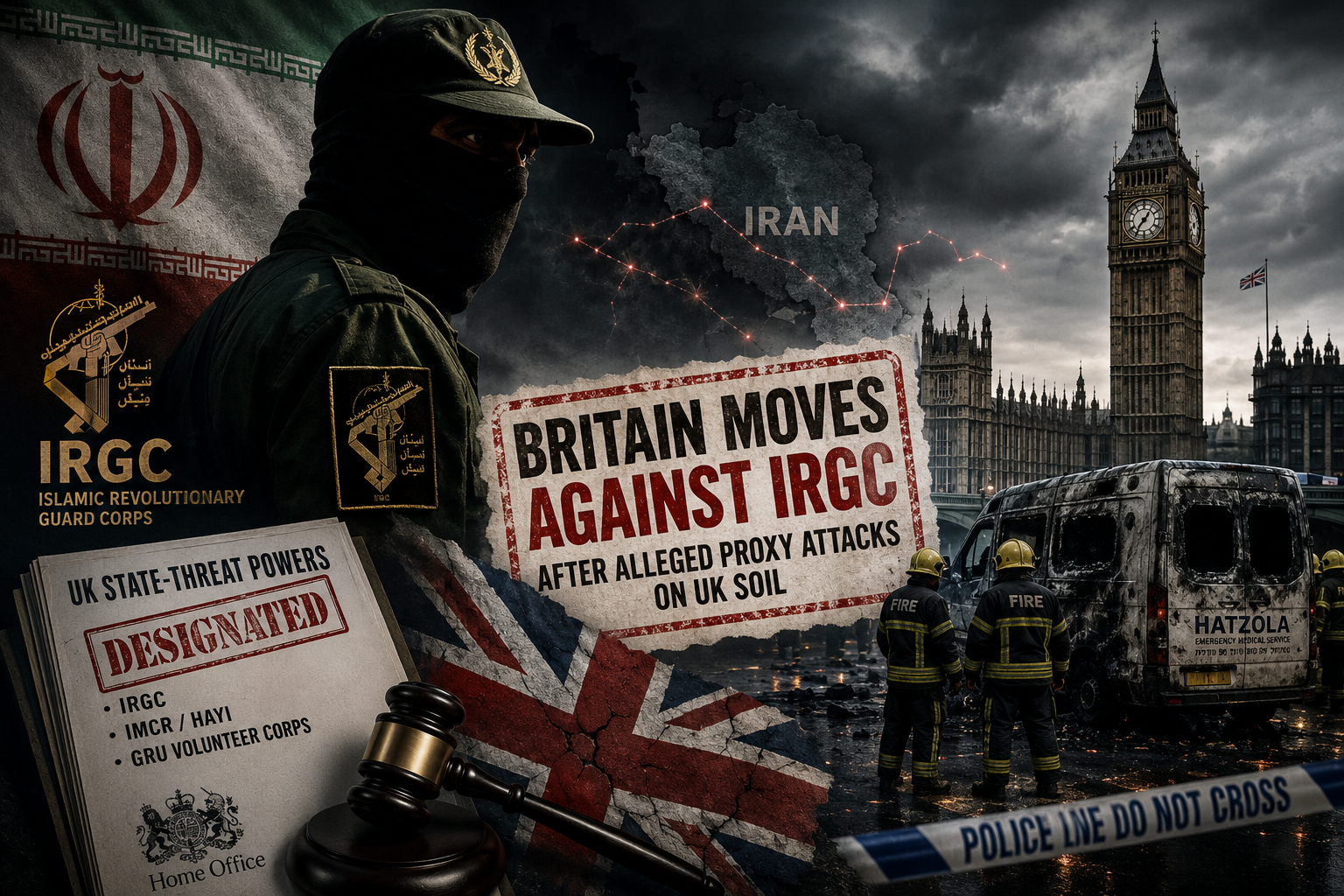
UK Targets Iran’s IRGC After Seven Attacks Linked To Tehran-Backed Network
Britain Strikes Back At Iran After Alleged Proxy Attacks On UK Streets
Britain has launched its most forceful legal crackdown yet against Iran’s Islamic Revolutionary Guard Corps after the Government linked an alleged Tehran-backed proxy network to a series of arson and intimidation attacks across the UK.
The IRGC, the Islamic Movement of Companions of the Right and Russia’s GRU Volunteer Corps are set to become the first organisations designated under Britain’s new state-threat powers. The measures must receive parliamentary approval, expected later this week.
Although the action is being widely described as a ban, it is legally distinct from traditional terrorist proscription under the Terrorism Act 2000. Instead, it uses a new framework designed specifically to confront hostile organisations connected to foreign governments.
Once approved, supporting or assisting a designated organisation could result in a prison sentence of up to 14 years. Those who carry out serious acts of sabotage, including arson, on behalf of such groups could face life imprisonment.
The decision represents a significant escalation in Britain’s confrontation with Tehran—and an acknowledgement that hostile states may increasingly use criminal intermediaries, ideological networks and deniable operatives rather than conventional intelligence officers.
Seven Attacks Allegedly Claimed By Iran-Linked Group
The immediate trigger is a series of seven attacks at British locations connected to Jewish and Israeli communities and Persian-language media.
The Islamic Movement of Companions of the Right, also known as IMCR or HAYI, has publicly claimed responsibility for the incidents. They reportedly included attacks on synagogues, Jewish facilities and media organisations critical of the Iranian regime.
One of the most prominent incidents occurred on 23 March, when four ambulances belonging to the Jewish volunteer emergency service Hatzola were set alight in Golders Green, north London.
The Government described the incident as an antisemitic arson attack and said members of the IRGC’s overseas operations arm, the Quds Force, were positioned behind the proxy organisation.
In unusually direct language, the Home Office said Quds Force members “almost certainly” directed IMCR attacks across Europe.
That assessment is important. It stops short of presenting publicly tested evidence proving that Tehran personally authorised every attack. However, it reflects the Government’s stated intelligence judgement that the incidents formed part of a broader campaign of Iranian state-backed hostile activity.
Iran has repeatedly rejected Western allegations that it directs criminal or violent operations abroad.
Why The IRGC Is Being Targeted
The IRGC is not simply another military organisation. It is one of the Iranian state’s most powerful institutions, reporting ultimately to Iran’s supreme leadership and controlling military, intelligence, economic and overseas operations.
Its Quds Force is responsible for activity beyond Iran’s borders and has long been accused by Western governments of training, financing and directing allied armed groups.
British security agencies have also warned for years about Iranian threats inside the UK.
Previous parliamentary and government assessments have cited assassination plots, surveillance operations, threats against dissidents and journalists, and attempts to recruit organised criminals to conduct attacks while giving Tehran plausible deniability.
A June 2026 House of Commons Library briefing recorded that hundreds of Iranian-linked individuals and organisations had already been sanctioned by Britain. The wider IRGC was subject to sanctions, but it had not previously been formally designated under powers equivalent to terrorist proscription.
Calls for stronger action intensified after reports that the IRGC had been connected to at least 20 credible threats in Britain, including an alleged plot targeting the Israeli Embassy in London.
The Government previously resisted outright proscription, partly because the IRGC is an official component of the Iranian state. Ministers feared that using conventional terrorism legislation against a sovereign government body could create legal complications, obstruct diplomatic contact and provoke retaliation against British interests.
The new state-threat regime was designed to close that gap.
What The New Powers Change
Traditional terrorist proscription primarily targets non-state organisations engaged in terrorism. The new designation system is intended to address organisations that operate for—or are controlled by—hostile foreign powers.
That distinction allows Britain to criminalise assistance for organisations such as the IRGC without pretending that they are structurally identical to independent terrorist groups.
The measures are intended to disrupt espionage, foreign interference, sabotage, intimidation and physical attacks. They could also strengthen the police’s ability to prosecute intermediaries who knowingly assist designated organisations but remain one step removed from the hostile act itself.
Prime Minister Sir Keir Starmer said the Government was acting against organisations that use proxies to threaten Britain while attempting to conceal the foreign state behind them.
Foreign Secretary Yvette Cooper separately announced financial sanctions against IMCR, including an asset freeze. She said Iran had continued attempting to undermine British security through criminal networks and proxy groups despite repeated warnings.
A Warning To Tehran—and Its Potential Recruits
The policy is not only directed at senior commanders in Iran. It is aimed at the wider ecosystem that makes deniable overseas operations possible.
That may include recruiters, financiers, criminal facilitators, surveillance teams, propagandists and individuals willing to carry out vandalism, arson or violence in exchange for money or ideological approval.
The central message is that acting through a proxy will no longer shield the sponsoring organisation—or its British-based helpers—from severe criminal penalties.
However, the Government will still need to demonstrate that the law can be applied effectively. Intelligence assessments may justify designation, but criminal prosecutions require admissible evidence proving what an individual knew, who directed them and whether their activity genuinely amounted to assistance.
Civil-liberties questions may also arise over what legally constitutes “support”, particularly where political commentary, journalism, religious activity or opposition to British foreign policy is involved. Clear guidance will be essential to separate legitimate expression from practical assistance to hostile operations.
Britain Enters A New Phase Of State Conflict
The move signals that Britain increasingly sees Iranian activity not merely as a diplomatic problem overseas but as a direct domestic-security threat.
The alleged attacks reveal the danger of modern proxy warfare: incidents that initially appear to be isolated hate crimes, vandalism or organised criminality may form part of a campaign commissioned from abroad.
By designating the IRGC and its alleged proxy under the new regime, Britain is attempting to dismantle that model from both ends—targeting the foreign organisation said to be directing the activity and the network accused of carrying it out.
The legislation will not eliminate Iranian state threats overnight. Tehran may shift tactics, use new intermediaries or respond against British diplomatic and regional interests.
Nevertheless, the decision marks a decisive change. Britain is no longer relying solely on sanctions, warnings and intelligence disruption. It is building a criminal-law framework intended to expose and punish foreign states that allegedly bring their shadow conflicts onto British streets.
