China’s Pacific Missile Test Sends a Brutal Warning to the West
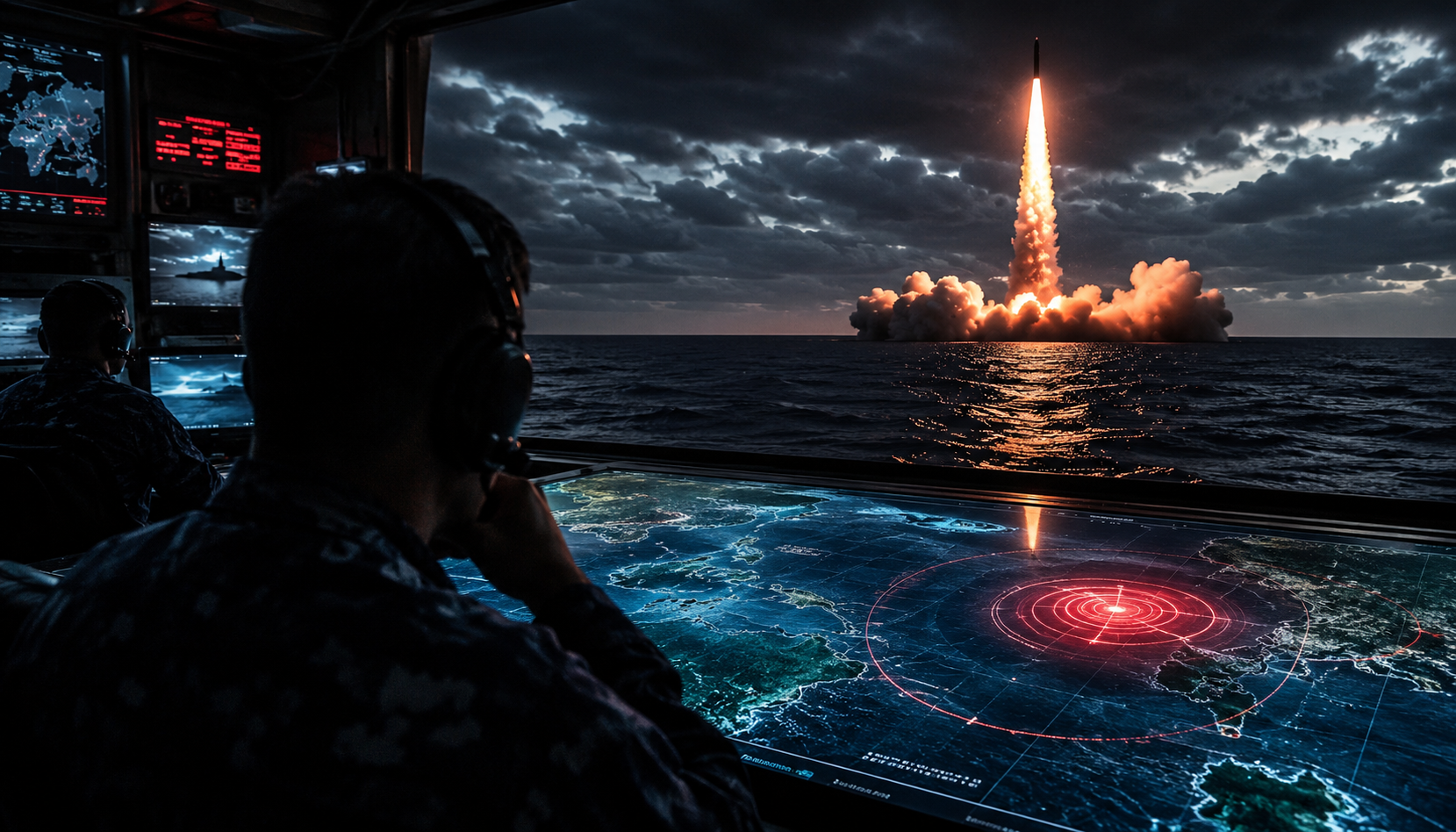
China’s Missile Test Was Not Just a Test. It Was a Signal
Beijing’s Missile Launch Shows the Next Taiwan Crisis Is Already Wider Than Taiwan
China’s ballistic missile launch into the South Pacific is serious because it was not just a technical demonstration. It was a public signal that Beijing wants regional governments to see its long-range missile reach, submarine capability and political confidence at the same time.
China said the missile carried a dummy warhead, was part of routine training and was not aimed at any country. That explanation matters, but it does not remove the strategic message. The launch landed in a region already anxious about China’s military expansion, nuclear growth and pressure around Taiwan.
Why The Launch Matters
The most important detail is that this was reportedly a long-range ballistic missile launched from a nuclear-powered submarine. That points toward survivable second-strike capability: the ability to keep nuclear-armed or nuclear-capable forces hidden at sea and still retaliate if China were attacked.
That is a different kind of signal from a land-based missile test. A submarine launch tells rivals that China is not only building missiles, but also improving the hidden naval leg of its strategic deterrent. For the United States, Australia, Japan, Taiwan and Pacific island states, that changes the geography of risk.
The timing sharpened the message. The launch came as Australia and Fiji signed a new mutual defence pact, part of a wider contest over influence in the South Pacific. Australia, New Zealand and Japan all raised concern, while China rejected criticism and framed the test as lawful and routine.
That is the contradiction at the heart of the story. Beijing says the launch was normal. The region sees it as anything but normal.
The South Pacific Is Now Part of the Deterrence Map
For years, the South Pacific was treated mainly as a diplomatic and economic competition zone. China sought policing, infrastructure, port, aid and security relationships. Australia, New Zealand and the United States tried to hold influence through aid, defence deals and political reassurance.
A ballistic missile test pushes that competition into a harder category. It tells Pacific governments that great-power rivalry is no longer theoretical. The region is becoming a live arena for deterrence, military signalling and strategic access.
That matters because the South Pacific sits behind the first island chain and across the wider reinforcement routes that would matter in any Taiwan, South China Sea or Western Pacific crisis. If a war broke out over Taiwan, the United States and its allies would need secure logistics, naval access, airfields, ports and political cooperation across the Pacific. China does not need to control every island to complicate that system. It only needs to make the region feel contested.
The missile launch therefore has two audiences. The first is Washington and its allies. The second is the Pacific itself. The message to both is that China can project strategic pressure far beyond the Taiwan Strait.
The Taiwan Implication
Taiwan is not the stated target of the test, but Taiwan is central to the wider meaning. China’s military pressure around Taiwan has already become more regular, more layered and more difficult to separate from wider Indo-Pacific operations.
Taiwan said on the same day that it was tracking an upward trend in Chinese naval movements during peak exercise season, including joint activity with Russia and multiple Chinese naval formations in the Western Pacific. Taiwanese officials also linked these movements to efforts to counter the US-led defence strategy along the first island chain.
That is why the missile test matters for Taiwan even if the missile did not fly near Taiwan. A future Taiwan crisis would not be limited to the beaches, ports and airspace around the island. It would involve submarines, long-range missiles, US bases, Japanese territory, Australian support, Pacific routes, space systems, cyber pressure and political coercion across the region.
China’s aim in such a crisis would not only be to defeat Taiwan militarily. It would be to make outside intervention look too dangerous, too expensive and too uncertain. A visible submarine-launched ballistic missile test strengthens that message.
Possible Responses
The first likely response is diplomatic condemnation. Australia, New Zealand and Japan have already signalled concern over transparency, timing and regional stability. Pacific island governments may also demand clearer notification and stronger respect for the South Pacific’s nuclear-free identity, especially because the region has a long political memory of nuclear testing and great-power disregard.
The second response is defence alignment. Australia will likely use this launch to justify deeper security ties with Fiji, Papua New Guinea, Vanuatu, Tonga and other Pacific partners. The argument will be simple: China is no longer just offering roads, ports and police cooperation. It is demonstrating strategic military reach.
The third response is military tracking. Japan, Australia, the United States and Taiwan will study the launch profile, possible submarine type, missile range, notification process and landing zone. Even a test with a dummy warhead gives opponents data about China’s operating patterns and confidence.
The fourth response is deterrence messaging. Expect more allied naval patrols, exercises, missile-defence discussions, submarine cooperation and Pacific basing conversations. The West will not answer one missile with one missile. It will answer by tightening the network around China.
Why This Is Serious But Not War
This is not an immediate sign that China is about to attack Taiwan. It is not proof that Beijing has decided to move from coercion to invasion. It is, however, a sign that China is building the military and political architecture needed to make a future crisis more dangerous for everyone else.
The Pentagon has assessed that China remains on track to field more than 1,000 nuclear warheads by 2030, while its missile, submarine and naval forces continue to expand. That does not mean war is inevitable. It does mean China is moving from a smaller minimum-deterrent posture toward something more powerful, more flexible and more visible.
The seriousness lies in the combination. A submarine-launched missile. A South Pacific landing area. A defence pact signed the same day. Rising Chinese naval movement near Taiwan. Regional governments complaining about opacity. Each part can be explained alone. Together, they point to a harder Indo-Pacific era.
What Happens Next
The next phase will be about normalisation. If China treats South Pacific missile activity as routine, regional governments will face a choice: protest each incident and risk escalation, or absorb the new reality and watch Beijing establish a precedent.
Taiwan will read the test as another piece of the wider pressure campaign. Australia will read it as proof that the Pacific cannot be treated as a soft diplomatic theatre. Japan will read it through the lens of missile risk, regional opacity and Taiwan contingency planning. The United States will read it as another sign that China wants the ability to deter American intervention far from the Chinese mainland.
The danger is not that one test causes a war. The danger is that each test makes the extraordinary feel normal. Once long-range missile launches, naval formations and Pacific coercive signalling become routine, the region has already moved closer to the conditions in which a Taiwan crisis could spread fast.
