Khamenei’s Funeral Turns Into a Warning Moment for Trump and the West
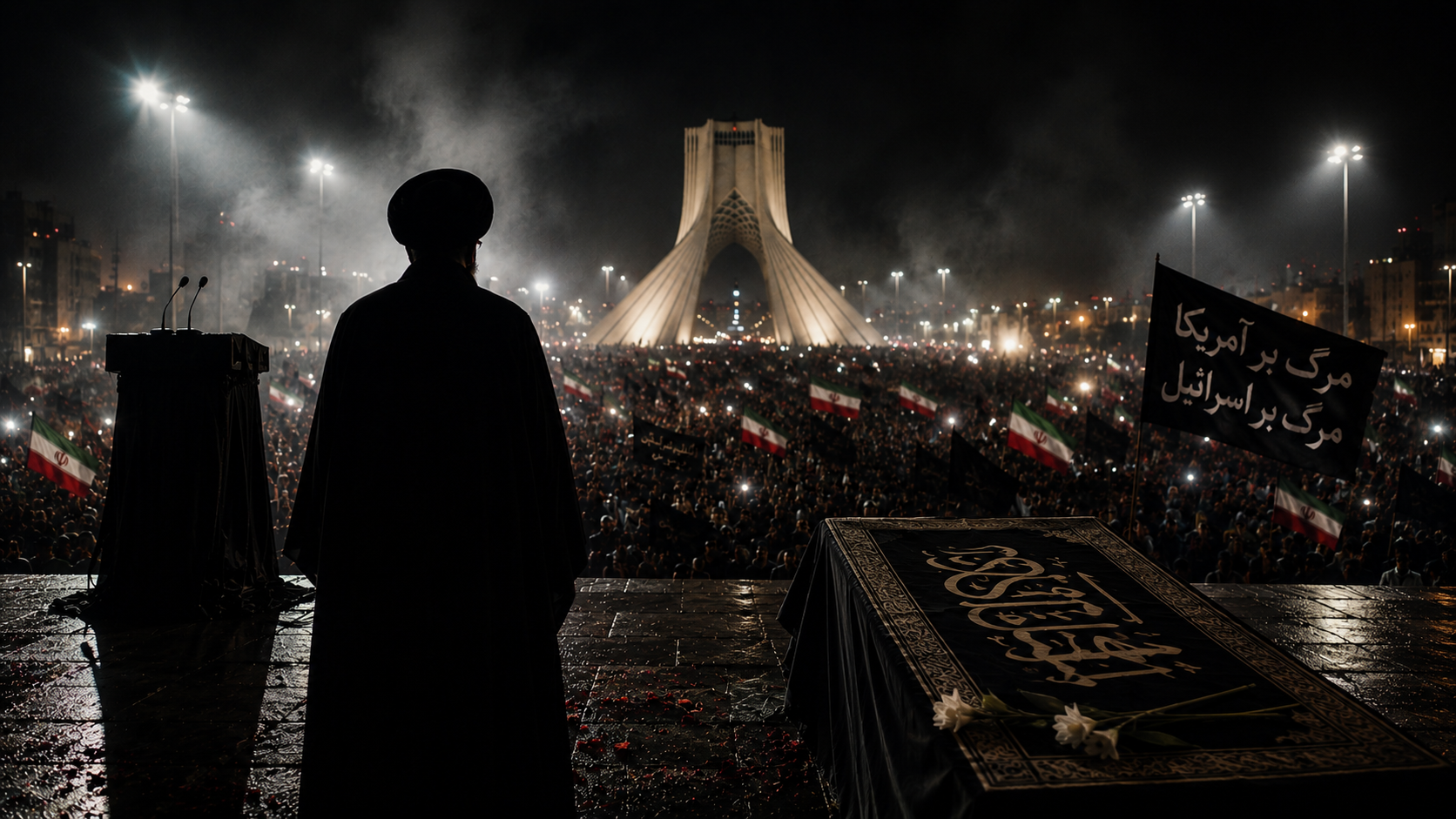
Tehran’s Funeral Procession Shows Iran Is Not Moving On Quietly
Khamenei’s Funeral Becomes Iran’s First Test of Power After His Death
Iran’s funeral procession for Ayatollah Ali Khamenei is not just a national mourning event. It is the first major public test of Iran’s post-Khamenei power structure, and it comes with open pressure for revenge against the United States, Israel and Donald Trump.
The spectacle in Tehran matters because funerals for revolutionary leaders are never only about grief. They are about legitimacy, loyalty, fear, succession and the message a regime wants to send before its enemies decide whether it looks wounded or dangerous.
Why This Funeral Matters Now
The procession through Tehran has turned Khamenei’s death into a political stage. Crowds, coffins, flags, chants and state choreography all serve one central purpose: to show that the Islamic Republic has not fractured after the loss of its most powerful figure.
That matters because Khamenei was not a ceremonial leader. The supreme leader sits above Iran’s elected presidency, controls the direction of state policy, commands the armed forces and holds decisive influence over the security apparatus, foreign policy, judiciary, media system and ideological machinery of the state.
His death therefore creates two simultaneous pressures. Iran must show unity at home while also convincing its enemies abroad that the regime remains capable of retaliation, escalation and strategic patience.
The funeral gives Tehran a way to do all three. It turns private mourning into mass mobilisation, succession anxiety into public symbolism, and anti-Western anger into a signal that the next phase of Iranian politics may be shaped by vengeance as much as stability.
The Succession Test Behind the Procession
The central issue is not whether Iran can hold a large funeral. It is whether the system can transfer authority without exposing weakness.
Iran’s constitution gives the Assembly of Experts the formal responsibility for selecting a supreme leader. In the event of death, resignation or dismissal, a temporary leadership arrangement is meant to assume the leader’s duties until a successor is appointed.
That legal framework matters, but Iran’s real succession politics have always involved more than written procedure. The balance between clerics, the Islamic Revolutionary Guard Corps, the presidency, intelligence bodies, senior religious networks and powerful family-linked factions is what determines whether authority is accepted or quietly contested.
This is why Mojtaba Khamenei’s position is so sensitive. As Khamenei’s son and reported successor, his legitimacy cannot rest only on inheritance. He must also persuade the system’s hard men, clerics and security elites that he can protect them, discipline rivals and preserve the revolutionary state under pressure.
His absence from public funeral appearances therefore matters. If it is purely a security decision, it still reveals how dangerous the moment is. If it reflects injury, internal caution or uncertainty over public presentation, it adds another layer of doubt around how visible and commanding Iran’s next leader can be.
The Revenge Pressure Is the Point
The strongest message from the procession is not sorrow. It is retaliation.
Public anger aimed at Trump, the United States and Israel gives Iran’s new leadership a dangerous political inheritance. Once a state funeral becomes a theatre of revenge, the leadership may find it harder to appear restrained without looking weak.
That does not mean Iran will automatically launch a major attack. Tehran has often mixed harsh rhetoric with calibrated action, using proxies, regional pressure, cyber activity, maritime disruption, missile threats and staged escalation rather than immediate all-out confrontation.
But the pressure is real. If the regime allows the funeral to become a promise of revenge, it creates expectations among hardliners, military commanders and loyalist supporters that the death of Khamenei must be answered in a visible way.
That is where the risk to Trump and the West becomes sharper. The immediate threat may not be a single dramatic strike, but a longer campaign of pressure designed to show that Iran can absorb a blow, keep its system intact and impose costs over time.
Why the West Will Be Watching the Crowd and the Leadership
For Washington, London, Brussels and regional capitals, the funeral is a live intelligence test. The size of the crowd matters, but so does the composition of the crowd, the slogans permitted, the officials present, the figures absent and the tone set by state media.
A controlled procession suggests the regime still has organisational reach. A visibly angry procession gives the leadership leverage, because it can tell outside powers that public fury limits its room for compromise.
But there is a contradiction inside that message. The more Iran leans into revenge politics, the harder it becomes to reassure markets, regional neighbours and negotiating channels that the post-Khamenei state will behave cautiously.
That contradiction could define the next phase. Iran wants enemies to fear its capacity for escalation, but it also needs enough stability to survive sanctions, internal dissent, elite competition and the aftermath of conflict.
The West will be watching for whether the new leadership prioritises theatrical defiance or practical consolidation. The first route raises the risk of proxy attacks and renewed military confrontation. The second may produce hard rhetoric in public while leaving room for quiet bargaining behind the scenes.
The Regional Stakes Are Immediate
The funeral’s regional meaning is obvious. Iran’s allies, rivals and enemies will read the procession as a signal of whether Tehran is wounded, unified or preparing to escalate.
For Israel, the key question is whether Iran’s next power structure becomes more risk-tolerant. A successor who feels politically insecure may overcompensate with aggressive language or action. A successor who feels secure may be more able to delay retaliation, delegate pressure to proxies or pursue a longer strategic game.
For Gulf states, the concern is energy and maritime stability. Any renewed confrontation around the Strait of Hormuz, shipping routes, oil infrastructure or missile threats would quickly become an international economic issue.
For Iran’s regional network, the funeral is also a loyalty test. Armed groups and allied movements will be expected to honour Khamenei’s legacy, but Tehran may not want every ally acting independently at once.
That creates a command problem. If the new leadership is strong, it can coordinate pressure. If it is weak, different actors may compete to prove loyalty through escalation.
What Remains Unclear
Several important points remain unproven or uncertain. The full balance of power around Mojtaba Khamenei is still opaque, and his lack of public visibility makes it harder to judge whether he is already in full command or being protected by a wider ruling circle.
It is also unclear how far the revenge language will translate into state action. Slogans at a funeral are politically useful, but military decisions require calculation, capability and timing.
The biggest unknown is whether Khamenei’s death strengthens the regime by creating a martyr narrative or weakens it by exposing the fragility of personal rule. Both outcomes can be true at once in the short term.
A martyr can unify loyalists while still leaving elites nervous about the future. A huge funeral can project strength while also revealing that the system needs spectacle to cover uncertainty.
What Happens Next
The next test is not the burial itself. It is what Iran does after the mourning period ends, when symbolism gives way to appointments, security decisions, foreign policy signals and possible retaliation.
The new leadership will need to show continuity without looking like a pale inheritance. It will need to satisfy hardliners without walking into a wider war. It will need to threaten the West while keeping enough diplomatic space to avoid economic and military overreach.
That is why Khamenei’s funeral matters far beyond Tehran. It is the moment Iran turns grief into political theatre, and the world starts measuring whether the next Islamic Republic will be more cautious, more unstable or more dangerous.
