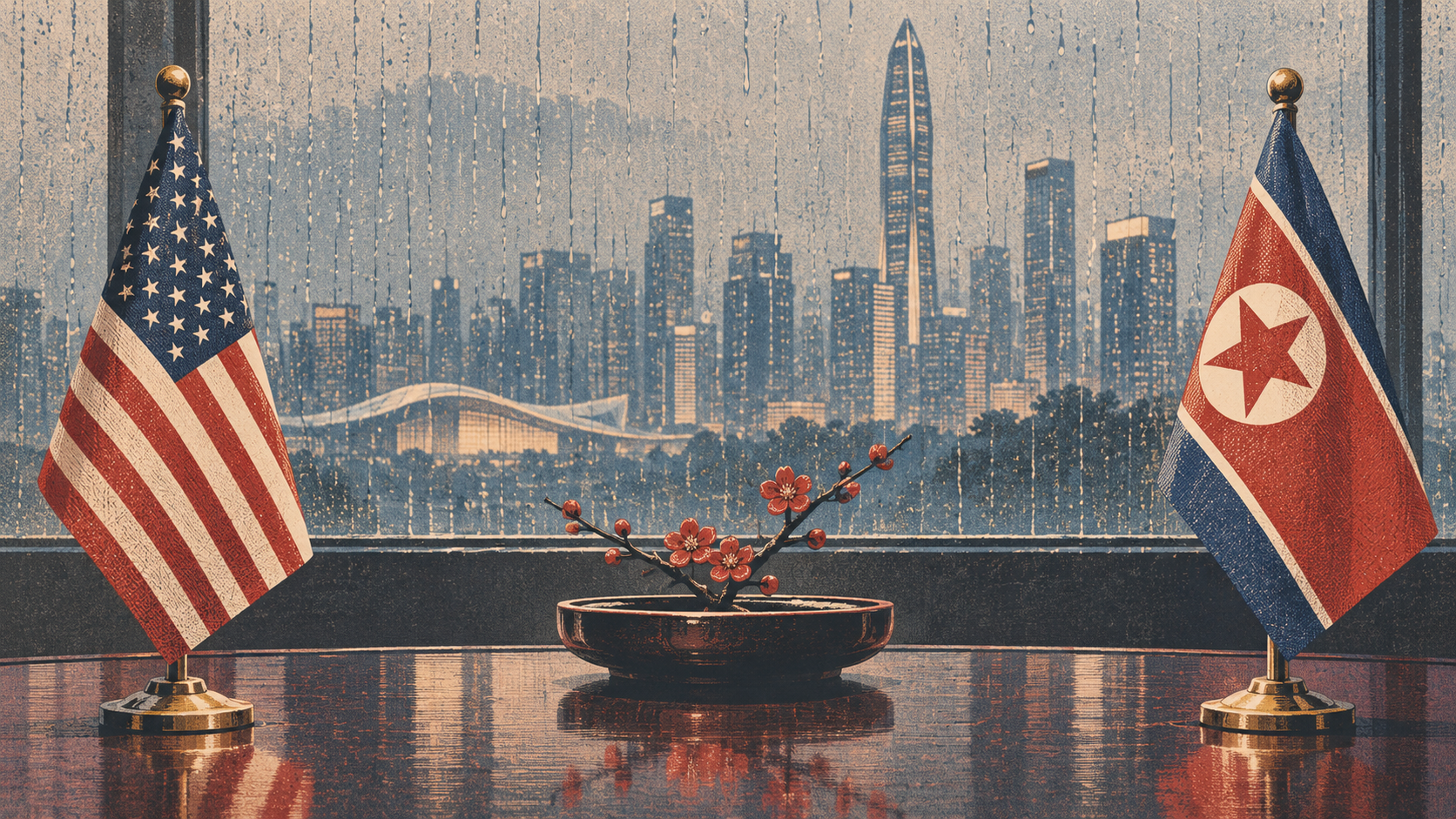
Trump Has Suggested a Meeting in Shenzhen. What Has Kim Jong Un Said?
Trump Has Named A Possible Host, But Kim Has Yet To Say Yes.
Donald Trump was leaving the White House on Monday, 16 November, when he raised the possibility of seeing Kim Jong Un in China this week. “We may meet with Kim Jong Un also,” he told reporters. He suggested Chinese President Xi Jinping might invite the North Korean leader to Shenzhen. As of Monday afternoon in Britain, Beijing had confirmed a meeting between Xi, Trump and Russian President Vladimir Putin. Pyongyang had given no public indication that Kim would attend.
Kim has offered a clue to how he might receive an invitation. In a speech to North Korea’s parliament, he said he had fond memories of Trump. In the same speech, he set a condition for renewed talks that goes to the heart of why their previous negotiations broke down. Before the two men can discuss what North Korea might give up, they face a more basic question. Does Kim still consider his nuclear arsenal open for negotiation?
What Did Trump Say About Meeting Kim?
Trump mentioned Putin and Kim in the same answer, but he used different language for each man. He said he was going to meet Putin. When he turned to Kim, the word he chose was “may”. He gave no time for an encounter and described an invitation as something Xi might issue.
Only days earlier, a US official had said there were no plans to engage with North Korea during the trip. The two accounts can sit together. Trump can leave room for a last-minute encounter even when his staff have no appointment to announce. He also raised the prospect of seeing Kim during an Asia trip in 2025. That visit ended without a meeting.
There is a precedent for a late arrangement working. In June 2019, Trump publicly suggested meeting Kim at the Korean Demilitarised Zone while he was in the region. Kim came to the border village of Panmunjom, where Trump briefly stepped into North Korea. The part of that story that matters this week is what happened between the suggestion and the handshake. Pyongyang agreed to take part.
What Has Kim Jong Un Actually Said?
Speaking to parliament in September 2025, Kim said he still had “fond memories” of Trump. He also said he saw no reason to avoid talks if Washington dropped its demand for North Korea to surrender its nuclear weapons. He ruled out abandoning the arsenal to obtain sanctions relief.
That condition matters because the two leaders once signed a statement that allowed Washington to pursue precisely that objective. At their first summit in Singapore in June 2018, Kim committed to work towards the complete denuclearisation of the Korean Peninsula. The wording left open which steps each government would take and when. Under the terms Kim described in 2025, an American president hoping to revive that commitment would first have to persuade him to discuss it.
Kim’s sister, Kim Yo Jong, offered a more recent indication of the government’s thinking on 4 November. A senior official in the ruling Workers’ Party, she acknowledged that dialogue was one route to peace but questioned whether talks would serve North Korea’s interests. Her immediate subject was an FBI accusation that North Korea was behind a cryptocurrency theft from Binance. She rejected the accusation and cited it as an example of what Pyongyang regards as American hostility.
Her statement came twelve days before Trump spoke outside the White House. It helps explain how Pyongyang views Washington, but it cannot tell us how Kim answered a proposal Trump had yet to make. North Korea’s mission to the United Nations gave no immediate response to an enquiry after Monday’s remarks.
What Has China Confirmed?
China has confirmed that Xi, Trump and Putin will meet in Shenzhen, where leaders are gathering for the Asia-Pacific Economic Cooperation forum. The three presidents are due to meet on Thursday, 19 November. Chinese foreign ministry spokesperson Mao Ning said they would discuss global peace and strategic stability. Asked for details of bilateral meetings alongside APEC, she said she had no information to share at that point.
North Korea is outside APEC’s membership, so Kim has no routine place at the gathering. An invitation from Xi could give him a reason to travel. Whether he would accept, whether he would see Trump separately and whether they would discuss nuclear policy are three questions Beijing’s announcement leaves open. Nothing Trump said on Monday placed Kim at the table with Xi and Putin.
What Could a Fourth Meeting Achieve?
The best guide is Hanoi. In February 2019, Trump and Kim arrived in Vietnam with the Singapore declaration already signed. The practical question was how much sanctions relief Washington would grant in exchange for North Korean nuclear concessions. North Korea’s foreign minister later described an offer to dismantle facilities at Yongbyon in return for the removal of some sanctions. The two delegations left without an agreement.
Hanoi shows how much can turn on a detail that barely features in a summit announcement. Closing facilities at one nuclear complex and giving up an entire arsenal are different undertakings. Lifting some sanctions and lifting them all carry different consequences. The leaders could agree on the value of meeting while their negotiators remained far apart on what each side would receive.
A fourth encounter could still accomplish something narrower. If Trump and Kim authorised officials to resume contact and named a subject for a follow-up meeting, both governments would leave China with work to do. Even a brief greeting would be their first face-to-face contact since 2019.
For now, the most informative statement would come from Pyongyang. Confirmation that Xi had issued an invitation would tell us what the host wants. An answer from Kim would tell us whether the meeting Trump floated has a second participant.
Sources
Reuters — Trump says he might meet with North Korea’s Kim Jong Un in China — Trump’s departure remarks and the immediate response to enquiries in New York.
Reuters — North Korea’s Kim says he is open to talks if US drops denuclearisation demand — Kim Jong Un’s own account of his terms for dialogue.
Yonhap — N. Korea says dialogue with U.S. an option but not a must for national interest — Kim Yo Jong’s 4 November statement and the dispute that prompted it.
Chinese Foreign Ministry — Mao Ning’s regular press conference on 16 November — Beijing’s description of the three-president meeting and its answer on bilateral talks.
Arms Control Association — Chronology of U.S.-North Korean Nuclear and Missile Diplomacy — The Singapore commitment, the offers in Hanoi and the encounter at Panmunjom.
Next Reads
Trump Is Preparing Another Gamble With Kim Jong Un — And This Time The Price Is Much Higher — How Pyongyang’s bargaining position has changed since Hanoi.
APEC Shenzhen Explained: Will Trump, Xi and Putin Really Meet? — An 11 November primer on the forum and the diplomacy that preceded Beijing’s confirmation.
North Korea May Have Up To 120 Nuclear Warheads — And Its Missiles Could Reach America — Why estimates of the arsenal at the centre of the dispute vary so widely.
