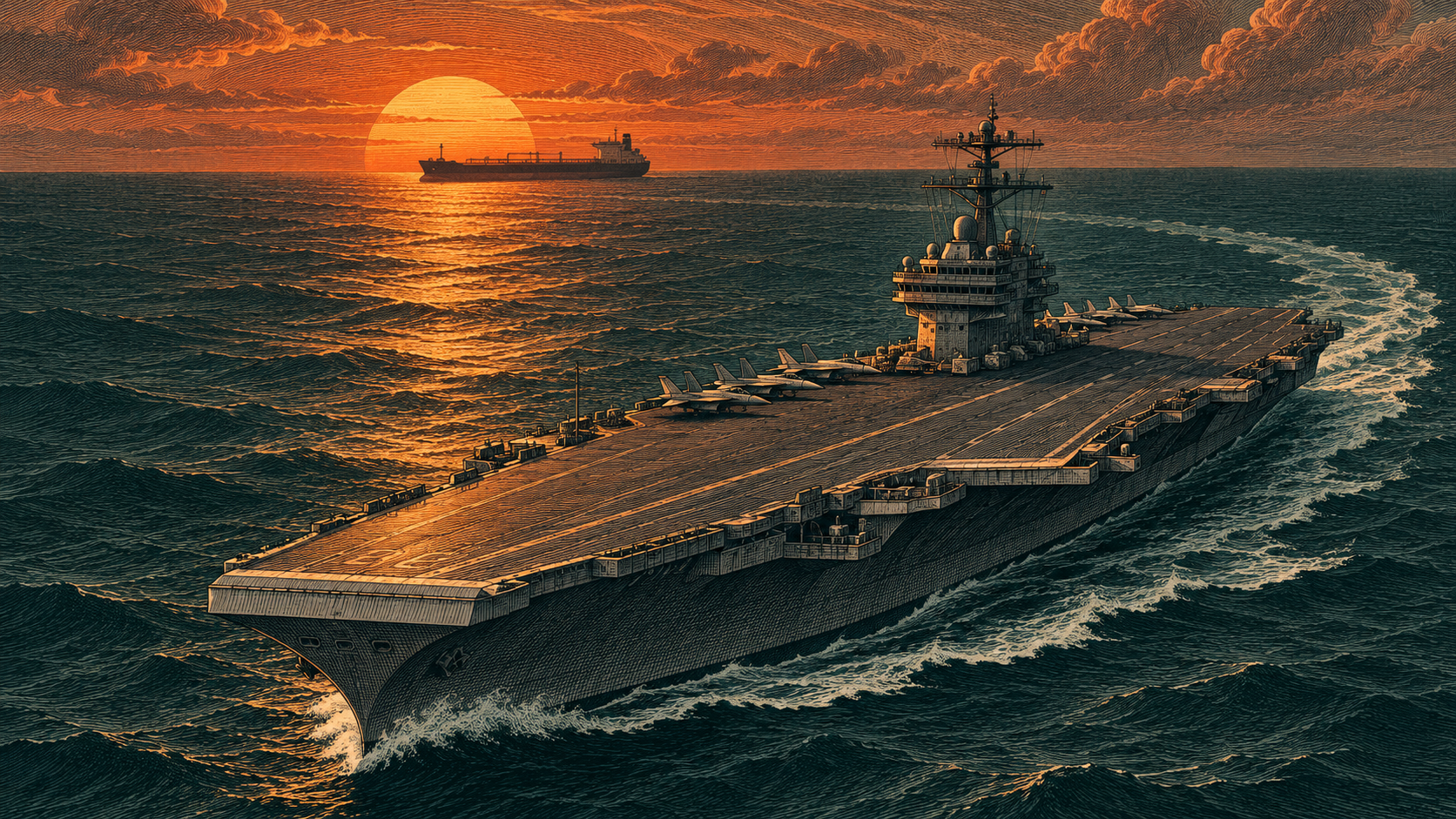
Why the USS Theodore Roosevelt Joined Two Other US Carriers in the Middle East
Could the Iran War Escalate Again?
The USS Theodore Roosevelt was expected to relieve another American aircraft carrier in the Middle East. On Monday, its arrival gave President Donald Trump a choice. He can let the handover go ahead, or he can keep three carriers in the region while he decides how far to press Iran. The first option helps explain why the ship came. The second explains why Tehran, Beijing and the Gulf capitals have reason to pay attention.
The Roosevelt joins the USS George H.W. Bush, which arrived in April, and the USS George Washington, which arrived in August. Their presence gives Washington more aircraft at sea as the US maintains its blockade of Iranian shipping. It also revives a question left unresolved through months of fighting and diplomacy. What would persuade either side that it has more to gain from a settlement than from another round of pressure?
How Unusual Is It to Have Three Carriers There?
Until this year, the last time the US had three carrier strike groups in the Middle East was 2003. Then came a three-carrier deployment in April 2026. November marks the second such concentration in a single year.
There is a mundane reason for some overlap. An incoming ship has to travel to the region before another can leave. The Roosevelt sailed from San Diego in September. Decisions made weeks ago can produce a dramatic-looking change in the fleet on a Monday afternoon, even if the president has issued no new order that morning.
What gives this particular handover political weight is that Washington has left open how it ends. People familiar with US planning said before the Roosevelt arrived that all three could stay if required. An extended overlap would commit ships, crews and aircraft for longer. Allowing one carrier to leave would still leave two in the region. Washington can therefore ease the immediate show of force while continuing its blockade.
Could the Iran War Erupt Again?
Yes. The danger is a return to sustained US strikes and Iranian retaliation. The April ceasefire and the broader understanding reached in June never produced a lasting peace. The June agreement broke down in early July, and pressure on shipping has continued. For a tanker crew taking a cargo through the Strait of Hormuz, the danger never fully went away.
The strongest public clue about Trump’s intentions came two days before the Roosevelt’s arrival. He had privately indicated that he might hold off on fresh attacks if Iran and Yemen’s Iran-backed Houthis avoided further provocations. That condition leaves considerable room for judgement. An incident at sea can unfold in minutes. Establishing who was responsible, whether they acted deliberately and who authorised it can take much longer.
Consider how the same incident could look from three capitals. If an American sailor were killed, Washington would face pressure to respond. Tehran might read a US reprisal as the opening move in a longer campaign. A Gulf government that depends on ships sailing the next morning would want an immediate halt, even while the two sides were still disputing what happened. Each government could describe its own decision as limited and defensive, yet the result could be a widening war.
There are also reasons for restraint. Saudi Crown Prince Mohammed bin Salman and Turkish President Recep Tayyip Erdoğan reportedly urged Trump to hold off on renewed attacks. Israel, meanwhile, has pressed for another campaign. These competing arguments expose the difficulty facing Washington. A military presence that reassures one regional partner can make another fear it will bear the economic and security costs of the next decision.
Why Hormuz Matters More Than the Carrier Count
On the day the Roosevelt’s arrival was confirmed, oil prices fell. Signs that Middle Eastern exports were recovering weighed more heavily on traders than the arrival of another American flight deck. That afternoon, Brent was trading around $94 a barrel, down more than 1 per cent. The same day, Iran’s Revolutionary Guards said two tankers had struck mines in the strait. The claim came from a party to the conflict, and recovering exports offered little comfort to crews facing that report.
Those developments can coexist because an oil trader and a shipowner have different decisions to make. A trader is judging how many barrels will reach the market over the coming months. A shipowner has to decide whether to send a particular crew through a particular stretch of water on a particular day. A navy can sustain a blockade, yet it cannot make that commercial decision on the owner’s behalf.
This is one limit of the leverage the three carriers give Washington. They make an American threat more credible. Restoring predictable oil deliveries also requires exporters, crews, insurers and buyers to believe that the next voyage will be worth the risk. A political agreement that made those voyages routine again could achieve something that additional warships alone cannot.
Why China Is Already Watching
China has a direct interest in the outcome. It is the principal buyer of Iranian oil, and the same narrow waterway serves several other suppliers. In the first half of 2025, before this war, about 89 per cent of the crude oil and condensate shipped through Hormuz went to Asia. China, India, Japan and South Korea together accounted for 74 per cent of the total. A refinery buying from a different Gulf producer can still depend on the same sea passage.
Beijing has already made its position public. In September, Chinese Foreign Minister Wang Yi urged Washington and Tehran to return to talks and called for normal passage through Hormuz to resume. He made that appeal directly to his Iranian counterpart in Beijing. China wants to preserve a relationship with Tehran while protecting a trade route shared by Iran’s neighbours and customers. Those interests become harder to reconcile the longer shipping remains dangerous.
There is a second question for Beijing. How long can Washington sustain an exceptional commitment in one region while maintaining its commitments in another? A carrier deployment draws on crews, escort ships, maintenance capacity and time. China has reason to watch what happens when the Roosevelt’s handover would ordinarily end. An extended deployment would reveal a choice about American priorities. The November carrier count alone tells us little about what Washington would do in a Taiwan crisis, with different geography, allies and stakes.
Diplomacy could offer an earlier indication of Beijing’s influence. Trump, Xi Jinping and Vladimir Putin are expected to meet on Thursday. As of Monday, China’s foreign ministry had yet to confirm that Iran would be on the agenda. If it comes up, the interesting question is what Beijing can secure from both sides. China can ask Tehran for assurances on shipping. Whether Washington would offer anything in return is another matter.
What Would Change the Outlook?
The most revealing development may be a departure. If one of the earlier carriers leaves, the timing would fit the original relief plan. If Washington announces that all three will remain for an extended period, it will have chosen to sustain an unusually large force even after an opportunity to scale it back. Either decision would tell us more about US intentions than Monday’s arrival in isolation.
For the people whose livelihoods depend on the Gulf, the better news would come from the merchant fleet. Tankers completing their voyages and exporters making deliveries on schedule would give the next crew a reason to sail. That is where the interests of Washington, Beijing and the Gulf governments most clearly meet. They differ over how much pressure Iran should face. They all have something to gain from a ship reaching its destination safely.
Sources
Associated Press — Confirmation of the Roosevelt’s arrival and the three carriers in the region
Reuters — The relief plan, Trump’s deliberations and regional diplomacy
Al Jazeera — The April ceasefire and the breakdown of the June understanding
US Energy Information Administration — Oil flows and destinations through Hormuz
Reuters — Wang Yi’s talks with Iran about restraint and shipping
Associated Press — Beijing’s statement ahead of the trilateral meeting
