

Decapitation Strikes and Regime Change: How Power Actually Transfers When a Leader Is Removed
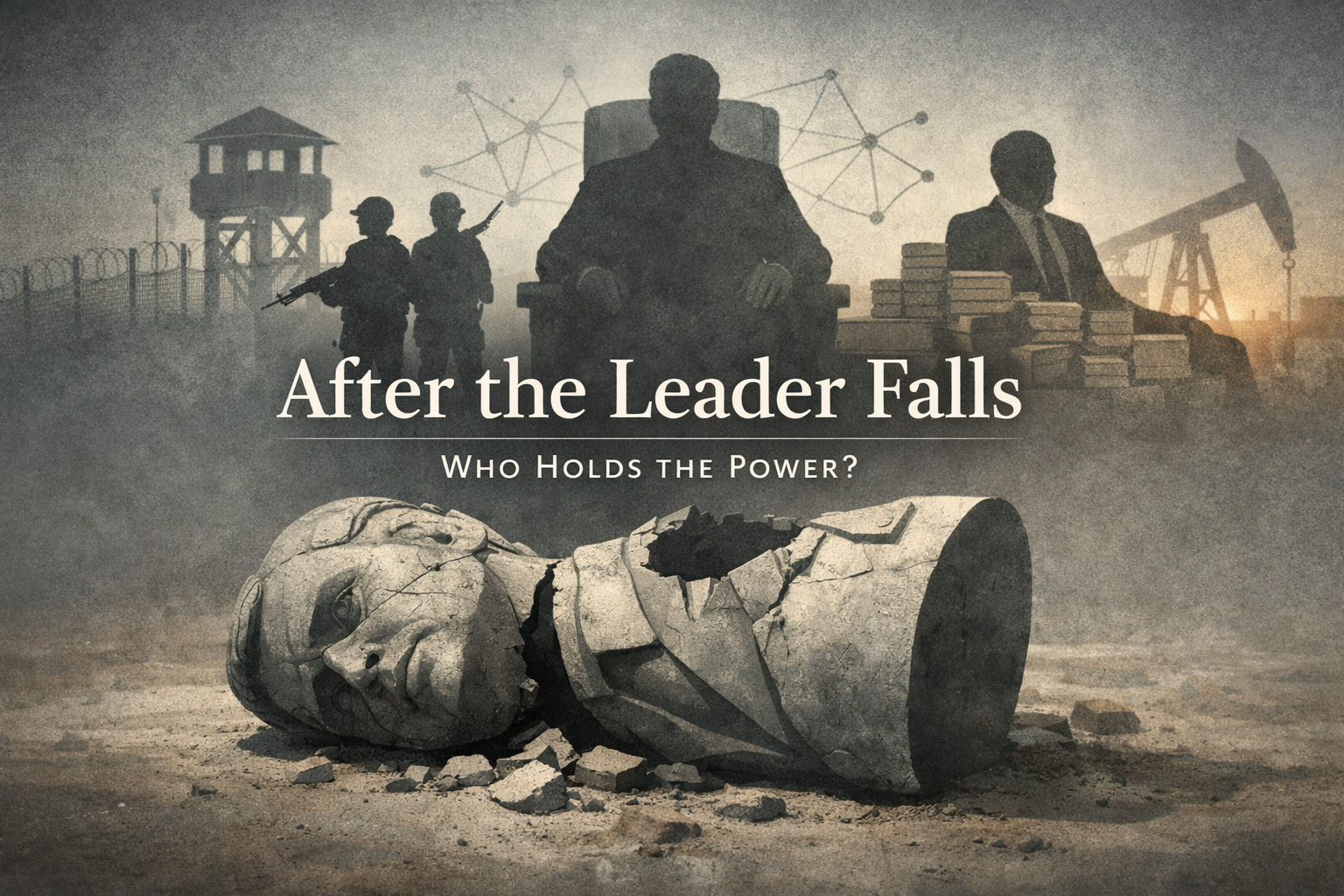
Removing a leader looks like a clean solution. A single person vanishes, the story ends, and the state resets. That is the fantasy behind decapitation strikes and many “regime change” plans.
In reality, leadership removal is rarely the same thing as system removal. In many states—especially authoritarian ones—power is not held by one individual like a crown. It is held by a coalition: security chiefs, money networks, party bosses, regional brokers, foreign patrons, and the people who control the files, the ports, the payroll, and the prisons.
This piece explains what actually happens when the top disappears overnight. It breaks down the real centers of power, why removals often backfire, and what separates fragmentation from consolidation after a sudden vacuum.
By the end, the reader will be able to look past the headline (“Leader removed”) and evaluate what matters: who controls force, who controls money, and who can claim legitimacy without triggering the whole machine to turn on them.
“The story turns on whether the power network can rewire itself faster than rivals can tear it apart.”
Key Points
Removing a leader rarely removes the system because institutions and patronage networks outlive individuals, and elites usually prefer continuity to chaos.
“Decapitation” can accelerate regime change only when it breaks the security chain of command, dries up the regime’s money, and creates a credible legitimacy alternative.
In authoritarian succession, three centers of power dominate: security (coercion), money (patronage and revenue), and legitimacy (public acceptance and international recognition).
A sudden vacuum produces either fragmentation or consolidation depending on whether elites can coordinate around a successor and whether security forces stay unified.
Removals can create a “martyr effect”, strengthening recruitment, unity, and discipline in the very network that was meant to be weakened.
Transitional governments stick when they secure basic order, build a broad coalition, and offer credible guarantees to rivals; they fail when they cannot control force or revenue, or when winners try to permanently punish losers.
Background
A decapitation strike is an attempt to disable a regime by removing its top leader (or leadership circle) through force, arrest, or covert action. The logic is simple: if the head is gone, the body collapses.
Regime change is broader. It means the governing system itself changes—rules, leadership selection, security alignment, economic control—not just the face at the podium.
Most modern states—democracies and dictatorships—run on three things:
Coercion: who can order armed men to act, and be obeyed.
Resources: who can pay salaries, buy loyalty, and control key assets.
Legitimacy: who can claim the right to rule without constant repression.
When a leader is removed, those three pillars do not vanish. They move. They get contested. And they usually get captured by whoever can coordinate fastest.
Last updated: January 2026.
Deep Dive
How It Works (Mechanism or Logic)
When the top leader disappears, the state enters a rapid bargaining phase among insiders. The basic question becomes: who inherits the levers without triggering a civil split?
Three dynamics kick in immediately:
The first dynamic is the security dilemma within the palace.
Everyone fears being purged next. That fear pushes elites to either consolidate quickly (to deter rivals) or fragment into competing armed blocs (to protect themselves).
2) The paperwork problem.
Modern states are not just speeches. They are systems: permits, payroll, logistics, intelligence files, procurement contracts, border controls. Whoever controls the bureaucratic chokepoints can keep the country running—or choke it.
3) The coordination race.
The first credible coalition to announce a successor, secure ministries, and signal continuity often wins—not because it is popular, but because it reduces uncertainty for everyone who has a gun or a budget.
This is why removal can produce “continuity with a new face”. The network’s priority is usually survival, not ideology.
Decapitation Strikes vs. Regime Change
Decapitation aims for speed. Regime change demands depth.
A decapitation plan works only if it breaks at least two of the following at the same time:
Command: security forces cannot coordinate, or key units defect.
Cash: the regime loses access to hard currency, commodities, or payroll mechanisms.
Claim: a successor alternative is instantly credible to insiders and outsiders.
If only the leader is removed but command remains intact, security elites can install a replacement and declare the system “stable.” If cash still flows, patronage continues. If no alternative claim exists, even opponents may accept a familiar machine over a dangerous vacuum.
Regime change, by contrast, is about replacing the machine: who appoints judges, who controls the intelligence services, how money moves, and what the new rules are for succession. That is slower, messier, and harder to do from the outside.
Succession in Authoritarian States: The Three Real Centers of Power
Authoritarian systems often look personal. Under the surface, they are coalitions that constantly manage risk. After a leader is removed, power usually settles where these three forces align:
Security (coercion).
This is the state’s spine: armed forces, intelligence agencies, elite guard units, police leadership, and the informal militias that sometimes matter more than uniforms. Security actors care about continuity, immunity, and control of the threat environment.
Money (patronage and revenue).
A regime is a payment system. Salaries, contracts, smuggling routes, commodity rents, construction licenses, import permits—these create loyalty and enforce discipline. If the money network stays coherent, it can “buy time” after a shock.
Legitimacy (acceptance and recognition).
Legitimacy has multiple audiences: the domestic public, the elite class, and foreign partners. The regime’s successor needs at least one legitimacy channel to prevent permanent reliance on mass repression. Sometimes legitimacy is ideological; often it is pragmatic: “order,” “stability”, “independence”, or “the least bad option”.
Often, the post-removal leader is not the “strongest”. It is the person who can sit at the intersection of security reassurance, money continuity, and a plausible legitimacy story.
What Happens When the Top Disappears Overnight: Fragmentation vs. Consolidation
Two outcomes dominate.
Fragmentation happens when:
Security forces split into competing chains of command.
Regional bosses act like mini-states because the center cannot enforce decisions.
Revenue sources become contested (ports, oil terminals, customs, central bank).
Rivals believe violence is safer than negotiation because no one can guarantee promises.
Fragmentation does not always look like formal civil war. It can look like “normal life” with creeping checkpoints, vanishing services, and multiple authorities collecting fees.
Consolidation happens when:
A successor is quickly named and accepted by key security actors.
The money network remains functional enough to pay salaries and keep basic services running.
The new center offers credible guarantees: limited purges, continuity for key interests, and a clear line on foreign policy.
The opposition cannot coordinate faster than the insider coalition.
Counterintuitively, consolidation can occur even when the successor is widely disliked. In a crisis, many actors prefer a predictable bad outcome over an unpredictable one.
The “Martyr Effect”: How Removals Can Strengthen the Network You Meant to Weaken
Removal can create a powerful emotional and strategic asset for the remaining network.
The martyr effect typically strengthens a regime or movement when:
The removed leader becomes a symbol of national humiliation or foreign domination.
Internal factions rally for survival because compromise now looks like betrayal.
Recruitment rises because “revenge” and “dignity” are easier to sell than policy.
The regime tightens discipline by framing dissent as collaboration with the enemy.
This can be especially potent when the leader’s removal is externally driven or visually dramatic. The story becomes less about governance failure and more about identity, sovereignty, and retaliation.
The paradox is simple: a removal can reduce one person’s capacity to command, while increasing the network’s capacity to mobilize.
A Simple Framework to Remember
A clean way to think about post-removal outcomes is FCL:
Force: Who controls the guns and the chain of command?
Cash: Who controls revenue, reserves, and the ability to pay?
Legitimacy: Who can plausibly claim the right to rule—at home and abroad?
If one actor holds Force + Cash, they can usually survive without legitimacy for a while.
If one actor holds force and legitimacy, they may still fail if they cannot pay or govern.
If one actor can assemble all three, consolidation is likely.
Regime change requires shifting at least two letters away from the old network—and holding them long enough for new rules to harden.
What Most Guides Miss
Most explanations focus on personalities: “strongman removed, successor emerges.” The overlooked constraint is credible commitment inside the elite class.
After a shock, rivals need to believe they will not be executed, jailed, or permanently expropriated if they accept a new order. If they do not believe that, they will fight rather than fold.
That is why “clean” transitions often include messy bargains: amnesties, safe exits, asset protections, and quiet deals that offend idealists but prevent a spiral into violence. It is also why transitions often stall: the moral demand for justice collides with the practical need to prevent spoilers from burning the system down.
The second overlooked factor is administrative continuity. A new government can win the narrative and still fail if it cannot run customs, keep hospitals stocked, or pay teachers. When state capacity breaks, armed entrepreneurs fill the gap.
Step-by-step / Checklist
Map the security chain of command. Identify which units matter and who appoints their leaders.
Track the money pipes. Determine where revenue comes from and who controls access (commodities, customs, central bank, contracts).
Identify the legitimacy story. What message can justify rule: stability, elections, sovereignty, reform, religion, resistance?
Look for a successor mechanism. Is there a constitution, party rule, military council tradition, or purely informal selection?
Assess elite fear. Are insiders more afraid of each other or of the public? Fear shapes consolidation.
Watch the first 72 hours of coordination. Who speaks, who appears with whom, who controls broadcasting and ministries?
Check external recognition signals. Foreign recognition can unlock money and constrain violence, but it can also fuel the martyr effect.
Test administrative continuity. Are salaries paid, borders functioning, and basic services maintained?
Scan for spoilers. Identify actors who lose most from change and therefore have incentive to sabotage it.
Why This Matters
Leadership removal is not a niche foreign-policy topic. It affects:
Regional stability: neighboring states face refugee flows, cross-border militias, and disrupted trade routes.
Energy and commodities: uncertainty around ports, pipelines, and contracts can move prices and insurance costs.
Financial risk: sanctions, capital flight, and payment disruption can lock countries out of markets for years.
Everyday safety: fragmentation often shows up as petty predation, arbitrary detention, and patchwork authority.
In the short term, the biggest risks are miscalculation and revenge dynamics: sudden power shifts tempt actors to “strike first” while they still can.
In the long term, the stakes are institutional. If succession becomes a violent contest, the state trains future elites to treat violence as the only reliable path to power.
Signals worth watching (in any case, in any country):
Security chiefs publicly aligning behind one successor.
Central bank and customs operations are continuing without interruption.
A clear promise on purges, prosecutions, and protections for the losing side.
A transitional roadmap with realistic sequencing: order first, rules next, elections when enforceable.
Real-World Impact
A port exporter in a coastal city depends on predictable customs clearance. After a leadership shock, two rival agencies claim authority. Containers sit for weeks, fees double, and buyers move to other suppliers. The business survives, but the city’s economy shrinks.
A nurse in a large capital sees a different problem. The hospital runs out of basic supplies because procurement contracts freeze. Patients still arrive, but the state’s ability to deliver health care becomes a daily crisis, not a policy debate.
A small manufacturer in a border region faces “soft fragmentation”. The national flag still flies, but local armed groups impose their own taxes and rules. Hiring, shipping, and even commuting become negotiations.
A mid-level civil servant in the finance ministry becomes a target. Rival factions want access to records and payment systems. The official’s survival strategy becomes silence and delay, which slows the state further—and accelerates the breakdown outsiders mistake for “corruption” alone.
The Road Ahead
Removing a leader can be a dramatic moment, but it is rarely the decisive one. The decisive moment is whether the remaining power network can reorganize without breaking the state—or whether rivals can pry apart security, money, and legitimacy faster than the center can stitch them back together.
Decapitation strikes bet on shock. Regime change demands control of institutions. That difference is why so many removals produce continuity and why a few produce chaos.
A reader is applying this framework well when they stop asking, “Who is gone?” and start asking, “Who now controls Force, Cash, and Legitimacy—and how stable is the bargain holding them together?”
