Hundreds of Drones. Dozens of Missiles. And Diplomats in Geneva.
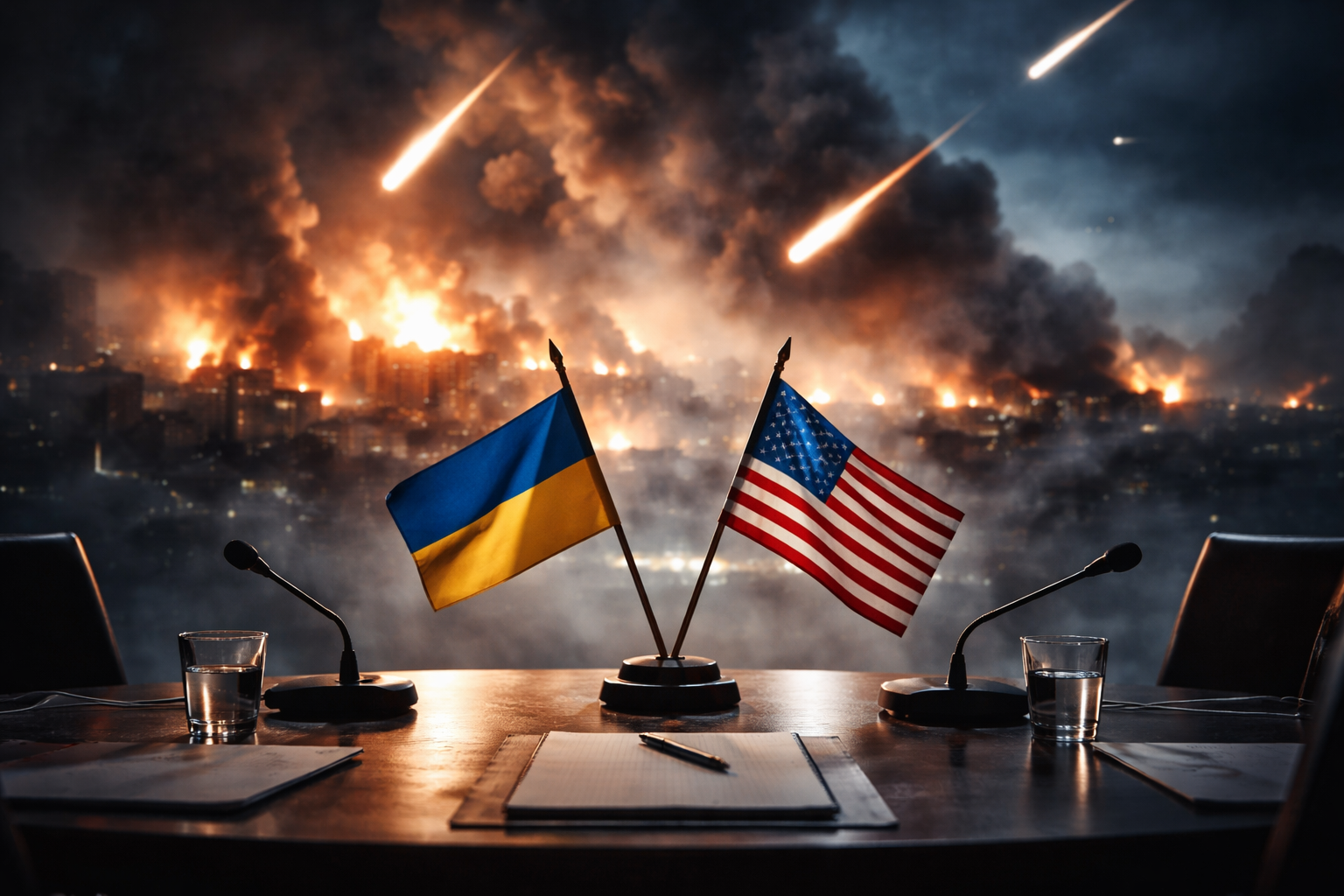
The Air War Surges While Geneva Talks Try to Hold the Line
Ukraine Under Massive Aerial Assault as Geneva Talks Begin
Ukraine reported a large overnight aerial attack involving hundreds of drones and dozens of missiles, with injuries reported across multiple areas.
The update came Thursday morning, February 26, 2026, as U.S. and Ukrainian negotiators met in Geneva for talks framed around postwar recovery and the next phase of diplomacy.
This is the uncomfortable rhythm of the war: escalation and negotiation often share the same news cycle, because neither track can fully pause the other.
The story turns on whether Geneva can convert long-term promises into near-term constraints on everyone’s choices.
Key Points
Ukraine reported a major overnight drone-and-missile attack with dozens of missiles and hundreds of drones, alongside updated injury figures.
U.S. and Ukrainian teams met in Geneva the same day, with discussions described as focused on reconstruction planning and preparations for further talks.
In days, Geneva can’t resolve core territorial and security disputes—but it can tighten alignment on what Ukraine asks for, what the U.S. will back, and what the “next meeting” looks like.
The fastest-moving levers are indirect: air defense support, sanctions posture, financial commitments, prisoner-exchange planning, and diplomatic sequencing.
The clearest near-term indicators are procedural and measurable: follow-on meetings scheduled, shared language on deliverables, and concrete packages that survive the next strike cycle.
Geneva, in this context, is not a peace conference where the war ends with signatures. It’s a working session where Ukraine and the United States try to align on a playbook: what to demand, what to offer, what to fund, and what to verify.
The battlefield context matters because air attacks change daily realities swiftly: injuries, damaged housing, disrupted heating and power, and pressure on air defenses.
Meanwhile, the political context matters because Washington’s role is not only military support. It’s also the shape of future financing, the credibility of security guarantees, and the sequencing of any broader diplomatic track.
The pressure: mass strikes are a negotiating atmosphere, not a negotiating offer
A large combined strike does two things at once. It tests Ukraine’s air defenses and imposes immediate costs. And it sets the “weather” around diplomacy: fear, anger, urgency, and headline pressure.
But it rarely communicates a clean, limited demand. In practice, big strikes more often signal endurance—“we can keep doing this”—than they signal a specific bargain. That makes Geneva harder, because negotiators need tradable items, not just atmosphere.
The trade-off: talks create headlines fast, but commitments move slowly
Negotiation headlines travel at the speed of a meeting photo. Commitments move at the speed of budgets, procurement, legislatures, legal texts, and verification.
So the realistic near-term output is not “peace.” It’s alignment: a narrower set of terms that Ukraine and the U.S. can hold consistently across days of bad news.
If the language coming out of Geneva becomes more specific—on what gets funded, on what conditions apply, on what sequencing is acceptable—that’s movement. If it stays broad and aspirational, the air war becomes the dominant “decider” by default.
The constraint: Russia isn’t at the table—so the levers are indirect
If Geneva is primarily U.S.-Ukraine, then Russia is influenced indirectly. That means the working levers are these:
Ukraine’s levers: battlefield resilience, continued operational capacity, domestic legitimacy, and the ability to credibly commit to reforms tied to reconstruction support.
U.S. levers: the scale and timing of military assistance, air-defense architecture support, sanctions posture, diplomatic access, and the credibility of long-term financing frameworks.
The constraint is obvious but decisive: you can’t trade territory, ceasefires, or security guarantees with the absent party. You can only shape the package you will later put on the table—and shape the costs of rejecting it.
The hinge in plain sight: money, guarantees, and timing as a commitment device
Wars often hinge on belief: who thinks the other side can outlast them.
A reconstruction “prosperity package” or decade-scale recovery plan can sound like a distant spreadsheet. But it can also function as a commitment device: it signals that Ukraine’s backers are building a long runway, not just shipping emergency help.
That changes incentives now. If Russia believes long-term backing is firm, the value of “waiting out” support drops. If it believes backing is fragile, escalation becomes rational.
This is why talks about reconstruction can matter even while missiles are still flying: they are one of the few tools that can change expectations without changing the front line.
The signal test: the first 72 hours of language, logistics, and follow-on meetings
In the next days, don’t watch for grand statements. Watch for operational signals:
First, scheduling: do officials immediately announce follow-on meetings with a defined agenda and participants?
Second, specificity: do they name concrete deliverables (even small ones) like a reconstruction framework, governance conditions, or an agreed list of priority systems and timelines?
Third, consistency: does the messaging hold steady after the next strike cycle, or does it wobble into contradiction?
If those signals appear, Geneva is doing real work. If they don’t, “talks” becomes a label attached to drift.
What Most Coverage Misses
The hinge is sequencing: not what each side wants in the end, but what must happen first so commitments become credible.
The mechanism is simple. If the U.S. and Ukraine can lock in a sequence that ties reconstruction funding, security arrangements, and verification steps to clear triggers, they reduce ambiguity—and ambiguity is where wars hide stalemates.
Two signposts to watch: whether Geneva produces (1) a defined follow-on process with dates and named principals, and (2) a concrete “package” structure that survives the next escalation cycle without being rewritten.
What Happens Next
In the next 24–72 hours, the fight will still look like the fight, because air attacks don’t stop for press statements. The short-term question is whether Geneva produces a tighter diplomatic track: clearer asks, clearer offers, and clearer sequencing.
Over weeks, the diplomatic picture depends on whether these talks align the U.S. and Ukraine enough to re-engage a broader process—while keeping public positions stable under pressure.
Over months, the main consequence is endurance, because reconstruction commitments and security arrangements shape long-run capacity: they influence investment, mobilization, industrial repair, and the willingness of partners to stay in the game. That matters because wars end when one side’s expected future gets worse than the deal on offer.
Watch for specific decision points and follow-ons: any announced next meeting, any published framework for reconstruction funding, and any shifts in the public stance on what a “trilateral” process would cover and when it would happen.
Real-World Impact
A family in a city hit overnight wakes up to broken windows, damaged roofs, and a new routine built around sirens and repair lines.
A landlord in a damaged block faces weeks of uncertainty: insurance arguments, contractors booked out, and tenants demanding timelines.
A small manufacturer loses a day to outages or damaged logistics, then spends the next week trying to source parts that now move slower and cost more.
A hospital runs normal care under surge conditions: staff fatigue, disrupted transport, and a constant readiness posture for the next wave.
The forward risk: if the signals don’t appear, escalation becomes the default
The core dilemma is that diplomacy requires a stable process, while the air war is designed to destabilize daily life.
If Geneva produces concrete sequencing and follow-on structure, it can narrow uncertainty and make future commitments more believable. If it doesn’t, the war’s “logic of default” wins: each side keeps escalating the tools it can scale, because nothing else is binding.
Watch the signposts: the next meeting date, the specificity of deliverables, and whether reconstruction talk turns into enforceable timelines rather than inspirational language.
This moment matters historically because it tests whether modern war can be constrained by process—before facts on the ground become the only negotiating text.
