

Iran Conflict Expands: Why This Could Spiral Beyond Control
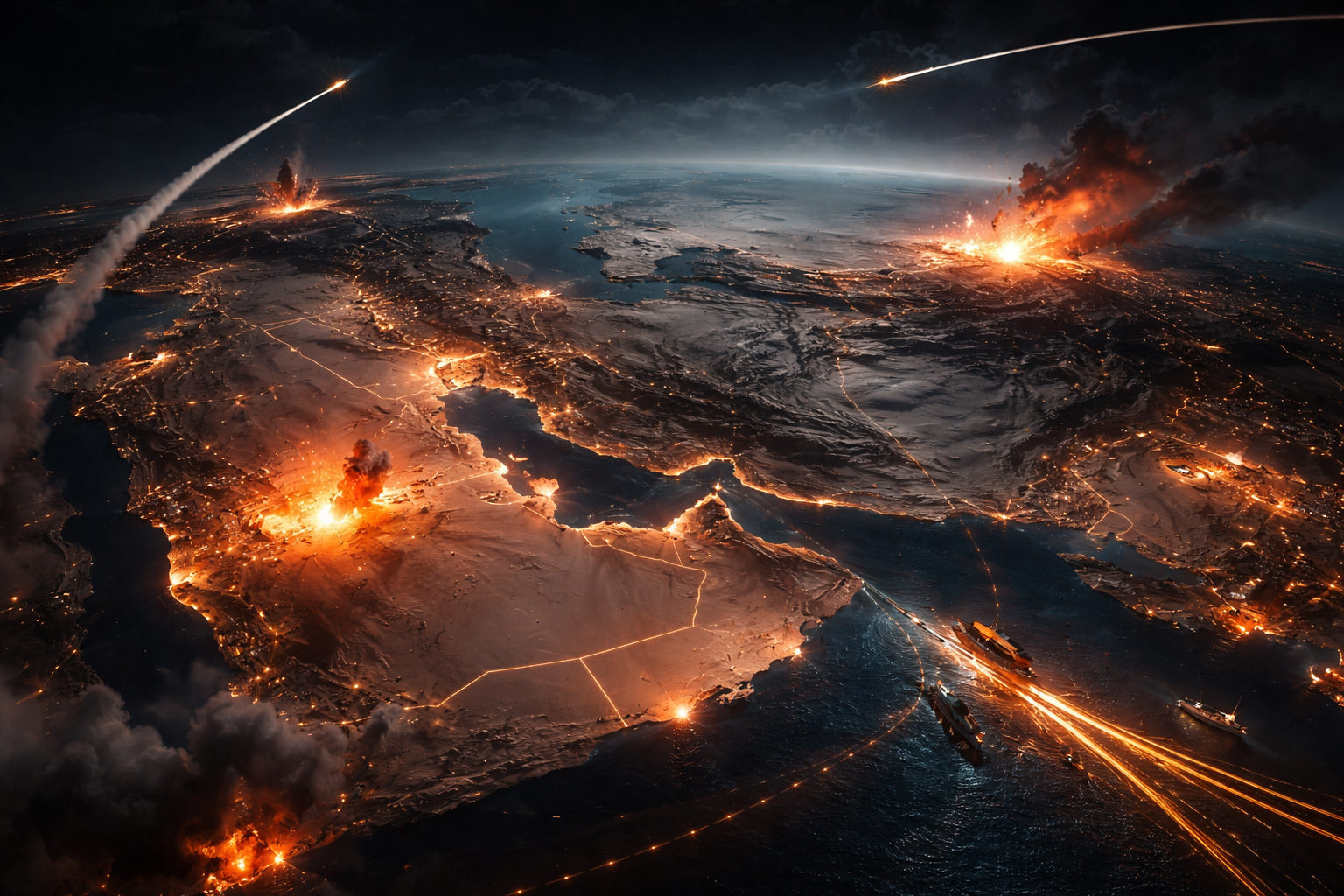
Escalation Warning: How This Conflict Could Go Global Fast
Middle East Escalation Warning: A Regional War Edges Toward Global Shock
The Middle East is entering its most dangerous phase in decades. Israel has warned it will intensify strikes on Iran, while Iran has issued direct threats against U.S. positions across the region.
At the same time, the Strait of Hormuz—one of the most critical arteries for global oil—remains effectively blocked, pushing energy markets into crisis and triggering economic shockwaves worldwide.
This is no longer a contained regional conflict. It is a multi-front confrontation involving the United States, Israel, Iran, and proxy forces across Lebanon, the Gulf, and beyond. The overlooked hinge is not just military escalation—it is the economic choke point that could force global powers into deeper conflict.
The story turns on whether the conflict remains regionally contained or tips into a wider war involving global powers.
Key Points
Israel has signaled it will expand and intensify strikes after continued Iranian missile attacks across the region.
Iran has warned civilians near U.S. bases to evacuate, indicating potential direct attacks on American assets.
The Strait of Hormuz blockade is disrupting up to a fifth of global oil flows, driving prices above $100 per barrel.
Global markets are reacting sharply, with stocks falling and inflation risks rising due to energy shocks.
Civilian casualties and displacement are accelerating, with thousands dead and hundreds of countless others displaced.
Diplomatic efforts exist but remain fragile, with conflicting claims about negotiations and ceasefire prospects.
Where This Escalation Really Begins
The current crisis traces back to late February 2026, when the United States and Israel launched coordinated strikes on Iran following the collapse of nuclear negotiations.
Iran responded with missile and drone attacks across Israel and Gulf states, transforming what began as targeted strikes into a sustained regional conflict.
Since then, the conflict has evolved into a hybrid war—combining airstrikes, missile barrages, cyber operations, and economic disruption.
What began as a strategic strike has become a system-wide confrontation.
The Current Flashpoint: Escalation Signals on All Sides
The latest warnings mark a clear shift.
Israel’s defense leadership has moved from containment to expansion, signaling broader and deeper strikes inside Iran.
Iran, in turn, is no longer limiting retaliation to Israel. Its Revolutionary Guard has explicitly warned civilians across the region to avoid U.S. military sites—language that typically precedes escalation.
Meanwhile, missile attacks continue across multiple countries, including Israel and Gulf states, showing that the battlefield is widening geographically.
This is no longer a bilateral conflict. It is a networked war.
The Economic Shock Driving Global Risk
The most immediate global impact is not military—it is economic.
Iran’s effective closure of the Strait of Hormuz is choking one of the world’s most critical oil routes.
Oil prices have surged past $110, and supply disruptions are hitting Asia, Europe, and beyond.
The consequences are already visible:
Fuel shortages emerging in parts of Europe
Rising inflation expectations globally
Stock market declines linked directly to energy instability
This situation creates a feedback loop: economic pressure increases political pressure, which raises the likelihood of further military escalation.
The Expanding Battlefield
The conflict is no longer confined to Iran and Israel.
Fighting has spread into Lebanon, with Israeli forces pushing north and clashes intensifying with Hezbollah.
Missile and drone attacks have reached Gulf countries, while cyberattacks and infrastructure strikes are adding new layers of disruption.
At the same time, global actors are getting involved:
Saudi Arabia pushing for stronger U.S. action
Pakistan's positioning as a mediator
China warning of a “vicious cycle” of escalation
This widening involvement increases the risk of miscalculation.
What Most Coverage Misses
Most reporting focuses on missiles, strikes, and troop movements. That is the visible war.
The hidden driver is systemic constraint—specifically, the inability of either side to deliver a decisive blow quickly.
Despite weeks of strikes, Iran’s missile capability remains degraded but intact. It has adapted by using mobile launchers and underground systems, making full neutralization extremely difficult.
At the same time, the United States and Israel face limits:
finite-precision munitions
political tolerance for prolonged war
economic backlash from energy disruption
This scenario creates a dangerous equilibrium: neither side can win quickly, but both can continue escalating.
That is the real risk—a prolonged conflict that expands by necessity, not choice.
Who Gains, Who Loses
In the short term, almost no one benefits.
Iran gains leverage through disruption—particularly energy markets—but faces sustained infrastructure damage and economic strain.
Israel demonstrates military reach but risks deeper regional entanglement.
The United States faces the most complex position: balancing military involvement, economic fallout, and domestic political pressure.
Globally, consumers and businesses absorb the cost through higher energy prices and economic instability.
What Happens Next: The Paths Ahead
There are three realistic paths forward.
The first is controlled de-escalation, driven by diplomacy and economic pressure. This would likely involve reopening shipping routes and freezing further strikes.
The second is prolonged regional war, where strikes continue without decisive outcomes, gradually expanding across multiple fronts.
The third—and most dangerous—is rapid escalation involving direct U.S.–Iran confrontation, potentially triggered by a strike on American forces.
The key signals to watch:
Whether the Strait of Hormuz reopens
Direct attacks on U.S. bases
Expansion of Israeli operations beyond current targets
Movement of additional U.S. military assets into the region
A Conflict at the Edge of Systemic Crisis
This moment is not just another Middle East flare-up. It is a convergence of military conflict, energy disruption, and global economic fragility.
The core dilemma is simple but severe: escalation may be rational for each actor in isolation, but collectively it drives the system toward instability.
If the energy shock persists and the battlefield continues to widen, the conflict risks crossing a threshold—from regional war to global crisis.
And once that threshold is crossed, it becomes much harder to reverse.
