Iran Is Burning—But It Still Won’t Back Down. Here’s Why
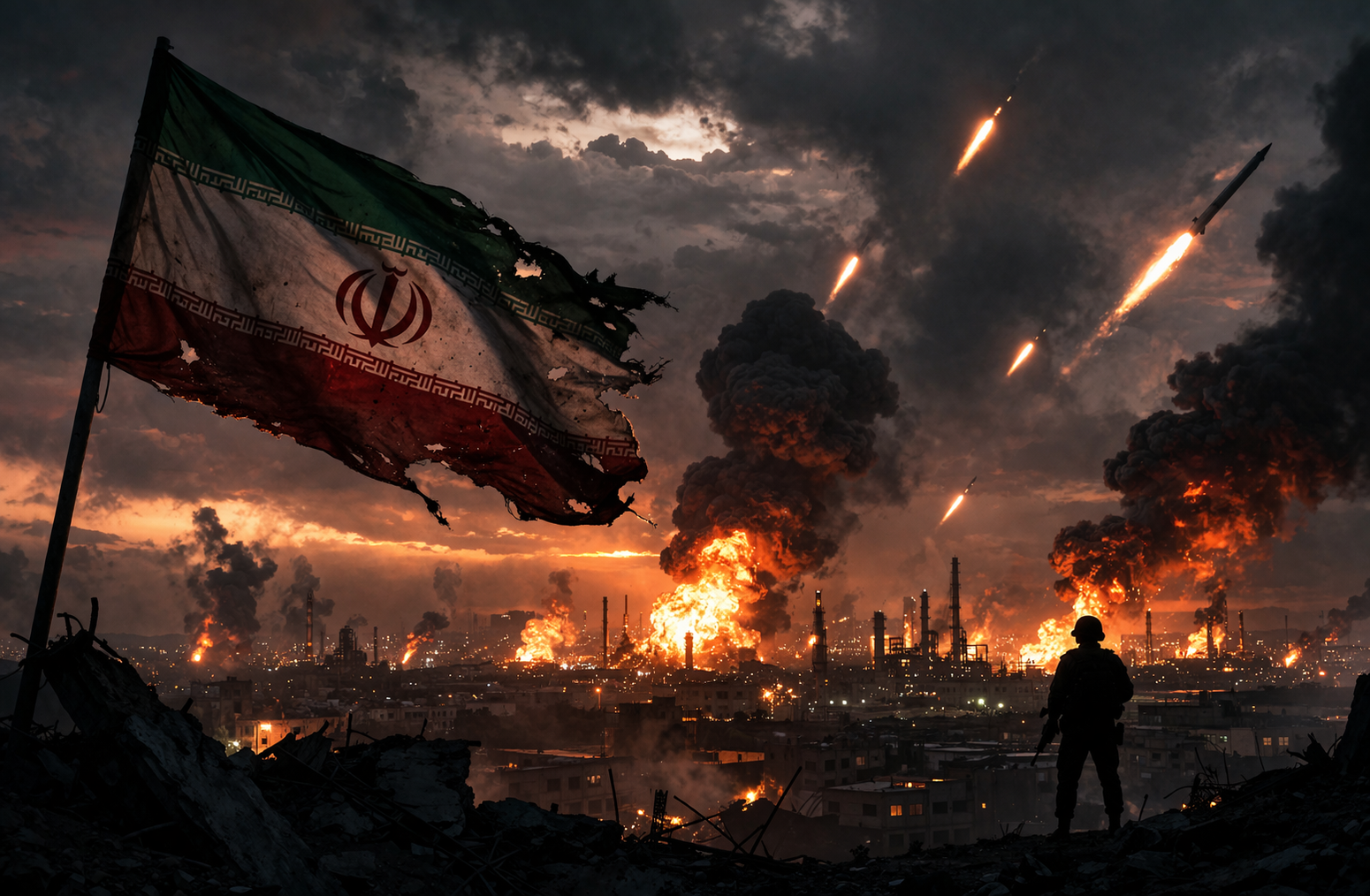
How Much of Iran Is Destroyed — And Why It’s Still Dangerous
Iran Has Been Hit Hard. So, Why Is It Still Fighting Back?
Iran is not backing down because the regime appears to believe that surrender now would be more dangerous than continued punishment. Tehran has taken serious damage, but it still has enough military capability, economic leverage, and political reason to think it can hold out for better terms. The latest ceasefire proposals were rejected because Iran wants something stronger than a pause. It wants a permanent end to the war, shipping guarantees around the Strait of Hormuz, and terms that do not look like capitulation under fire.
That matters because this war is no longer just about battlefield losses. It is about whether Iran’s leadership can absorb punishment without losing deterrence, domestic authority, and regional relevance. Key petrochemical facilities have been hit, missile launch capacity has been degraded, and pressure on Iran’s economic system is growing. But the state has not been reduced to helplessness. It can still launch missiles and drones, threaten shipping, and impose wider costs across the region.
The question is not whether Iran has been hurt. It plainly has. The real question is whether it has been hurt enough to conclude that resistance is hopeless.
The story turns on whether Tehran still believes endurance can produce better terms than surrender.
Key Points
Iran is refusing to back down because its leadership appears to think a coerced ceasefire would invite even more pressure later.
Important parts of Iran’s military and economic infrastructure have been damaged, but there is no credible public number for the total share destroyed.
Reported damage is heaviest in missile launch capacity, petrochemical assets, air defense systems, command nodes, and some nuclear-related facilities.
Iran’s arsenal is clearly smaller and less ready than it was at the start of the war, but outside experts and officials still assess that it retains substantial missile and drone capacity.
Underground storage, dispersed production, and tunneling networks make clean real-time battle-damage estimates extremely difficult.
Tehran may believe that as long as it can still threaten Israel, Gulf infrastructure, and the Strait of Hormuz, it still has bargaining power.
The war now looks less like a contest over immediate victory and more like a contest over which side breaks first under cost, risk, and time.
Why Tehran Thinks Backing Down Is More Dangerous Than Fighting On
From the outside, Iran’s position can look irrational. It has been hit across military, economic, and strategic targets. It faces pressure from Israel, the United States, and parts of the Gulf. Its civilian economy is under fresh strain. Its population has been living through a long information blackout and mounting disruption.
But regimes like Iran do not judge war the same way private citizens do. They judge it through survival, precedent, and power. If Tehran yields under direct attack, it may conclude that it is setting a catastrophic precedent: that enough military pressure will force the Islamic Republic to fold. For a system that has spent decades trying to build deterrence through missiles, proxies, geography, and endurance, that outcome could be seen as more dangerous than another month of bombing.
There is also a domestic reason. Authoritarian states under external assault often become less likely to compromise publicly, not more. Any leadership faction seen as accepting humiliation can be weakened internally. In Iran’s case, that risk is sharper because the system has long sold itself as the power that resists outside coercion. Once a regime defines itself through resistance, backing down becomes politically expensive even when militarily sensible.
That does not mean Iran is comfortable. It means its leaders may believe that visible pain tolerance is itself a weapon.
How Much of Iran’s Key Infrastructure Is Destroyed?
The honest answer is that nobody outside the relevant war rooms knows the total percentage. Anyone claiming a single clean number for how much of Iran’s key infrastructure is destroyed is pretending to know more than the public record allows.
What can be said with confidence is narrower and more useful. Iran’s infrastructure has suffered heavy but uneven damage. Some sectors matter far more than others.
The first category is missile warfighting capacity. Israeli and U.S. strikes have focused intensely on launchers, storage sites, drone infrastructure, command-and-control links, and production nodes. Israeli reporting cited by CSIS said 70 percent of Iran’s ballistic missile launchers had been disabled by Day 16 of the campaign. Reuters later reported that U.S. intelligence could confirm with certainty only about a third of Iran’s missile arsenal destroyed, with another third possibly damaged, buried, or otherwise impaired, while the rest could still be active. That gap between launcher losses and missile losses is crucial.
The second category is nuclear-linked infrastructure. Expert assessments have described severe damage to core facilities tied to enrichment and fuel-cycle work, including Fordow, Natanz, and Isfahan. Fresh reporting has also highlighted strikes near Bushehr, raising wider fears about escalation around nuclear-adjacent sites, even though the power plant itself was reported as not directly damaged in earlier coverage.
The third category is economic infrastructure, especially energy and petrochemicals. Fresh reporting says Israel struck Iran’s largest petrochemical facility in Asaluyeh, part of the wider South Pars complex, and that an earlier strike on Mahshahr had already damaged another major export hub. Reporting described Asaluyeh as accounting for about half of Iran’s petrochemical production and suggested the combined damage could affect about 85 percent of petrochemical export capacity. That is a major strategic hit because petrochemicals are not a side issue. They are one of the few large hard-currency channels still available to Iran under sanctions.
The fourth category is civilian and connective infrastructure. There have been threats against bridges, power plants, and wider infrastructure, and some strikes have already hit objects with broad economic and civilian value. That raises two issues at once: whether these attacks deepen coercive pressure on Tehran, and whether they stiffen Iran’s resolve by making the war look existential rather than limited.
So how much is destroyed? Enough to cause serious strategic degradation. Not enough to say Iran is nationally paralyzed.
That is the important distinction.
Why Damage Does Not Automatically Produce Surrender
This is where many fast takes go wrong. They assume that once a country’s infrastructure is damaged badly enough, surrender becomes the obvious path. In reality, infrastructure damage only changes political behavior if it destroys the target’s remaining leverage faster than it destroys its tolerance for pain.
Iran may calculate that it still has enough leverage left.
It can still threaten population centers through missiles and drones. It can still pressure Gulf energy systems. It can still exploit the Strait of Hormuz as a choke point. It can still try to outlast the political patience of its enemies. And it can still frame the war domestically as proof that compromise with the United States and Israel would not have protected it anyway.
That last point matters. If Iranian leaders believe any truce without structural guarantees simply buys time for the next round of attacks, then a weak ceasefire is not safety. It is postponement.
What Most Coverage Misses
The most overlooked hinge is that Iran does not need to be strong in an absolute sense. It only needs to be dangerous enough to keep the price of defeating it uncomfortably high.
That changes the meaning of battlefield losses. A state can lose launchers, factories, ports, and commanders and still think it has not lost the war if it retains enough surviving force to threaten escalation. For Iran, that means missiles, drones, underground reserves, maritime disruption, and regional sabotage potential.
So the real threshold is not “how much has been destroyed. ”It is “how much coercive capacity survives.”
As long as that answer is “enough,” Tehran still has a reason to hold out.
How Much Weaponry Does Iran Have Left?
No reliable outsider can give an exact real-time count. That is the first thing any serious article has to say plainly.
Before this war, Iran was widely assessed as having the largest and most diverse missile arsenal in the Middle East. CSIS described that force as numbering in the thousands across ballistic and cruise missiles. Some prewar estimates placed Iran’s ballistic missile inventory around 2,500 to 3,000, though readiness rates, dispersal, survivability, and reserve policy meant not all of that would have been immediately usable. One CSIS analysis argued that even if the notional stockpile was about 3,000 ballistic missiles, the number readily available for rapid employment could be much lower, closer to around 1,000 under wartime conditions.
Since the war intensified, Iran has already expended a large number of weapons. CSIS cited U.S. Central Command’s Brad Cooper, saying Iran had launched 500 ballistic missiles and 2,000 drones by March 4. Other analysis noted that launch rates dropped sharply after the opening phase. That could reflect depletion, but it could also reflect rationing, damaged command-and-control, destroyed launchers, or a decision to preserve remaining inventory for high-value moments.
That distinction matters because missile wars are not just about how many weapons exist on paper. They are about how many can be found, moved, prepared, launched, coordinated, and protected under attack.
Iran’s total stockpile may still be large. Its ready-to-fire stockpile is almost certainly much smaller than before.
Those are not the same thing.
Reuters’ reporting that the United States could only confirm about one-third of the arsenal destroyed is revealing. It suggests two things at once. First, Iran has definitely lost a large amount. Second, the surviving picture is murky enough that outside governments still cannot cleanly map what remains. Underground bunkers, tunneled storage, burial under rubble, deceptive movement, and dispersed stocks all complicate any count. The same broad uncertainty applies to Iran’s drone force.
The safest judgment is this: Iran has fewer ready missiles and drones than it had at the start of the war, reduced launch tempo, and weaker launch infrastructure, but it still appears to retain enough surviving capability to keep up intermittent and dangerous attacks.
The Difference Between Launchers and Missiles
One of the biggest analytical mistakes is treating missile inventories and launch capacity as the same thing.
A country can still own a large number of missiles and yet struggle to use them if launchers are gone, roads are cratered, crews are disrupted, command nodes are hit, and air defenses can no longer protect movement from storage to firing point. In Iran’s case, repeated strikes on ballistic missile launchers and drone sites appear to have hurt the machinery of launch faster than the stockpile itself.
This helps explain the confusing picture in the reporting. One set of claims points to severe degradation of launcher capacity. Another says only part of the total arsenal can be firmly counted as destroyed. Both can be true.
Iran may still have missiles left underground, but not the same ability to launch them at the rate it once could.
That means Iran’s remaining arsenal is best understood as constrained, not gone.
Why the Strait of Hormuz Keeps Iran in the Fight
Iran’s leverage is not just missiles. It is geography.
The Strait of Hormuz carries a massive share of global oil and LNG flows. Even partial disruption sends shockwaves through shipping, insurance, energy prices, and diplomatic calculations. Reuters reported that the closure and selective passage regime has sharply affected oil revenues across the region, with countries divided between those that can route around Hormuz and those that cannot. The UAE has also said guaranteed use of Hormuz must be part of any future settlement.
That gives Tehran a form of leverage that survives even when military assets are under attack. It does not need battlefield dominance to create economic pain. It needs enough control, enough threat credibility, and enough surviving capacity to keep the waterway politically dangerous.
This is why the war is so hard to close cleanly. Iran can lose territory nowhere, lose infrastructure in many places, and still keep one hand on a global chokepoint.
That is a powerful bargaining chip.
The Economic Pressure Is Real, but So Is the Regime’s Incentive to Absorb It
The strikes on South Pars and Asaluyeh matter for reasons beyond immediate fire damage. South Pars is not just another industrial site. It is a central energy lifeline, tied to domestic supply, industrial power, and export income. AP described it as essential to homes, factories, and gas-based chemical exports.
In a normal economy, heavy damage to that sort of node would increase pressure for de-escalation. In Iran, it still does, but the regime may conclude that economic pain is survivable if political surrender is not. Sanctioned states often build exactly this mindset. They become used to operating under stress, corruption, shortages, and distorted trade flows. That does not make the damage unimportant. It means the threshold for political breaking can be much higher than outsiders expect.
There is another hard reality here. War can centralize power. The more the economy comes under siege, the more coercive states often tighten elite control over the surviving flows of money, energy, information, and logistics. Iran’s long internet blackout fits that broader pattern of wartime control.
What Could Actually Make Iran Change Course
Iran is most likely to reconsider if several pressures converge at once.
One is a deeper collapse in launch capacity, not just additional stockpile losses. If surviving missiles cannot be moved and fired with meaningful effect, Iran’s bargaining position weakens quickly.
Another is sustained damage to the revenue-producing energy and petrochemical system. The more the war eats into hard-currency generation and domestic energy reliability, the harder it becomes for the regime to present endurance as manageable.
A third is diplomacy with real guarantees. Tehran’s latest language makes clear that a temporary truce without durable assurances is not enough. It wants a permanent end to hostilities, safer shipping conditions, and broader structural terms. Whether such guarantees are even realistic is another question. But without them, Iran may view a ceasefire as a trap rather than an exit.
There is also the question of internal cohesion. External bombing can strengthen a regime in the short run, but a longer war can expose fractures between elite factions, security services, economic managers, and the broader public. That is one of the hardest variables to read from outside.
What Happens Next
The next phase of this war depends on whether Iran’s remaining coercive tools still look credible to its enemies and still feel worth preserving to its leaders.
If Tehran can keep landing missiles, keep threatening regional infrastructure, keep exploiting Hormuz, and keep the economic shock alive, it can argue to itself that it still has leverage and should not settle cheaply.
If its launch capacity keeps shrinking, its revenue nodes keep burning, and its surviving weapons become harder to use than to save, the logic changes. At that point, endurance stops being bargaining power and starts becoming strategic self-harm.
That is the real fork in the road. Iran has clearly been weakened. But weakness is not the same as defeat, and damage is not the same as disarmament. The decisive question now is not whether Tehran has lost a lot. It has. The decisive question is whether it still has enough left to make defiance seem rational.
