Russia Isn’t Just Backing Iran — It May Be Quietly Wiring the War
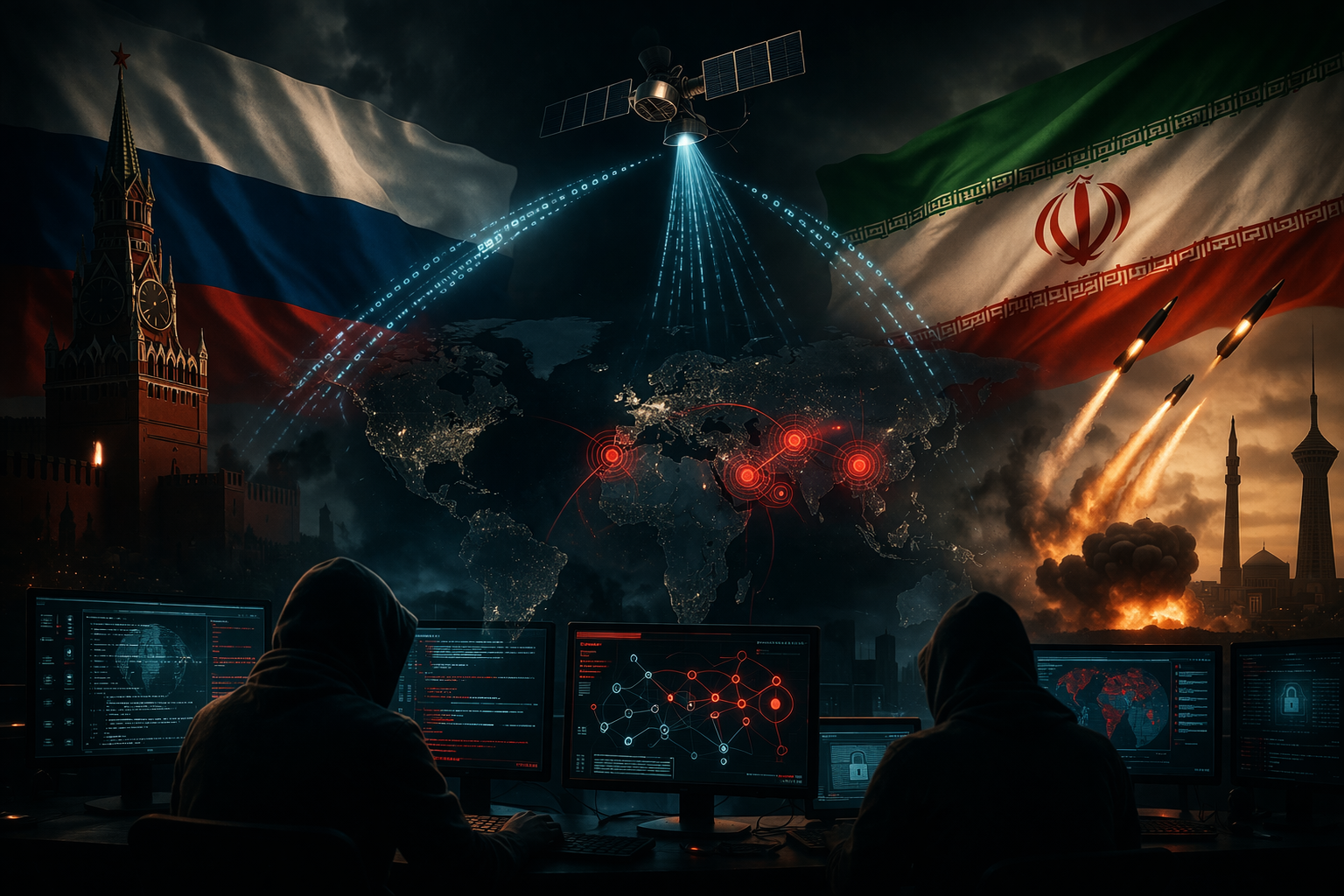
The Hidden War: How Russia’s Cyber and Satellite Support Could Be Reshaping Iran’s Conflict
Ukraine’s intelligence claims point to something far bigger than cooperation — a shift toward coordinated, hybrid warfare that blurs the line between separate conflicts.
This isn’t about support — it’s about synchronisation
Ukraine’s latest claim is simple on the surface: Russia is allegedly providing Iran with cyber tools and satellite intelligence.
But if true, it signals something far more serious.
Not support. Not alignment.
Integration.
According to Ukrainian intelligence cited in recent reporting, Russian satellites conducted dozens of surveillance missions across multiple countries, mapping military bases, airports, and energy infrastructure – shortly before Iranian strikes followed.
At the same time, cyber groups linked to both countries are reportedly coordinating attacks, sharing infrastructure, tools, and methods.
That combination — eyes in the sky + attacks in the network — is not casual cooperation.
It is operational warfare.
The war is no longer contained to geography
For years, conflicts have been described as separate:
Russia vs Ukraine
Iran vs the US and Israel
That framing is now breaking down.
What we are seeing instead is overlap — a merging of battlefields.
Russia has already benefited from Iranian drones in Ukraine.
Now Ukraine claims the flow is reversing — with Moscow helping Tehran strike more effectively in the Middle East.
This creates something new:
A distributed war, where actors fight in multiple regions but share tools, intelligence, and timing.
Not allies in parallel wars.
Participants in a shared system.
The mechanics: how this actually works
The alleged model is not complicated — which is exactly why it’s powerful.
Surveillance layer
Russian satellites map targets across the Middle East – military bases, oil infrastructure, and strategic sites.Data transfer
Intelligence is passed through secure channels, potentially involving embedded personnel or direct communication links.Cyber preparation
Joint or coordinated cyber groups probe, disrupt, or soften targets — from infrastructure to communications systems.Kinetic strike
Iran launches drones or missiles with improved targeting accuracy and timing.
This is modern warfare architecture:
Sensors
Data
Digital disruption
Physical strike
All linked.
What media misses
Most coverage treats this as “Russia helping Iran".
That framing is too small.
The real story is this:
War is becoming modular.
Countries no longer need to deploy troops to influence a battlefield.
They can contribute capabilities instead of soldiers:
One provides drones
Another provides intelligence
Another provides cyber disruption
The result is a composite force that doesn’t officially exist but functions like one.
This is how escalation happens without formal escalation.
And it is far harder to deter.
Why this matters now
Timing is everything here.
This allegation emerges as the following:
Middle East conflict intensifies
Ukraine remains locked in a grinding war
Global energy markets are already destabilised
Russia has incentives to support disruption elsewhere:
Higher oil prices benefit its economy
Western focus gets split between theatres
Ukraine receives less attention and fewer resources
At the same time, Iran gains:
Better targeting capability
Enhanced cyber reach
Strategic backing without visible dependency
This is not charity.
It is mutual leverage.
A pattern that didn’t start today
This didn’t appear out of nowhere.
For years:
Iran supplied Russia with Shahed drones used in Ukraine
Russia and Iran deepened military and intelligence ties
Both positioned themselves against Western sanctions and influence
Recent reports suggest intelligence sharing has already been ongoing, with Moscow providing data on US positions and movements.
What’s changing now is scale and visibility.
What was once quiet cooperation is starting to look like coordinated systems-level behaviour.
The cyber layer is the real escalation
Missiles get headlines.
Cyber doesn’t.
But cyber is where the real shift is happening.
Iranian-linked groups have already escalated attacks globally — targeting infrastructure, companies, and individuals with increasing aggression.
Now add:
Russian infrastructure
Shared tools
Coordinated campaigns
That creates something far more dangerous:
Persistent, deniable, cross-border disruption.
Not a single strike.
A continuous pressure system.
What happens next
Three paths are now realistically in play:
1. Quiet continuation (most likely)
The cooperation continues below the threshold of open confrontation — deniable, indirect, but impactful.
2. Attribution escalation (most dangerous)
If Western intelligence publicly confirms coordination, pressure mounts for retaliation — cyber or otherwise.
3. Systemic spillover (most underestimated)
More actors begin adopting the same model:
Shared intelligence
Distributed cyber campaigns
Proxy-enabled strikes
At that point, the world doesn’t face one war.
It faces a network of wars.
The real shift
The biggest change here is not about Russia.
Or Iran.
Or Ukraine.
It is about how wars are now fought.
No declarations.
No clear fronts.
No single battlefield.
Just overlapping systems:
intelligence
cyber
proxy forces
economic leverage
All moving at once.
The danger is not just escalation.
It’s ambiguity.
Because when wars stop looking like wars —
they become much easier to expand.
and much harder to stop.
