Iran Receives Official US Response To War-Ending Proposal As Hormuz Talks Enter Critical Phase
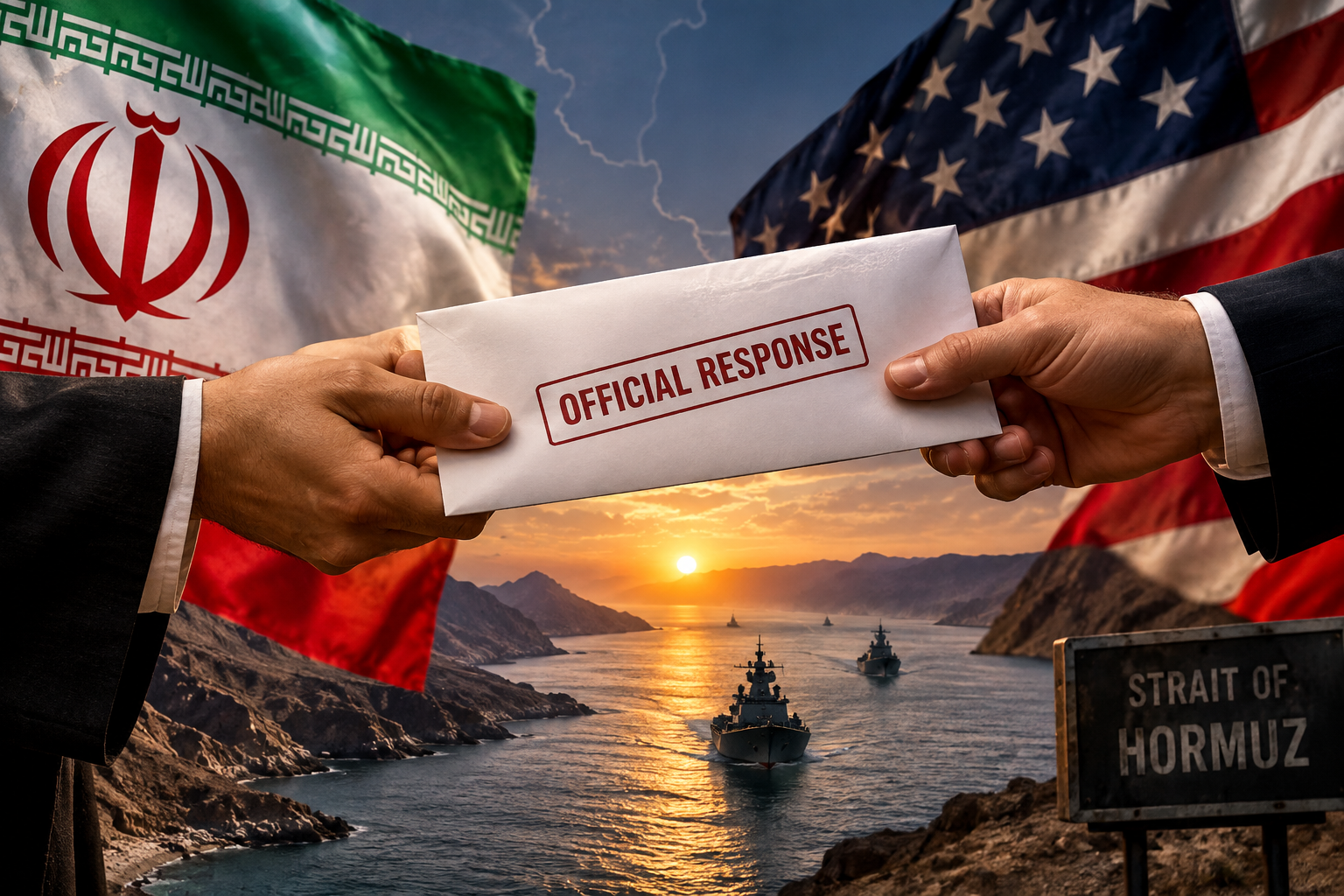
Iran Receives US Reply As Strait Of Hormuz Remains At Heart Of War Talks
The US Responds To Iran’s Peace Plan
Tehran has Washington’s formal answer. What it means is still unclear.
Iran says it has received an official United States response to its latest proposal for ending the war, moving a week of indirect diplomacy into a new and potentially decisive stage.
Foreign Minister Abbas Araghchi presented the American response to President Masoud Pezeshkian during a cabinet meeting on Wednesday, 30 September, according to Iranian government spokeswoman Fatemeh Mohajerani.
Tehran has not disclosed the contents of the reply. It has not said whether Washington accepted part of Iran’s proposal, rejected it outright or returned a revised set of terms.
That uncertainty matters. President Donald Trump had already publicly rejected the Iranian offer days earlier, yet diplomatic contact continued through Qatari mediators.
The result is an unusual position: the political rhetoric has sounded uncompromising, while the negotiating channel has remained open.
What Iran Put On The Table
Iran’s latest proposal was built around a seven-day timetable.
Araghchi said Tehran was prepared to reopen the Strait of Hormuz and restart wider talks if the United States first met a series of conditions. Those demands included an end to the US naval blockade of Iranian ports, relief from restrictions on Iranian oil sales, access to frozen Iranian assets and a halt to hostilities.
Iran has also linked the plan to a broader regional ceasefire.
The exact structure matters because the dispute is not simply over whether the war should end. Washington and Tehran remain divided over what happens first.
Iran wants American economic and military pressure eased before surrendering much of the leverage it holds through the strait. The United States has pressed for stronger guarantees and wants the nuclear issue addressed as part of any wider settlement.
That sequencing problem has become the central obstacle.
The same issue has shaped earlier attempts to stop the conflict. A previous framework temporarily eased tensions before breaking down, leaving both sides more suspicious of promises that depend on later steps.
For Iran, reopening Hormuz too early would mean giving up one of its strongest bargaining tools. For Washington, granting sanctions relief and reducing military pressure before receiving firm concessions would carry its own risks.
That is why a plan that can sound simple on paper becomes far harder when translated into an order of actions.
Why The Strait Of Hormuz Sits At The Centre
The Strait of Hormuz has become the strategic hinge of the conflict.
The narrow waterway links the Persian Gulf to the Gulf of Oman and the wider Indian Ocean. In normal conditions, it carries a major share of the world’s oil and liquefied natural gas exports.
The war has turned that geography into leverage.
Iran has used restrictions, threats and military pressure around the strait to impose economic costs far beyond the immediate battlefield. The United States, meanwhile, has sought to keep commercial shipping moving while limiting Iran’s ability to use the route on its own terms.
The result has not been a simple open-or-closed divide. As shipping data has shown during the crisis, vessels have continued to move through the area under highly abnormal conditions, with risk, military protection and route choice shaping traffic.
That makes Hormuz both an economic issue and a negotiating instrument.
Any durable agreement is likely to need a mechanism that keeps the waterway open while giving both sides enough security to avoid immediately returning to military pressure.
Trump Had Already Rejected The Offer
The arrival of a formal American response follows days of mixed signals.
Trump publicly rejected Iran’s latest proposal, arguing that Tehran was seeking a deal from a position of weakness. Members of his administration also questioned whether Iran was negotiating in good faith.
Iran nevertheless continued to demand an official reply through the mediators.
That distinction explains why Wednesday’s development matters.
A presidential statement made in public can establish Washington’s political position. A formal response delivered through the negotiating channel can do something different: spell out conditions, amendments or demands that mediators can take back to the other side.
Tehran has not yet revealed whether that happened.
Until the text or substance of the American reply is disclosed, it would be premature to describe the development as either a breakthrough or the end of the talks.
What can be said is that the diplomatic process has not disappeared.
Qatar’s Role Is Becoming More Important
Qatar has become one of the main channels between two governments that remain deeply hostile to each other.
The latest American feedback was transmitted through Qatari mediation after indirect discussions surrounding the United Nations General Assembly in New York.
That method allows Washington and Tehran to negotiate without requiring a full political normalisation between them.
It also gives both sides room to test proposals before committing publicly.
The difficulty is that mediated diplomacy can slow the process. Every change in wording, timing or sequencing has to move between delegations, while public statements can harden positions before negotiators finish working.
The current dispute shows that problem clearly.
Trump’s public rejection suggested the Iranian plan had little future. Yet the continued exchange through Qatar shows that negotiations were still active enough for Washington to send a formal answer.
What Happens Next
The next important step is Iran’s response to the American reply.
If Washington has returned revised terms rather than a simple rejection, Tehran will have to decide whether the changes are close enough to its own proposal to keep negotiating.
If the US response demands that Iran move first on Hormuz, nuclear inspections or other security questions, the sequencing dispute could quickly reappear.
If Washington offers some form of phased relief in exchange for phased Iranian action, mediators may have more room to construct an interim deal.
There are also wider pressures on both governments.
Iran’s economy has been strained by sanctions, blockade measures and the costs of war. The United States faces the economic consequences of prolonged instability in Gulf energy markets, as well as the military and political costs of an open-ended conflict.
Neither of those pressures guarantees compromise. They do, however, explain why talks have continued despite hostile rhetoric from both sides.
The earlier US-Iran ceasefire framework showed that a temporary reduction in fighting is possible. It also showed how quickly an agreement can fail when the two sides disagree over implementation.
The formal US response therefore marks movement, but not yet resolution.
The most important fact remains the one Tehran has not disclosed: what Washington actually offered.
Until that becomes clear, the war-ending proposal remains alive as a diplomatic process, but its chances of producing a lasting settlement cannot be established from the public evidence.
Sources
Associated Press — Iran indicates it has received an official US response to its latest offer on ending the war — Confirms Iran’s acknowledgement of the formal US response, its presentation to President Pezeshkian and the undisclosed contents.
Reuters — Iran says it receives US response to latest proposal as Washington pulls out of Iraq — Supports the Qatari-mediated exchange, the seven-day proposal and the dispute over sequencing.
IRNA — Foreign minister outlines Iran’s seven-day plan to reopen Strait of Hormuz — Sets out Abbas Araghchi’s stated timetable and Iran’s conditions for reopening the strait.
Next Reads
US-Iran War: Why the Strait of Hormuz Could Decide the Outcome — Explains why control of the waterway has become central to both military strategy and diplomacy.
US–Iran Ceasefire Plan: Why the Strait of Hormuz Is the Real Battleground — Provides background on the earlier ceasefire framework and the dispute over what each side must concede.
Trump Says Hormuz Is Open. Iran Says It’s Closed. The Shipping Data Tells A Stranger Story — Looks at how commercial shipping has actually operated during the conflict.
