

US-Iran War: Why the Strait of Hormuz Could Decide the Outcome
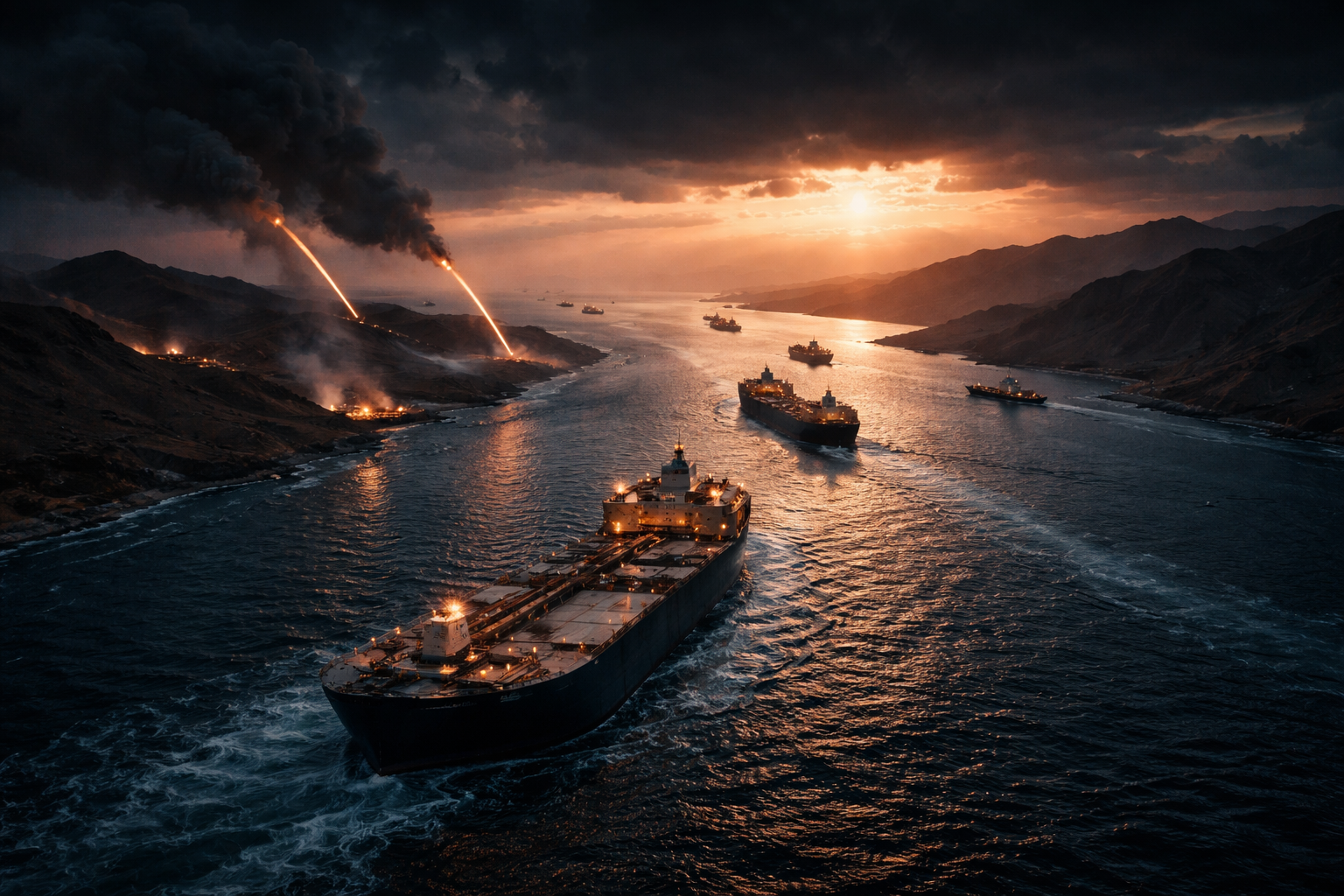
The Strait of Hormuz: The Tiny Waterway That Could Decide the War
One Narrow Channel, One Global Shock: The Hormuz Battlefield
At the mouth of the Persian Gulf lies one of the most consequential pieces of geography on Earth: the Strait of Hormuz. Only about 24 miles wide at its narrowest point, this narrow waterway carries an extraordinary share of the world’s energy supply. Roughly one-fifth of global oil consumption moves through it every day.
In normal times, tankers from Saudi Arabia, Iraq, Kuwait, the United Arab Emirates, and Qatar pass through the strait in a constant procession. But during the escalating confrontation between Iran, the United States, and Israel, that steady flow has begun to fracture.
Shipping traffic has collapsed, oil prices have surged, and governments are scrambling to protect the route. As of early March 2026, tanker movements have dropped dramatically as insurers withdraw and ships avoid the area.
The Strait of Hormuz has long been described as the world’s most important energy chokepoint. What is now becoming clear is that it may also be the strategic hinge of the entire war.
The story turns on whether Iran can turn geography into leverage without triggering overwhelming military retaliation.
Key Points
The Strait of Hormuz carries about 20 percent of the world’s oil and a major share of liquefied natural gas exports.
Escalating conflict has sharply reduced shipping traffic and driven oil prices upward as markets fear a prolonged disruption.
Gulf states depend heavily on the strait to export energy, making it a pressure point for the global economy.
Iran cannot fully close the route indefinitely without harming its exports and inviting an international military response.
The battle over Hormuz is less about ships alone and more about economic warfare, deterrence, and political leverage.
The longer the strait remains unstable, the more pressure it places on global energy markets and on the governments fighting the war, potentially leading to increased oil prices and geopolitical tensions that could affect global economies.
The Narrow Passage That Powers the World
The Strait of Hormuz sits between Iran to the north and Oman to the south. It is the only sea passage connecting the Persian Gulf to the open ocean.
For the world’s energy markets, that geography is decisive.
Tankers carrying roughly 21 million barrels of oil per day pass through the strait, representing about one-fifth of global petroleum consumption.
The corridor also handles enormous volumes of liquefied natural gas, especially from Qatar. If the flow stops, the shock reverberates across global energy markets almost instantly.
Many trade routes have few practical alternatives. Pipelines from Saudi Arabia and the United Arab Emirates can bypass the strait, but their capacity is limited, meaning that in times of disruption, the overall supply of oil and gas to global markets could be significantly affected. Most Gulf exports must still pass through Hormuz.
That makes the strait less a shipping lane and more a strategic valve controlling the world’s energy supply.
How the War Is Already Disrupting Hormuz
Even without a formal blockade, the conflict has already begun to choke the waterway.
Shipping companies, insurers, and tanker operators are reacting to the growing risks. War-risk insurance premiums have surged, and some insurers have withdrawn coverage entirely.
Commercial traffic has plunged. Recently, only a handful of ships have transited the strait compared with more than a hundred per day in normal conditions.
Meanwhile, governments are scrambling to stabilize the route. The United States has moved to provide billions of dollars in insurance coverage for ships traveling through the Gulf to restore confidence in the corridor.
The energy markets are already reacting. Oil prices have spiked amid fears that the conflict could shut off a major portion of global supply.
The immediate disruption is therefore economic before it is military.
Why Iran Holds the Geographic Advantage
Iran’s leverage comes from its position along the northern coast of the strait.
From that coastline, Iranian forces can threaten shipping using a mix of tools:
naval mines
fast attack boats
anti-ship missiles
drones and coastal artillery
These capabilities make the strait extremely difficult to secure completely.
Even small attacks can produce outsized effects. A handful of damaged tankers, or credible threats against them, can send insurance costs soaring and deter shipping.
In other words, Iran does not need to physically close the strait to disrupt it.
The perception of danger may be enough.
The Global Economic Pressure Point
The importance of Hormuz extends far beyond the Middle East.
Major Asian economies depend heavily on Gulf oil flowing through the strait. China, India, Japan, and South Korea all rely on those supplies.
A prolonged disruption could therefore trigger global inflation, slower economic growth, and political pressure in importing countries.
Markets are already reacting. Energy price spikes are feeding broader economic uncertainty, and financial markets are responding sharply to the possibility of prolonged conflict.
For governments fighting the war, that economic ripple effect matters enormously.
High oil prices can reshape public opinion, strain alliances, and influence political decisions far from the battlefield, such as increasing support for alternative energy policies or affecting election outcomes in countries reliant on oil imports.
What Most Coverage Misses
Much of the public discussion focuses on whether Iran will “close” the Strait of Hormuz. That framing is misleading.
A full, sustained closure is extremely unlikely. The strait is an international transit route, and any attempt to block it completely would almost certainly trigger a massive multinational military response.
More importantly, Iran itself depends on the same route to export oil.
Instead, the real strategy is intermittent disruption.
Temporary closures, harassment of ships, drone attacks, and naval exercises can reduce traffic dramatically without formally declaring a blockade. These actions create uncertainty, which pushes insurers and shipping companies to avoid the route.
This allows Iran to exert pressure on global energy markets without crossing the threshold that would trigger a full-scale intervention.
The war over Hormuz is therefore less about shutting the strait and more about making it unpredictable.
The Strategic Dilemma Now Facing Washington
For the United States and its allies, the challenge is restoring confidence in the corridor without triggering a wider war.
One option is escorting tankers with naval forces, similar to operations during the “Tanker War” phase of the Iran-Iraq conflict in the 1980s.
Another approach is economic stabilization, such as government insurance programs for shipping.
But both options carry risks.
Military escorts increase the chance of direct clashes between Iranian and Western forces. Financial guarantees, meanwhile, may not convince shipping companies if attacks continue, especially if they perceive that the risk to their vessels outweighs the financial compensation offered.
The result is a strategic stalemate.
Iran can threaten disruption at relatively low cost, while the U.S. and its allies must invest heavily to keep the waterway open.
The Signposts That Will Determine the Outcome
The future of the conflict may hinge on three signals.
The first signal is whether shipping traffic through the strait begins to recover or continues to collapse. Sustained declines would amplify global economic pressure.
The second factor is the question of whether the United States will deploy large-scale naval escorts for tankers. That would signal a shift toward direct maritime confrontation.
Third, we need to consider whether Iran will escalate from harassment to sustained attacks on shipping infrastructure.
Each step carries enormous consequences.
If the strait stabilizes, the economic shock may remain manageable. If it spirals into sustained disruption, the conflict could transform from a regional war into a global economic crisis.
The narrow passage at the Persian Gulf's entrance may be the most important battlefield.
