LeBron James Isn’t Running—but His Odds Say Everything About Democrats
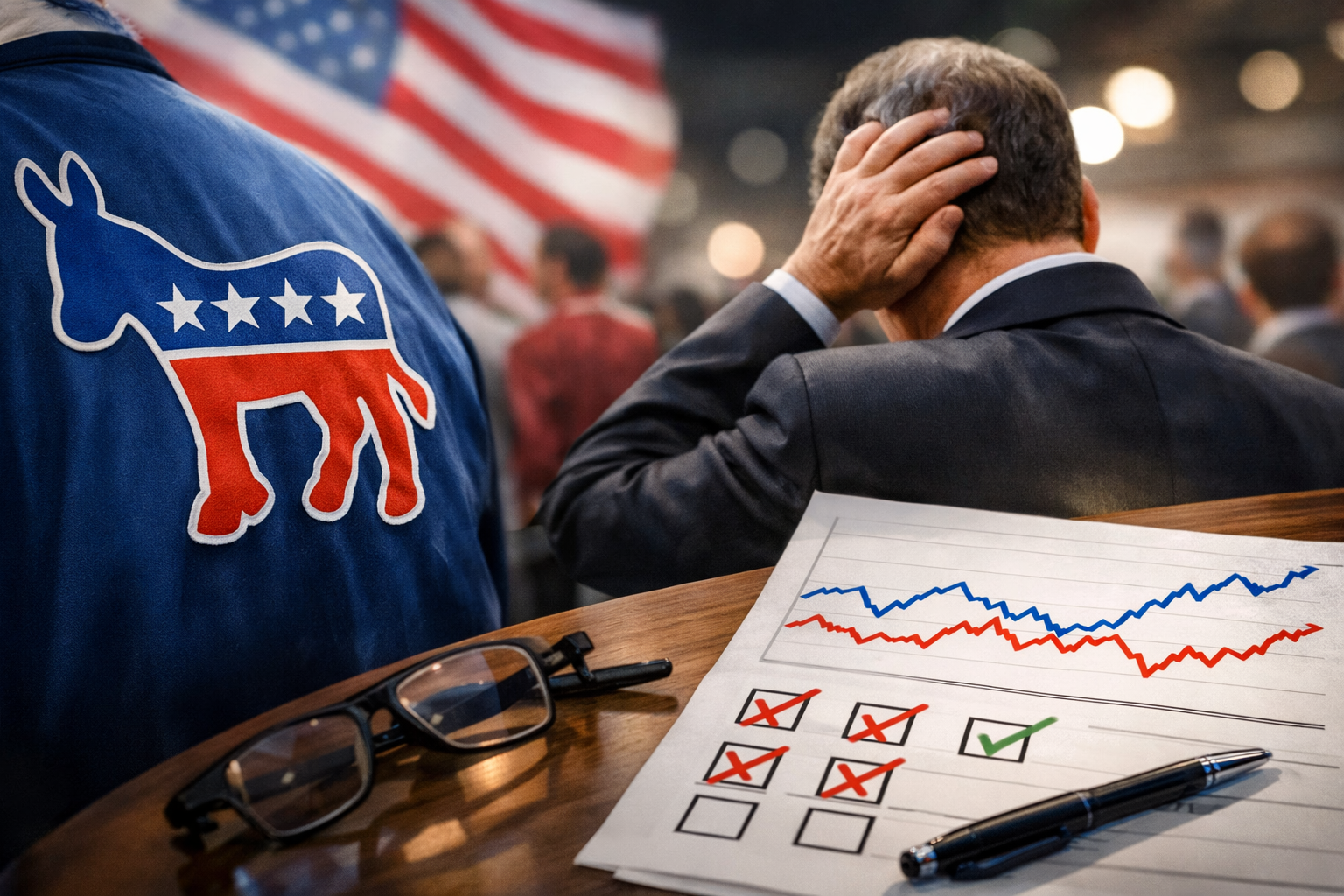
Democratic Party Crisis? Leadership, LeBron Odds, and 2026 Midterms
Are Democrats Facing a Crisis? The Polling Says “Yes”—But the Midterms Might Say “Not So Fast”
The Democratic Party is caught in a strange political paradox: its brand is weak, its leadership bench looks unsettled, and a growing share of Americans don’t want to identify with either party. Yet multiple trackers and recent polls show that Democrats are running ahead on the most important early indicator for the 2026 midterms—the generic congressional ballot.
That disconnect is the story. It’s also why the “Democrats are doomed” and “Democrats are back” takes both miss something crucial.
The narrative revolves around the potential for Democrats to emerge as an opposition party in a nation where party disfavor is on the rise—a critical point.
Key Points
Democratic “party image” metrics remain historically soft, with multiple long-running surveys showing low favorability for the party even as Republicans also struggle.
Generic-ballot polling entering 2026 shows Democrats with an advantage in several prominent trackers—useful, but still early and volatile.
“Leadership crisis” talk is partly real and partly structural: the party lacks a single, unifying national messenger, while voters increasingly reject party labels altogether.
LeBron James shows up as a “favorite” in prediction markets for a future Democratic nomination largely because markets reward fame, fundraising potential, and media gravity—not because he’s running.
The midterm outlook is best described as “Democrats have a plausible path to gains, but it depends on turnout, candidate quality, and whether the election becomes a referendum on President Trump.”
Background
When people ask whether a party is in “crisis,” they usually mean two things: (1) does the public dislike what the party stands for, and (2) does the party look capable of winning power anyway?
On the first, the Democratic Party has been dealing with a long-running image problem. Pew’s work has highlighted historically low ratings for the party’s favorability recently, even when Republican ratings also look unhealthy. Gallup’s party-image tracking shows a broader pattern: neither party dominates on trust and favorability, and the reasons people give for liking or disliking each party are often values-based rather than policy-specific—which makes “fixing the brand” harder.
On the second—winning power—midterms are not presidential elections. They behave more like a national performance review for the party controlling the White House. Right now, that matters because the political environment is being interpreted through the lens of President Donald Trump’s second term, including public debate about election administration and the temperature of partisan conflict.
Analysis
Is the Democratic Party facing a real crisis?
Yes, but it’s a specific kind of crisis: a crisis of party legitimacy rather than a simple crisis of votes.
A growing share of Americans—especially younger adults—are opting out of party identity, calling themselves independents instead. That is not a “Democrats only” problem, but it hits Democrats in a particular way because their coalition is diverse, values-driven, and often harder to unify behind a single economic story.
This trend produces a visible symptom: Democrats can be ahead on the ballot while still feeling unpopular, fragmented, and under-confident. People may express their dislike for the party to pollsters, yet choose to vote for it in order to obstruct the alternative.
Do Democrats have a leadership crisis?
They have a leadership gap, and the gap is being interpreted as a crisis.
At the congressional level, Democrats have defined leaders. But the party’s broader leadership challenge is that it lacks a single, dominant national figure who can do three jobs at once:
communicate a simple economic message,
defend institutions without sounding sanctimonious, and
Keep the coalition together without constant internal renegotiation.
Polling and commentary describing Democrats as “out of touch” and facing a “leadership crisis” reflects this broader perception problem: voters don’t always know what Democrats stand for right now, and they don’t always see who’s in charge of the story.
Why is LeBron James a “favorite”?
This one needs translation: “Favorite” is showing up in prediction-market odds and speculative political chatter, not because LeBron James has launched a campaign.
Prediction markets like Polymarket list odds for future events such as the 2028 Democratic nomination. LeBron appears in that ecosystem because celebrity candidates are legible bets: they have name recognition, built-in audiences, and the ability to dominate media coverage instantly. Markets also trade on narratives and attention, not just traditional political infrastructure.
There’s also a cultural logic: American politics is now entertainment-adjacent. A famous figure can “feel plausible” to a public that has already watched outsiders win power. But a “price” on a market is not a poll, and it’s definitely not a campaign.
How will Democrats do in the 2026 midterms?
The most defensible answer right now is Democrats have an early advantage on the generic ballot, but the race is still wide open.
Several prominent measures show Democrats ahead. A recent Fox News poll put Democrats up on the generic congressional ballot. Aggregators and trackers also show a Democratic edge, with different methodologies and sample frames.
But a generic ballot is an instrument, not a prophecy. It tells you the national mood, and it often correlates with the eventual national House vote. It does not tell you which districts flip, how turnout behaves, or whether candidate quality swings key races.
If 2026 becomes a clean referendum on the White House and the economy feels sour, Democrats can win seats even with weak favorability. If the election becomes fragmented—culture issues, local controversies, third-party noise, turnout collapse—Democrats can underperform even while “leading” in polling averages.
What Most Coverage Misses
The hinge is that Democrats don’t need to be liked to win; they need to be the default vehicle for “check the president.”
The mechanism is midterm asymmetry: voters who are unhappy with the White House are more motivated to vote than voters who are merely content. Meanwhile, rising “independent” identification means party favorability can fall even as partisan voting remains stable—people still vote like partisans while refusing the label.
Two signposts to watch:
Whether Trump’s approval and “right direction/wrong track” measures drift down in spring and summer—especially among independents—because that typically hardens a midterm penalty.
Whether Democratic recruitment improves in battleground House districts and key Senate states—because candidate quality matters more when party brands are toxic. (Early 2026 coverage already frames the battlefield as highly contested.)
What Happens Next
In the next 24–72 hours, you won’t get a decisive answer from polling. The meaningful shifts tend to come from slow-moving forces: inflation and wages, foreign-policy shocks, legal fights, and public trust in election administration.
Over the next few weeks and months, the real question is whether Democrats can turn “opposition energy” into a credible governing pitch. That matters because opposition-only coalitions can win a midterm and still fracture immediately afterward.
The core “because” line is simple: Democrats are positioned to benefit if the election is a referendum on Trump’s term, because midterms punish the party in power when voters feel anxious, exhausted, or financially squeezed—even if they don’t like the alternative.
Dates and events to watch:
Observe the regular release of major generic ballots, such as weekly trackers and monthly institutional polls.
Any escalation in the federal-state conflict over election administration and voting rules could potentially increase turnout and further polarize the electorate.
Real-World Impact
A suburban swing-district household that hates politics may still vote because they feel prices are squeezing them and want a check on Washington.
Young voters, identifying as independents, may eschew party affiliations entirely, yet they may still cast ballots if they perceive threats to their rights or institutions.
A small business owner may split their votes, supporting a Republican locally but voting Democratic for Congress to ensure gridlock.
A politically disengaged voter might get pulled in by a celebrity narrative, not to elect a celebrity, but because it signals that “normal politics” feels broken.
The Midterms Will Test Whether “Anti-Party” America Still Votes for a Party
The Democratic Party is facing a crisis of identity, message discipline, and public trust. It is also, at least for now, positioned to gain ground in the midterms.
Those two things can be true at once. In fact, they often are in modern American politics: voters dislike institutions, distrust parties, and then vote in predictable blocs when the stakes feel high.
The fork in the road is whether Democrats convert opposition momentum into a durable narrative—or whether they win by default and learn nothing. Watch the generic ballot, observe independents, and watch whether the campaign becomes a referendum on Trump or a messy collage of local fears. Either way, 2026 is shaping up as another proof point that party weakness and electoral success are no longer opposites—they’re increasingly the same system.
