Ranked: The World’s Best and Worst Prisons—and What Happens When Inmates Get Out
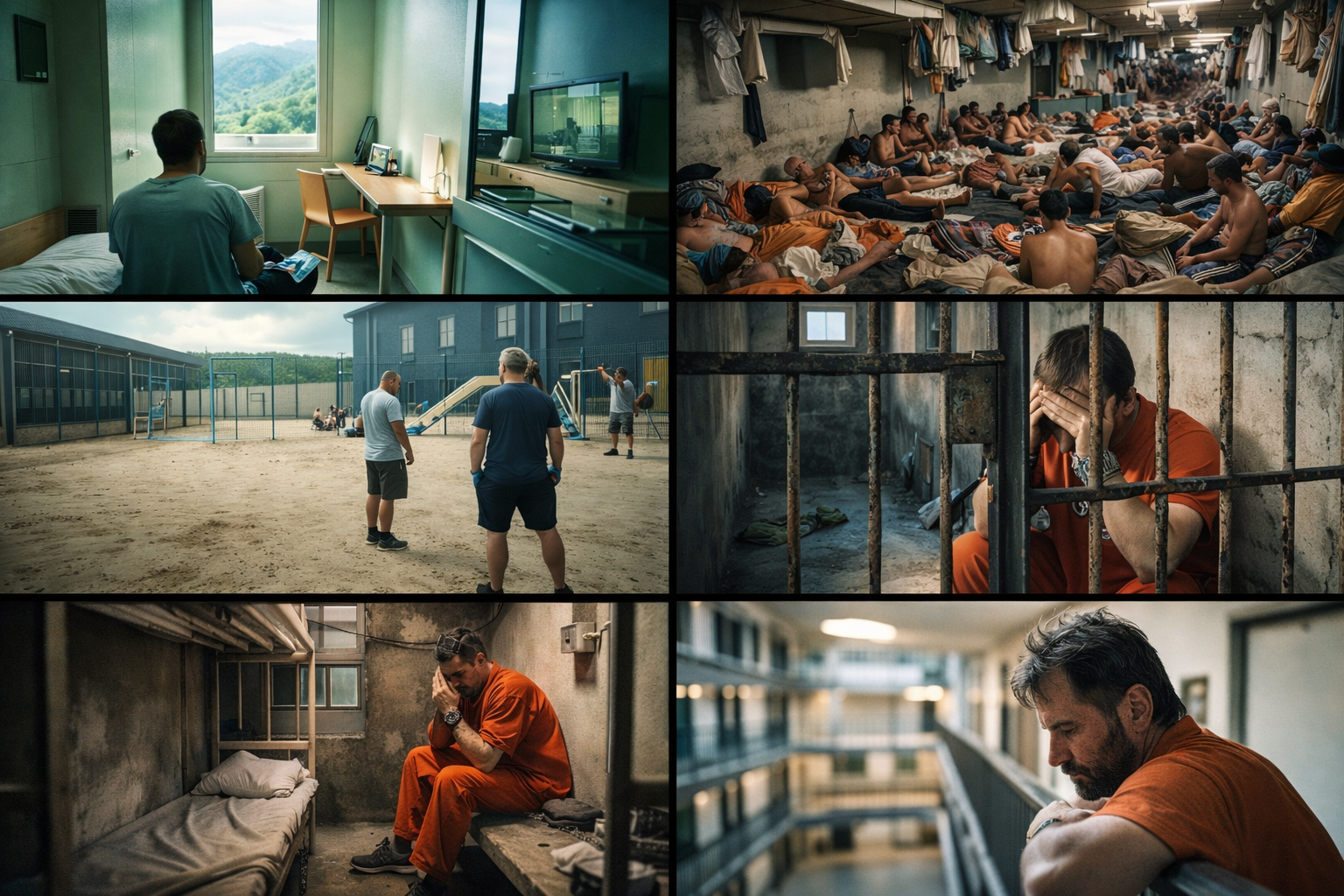
Ranked: The World’s Prisons by Violence, Control, and Rehabilitation
Inside the Global Prison Rankings: Where Inmates Leave Better… and Where They Leave Broken
The argument is often framed as a moral fork: punishment or rehabilitation. But the real trade-off is operational. The deprivation of liberty is a punishment. The question is how the state uses its time and whether it increases or decreases future harm.
There is a second tension underneath: the public wants accountability that feels proportional, victims want safety that lasts, and governments want measurable outcomes that justify budgets. Those goals can align, but only if prison is designed around outcomes, not optics.
The story turns on whether prison is treated as a warehouse for people society fears or as a disciplined pipeline that reduces the risk they pose when the gate opens.
Key Points
Prison can punish and still be rehabilitative, because the punishment is the loss of freedom; everything else is design.
“Best prisons for prisoners” tend to share the same features: predictable routines, meaningful activity, trained staff who manage behavior without constant force, and clear reentry planning.
“Worst prisons for prisoners” also share a pattern: overcrowding, violence, medical neglect, arbitrary treatment, extreme isolation, and weak legal safeguards.
International reoffending rates are tricky to compare because definitions vary (rearrest vs reconviction vs return-to-prison), so rankings must focus on daily life and system intent.
The first 90 days after release are often the real sentence: housing, treatment continuity, paperwork, and employment access decide whether someone stabilizes or spirals.
The public safety question is practical: which model reduces future victims per bed, per staff hour, and per dollar?
Background
Prisons exist for several reasons at once. They incapacitate (a person cannot offend in the community while confined). They deter (at least in theory). They express condemnation as society marks a boundary. And they sometimes rehabilitate people, making them less likely to harm others.
Most modern systems claim all four. In practice, they trade them off. A punishment-first culture tends to deliver harsh conditions, rigid control, and a daily life built around deprivation. A rehabilitation-first culture still uses coercion—prison is not voluntary—but tries to preserve a version of normal life: work, education, treatment, routines, and constructive relationships with trained staff.
The implications extend beyond the dichotomy of compassion versus severity. If incarceration is common, then prison becomes a major social institution that shapes communities, labor markets, public health, and crime itself.
Analysis
Reform or Punishment Is the Wrong Question
The cleanest way to understand the choice is this: punishment is the sentence, not the suffering. The state already punishes by taking liberty. When it adds chaos—violence, humiliation, untreated illness, isolation without limit—it is not adding justice. It is often adding risk.
That does not mean “soft.” It means deliberate. A prison can be firm, restrictive, and safe while still being structured around a goal: returning a person to society less dangerous than before.
If the system cannot plausibly explain how daily life inside makes the public safer outside, it is running on symbolism.
The Rankings Hinge on One Thing: Daily Life
People argue about prisons as buildings. The reality is time: morning count, meals, movement, work, school, boredom, fear, conflict, and sleep. That routine either trains self-control and stability or trains hypervigilance and dominance.
A "good" prison establishes a structure for the day. You wake up to consistent rules. You know when you’ll eat, when you’ll work, when you’ll learn, when you’ll exercise, and when you’ll call home. Predictability is not softness. It’s risk management. It lowers the pressure that creates prison gangs, extortion economies, and impulsive violence. When staff are trained to manage behavior through constant contact and de-escalation, the prison stays governed by the state, not by whoever can scare the most people.
In a “bad” prison, the day is fog. Movement is arbitrary. Food and medicine become leverage. Protection becomes informal, which means power flows to the strongest group. The prison becomes a market for fear—contraband, debt, coercion, sexual violence—and the state quietly loses control of what it claims to control.
That is why the “best prisons for prisoners” usually do not have the nicest walls. They are the ones where order is maintained without trapping people in survival mode—and where release is treated as the most dangerous moment, not an afterthought.
Best Prisons for Prisoners (Ranked)
Rank 1—Halden Prison (Norway).
Halden is built around “normality”: prisoners typically live in small-unit housing with private rooms, communal kitchens, and structured days designed to resemble ordinary life under supervision. The working hours matter. A normal day is anchored by purposeful activity—workshops, education, training, and sports—so idleness doesn’t become the main currency. Staff are unarmed and trained in “dynamic security,” meaning safety is built through relationships and continuous engagement rather than constant physical force.
Gangs exist in Norway, but they are less likely to become the organizing principle of daily life when routine is stable and staff presence is relational. Violence is typically discussed as comparatively low by international standards, but it is not zero. Publicly discussed figures from oversight reporting have pointed to fluctuations in threats and violent incidents inside Halden, and recent external scrutiny has highlighted staffing pressures that can make safety harder to maintain. The point is not that Halden is a utopia; it’s that the institution is designed to prevent prison from turning into a violent social order of its own.
Education and skills-building are treated as core, not optional. The model assumes release is inevitable for most people and tries to send them out with habits, qualifications, and a realistic plan. Family contact is treated as stabilizing, with visiting arrangements designed to sustain relationships rather than sever them.
Likelihood to reoffend is usually discussed at the Norway system level rather than “Halden-specific.” Norway is often cited for low reconviction rates compared with many Western systems, but cross-country comparisons are messy because definitions and follow-up windows differ.
Famous escapes: Halden’s public reputation is that it operates without the classic “hard” security look, yet it is known for preventing headline-grabbing breakouts. No widely documented “famous escape” is associated with the prison in mainstream reporting.
Rank 2—Bastøy Prison (Norway).
Bastøy is an open prison on an island, designed as a step-down environment for people nearing release or assessed as suitable for low-security custody. Daily life is built around responsibility: prisoners typically live in cottage-style housing and spend the working day doing practical labor—farming, maintenance, kitchens, repairs, and other trades. The culture is closer to “structured community with rules” than “cell block with constant tension.”
That structure changes the social incentives. When the day is busy, autonomy is real, and privileges depend on compliance, the reward for violent dominance shrinks. Gangs can exist as identities that people carry, but the island model is designed to make gang hierarchy less useful on a day-to-day basis. Violence is therefore typically described as low compared with many closed prisons, although “low” reflects selection as much as environment: Bastøy is not where the highest-risk prisoners begin their sentences.
Education and employable skills are embedded into the routine. The prison’s logic is that stable work habits and real-world competence matter more than deprivation theater. Contact with family and visitors is part of the model, though controlled.
Likelihood to reoffend is frequently cited as unusually low in features about Bastøy, but treat prison-specific numbers cautiously: who gets transferred there matters. Even with that caveat, the mechanism is clear—reentry preparation is the mission.
Famous escapes: Bastøy has had rare absconding incidents. A widely reported case in 2015 involved an inmate leaving the island by paddling a surfboard using a plastic shovel. The broader lesson is that an open prison doesn’t rely on walls; it relies on incentives and consequences. If you run, you lose the open setting and return to higher security.
Rank 3—Suomenlinna (Open Prison) and Finland’s open-prison approach
Suomenlinna’s open prison sits inside a tourist area—one of the most unintuitive signals of how Finland thinks about reintegration. Daily life is explicitly transitional: prisoners live in basic but comfortable accommodation with shared facilities (including communal kitchens and saunas), and many hold paid jobs. Some work on maintaining and renovating the fortress structures; others can have jobs in the city. That paycheck matters psychologically: you’re expected to live like an adult with responsibilities, not like a person suspended outside time.
Family contact is built into the transition logic. Permits to visit the mainland—including family overnights—are part of the step-down pathway for eligible prisoners. Education is not ornamental; it’s a route back to stable employment. The environment is designed to make “normal life with constraints” feel familiar by the time release comes.
In open prisons, the presence of gangs and violent hierarchies tends to be less prominent due to population filtering and conditions that mitigate scarcity-driven power dynamics. The bigger risks are relapse and rule-breaking, not predatory control.
Discussions about the likelihood of reoffending at the national/system level are more reliable than those at the prison-by-prison level. Finland’s results are harder to compare internationally because different countries measure “reoffending” differently.
Famous escapes: the open model is “easy to leave” physically, but escapes are described as rare. Finland’s system leans on a blunt deterrent: walk away and you lose the open prison and its privileges. Finland’s open-prison system has been described as seeing escape attempts each year, but not as a place known for dramatic, legendary breakouts.
Rank 4 represents the direction Finland is taking with its "Smart Prison" initiative.
“Smart Prison” is less about gadgets and more about continuity. In practice, it means tightly controlled digital access to approved services—education, rehabilitative tools, and structured communication—so prisoners can study, plan, and handle administrative life without everything bottlenecking through paper queues and limited office hours.
Done well, it changes the texture of custody. Less dead time. More learning. Access to services is more predictable. People managing addiction recovery or mental health needs can benefit from improved continuity. Family contact can be supported through regulated channels when permitted, reducing the “relationship collapse” that often accelerates reoffending.
The risk is institutional: technology must extend staff, not replace them. A prison can be digitally “efficient” and still psychologically brutal if human contact is reduced to transactions.
The likelihood of reoffending is not clearly defined as "Smart Prison-specific" in public discourse, but the theory is measurable: continuity reduces post-release chaos, and post-release chaos is where relapse and reoffending spike.
Famous escapes: no widely reported “signature escape” is associated with Finland’s Smart Prison model. The story is systems design, not breakout lore.
Rank 5—Justice Centre Leoben (Austria).
Leoben is often cited because design affects behavior. The architecture supports more out-of-cell time and a daily rhythm that feels closer to supervised community living than total warehousing. The prison is integrated with a court complex and has been described as emphasizing visibility, order, and dignity—features that reduce the constant adrenaline that produces violence.
Daily life in such settings is structured around routine: work where possible, education access, scheduled exercise, and predictable staff interaction. When people can move with purpose (rather than simply being locked down), the informal economy of intimidation loses oxygen.
Family visits and external contact follow controlled rules typical of European systems: movement is restricted, but not completely isolated. Reentry prospects depend heavily on what happens after release—housing, employment, and support—so the prison’s advantage is mostly inside the walls: it tries not to generate extra damage.
The likelihood to reoffend is best discussed at the national level; prison-by-prison comparisons are rarely clean.
Famous escapes: Leoben is not widely known for famous escape stories. Its reputation is tied to design and philosophy rather than breakout incidents.
Rank 6—HMP Grendon (England, UK).
Grendon operates as a therapeutic community prison, prioritizing treatment as a fundamental aspect of daily life. Prisoners are expected to engage in intensive group work, community meetings, and structured psychological programs designed to reduce violent and antisocial patterns. Daily life is less “boredom and tension” and more “scheduled emotional labor under rules.”
That matters in a national context where prison violence is a serious problem. Official statistics for England and Wales show very high assault volumes across the estate (tens of thousands of assaults in a year, with thousands classified as serious). In such an environment, staff strain and routine breakdowns foster the growth of gangs and status hierarchies. Grendon’s model is essentially a counter-design: it tries to make behavior visible, accountable, and treatable.
Education and purposeful activity exist, but the defining feature is therapy as core work. Family visits follow the controlled UK framework. Reoffending outcomes for therapeutic community participants have been studied historically and can look better for engaged participants, but results depend on who is selected, whether they complete the program, and what support exists after release.
Famous escapes: Grendon has a documented, high-profile escape incident from the early 2000s in which three inmates, including two convicted murderers, broke out after cutting through fencing and stealing a vehicle. All were recaptured shortly afterward. It is a reminder that even “treatment-led” prisons still face classic security risks.
Worst Prisons for Prisoners (Ranked)
Rank 1—Saydnaya Military Prison (Syria).
Saydnaya’s “daily life” has been described in major human rights investigations as systematic cruelty: starvation conditions, torture, forced confessions, and routine degradation. This is not a prison designed for rehabilitation or lawful reintegration. It has been framed as a tool of state terror.
Violence statistics here are not “assault counts.” The most widely cited numbers are about executions and deaths in custody. Major reporting and investigations have described mass hangings occurring repeatedly over years, with thousands believed killed.
Education, therapy, and normal family visits are not credible themes in the core documentation about Saydnaya. Prospects after release are often unknown because many detainees disappeared or were held without transparent legal process.
Likelihood to reoffend is not a meaningful metric. The institution is not built to prevent future crime; it is built to punish and intimidate.
Famous escapes: Saydnaya is not known for cinematic escapes. The most famous “exit” came through political collapse: in December 2024, following the fall of Assad’s government, prisoners poured out as gates and cells were forced open in chaotic mass releases. The scale was historic—and so was the fear that, in the chaos, dangerous criminals as well as political detainees could slip away without accountability.
Rank 2—Evin Prison (Iran).
Evin is notorious as a detention hub where daily life can shift from routine custody to coercive pressure, depending on ward and case type. For political detainees, the day-to-day reality described in major reporting and advocacy often includes isolation or near-isolation, intense surveillance, restricted communication, and uncertainty used as control.
Violence statistics here appear most clearly during crises. Evin has had deadly incidents, including a major fire in 2022 that killed prisoners and injured many others. In June 2025, an Israeli airstrike hit the Evin complex, killing dozens. In the aftermath of that strike, Iranian authorities reported that 75 inmates escaped during the chaos, with 27 still at large weeks later.
Family visits and phone access are a recurring fault line: contact can be restricted, disrupted, or shaped by security decisions. Reports have also raised significant concerns about medical access, particularly for chronic illnesses and injuries resulting from crackdowns and transfers.
Likelihood to reoffend is difficult to apply because many people held in Evin are political or security detainees rather than conventional criminals, and because the system focuses on goals other than rehabilitation.
Famous escapes: The most significant recent “escape event” tied to Evin was the June 2025 strike aftermath, when dozens fled amid damage, panic, and transfers.
Rank 3—Makala Central Prison (Democratic Republic of the Congo).
Makala is repeatedly described as a severe overcrowding crisis: a facility built for a fraction of the population it holds, with sanitation, food, and medical care overwhelmed. From day to day, scarcity governs everything. In such conditions, informal power structures tend to fill the vacuum—who controls access to a sleeping spot, food, medicine, or protection? Violence becomes both interpersonal and systemic.
The violence “statistics” here include mass-casualty events. In September 2024, an attempted jailbreak led to at least 129 deaths and dozens of injuries, with reports of rape during the chaos. Makala has also seen large-scale escapes in prior years, including a major mass jailbreak in 2017 in which thousands reportedly got out.
Education and rehabilitation are structurally difficult when basic safety and health are unstable. Family support can become the only supply chain for essentials, deepening inequality inside.
Likelihood to reoffend is not reliably measured in a comparable way. The more relevant risk is that the prison itself functions as a trauma amplifier, worsening the very instability that drives future offending.
Famous escapes: Makala is one of the clearest examples on this list where “escape” is not exceptional—it is recurring history. The 2017 mass jailbreak is one of the most famous in the region, and the 2024 attempt became infamous for its death toll even as the number of successful escapees remained disputed.
Rank 4—CECOT (El Salvador).
CECOT is designed for maximum deterrence and maximum incapacitation. Daily life has been described as tightly controlled, collective confinement with minimal space, shaved heads, and constant surveillance. Two day-to-day details matter: there is no outdoor recreational space, and family visits are not allowed. Detainees have described being held incommunicado, with outside contact cut off.
Gangs are central to the prison’s rationale: it exists to contain alleged gang members en masse under a state-of-emergency policy. But that does not mean “gang influence disappears.” It means the state is attempting to dominate it through overwhelming restriction rather than through rehabilitation.
Human rights reporting has documented allegations of torture and serious abuse for certain detainee groups, despite contested and politically charged violence statistics. International bodies have also highlighted overcrowding concerns, with some assessments claiming extremely low personal space per prisoner.
The institution doesn't seem to prioritize the likelihood of reoffending. The prison is built to keep people in, not to prepare them to leave.
Famous escapes: none are widely documented as successful since CECOT opened. Its public identity is “no way out,” enforced by scale, isolation, and control.
Rank 5—ADX Florence (United States).
ADX is the global shorthand for supermax isolation. Daily life is defined by solitary confinement: prisoners are typically alone in a small concrete cell for nearly the entire day, with a narrow window slit and tightly controlled movement. The design minimizes contact with other people. Special restrictions further limit communication for some prisoners. The system operates on a “step-down” concept for some inmates, but the baseline experience is separation and silence.
Gangs matter here in an indirect way. ADX exists to isolate people considered capable of directing violence and criminal networks from inside prison. It is the state’s attempt to sever influence by cutting off contact.
Violence inside ADX is not routine in the way it is in crowded prisons, because contact is limited. But “limited contact” does not mean “no violence.” Homicides have occurred, including a notorious killing in the mid-2000s during a supervised recreation situation—an illustration that even extreme control can fail at the margins.
Education opportunities are narrow and heavily controlled. Family contact is permitted under strict rules, and for certain prisoners it can be exceptionally restricted.
Likelihood to reoffend is difficult to interpret because many ADX prisoners will never be released and the population is highly atypical. For U.S. prisoners overall, national follow-up studies have found very high rearrest rates over multi-year windows.
Famous escapes: ADX’s modern reputation is “escape-proof.” No successful escapes have been widely documented since it opened in 1994.
Rank 6—Qarchak Women’s Prison (Iran).
Qarchak has been described in human rights reporting as overcrowded, unsanitary, and medically dangerous. Day-to-day life is framed less by routine and more by survival logistics: access to clean water, hygiene, medical attention, and protection in a crowded environment where people with very different offenses may be held together.
Gangs in the classic sense are not the usual headline. The more common theme is a chaotic internal environment where intimidation, scarcity, and institutional neglect shape behavior. Violence includes interpersonal conflict driven by crowding and stress, as well as allegations of abuse and denial of medical care. Recent reporting by advocacy organizations has highlighted deaths linked to medical neglect.
Education and rehabilitative programming are not widely presented as central features. Family contact and phone access are described as unreliable and vulnerable to restriction.
Likelihood to reoffend is not meaningfully comparable here, because the institution’s defining characteristic in reporting is harm and degradation rather than reintegration design.
Famous escapes: no widely documented “famous escape” is strongly associated with Qarchak. Its notoriety is conditioned, not based on breakout history.
What Most Coverage Misses
The key point is that the quality of a "best prison" is not solely determined by its appearance but rather by the ease with which it reintegrates into society.
The mechanism is budgetary and behavioral at the same time. A system can spend money creating stable routines inside and stable scaffolding outside (housing, treatment, documentation, employment pathways), or it can spend money managing the damage created by chaotic custody—and then pay again through policing, courts, emergency health care, and new victims.
Two signposts matter over the next year: whether governments shift funding toward reentry capacity (especially housing and treatment continuity) and whether they publish outcomes that follow people beyond release rather than focusing on headline-grabbing crackdowns and bed counts.
Why This Matters
Victims and potential victims are the first stakeholders. So are prison staff, families, and communities with high churn between custody and release.
In the short term, harsh confinement can satisfy demands for accountability and temporarily incapacitate high-risk people. It can also amplify violence inside facilities and degrade mental health and physical health in ways that spill back into society quickly.
In the long term, systems that treat prison as a transition tend to reduce repeat harm—because stable routines, treatment, and realistic reentry planning reduce the chaos that drives reoffending.
The main consequence is simple: public safety improves when prison reduces the conditions that make repeat harm likely, because fewer people leave custody more volatile than when they entered.
Real-World Impact
A person leaving a high-structure prison with a verified housing plan, medication continuity, and a job-ready skill arrives in the community with a hard life but a map. A missed train or a disappointing interview is a setback, not a collapse.
A person leaving an overcrowded, violent facility often arrives wired for danger: hypervigilant, distrustful, and dysregulated. One missed appointment can cascade into breach, recall, homelessness, relapse, or impulsive offending.
A correctional officer in a stable regime is more likely to enforce rules consistently and go home intact. In a chaotic regime, the job becomes survival, and survival instincts shape the whole institution.
Neighborhoods with lower prison churn see fewer children growing up treating incarceration as normal adulthood. That is a quiet public safety dividend that does not fit on a slogan.
The Next Prison Debate Will Be About Measurement, Not Morality
A prison system can deliver punishment and still be serious about rehabilitation because those aims are not opposites. The sentence is the punishment. The design decides whether the punishment ends at the gate or bleeds into the next cycle of harm.
The most credible reforms in the coming years will be the ones that publish hard outcomes, invest in the first 90 days after release, and reserve extreme isolation for truly exceptional cases rather than using it as a default tool.
Watch for two concrete signals: expansion of reentry capacity (housing, treatment, probation staffing) and publication of transparent reoffending measures that define terms clearly. That is where this era will be judged.
