Malaria Is Adapting Faster Than Control Systems Can Cope
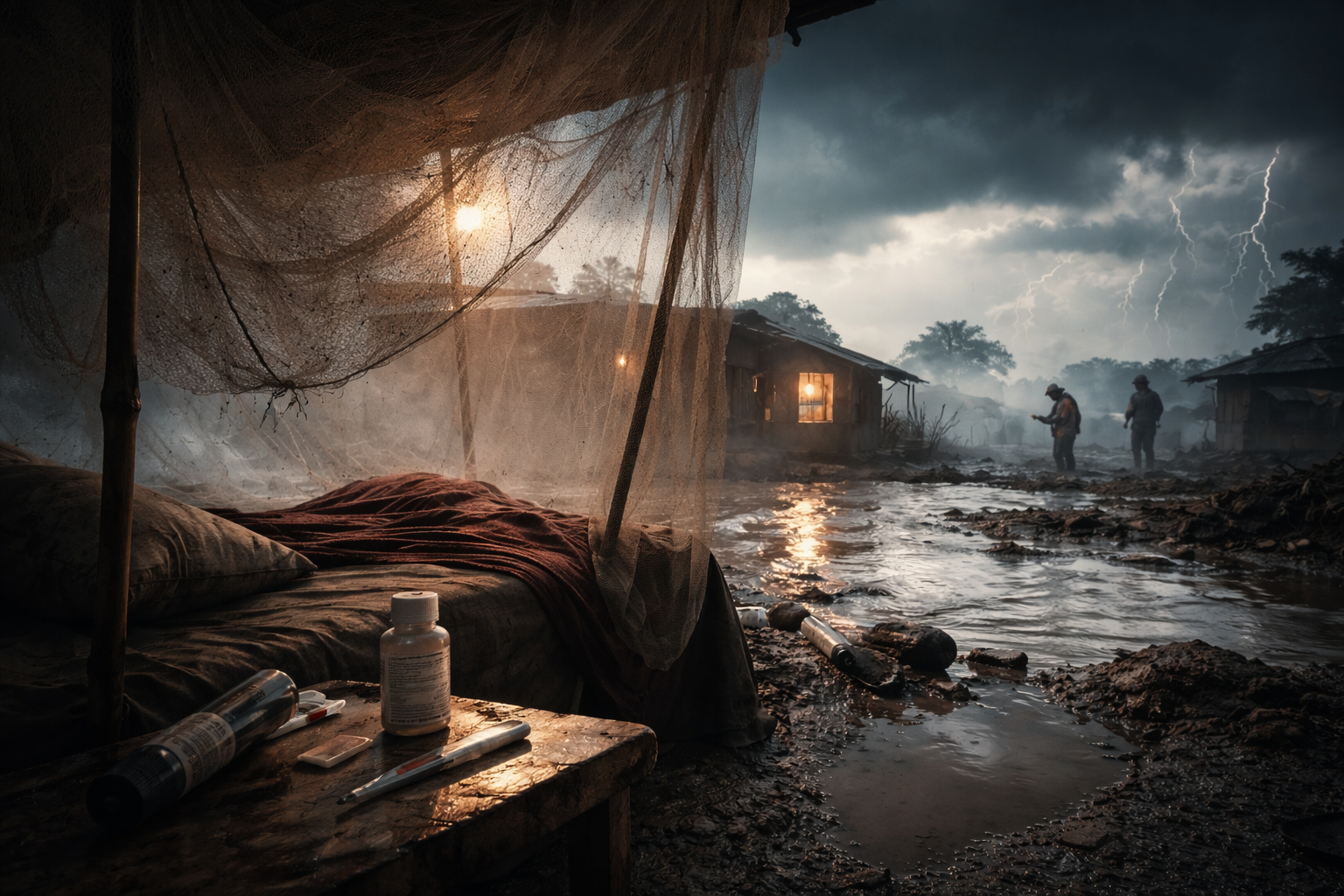
New projections show extreme weather could drive malaria rebounds in Africa by 2050. Here’s where risk rises, why, and what policy must do in 2026–2030.
The shifting climate map for malaria indicates that control efforts may fail first in areas that are least expected.
The most consequential new signal on climate and malaria is a Nature study published today that tries to answer the question programs actually face: not just where mosquitoes could live, but where malaria control breaks under climate stress.
The headline finding is blunt. The authors estimate that Africa will see approximately 123 million additional malaria cases and about 532,000 additional deaths between 2024 and 2050 under a middle-of-the-road warming pathway, while keeping today’s control levels constant. The surprise is the mechanism: extreme weather disruption dominates, accounting for most of the projected increase, far more than slow-moving changes in average temperature or rainfall.
That flips the intervention logic. The problem is not only a shifting “suitability map.” It’s a systems-resilience map.
The story turns on whether malaria policy treats climate as a biology problem or as a shock-and-recovery problem.
Key Points
A new Nature study (published January 28, 2026) projects a large additional malaria burden in Africa by 2050 under current control levels, with wide uncertainty ranges.
We model extreme weather events (floods, cyclones, and related disruption) as the primary driver of additional cases and deaths—more so than ecological shifts alone.
We project that intensification in already endemic areas, rather than dramatic range expansion into new areas, will lead to the biggest increases.
Disruption pathways are both practical and ugly: they disrupt treatment access, damage housing, and impede the delivery of vector control after shocks.
Classic tools (nets, spraying, drugs) still work—but their performance becomes more sensitive to logistics, durability, and rapid replacement.
The “new risk map” is a blend of hazard (extremes) × exposure (who lives in harm’s way) × fragility (health system capacity).
2026–2030 policy wins are less about futuristic tech and more about surge capacity, pre-positioned supplies, and climate-informed targeting.
Background
For two decades, the climate–malaria debate has been dominated by averages: warming temperatures, changing rainfall patterns, and how those shape mosquito ecology and parasite development. That work matters, but it often fails decision-makers because programs don’t run on climate normals—they run on supply chains, clinic staffing, surveillance, and last-mile delivery.
Meanwhile, malaria progress has already been under pressure from insecticide resistance, drug resistance signals, financing gaps, and conflict-driven service disruption. Against that backdrop, climate change is not a single “more malaria” switch. It is an amplifier that can raise transmission in some places, lower it in others, and—most importantly—turn occasional crises into recurrent operating conditions.
Analysis
The Core Finding, Translated Into Decisions
The Nature study’s most operational claim is this: if you decompose climate impacts into (1) ecological changes and (2) disruption from extremes, the disruption component dominates. In plain terms, storms and floods don’t just change mosquito habitat—they interrupt the very tools used to suppress malaria.
For policy, that means priorities shift from “Where will malaria move?” to “Where will control fail first?” Those are not the same places. A district can remain biologically suitable for decades and still be stable if clinics function and prevention coverage stays high. Another district can see sharp spikes if repeated shocks keep knocking out treatment access and vector control.
Why Extremes Matter More Than Averages
Averages move slowly; health systems don’t. A single flood can do in weeks what gradual warming does in years:
Roads fail → diagnostics and antimalarials don’t reach clinics.
Clinics are damaged or overwhelmed → febrile illness goes untreated longer, and transmission rises.
Homes are damaged → more nighttime exposure, less effective protection.
Vector control campaigns slip → missed indoor residual spraying rounds; net replacement delayed.
Population displacement results in crowded shelters, reduced protection, and blind spots in surveillance.
The key is compounding. If extremes become more frequent, programs spend more time in recovery mode, with less time to build coverage.
The New Risk Map Logic: Hazard × Fragility
The paper’s logic implies a three-layer risk map:
Climate hazard: where floods/cyclones are projected to intensify or recur.
Exposure: where large populations already face malaria risk.
System fragility: where treatment access, housing quality, and campaign delivery are easiest to knock off course.
This is why intensification in existing endemic zones matters so much. A modest percentage-point shift in infection prevalence can translate into enormous case numbers when the baseline burden and population are already high.
Control Tools Under Climate Stress: What Still Works, What Becomes Brittle
Bed nets (LLINs). Nets remain foundational, but extremes increase the need for durable products, faster replacement cycles, and better last-mile distribution after damage and displacement. Resistance management also matters: where pyrethroid resistance is high, next-generation nets can protect gains—but only if procurement and distribution keep pace.
Indoor residual spraying (IRS). Spraying can be highly effective when well-targeted, but it is operationally sensitive. Extreme events can disrupt spray schedules, displace households, and strain local delivery teams. IRS becomes a “high payoff, high execution” tool—best in areas where campaigns can be reliably completed and repeated.
Drugs and prevention. Treatment and chemoprevention work—until clinics run out, staff can’t travel, or patients can’t reach care. Climate stress makes buffer stocks, decentralized distribution, and rapid restocking disproportionately valuable. It also raises the importance of rapid diagnostics and community health worker reach when facilities are compromised.
Vaccines. Malaria vaccines are real progress, but they are not a climate shield by themselves. Their climate sensitivity is less biological and more operational: cold chain reliability, routine immunization continuity, and catch-up capacity after shocks. In areas with recurrent extremes, vaccination can be a stabilizer—if delivery is designed for disruption, not for calm conditions.
Health Systems: Surveillance and Response Capacity as the “Hidden” Intervention
If extremes drive most additional burdens, then surveillance and response capacity becomes a frontline intervention, not a support function.
The practical goal is speed: detect a surge early, confirm it, treat quickly, and restore prevention coverage before transmission resets higher. That requires:
climate-informed early warning linked to case data,
pre-agreed surge playbooks (who moves, what ships, within how many days),
and ring-fenced funds that can be released immediately.
What Most Coverage Misses
The hinge is that the first failures are likely to be logistical, not ecological.
That changes incentives and timelines because ministries and donors can’t “model” their way out of supply chain breaks. They have to buy reliability: redundant routes, pre-positioned commodities, emergency contracting, and local surge staffing.
Two signposts to watch over the next weeks and months:
Funding rules shift toward contingency financing (rapid-release mechanisms) rather than only annual campaign budgets.
National malaria strategies start mapping “shock corridors” (floodplains, cyclone-prone coasts, displacement hotspots) alongside transmission intensity.
What Changes Now
In the short term (weeks to months), the biggest shift should be how risk is prioritized: not only by incidence but by probability of disruption. In the medium term (2026–2030), policy should treat climate adaptation as a core malaria deliverable:
Design campaigns for interruption: smaller, more frequent distribution pulses; faster post-shock replacement.
Protect treatment access: decentralized diagnostics and antimalarials; mobile outreach for displaced communities.
Build surge capacity: emergency staffing rosters, commodity buffers, and rapid logistics contracts.
Target next-gen vector control where resistance is high and execution capacity is strong.
Integrate vaccines as a burden-reduction floor—especially where repeated shocks make it challenging to sustain perfect net/spray coverage.
The mechanism is simple: when extremes repeatedly interrupt access and coverage, the effective reproduction of malaria rises even if the ecology changes only modestly.
Real-World Impact
A severe storm strikes a coastal district. The clinic roof is damaged; power is intermittent. For three weeks, rapid tests run out, and fevers are treated late or not at all. Nets are lost in flooding. One month later, cases spike—not because mosquitoes discovered a new climate niche, but because the control system paused.
A floodplain community sees repeated seasonal flooding. Each year, roads become unreliable. Spraying teams miss the window. Community health workers step in to fill the gaps, but without consistent restocking, treatment becomes inconsistent. The area doesn’t become “newly malarial.” It becomes persistently harder to keep malaria down.
A rapidly growing peri-urban area has better housing and lower baseline risk, but informal settlements expand into low-lying zones. After heavy rains, stagnant water rises, and care-seeking drops as transport costs jump. Malaria becomes a pocketed, inequality-shaped problem.
The 2026–2030 Malaria Playbook in a Warming World
This represents a pivotal juncture. One path treats climate change as an additional variable in mosquito models and waits for “the new map.” The other path accepts the uncomfortable truth that extremes are already rewriting operational reality—and invests accordingly.
The best bet is to use nets, spraying, drugs, and vaccines together. It is making those tools shock-tolerant: faster replacement, stronger delivery, better targeting, and rapid response capacity.
If policy gets that right, climate change becomes a headwind, not a derailment. If it doesn’t, malaria control may fail first in the places where health systems are least able to absorb repeated hits—and the burden rises long before any dramatic “range expansion” makes headlines.
History may mark this period as the moment malaria stopped being only a disease of ecology—and became, unmistakably, a disease of system resilience.
