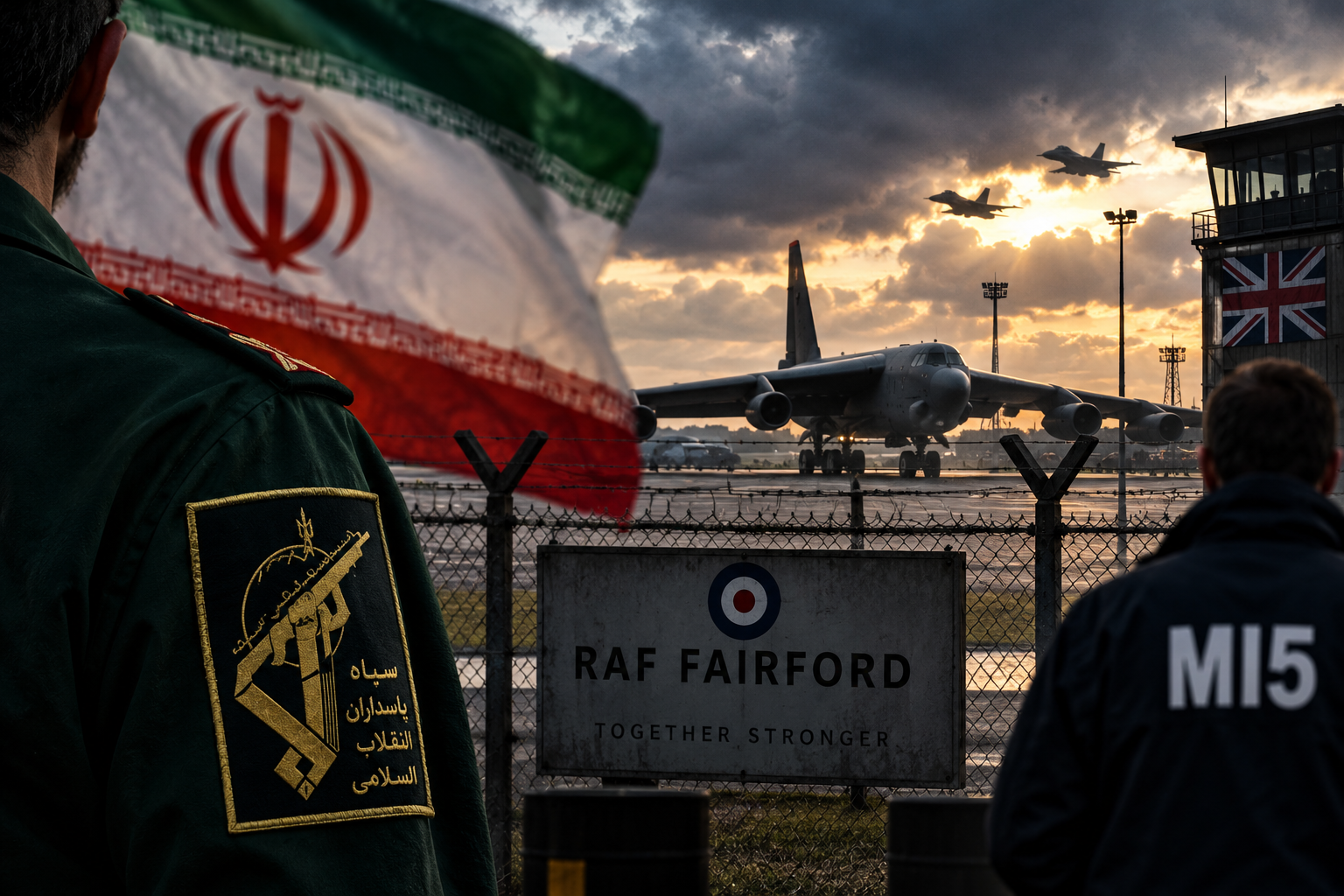
Britain's Military Bases Face New Iranian Threat
Iran Threat To British Airbases Raises Security Alarm
Sir Ken McCallum Says Iran Has Shifted Towards Harder Military Targets Following The RAF Fairford Investigation, As Britain Confronts A Wider Campaign Of State-Linked Threats
Britain's domestic intelligence chief has warned that Iran is seeking to target military installations in the United Kingdom, describing a significant change in the threats facing the country and revealing that the suspected plot involving RAF Fairford was not an isolated concern.
Sir Ken McCallum, director general of MI5, delivered the warning on Tuesday, 13 October 2026, during his annual assessment of threats to British national security. He said Iranian operations had moved beyond their established focus on political opponents and Jewish institutions towards more heavily protected military targets.
The warning follows an investigation into suspicious activity near RAF Fairford in Gloucestershire, a strategic airbase used by American bombers during military operations against Iran.
Just one day earlier, Prime Minister Andy Burnham told Parliament that the British government assessed the suspected Fairford operation was highly likely to have been coordinated in Iran and almost certainly directed by the Islamic Revolutionary Guard Corps.
Iran denies involvement in the incident. Seven men have been arrested during the investigation and released on bail, with no charges announced.
The new warning means British authorities are treating the Fairford incident within a wider intelligence picture, rather than solely as an unexplained episode involving suspicious vehicles near an airfield.
MI5 Reveals A Major Shift In Iran's Targeting Of Britain
For several years, British security officials have warned that Iranian intelligence organisations and their associates were pursuing opponents of Tehran who live outside Iran.
Those concerns included alleged assassination plots, kidnapping threats, intimidation of journalists and hostile surveillance directed at individuals considered enemies of the Iranian government.
The latest assessment identifies a broader range of potential targets.
McCallum said a "major shift this year has been Iranian ambitions to come at harder targets, like military sites."
Referring to the RAF Fairford investigation, he added that the incident "is not unique", pointing to other examples in Britain and elsewhere around the world.
That distinction matters.
An operation directed against an individual can involve surveillance, threats or an attempt to recruit someone with access to the intended victim. A military installation presents different obstacles, including controlled access, specialist security arrangements and the possibility of a response by armed personnel.
Attempting to threaten such a facility can also have consequences beyond the immediate location. It can force military commanders to reconsider aircraft deployments, security precautions and the protection of personnel.
McCallum did not publicly identify every military facility that intelligence officers believe may be at risk. Nor did his remarks establish that attacks on additional British bases were imminent.
His assessment instead points to a change in Iranian ambitions, with potential military targets becoming part of an already extensive security challenge.
Why RAF Fairford Has Become The Centre Of The Investigation
RAF Fairford is an important operating location for the United States Air Force in Gloucestershire.
Its significance increased during the conflict involving Iran and the United States because American long-range bombers used the installation in support of military operations against Iranian targets.
That made the base strategically important and potentially attractive to anyone seeking to disrupt American operations.
The immediate investigation began shortly after midnight on Sunday, 27 September 2026.
Police responded to information concerning three suspicious vans near Whelford, a village close to RAF Fairford. Five men were initially arrested, and counter-terrorism investigators subsequently examined whether the circumstances involved preparations for a terrorist act.
The police response was substantial.
A security cordon was established, military explosive-ordnance specialists attended, and nearby residents were evacuated while officers examined the vehicles and surrounding area.
Investigators recovered petrol, but no explosives were discovered in the vehicles.
That finding is important because it limits what can be concluded from the physical evidence publicly disclosed. The presence of petrol does not itself establish that an explosive attack was ready to take place.
The investigation nevertheless continued beyond the original five suspects.
Further arrests brought the total to seven, with officers examining possible foreign-state involvement and connections between those detained.
All seven men have been released on bail while the investigation proceeds. Arrest does not establish guilt, and the government's intelligence assessment is distinct from evidence tested in a criminal court.
The RAF Fairford terrorism investigation has therefore become significant for two separate reasons: what police may ultimately establish about the events of 27 September, and what intelligence officers believe those events suggest about a wider threat.
Britain Accuses Iran's Revolutionary Guards Of Directing The Incident
On Monday, 12 October, Prime Minister Andy Burnham made the British government's strongest public attribution concerning RAF Fairford.
He told Parliament that the government assessed the suspected operation was highly likely to have been coordinated in Iran and almost certainly directed by the Islamic Revolutionary Guard Corps, commonly known as the IRGC.
The Revolutionary Guards are a powerful component of Iran's security establishment, with responsibilities extending across military operations, intelligence and activities beyond the country's borders.
Burnham's statement moved the government's position beyond simply acknowledging that Iranian involvement was under investigation.
It also raised the diplomatic consequences of the incident.
The British government summoned Iran's ambassador and announced sanctions against two Iranian nationals accused of involvement in hostile activity connected with the Iranian state.
Foreign Secretary Ed Miliband said Britain would not tolerate threats conducted through criminal networks, proxy organisations or state-backed activity.
Iran has rejected responsibility for the Fairford incident and challenged the accusations made against it.
The British government has not publicly released the full intelligence underpinning its attribution. That limits independent assessment of the evidence, even though ministers have expressed a high degree of confidence.
The government's accusation against the Revolutionary Guards is therefore a consequential official assessment, not a criminal conviction or a publicly demonstrated account of exactly how the alleged operation was organised.
Why American Bombers Were Withdrawn From RAF Fairford
The security concerns surrounding RAF Fairford have already affected military deployments.
American B-1 bombers were moved away from the Gloucestershire base following fears about a possible Iranian-linked threat, including concerns involving drones.
The redeployment was a precautionary response to an assessed risk. It did not mean a drone attack had occurred.
No drones or explosive devices were publicly confirmed as having been recovered during the initial investigation near the base.
That distinction matters because the potential damage from an attack and the evidence that an attack was operationally ready are separate questions.
Modern military aircraft are highly valuable assets. Even a relatively inexpensive means of disrupting aircraft operations can create a disproportionate security problem if commanders believe a credible threat exists.
Airbases must protect runways, aircraft, fuel infrastructure, personnel and supporting equipment. An alert can also disrupt flight schedules and the availability of aircraft for planned missions.
Moving bombers does not necessarily remove the broader military threat, particularly when aircraft can operate from other locations. It can, however, reduce immediate exposure while intelligence is assessed and protective arrangements are reviewed.
The American decision shows how intelligence concerning a possible threat can produce military consequences without an actual attack taking place.
It does not independently prove who directed the suspected Fairford operation.
How Iran's Alleged Use Of Criminal Proxies Complicates Security Investigations
One of MI5's longstanding concerns is the use of people outside formal intelligence services to conduct hostile activities.
Such individuals may be recruited through criminal networks, financial incentives or intermediaries who conceal the identity of the ultimate organiser.
The result can be a complicated chain between a government intelligence organisation and the person carrying out an act.
That structure can make attribution difficult.
Investigators must distinguish between someone who knowingly acts for a foreign government, someone who believes they are performing a criminal task for payment, and someone whose actions have no proven connection to a state.
McCallum has previously described Iranian state actors as making extensive use of criminals as proxies.
This concern is not confined to Iran. British security agencies have also identified similar methods in hostile Russian activity across Europe.
For investigators, the critical evidence may involve communications, payments, instructions, reconnaissance, travel or contacts between individuals rather than the discovery of conventional weapons alone.
But it would be premature to conclude that every suspect in the Fairford investigation knowingly worked for Iranian intelligence, or that the available public evidence reveals the full structure of the alleged operation.
Those questions remain for investigators.
Iranian Threats Have Extended Beyond Military Targets
MI5's latest warning also places military targeting within a broader pattern of activity attributed to Iran.
The security service has previously identified threats against Iranian dissidents, journalists and other people regarded as opponents of the government in Tehran.
In 2024, McCallum said British authorities had responded to twenty potentially lethal Iran-backed plots since January 2022.
His 2025 annual threat update described more than twenty potentially lethal Iran-backed plots in the preceding year alone.
Those figures reflected the security service's assessment of cases involving potentially lethal threats, not a count of completed attacks or successful prosecutions.
British officials have also accused Iranian-linked proxies of involvement in attacks targeting Jewish and Israeli communities and institutions.
These concerns intensified during the conflict in the Middle East, when the risk of violence against people far removed from the fighting became an important domestic security issue.
Military facilities represent a different category of target because of their direct connection to national defence and, in the case of RAF Fairford, American military operations.
The new assessment does not suggest that earlier threats have disappeared. It indicates that British intelligence officers must contend with a wider set of potential targets.
Russia Remains MI5's Principal State Threat
Iran was not the only country identified during McCallum's annual address.
The intelligence chief also warned about Russia's continued use of hostile activity below the threshold of conventional warfare.
He described Russia as Britain's leading state aggressor, pointing to a broader campaign involving sabotage, cyber operations and the recruitment of intermediaries.
This form of activity is often described as hybrid warfare because it combines different methods of pressure without necessarily involving an openly declared military attack.
The distinction between Russian and Iranian activity is important.
The two states have different strategic interests and operational capabilities. Their activities should not be assumed to form a single coordinated campaign simply because British security officials identify both as serious threats.
But MI5 must investigate their activity alongside its established counter-terrorism responsibilities.
McCallum said the service's work on state threats had expanded sharply over the past decade, with the operational demands of state-threat investigations now approaching those of counter-terrorism.
That represents a significant change in the service's workload.
Intelligence officers must simultaneously investigate potential terrorist attacks, foreign-state espionage, sabotage, hostile cyber activity and threats against people living in Britain.
These cases can involve different laws, evidence and agencies, even when some of the methods used by hostile actors overlap.
MI5 Also Warns Of Artificial Intelligence Being Used In Future Attacks
Another concern raised in the speech was the potential misuse of artificial intelligence by violent extremists and hostile actors.
McCallum warned that AI could help people seeking to carry out attacks by assisting with technical tasks or making dangerous information easier to access.
He also identified longer-term concerns involving biological threats.
MI5 has established a dedicated AI Threat Assessment Centre to evaluate how developing technology could affect national security.
That development does not mean an AI-enabled biological attack has been established in Britain. Nor does it mean every hypothetical technological risk is currently achievable.
The immediate security challenge is to determine which capabilities genuinely increase the threat, how quickly they are developing, and where existing protective measures need improvement.
For an intelligence service already confronting a larger volume of state-linked activity, emerging technology adds another set of questions about detection, prevention and response.
What Could The Warning Mean For British Military Security?
Military installations already operate under security procedures designed to protect personnel, aircraft, equipment and sensitive information.
An intelligence assessment identifying a changing threat can lead authorities to review those arrangements.
Possible responses include tighter access controls, stronger coordination with police, improved protection against drones and closer monitoring of suspicious approaches to sensitive facilities.
These are general security measures rather than confirmation of any new deployment or security order at a particular base.
The Fairford case demonstrates why military protection cannot be assessed solely by whether a physical attack succeeds.
A credible warning can interrupt operations, affect aircraft deployments and require substantial police and military resources.
It can also create uncertainty for nearby communities.
Residents close to RAF Fairford experienced evacuations and emergency restrictions during the September incident despite investigators ultimately confirming that no explosives had been found.
The challenge for officials is to act on credible intelligence while avoiding unnecessary alarm and ensuring that people under investigation are not treated as guilty before evidence is established.
There is no public basis in McCallum's warning for concluding that every British military installation faces an immediate attack.
The assessment instead supports heightened attention to military sites as a category of potential target.
Could The Iran Conflict Spread Further Onto British Soil?
The Fairford investigation raises a difficult question about the relationship between Britain's territory and American military operations.
RAF Fairford is a British military installation used by the United States under longstanding defence arrangements.
When American forces operate from UK territory during an international conflict, a threat directed at those forces can become a security problem for Britain even if the British government is not conducting the same offensive operations.
Iran has previously maintained that facilities used to conduct attacks against its territory may be considered military targets.
That position does not establish that any particular attack would be lawful.
International law places constraints on the use of force, the targeting of military objectives and the protection of civilians. Any operation conducted clandestinely on British soil would raise serious questions concerning sovereignty, attribution and the applicable legal framework.
The possibility of further confrontation does not mean escalation is inevitable.
Britain's immediate response has centred on intelligence assessments, counter-terrorism investigations, diplomatic action and sanctions.
Whether further measures follow will depend partly on what investigators establish and on how the security assessment develops.
For the moment, the most consequential unanswered questions concern the evidence linking the Fairford suspects to Iranian direction, the nature of the suspected operation and the additional military-targeting activity referenced by MI5.
The government has made a firm public attribution concerning Iran's Revolutionary Guards. McCallum has now placed the suspected incident within a broader threat pattern.
The criminal investigation remains open, and the full evidence behind both assessments has not been made public.
Sources
Associated Press — MI5 Chief Says Iran Is Targeting Military Sites And RAF Fairford Was 'Not Unique' — 13 October 2026. McCallum's warning, the shift towards military targets and the Fairford investigation.
Reuters — Iran And Russia Ramping Up Hybrid Campaigns In Britain, UK Spy Chief Says — 13 October 2026. MI5's wider assessment of hostile-state activity, Russia and emerging AI risks.
Foreign, Commonwealth & Development Office — Foreign Secretary Statement On Iran, 12 October — The government's diplomatic response, summoning of Iran's ambassador and sanctions against two Iranian nationals.
Next Reads
Iran's Revolutionary Guards 'Almost Certainly' Directed RAF Fairford Plot, PM Says — Could Britain Be Dragged Into A Wider War? — The government's formal accusation against Tehran and the implications for Britain's involvement in the conflict.
Seventh Arrest Deepens RAF Fairford Terror Probe As Investigators Examine Possible Iran-Linked Plot — The expanding police investigation and the significance of the seventh arrest.
Iran Link Examined As Five Men Questioned Over Alleged Terrorism And Explosives Offences Near RAF Fairford — The original September security operation, early arrests and evidence known at the time.
