Supreme Court Backs Trump in Elon Musk DOGE Records Fight as Government Secrecy Battle Escalates
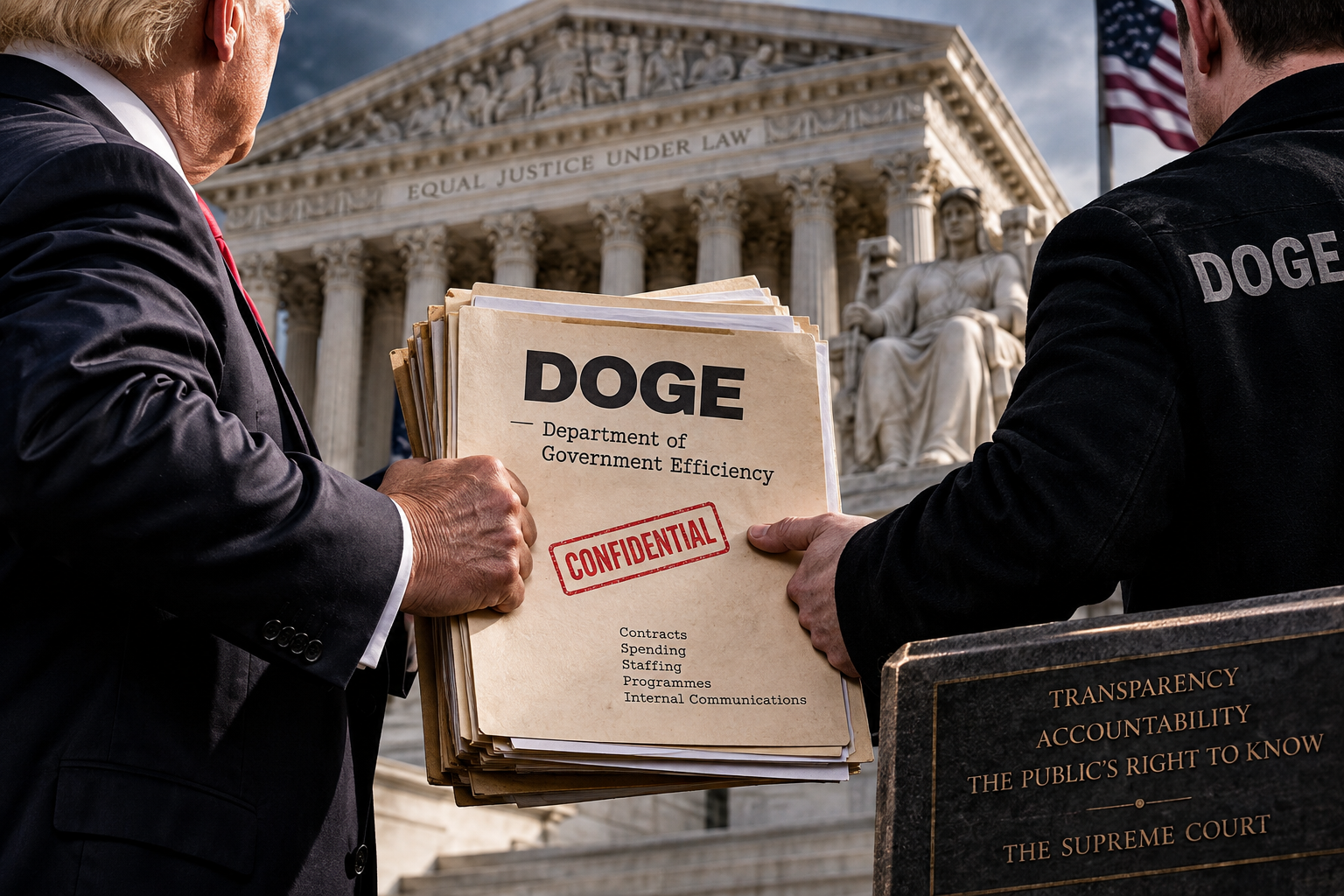
Trump Administration Challenges DOGE Disclosure Order
Elon Musk DOGE Files at Centre of Legal Showdown
Justices Agree to Hear Administration’s Appeal After Lower Courts Back Watchdog Seeking Records of DOGE’s Government Overhaul
The United States Supreme Court has agreed to hear Donald Trump’s attempt to prevent the disclosure of records surrounding Elon Musk’s Department of Government Efficiency, bringing one of the most consequential transparency disputes of his second presidency before America’s highest court.
The decision, announced on Tuesday, 13 October 2026, gives the Trump administration another opportunity to challenge lower court orders requiring DOGE to respond to requests for information about its sweeping changes to federal government operations.
The case raises a deceptively simple question: was DOGE an ordinary presidential advisory body, or did it exercise enough independent government authority to become subject to federal transparency law?
The answer could determine whether internal records about Musk’s government operation must be made available through the Freedom of Information Act.
The Supreme Court has not yet decided that question. Its latest action is an agreement to hear the administration’s appeal, rather than a final judgment allowing DOGE to withhold the records.
For Citizens for Responsibility and Ethics in Washington, the watchdog organisation bringing the case, the dispute concerns the public’s ability to understand how DOGE influenced government staffing, spending and federal programmes.
For the Trump administration, it concerns the confidentiality of presidential advisers and the constitutional boundaries surrounding judicial scrutiny of executive-branch deliberations.
What the Supreme Court Decided on 13 October
The justices agreed to review the Trump administration’s challenge to court-ordered disclosures and evidence-gathering in litigation over DOGE records.
The case is formally associated with the U.S. DOGE Service, the government body at the centre of Musk’s efficiency initiative.
It reaches the Supreme Court after several rounds of litigation involving a federal district judge, the United States Court of Appeals for the District of Columbia Circuit and an earlier Supreme Court intervention.
In April 2025, US District Judge Christopher Cooper ordered DOGE to process the watchdog’s Freedom of Information Act requests on an expedited basis. The court found sufficient grounds to treat DOGE as likely falling within the law’s definition of a federal agency.
The administration challenged the decision, arguing that DOGE functioned as an advisory organisation serving the president rather than an independent federal agency.
An appeals court declined to halt the lower court’s directions.
The Supreme Court intervened in June 2025, restricting the scope of certain evidence-gathering orders. The case subsequently returned through the appeals process.
The administration's latest challenge asks the justices to examine whether the remaining judicial demands intrude too deeply into presidential advisory functions.
By accepting the case, the Supreme Court has ensured the dispute will receive further consideration.
It has not yet established that DOGE is exempt from transparency requirements.
Why Elon Musk’s DOGE Records Are Being Challenged
DOGE was created during the opening hours of Trump’s second presidency.
On 20 January 2025, Trump signed an executive order establishing the initiative as part of a programme intended to modernise government operations, reduce expenditure and improve federal efficiency.
Musk became its most prominent public figure.
The billionaire businessman had supported Trump’s return to the White House and entered the administration with an unusually high profile for someone involved in federal restructuring.
His association with Tesla, SpaceX and the social media platform X brought extraordinary public attention to an operation that would ordinarily have been conducted by less recognisable government officials.
DOGE moved rapidly.
Its activities included scrutinising government contracts, identifying proposed spending reductions, examining federal staffing and pursuing changes to administrative structures.
The administration presented the initiative as an effort to confront waste and bureaucracy that it believed had accumulated across Washington.
Critics challenged both the methods used and the level of independent authority exercised by DOGE personnel.
Those concerns created a demand for documents explaining how decisions were proposed, authorised and implemented.
The wider political significance of Musk’s role is also examined in Regime Change and the transformation of Trump’s presidency, where his involvement illustrates the relationship between presidential power and an unconventional outside adviser.
The Supreme Court dispute is more narrowly focused.
It concerns the legal status of DOGE and how much information the organisation can be compelled to disclose.
The Legal Question That Could Determine Whether DOGE Files Become Public
The Freedom of Information Act, usually known as FOIA, allows members of the public to request records held by federal agencies.
It is one of the central legal mechanisms through which journalists, researchers, campaigners and ordinary citizens can examine government activity.
Federal agencies are generally required to process valid requests and disclose responsive records unless a recognised exemption applies.
Not every body connected with the president is necessarily covered.
Some presidential advisory organisations fall outside the statutory definition of an agency, particularly where they lack independent authority and exist primarily to provide advice directly to the president.
This distinction lies at the centre of the DOGE case.
The Trump administration argues that DOGE was an advisory body operating within the president’s executive structure.
Under that interpretation, requiring disclosure of internal recommendations could interfere with the confidentiality needed for presidential decision-making.
The government also contends that the lower courts authorised intrusive evidence-gathering inconsistent with the constitutional separation of powers.
The watchdog organisation advances a different interpretation.
Citizens for Responsibility and Ethics in Washington argues that DOGE exercised substantial independent authority across federal government operations.
Its position is that an organisation cannot escape ordinary transparency obligations simply by being described as advisory if its actual functions resemble those of a federal agency.
That makes the evidence about DOGE’s operations particularly important.
The organisation’s title, structure and relationship with the White House matter. But so does the authority it exercised in practice.
The legal dispute therefore turns partly on the difference between advising officials to take action and possessing authority to direct or implement government changes.
Why the Government Wants to Limit Disclosure
The administration’s central argument is based on presidential confidentiality.
Presidents depend on advisers who can offer assessments, proposals and criticism without every internal discussion immediately becoming public.
The government maintains that forcing disclosure of certain DOGE communications could undermine that process.
Justice Department lawyers have argued that intrusive discovery involving presidential advisory bodies presents precisely the constitutional and statutory concerns that protect such organisations from ordinary agency disclosure rules.
The administration also objects to the lower courts permitting a deposition of Amy Gleason, DOGE’s acting administrator.
A deposition involves questioning a witness under oath as part of legal proceedings.
In this dispute, the proposed questioning concerns matters relevant to DOGE’s legal status and functions.
Government lawyers argue that allowing such questioning would intrude into sensitive executive operations.
The watchdog counters that limited evidence-gathering is necessary to establish whether DOGE actually operated as an agency.
That disagreement creates a procedural difficulty.
If DOGE’s legal status depends on what it did, courts may need evidence about its actual activities.
Yet the administration argues that obtaining some of that evidence would itself compromise protected presidential functions.
The Supreme Court must consider where the permissible boundary lies.
The Earlier Supreme Court Intervention in June 2025
The latest development is not the first time the justices have entered this dispute.
On 6 June 2025, the Supreme Court granted an emergency application from the government and intervened in the case.
The justices concluded that portions of the district court’s evidence-gathering order were too broad.
In particular, the earlier order required disclosure concerning internal executive-branch recommendations and whether those recommendations had been followed.
The Supreme Court found that those demands had not been adequately tailored.
It vacated an appellate order and sent the matter back for further consideration.
Justices Sonia Sotomayor, Elena Kagan and Ketanji Brown Jackson indicated that they would have denied the government’s application.
That intervention restricted the legal process without finally deciding the broader question of whether DOGE was covered by FOIA.
Following the Supreme Court’s direction, the watchdog narrowed aspects of its requests.
The litigation continued.
In July 2026, the appeals court again declined to halt the remaining disclosure-related proceedings.
The Trump administration then pursued another Supreme Court review.
The current decision to hear the case follows that sequence.
It gives the justices an opportunity to address the legal dispute after the lower courts have considered the earlier instructions.
The Dispute Over DOGE’s Claimed Savings
DOGE’s records have significance beyond the legal distinction between an agency and an advisory body.
The organisation made substantial claims about savings achieved through reductions in government contracts, grants and other expenditure.
DOGE maintained that its initiatives delivered tens of billions of dollars in savings.
However, the accuracy and supporting evidence for some of those figures have been challenged.
The United States Government Accountability Office, the federal auditing body, identified problems with reported savings associated with contract, grant and lease terminations.
Among the concerns were unsupported figures, inaccuracies and terminations that had already been under way before DOGE became involved.
These findings do not establish that every DOGE savings claim was false.
They do demonstrate why access to reliable records matters when assessing the financial effects of government reforms.
An announced saving is not always the same as money ultimately saved by taxpayers.
A cancelled contract may have had a larger stated maximum value than the amount the government was actually expected to spend.
A termination may have been proposed before a new initiative took responsibility for it.
The time when expenditure is avoided can also affect how an apparent saving is measured.
Reliable accounting requires examining the underlying transactions.
Documents showing the decisions behind DOGE’s actions could help establish which financial claims were justified, which changes occurred independently and how much authority DOGE personnel exercised.
The FOIA lawsuit, however, is not itself a ruling on DOGE’s financial performance.
The Supreme Court is being asked to decide questions about disclosure and judicial authority, not to certify the organisation’s claimed savings.
Concerns About Government Data and Access
DOGE’s operations also generated questions about access to information held by federal agencies.
Its work involved engagement with multiple government systems and administrative structures.
This raised concerns about how sensitive information was handled, which individuals received access and what safeguards were in place.
A federal auditing review examining protections surrounding DOGE-related access reported that limited available information prevented auditors from providing full assurance about the protection of systems and data.
The auditors’ findings identified gaps in evidence available to assess those safeguards.
That distinction is important.
An inability to establish that information was properly protected is not, by itself, proof that a particular dataset was stolen or misused.
It does, however, create an accountability problem.
Government systems can contain sensitive information about personnel, financial administration and public services.
When an organisation receives access to such systems, the public interest extends beyond the efficiency gains being claimed.
It includes understanding who authorised access, which controls applied and how the government assessed potential risks.
Some of those questions may be investigated through other oversight mechanisms.
The present Supreme Court case concerns the separate issue of whether DOGE can be required to disclose records under FOIA and participate in related judicial evidence-gathering.
What Trump’s Administration Says About Presidential Power
The case touches a constitutional principle that extends far beyond one president.
The American system divides authority between the executive, legislative and judicial branches.
Courts can review whether federal bodies have complied with applicable laws.
At the same time, the executive branch retains constitutional responsibilities that may require confidential internal advice.
The Trump administration argues that the lower court proceedings crossed that boundary.
Its position is that demanding information from DOGE as though it were an ordinary agency threatens the autonomy of the presidential advisory process.
The administration also says the appeals court failed to give sufficient weight to the Supreme Court’s earlier warning about separation-of-powers concerns.
The legal argument is not simply that the government dislikes releasing the material.
It is that the courts allegedly lack authority to compel some of the disputed disclosures in the manner ordered.
The watchdog challenges the premise that DOGE should be treated as a protected advisory body.
It argues that the organisation’s operational role makes judicial scrutiny appropriate under the transparency statute.
Neither position automatically resolves the case.
The legal outcome depends on how the justices interpret the applicable precedents, the statutory definition of a federal agency and the particular evidence-gathering orders being challenged.
A decision could affect similar disputes involving bodies that operate close to the White House while carrying out significant government work.
Why the Case Matters Beyond Elon Musk
Musk's direct involvement with DOGE was relatively short.
He left his formal government role after several months, and his relationship with Trump subsequently experienced public disagreements.
Those developments did not end the legal questions created by DOGE’s activities.
The disputed records relate to decisions and organisational arrangements established during the early period of the administration.
The Supreme Court’s judgment could therefore establish principles that remain relevant after the individuals involved have left their positions.
Future presidents may create special initiatives, advisory organisations or temporary reform programmes intended to operate across established departments.
Some may exercise considerable influence without resembling conventional federal agencies.
Whether such bodies become subject to FOIA could depend on their functions rather than their public descriptions.
A broad ruling in favour of the administration could strengthen the ability of presidential advisory bodies to resist certain disclosure demands.
A ruling supporting the watchdog’s position could reaffirm judicial authority to examine whether organisations presented as advisory bodies actually exercise independent agency functions.
Neither outcome would necessarily require every internal presidential communication to become public.
Even agencies covered by FOIA may invoke legally recognised exemptions for particular records.
The question is where legal accountability begins and what evidence a court may obtain to determine whether the law applies.
The issue also connects with wider disputes over presidential authority, including Trump’s separate Supreme Court battle over federal election rules.
Although the legal questions differ, both involve the extent of executive authority and the role of courts in examining its exercise.
What Happens Next in the Supreme Court DOGE Case?
The Supreme Court is expected to hear arguments during its current term and issue a decision by the end of June 2027.
The precise date of a ruling has not been established.
The justices will consider the administration’s challenge to the lower court proceedings, including the dispute over DOGE’s legal status and the scope of permissible evidence-gathering.
A final decision could uphold the administration’s objections, allow the watchdog’s legal effort to continue or resolve the dispute on narrower procedural grounds.
The Court might also send aspects of the case back to lower courts for further consideration.
For that reason, the decision to hear the case should not be confused with a definitive determination that DOGE’s records are exempt from public disclosure.
The outcome remains unresolved.
Citizens for Responsibility and Ethics in Washington is seeking access to records that could clarify how the organisation operated during the early months of Trump’s second presidency.
The administration is defending a legal boundary around presidential advice and communications.
The next decisive step will be the Supreme Court’s judgment on how far the courts may go in examining DOGE’s activities and compelling the government to provide information.
Until that judgment arrives, the central question remains open: whether DOGE’s actual powers placed it within the reach of federal transparency law.
Sources
Supreme Court of the United States — U.S. DOGE Service v. United States District Court, Docket No. 25-1103 — Official case record, the administration’s petition and procedural history.
Associated Press — Supreme Court Sides With Trump Administration in Lawsuit Seeking Records on Elon Musk’s DOGE, 13 October 2026 — The latest Supreme Court development, opposing legal positions and earlier proceedings.
Reuters — Supreme Court to Hear Trump’s Fight With Watchdog Group Over DOGE, 13 October 2026 — Legal chronology, DOGE’s activities, federal auditing concerns and the anticipated ruling timetable.
Next Reads
Regime Change Summary And Analysis: How Trump Transformed The American Presidency — An examination of Trump’s second presidency, Elon Musk’s influence and the administration’s approach to government power.
Trump Takes Mail-In Ballot Battle Back To Supreme Court In Race Against Midterm Clock — Another legal confrontation involving the president’s executive authority and federal courts.
The Most Powerful People in the World Today Ranked — A broader examination of how political office, technology, wealth and institutional authority shape global influence.
