

Nuclear Deterrence Explained: MAD, Second Strikes And Miscalculation
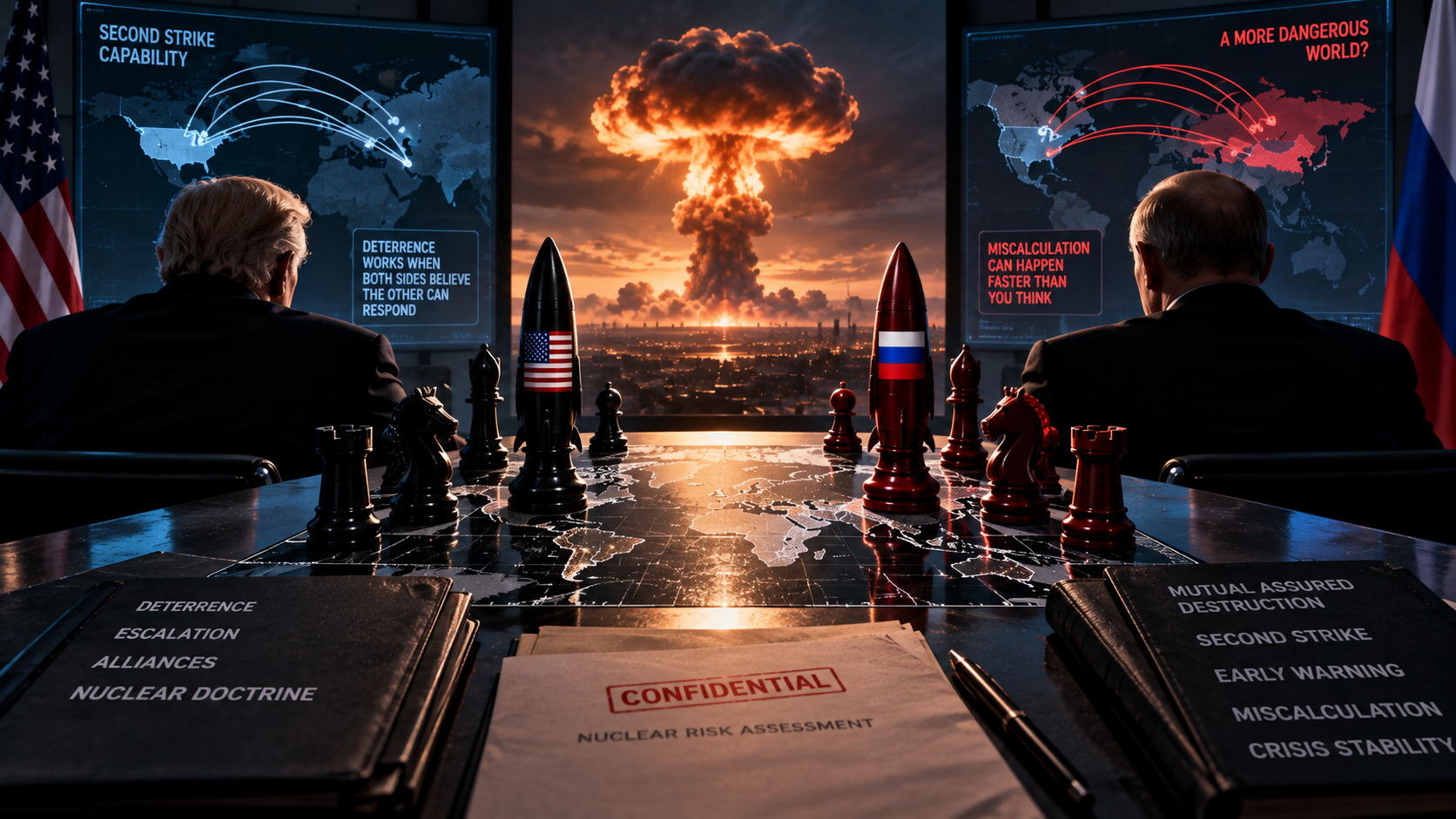
Nuclear Deterrence Depends On More Than Warhead Numbers
Why A Second Strike Is Central To Nuclear Deterrence
The threat of retaliation can discourage attack, but its effectiveness depends on survival, communication and human judgement.
Nuclear deterrence is an attempt to prevent an adversary from acting by making the expected consequences unacceptable. Its familiar promise is simple: an attack will not eliminate the victim’s ability to retaliate.
The difficulty lies in everything that must be true for that promise to work. Weapons must survive. Orders must remain controlled. The adversary must understand the threat. Leaders must interpret uncertain events without turning a warning into the catastrophe they fear.
Deterrence is therefore a relationship between capabilities and beliefs, not a protective property automatically produced by possessing a nuclear weapon.
Deterrence Is Different From Fighting
A military force can be designed to defeat an attack, punish one or discourage it from happening. Those purposes overlap, but they are not identical.
Deterrence by denial seeks to make an objective difficult or impossible to achieve. Deterrence by punishment threatens costs that outweigh the expected benefit. Nuclear deterrence is strongly associated with the second approach, although actual military strategies combine several forms of pressure.
NATO describes its nuclear capability as intended to preserve peace, prevent coercion and deter aggression. That establishes the alliance’s stated purpose. Whether a particular posture achieves that purpose is an analytical question, not something the statement itself proves.
An adversary may also misunderstand which actions would trigger a response. That is why public commitments, private signals and the surrounding political relationship matter alongside hardware.
What Does MAD Mean?
Mutually assured destruction describes a situation in which opposing sides retain the capacity to inflict devastating damage even after suffering a nuclear attack. If neither can escape retaliation, initiating an exchange offers no clean route to victory.
The term is often used loosely as a synonym for the entire nuclear age. It is more useful as a description of a strategic condition. Real doctrines differ, and governments have debated limited options, counterforce attacks, missile defence and escalation control.
MAD also does not mean every weapon must survive or that both arsenals must be numerically equal. The relevant question is whether the surviving response would impose costs the attacker regards as unacceptable.
That question contains uncertainty. There is no universally agreed number that mechanically creates reliable deterrence in every political relationship.
Why A Second Strike Matters
A first strike is an initial attack. A second-strike capability is the ability to respond after absorbing one. The distinction is about survivability and response, not simply about owning a second set of weapons.
A force concentrated in vulnerable locations could create an incentive to act before it is destroyed. A force that can survive reduces that particular pressure because waiting does not necessarily mean losing the ability to respond.
Submarines, hardened facilities, mobility and resilient communications can contribute to survivability in different ways. None is magical. Their value depends on detection, protection, readiness, command arrangements and the adversary’s capabilities.
The strategic ideal is a force secure enough that leaders need not make an irreversible decision merely because a warning might be real.
A Compact Map Of The Logic
A retaliatory force survives
Deterrence Logic: Attack cannot remove the response
Potential Failure: Survival is doubted
The response can be ordered
Deterrence Logic: The threat remains operational
Potential Failure: Communications fail
The adversary understands
Deterrence Logic: Expected costs discourage attack
Potential Failure: Signals are misread
Leaders retain control
Deterrence Logic: Restraint remains possible
Potential Failure: Pressure or error accelerates action
These conditions interact. Improving one dimension can complicate another. A system designed for rapid response may leave less time to investigate a false warning. Greater secrecy can protect forces while making reassurance harder.
Why More Weapons Do Not Answer Every Question
Arsenal totals attract attention because they are easy to compare. But a total does not reveal readiness, survivability, targeting assumptions or the reliability of command systems.
Two states could possess different numbers and still threaten unacceptable harm. They could also possess large arsenals while worrying that particular parts of their forces are vulnerable.
The distinction matters when reading claims that a numerical increase necessarily creates safety or necessarily proves an imminent intention to attack. Capability, purpose and likely use require separate evidence.
This article therefore avoids a current warhead leaderboard. The underlying mechanisms are more durable than a stockpile estimate that needs continual updating.
Extended Deterrence Adds Another Question
Extended deterrence means protecting an ally through the threat of a response. It asks an adversary to believe that attacking one country could bring retaliation from another.
That creates a credibility problem: would a protecting state accept grave risks for its ally? Alliances use commitments, deployments, consultation and conventional forces to make the relationship more than a promise on paper.
There can be different audiences for the same message. An adversary needs to be discouraged. An ally needs reassurance. Domestic populations need to understand the commitment and its risks.
A signal that reassures one audience may alarm another. Managing that tension is part of deterrence policy rather than an exception to it.
Miscalculation Does Not Require Irrational Leaders
People can make dangerous decisions using incomplete information while believing they are acting reasonably. An exercise may resemble preparation for attack. A defensive movement may look offensive. A technical warning may arrive during an already tense confrontation.
The National Security Archive’s records of US false missile warnings in 1979 and 1980 show why the distinction between an alert and an actual attack matters. Those incidents triggered actions within military warning systems without establishing that an enemy attack was under way.
The lesson is not that an alarm automatically launches nuclear weapons. It is that systems must discriminate between signals quickly enough to support both response and restraint.
Taylor Tailored’s account of nuclear war’s closest calls provides historical context. Each case should still be examined for what the records establish about actual decision authority.
Does Nuclear Deterrence Prevent Conventional War?
A nuclear relationship does not prevent every form of conflict. States can compete below the threshold they believe would trigger a nuclear response. They may disagree about where that threshold lies.
One possible consequence is restraint in a major confrontation alongside risk-taking in smaller conflicts. Analysts sometimes discuss this as a stability–instability problem. It is a hypothesis about incentives, not a rule that explains every war.
To assess a specific conflict, examine the objectives, conventional balance, alliance commitments and communications. Merely noting that nuclear weapons exist does not establish what caused a decision.
A Hypothetical Crisis Shows The Trade-Off
Imagine two nuclear-armed states during a conventional confrontation. One moves a force because it fears an attack. The other observes the movement but cannot confidently distinguish a protective action from preparation to strike.
Neither government needs to desire nuclear war for the situation to become more dangerous. Each may interpret the other’s response as confirmation of its initial concern. A sequence of locally understandable choices can create a collectively hazardous result.
This is an illustrative scenario, not a forecast about any current conflict. Its value is showing why analysts examine perceptions, communications and decision time rather than only asking whether leaders are rational.
A stabilising intervention might clarify the purpose of the movement or create time for verification. Whether it works depends on credibility. A message from an adversary cannot be assumed true merely because accepting it would be convenient.
The Difference Between A Threat And A Forecast
A public warning may seek to deter an action, reassure an audience or influence negotiation. It is evidence that the warning was made. It is not automatically a reliable prediction of the speaker’s next move.
Assess the wording, audience and relationship to observable behaviour. Distinguish a general doctrinal statement from a specific change in readiness. Avoid assigning numerical probabilities from rhetoric alone.
The same discipline applies to confident reassurance. Declaring that deterrence will certainly hold goes beyond what any historical record can establish about a future crisis.
Useful analysis identifies conditions that could strengthen or weaken restraint and the evidence that would show those conditions changing. It can be precise about mechanisms while remaining uncertain about outcomes. That is a more responsible way to discuss nuclear risk than treating every threat as either empty theatre or an inevitable countdown.
Deterrence And Compellence
Deterrence seeks to prevent an action. Compellence seeks to make another actor do something, such as reverse a decision or withdraw a force. The distinction helps explain why a threat that discourages one action may fail to produce another.
Preventing a new attack and forcing an adversary to abandon an objective can present different stakes and incentives. A government may regard backing down as politically or strategically costly even when it recognises the danger of escalation.
For a reader, identify the demand before judging the threat. Is the message setting a boundary, seeking a concession or doing both? Has the other side understood the same boundary?
This is conceptual analysis, not a prediction about how a particular government will respond. It shows why claims that nuclear weapons make a state able to dictate every outcome are much too broad.
Credibility Can Create A Commitment Problem
A threat must be credible enough to influence an adversary, but making it credible can also create pressure to act when circumstances change. Leaders may worry about the consequences of appearing to retreat from an explicit commitment.
Ambiguity can preserve flexibility while creating uncertainty about the response. Clarity can communicate a boundary while reducing room for adaptation. Neither is automatically best in every situation.
The trade-off depends on the audience, the stakes and the surrounding relationship. An analyst should therefore explain why a particular signal might help or harm restraint rather than treating stronger wording as inherently more effective.
A commitment also needs to be interpreted in relation to capabilities and behaviour. Words unsupported by practical arrangements may be discounted, while actions undertaken without explanation may be misread.
Arms Control Is Not The Same As Trust
An agreement can be useful between adversaries precisely because they do not trust one another. Defined limits, information exchanges and verification arrangements can make some behaviour easier to assess.
Whether a particular agreement achieves that depends on its terms, compliance and the strategic environment. The existence of a treaty does not abolish rivalry, and the absence of one does not prove war is inevitable.
The useful question is what uncertainty or incentive the arrangement addresses. Does it limit a capability, provide warning of an activity or create a process for clarifying disputes?
This mechanism-focused approach avoids judging risk reduction solely by the warmth of diplomatic language. An unglamorous procedure can matter if it reduces the chance that a routine activity is mistaken for an attack.
What Evidence Could Change An Assessment?
Before accepting a claim that deterrence is strengthening or weakening, identify the observations on which it depends. These might concern survivability, communications, alliance cohesion or changes in doctrine.
A single dramatic speech may matter, but it should be placed within that broader evidence. The same applies to a weapons test: what capability was demonstrated, under what conditions and with what uncertainty?
A sound assessment remains revisable. It states the conditions supporting restraint and the changes that could undermine them. That is more useful than a permanent label of safe or doomed attached to a complex relationship.
A useful discussion also distinguishes risk reduction from a promise of zero risk. A measure can improve the information available to decision-makers without eliminating hostile intent or every possibility of error. Its value should be assessed against the specific failure it is intended to prevent.
How Could Risk Be Reduced?
Risk reduction can address warning errors, ambiguous signals, uncontrolled escalation and incentives to strike first. Communication channels, notifications, arms-control arrangements and resilient command systems can each contribute, depending on their design and use.
They cannot guarantee agreement or abolish hostile intent. Their practical value may be giving decision-makers more accurate information and more time before an irreversible choice.
The same caution applies to claims about technology. A faster sensor or more sophisticated algorithm can improve some tasks without resolving the political meaning of the event it detects.
Nuclear deterrence rests on a disturbing proposition: catastrophe can be prevented by making its possibility credible. Understanding it requires holding both sides of that proposition in view—the restraint it seeks to create and the risks that remain when people, machines and governments interpret one another under pressure.
