Russia Hosts Taliban With China, Iran And India As Moscow Builds An Afghanistan Order Without The West
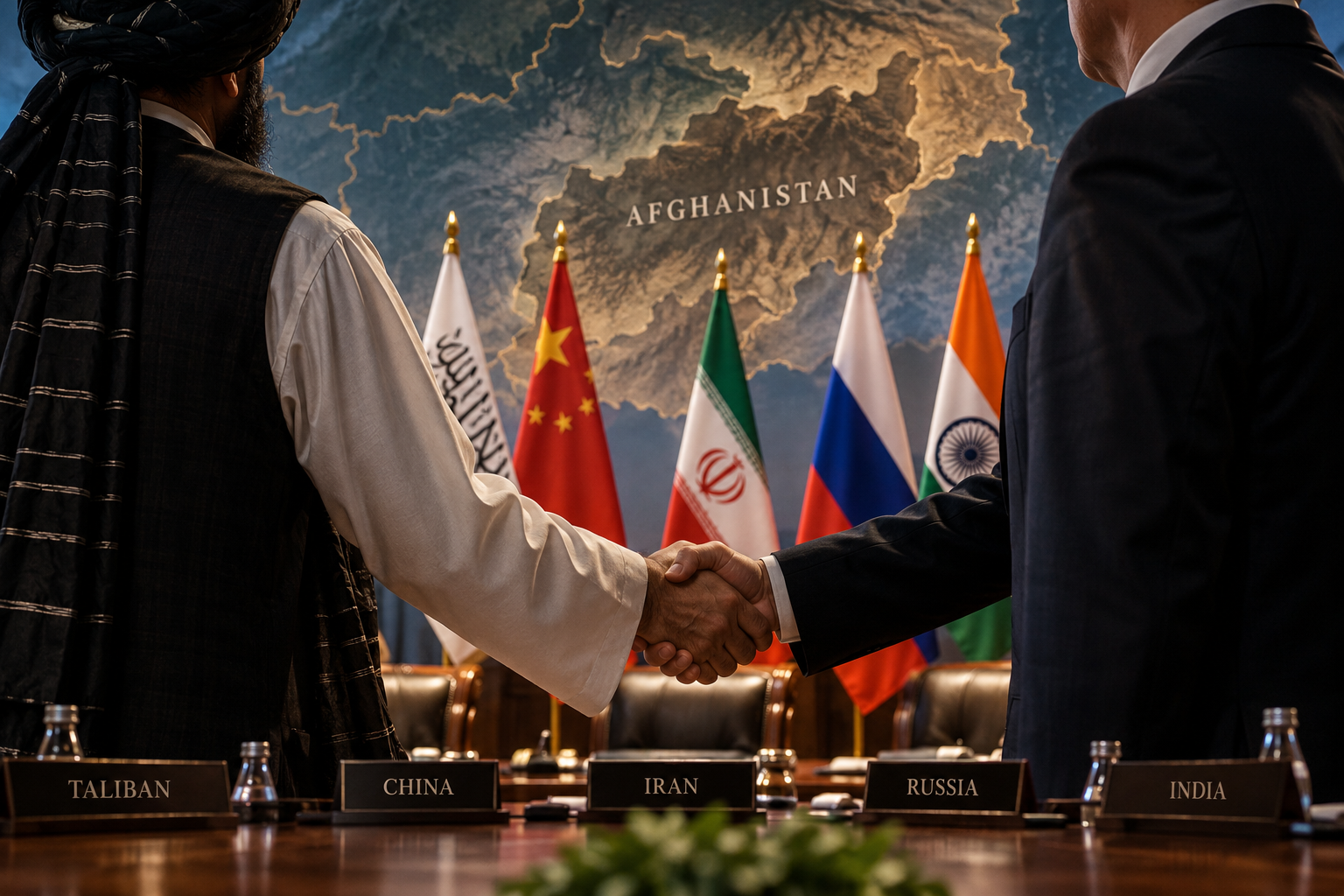
Moscow Hosts Taliban And Asian Powers As Russia Rejects Any NATO Return To Afghanistan
China, India And Iran Join Russia And Taliban For Talks With The West Outside The Room
Russia says the meeting is about security and economic cooperation. The harder question is who now gets to shape Afghanistan.
Russia has brought Afghanistan’s Taliban government into the same diplomatic room as China, India, Iran, Pakistan and the Central Asian states for a new round of talks in Moscow.
The eighth Moscow Format consultations on Afghanistan opened on 5 October with Taliban Foreign Minister Amir Khan Muttaqi leading the Afghan delegation. Representatives from China, India, Iran, Kazakhstan, Kyrgyzstan, Pakistan, Tajikistan and Uzbekistan also attended, while Belarus and Egypt were invited as guests.
On paper, the agenda is practical: political and economic cooperation, counter-terrorism and the fight against narcotics.
In reality, the meeting also shows how far the regional order around Afghanistan has shifted since the United States and NATO withdrew in 2021.
The Western powers that spent two decades fighting in Afghanistan are not setting the terms in Moscow. Russia and the major states surrounding Afghanistan are.
And Moscow has made one point unusually explicit: it does not want NATO military infrastructure returning to Afghanistan or appearing in neighbouring states.
That makes this more than another conference about a difficult country. It is also a statement about the security architecture emerging across Eurasia.
Why The Taliban Is At The Centre Of The Meeting
The simplest reason for inviting the Taliban is that it governs Afghanistan.
Whatever outside governments think of the movement, the Taliban controls the state, its borders, most of its security apparatus and the decisions that determine whether Afghanistan becomes a source of regional instability or a partner in managing it.
Russia has gone further than most countries. In 2025 it became the first state to formally recognise the Taliban government.
That decision did not erase the Taliban’s international isolation. Restrictions imposed on women and girls continue to be one of the main reasons much of the world has withheld formal recognition.
But neighbouring powers still have to deal with the government that exists.
For Russia and Central Asia, the priorities include militant movements, border security, narcotics and the possibility that instability could move north from Afghanistan.
China has its own security concerns and an economic interest in keeping the country stable enough for trade, mining and infrastructure links.
Iran shares a long border with Afghanistan and has to manage refugees, water disputes, trade and security.
India has no desire to leave Afghanistan entirely to Pakistan or China and has maintained contacts with the Taliban while avoiding formal recognition.
Pakistan has perhaps the most complicated relationship of all. It once had extensive influence over the Taliban movement, but relations between Kabul and Islamabad have deteriorated sharply, with repeated disputes over cross-border militancy and military action.
That means the Taliban is not in Moscow because all of these countries suddenly approve of its government.
It is there because Afghanistan is strategically unavoidable.
What They Are Likely To Discuss Behind The Formal Agenda
The declared subjects tell only part of the story.
Counter-terrorism will be near the top of the agenda. Russia has publicly praised Taliban action against Islamic State militants, while regional governments remain concerned about armed groups operating in or around Afghanistan.
The question is whether the Taliban can convince its neighbours that Afghan territory will not again become a launchpad for attacks elsewhere.
The second issue is Pakistan.
Tensions between Afghanistan and Pakistan have become serious enough for Russia to offer help in reducing them. Muttaqi used the Moscow meeting to argue that disputes with Islamabad should be handled through diplomacy rather than force.
That matters because Pakistan is not an outsider to the talks. It is sitting at the same table.
The third issue is economic integration.
Afghanistan sits between Central Asia, South Asia, Iran and China. Roads, railways, electricity links, minerals, trade corridors and transit routes all become more valuable if the country is stable enough to connect them.
For a landlocked state that remains economically weak and internationally constrained, regional trade offers the Taliban something recognition alone cannot: revenue and practical legitimacy.
The fourth issue is narcotics.
Russia has long treated Afghan drug production as a domestic security problem because trafficking routes run north through Central Asia. Moscow says cooperation with the Taliban has helped reduce that threat.
Then comes the issue likely to matter most geopolitically: whether Western military power can ever re-enter Afghanistan.
Moscow Is Drawing A Line Against NATO
Sergey Lavrov used the opening of the meeting to reject the deployment of NATO military infrastructure in Afghanistan or neighbouring countries.
That language matters.
It turns the Moscow Format from a conversation about Afghanistan’s internal problems into a discussion about who has the right to operate militarily across the wider region.
Russia’s position is clear. It wants Afghanistan embedded in a regional security system in which Moscow, Beijing, Tehran, New Delhi, Islamabad and Central Asian governments manage the problems themselves.
A return of American or NATO forces would cut directly across that vision.
This is part of a wider pattern. Russia and China increasingly argue that security problems in Eurasia should be handled through regional institutions and bilateral relationships rather than Western-led military structures.
That does not mean the countries at the table form one coherent alliance.
India is not strategically aligned with China. India and Pakistan remain rivals. Iran and Pakistan have their own tensions. Russia and China cooperate closely but still pursue their own interests.
The significance is therefore not a new anti-Western bloc acting as one.
It is that very different states can still agree on reducing Western military influence while competing with one another inside the space left behind.
That distinction matters.
The world emerging around Afghanistan is not neatly divided into two camps. It is more transactional than that.
China, Iran And India Each Want Something Different
China’s interest is partly geographic.
Afghanistan sits close to China’s western frontier and near routes linking Central Asia, Pakistan and Iran. Beijing wants militant threats contained and commercial opportunities protected without becoming responsible for rebuilding the country.
China also benefits when governments across the region become economically connected to Chinese trade and infrastructure.
Iran’s calculation is different.
Tehran needs a stable eastern border, workable trade, control over refugee pressures and some ability to influence what happens inside Afghanistan. It also shares Moscow’s opposition to a renewed American military footprint close to Iranian territory.
The importance of that alignment is magnified by the wider confrontation between Washington and Tehran. Russia and China have already become central to the question of how much strategic and economic space Iran retains under American pressure, a dynamic explored in how Russia and China support Iran without necessarily entering its wars.
India is the awkward but important participant.
New Delhi has strong ties with Russia, growing competition with China and a long history of hostility with Pakistan. Afghanistan matters because India does not want strategic access to Kabul monopolised by either Islamabad or Beijing.
Its presence in Moscow is therefore evidence of something broader: participation in a Russia-led forum does not automatically mean membership of a Russia-China-Iran camp.
India can cooperate with Washington in one arena and sit with the Taliban, Russia and Iran in another.
That is increasingly how multi-aligned powers behave.
Why This Matters Beyond Afghanistan
The meeting shows how states excluded from, sanctioned by or increasingly sceptical of Western institutions are building diplomatic mechanisms that do not depend on Washington.
But it would be a mistake to describe every such meeting as the birth of a single rival alliance.
The more important change is subtler.
Countries are creating more places where the United States is not the organiser, not the guarantor and sometimes not in the room.
That matters because power is not only military.
It is also the ability to convene, mediate, finance, recognise, trade and decide which security arrangements are legitimate.
Russia is using Afghanistan to demonstrate that it can still organise regional diplomacy despite confrontation with the West elsewhere.
China gets a forum where its preference for non-Western regional management fits naturally.
Iran gets strategic depth against American pressure.
India retains access without choosing one geopolitical camp.
The Taliban gains the most immediate prize of all: normalisation.
Every photograph of its foreign minister standing beside established regional governments helps move the Taliban from insurgent movement to functioning state actor in the eyes of international audiences, even where formal recognition remains absent.
How Trump Is Likely To View The Meeting
There has been no confirmed Trump response to the Moscow gathering at the time of publication.
Any assessment of his reaction therefore has to be separated from what he has actually said.
The strongest guide is Bagram.
Trump has repeatedly treated the loss of Bagram Airfield as one of the clearest symbols of what he regards as the failure of the 2021 withdrawal. In an August 2026 White House proclamation marking the fifth anniversary of the Abbey Gate attack, he again criticised the decision to abandon Bagram and stressed its strategic value.
That makes Lavrov’s rejection of any renewed NATO infrastructure particularly relevant.
From Trump’s perspective, the Moscow meeting could be read as evidence that strategic space once occupied by the United States is now being organised by Russia, China, Iran and the Taliban itself.
The fact that India is also present complicates any simple hostile-bloc narrative, because Washington continues to have important strategic reasons to work with New Delhi.
But Bagram changes the optics.
A Russian-led meeting in which Moscow praises the Taliban, works with it on security and declares a Western military return unacceptable touches several issues Trump has made politically important: the Afghanistan withdrawal, terrorism, competition with China and American military access.
It also intersects with his current confrontation with Iran. Washington has recently intensified pressure on Tehran while China remains one of the most difficult pressure points in Trump’s Iran strategy.
Trump would therefore have reasons to see the gathering not simply as Afghan diplomacy, but as another arena in which major powers are testing how much can be organised outside American influence.
That does not automatically mean he would seek to return US forces to Afghanistan.
It does mean the question of access, intelligence and counter-terrorism will remain strategically uncomfortable for Washington.
The Taliban Is Turning Geography Into Leverage
The Taliban’s greatest diplomatic asset is not ideology. It is location.
Afghanistan sits beside Iran, Pakistan, China and Central Asia and close to some of the world’s most important strategic fault lines.
No regional power can simply ignore it.
That gives the Taliban room to pursue relationships with governments that may dislike its domestic policies but still need cooperation on security, migration, trade or infrastructure.
Russia’s recognition accelerated that process.
The Moscow meeting pushes it further.
The Taliban is not becoming universally accepted. Its treatment of women and girls remains a profound barrier to wider legitimacy, and many governments remain unwilling to recognise it formally.
But isolation is no longer complete.
The regional powers around Afghanistan are increasingly choosing engagement over exclusion.
For Washington, the important point is not that Russia, China, Iran and India have suddenly formed a Taliban alliance.
They have not.
The more consequential shift is that Afghanistan is becoming embedded in a regional system that can function without the United States.
And once that system has deeper trade routes, security relationships and diplomatic habits, rebuilding American influence becomes harder even if Washington later decides that leaving the field entirely was a strategic mistake.
Sources
Associated Press — Russia hosts a Taliban delegation, others for consultations on Afghanistan — Confirms the 5 October meeting, participating states, Lavrov’s remarks, Russia’s recognition of the Taliban and Moscow’s opposition to a NATO military return.
Reuters — Afghan Taliban says problems with Pakistan can be resolved through diplomacy — Supports the Afghanistan-Pakistan diplomatic dimension and Muttaqi’s public position during the Moscow talks.
The White House — Fifth Anniversary of the Attack at Abbey Gate — Establishes Trump’s August 2026 criticism of the Afghanistan withdrawal and his emphasis on the loss and strategic importance of Bagram Airfield.
Next Reads
Russia, China and Iran War Support Explained — Explains how Moscow, Beijing and Tehran cooperate where their interests overlap without forming a conventional military alliance.
Trump Threatens Iran’s Supporters — And China Is The Obvious Collision Point — Useful context for why China and Iran appearing together in Moscow matters to current US strategy.
CIA Chief’s Secretive Moscow Mission As US Military C-17 Lands In Russia — Examines the wider tension between US-Russia rivalry and the continued need for direct strategic communication.
