

Saudi Pipeline Shutdown Puts Up to 4% of Global Oil Supply at Risk — the Buffer Is Finite
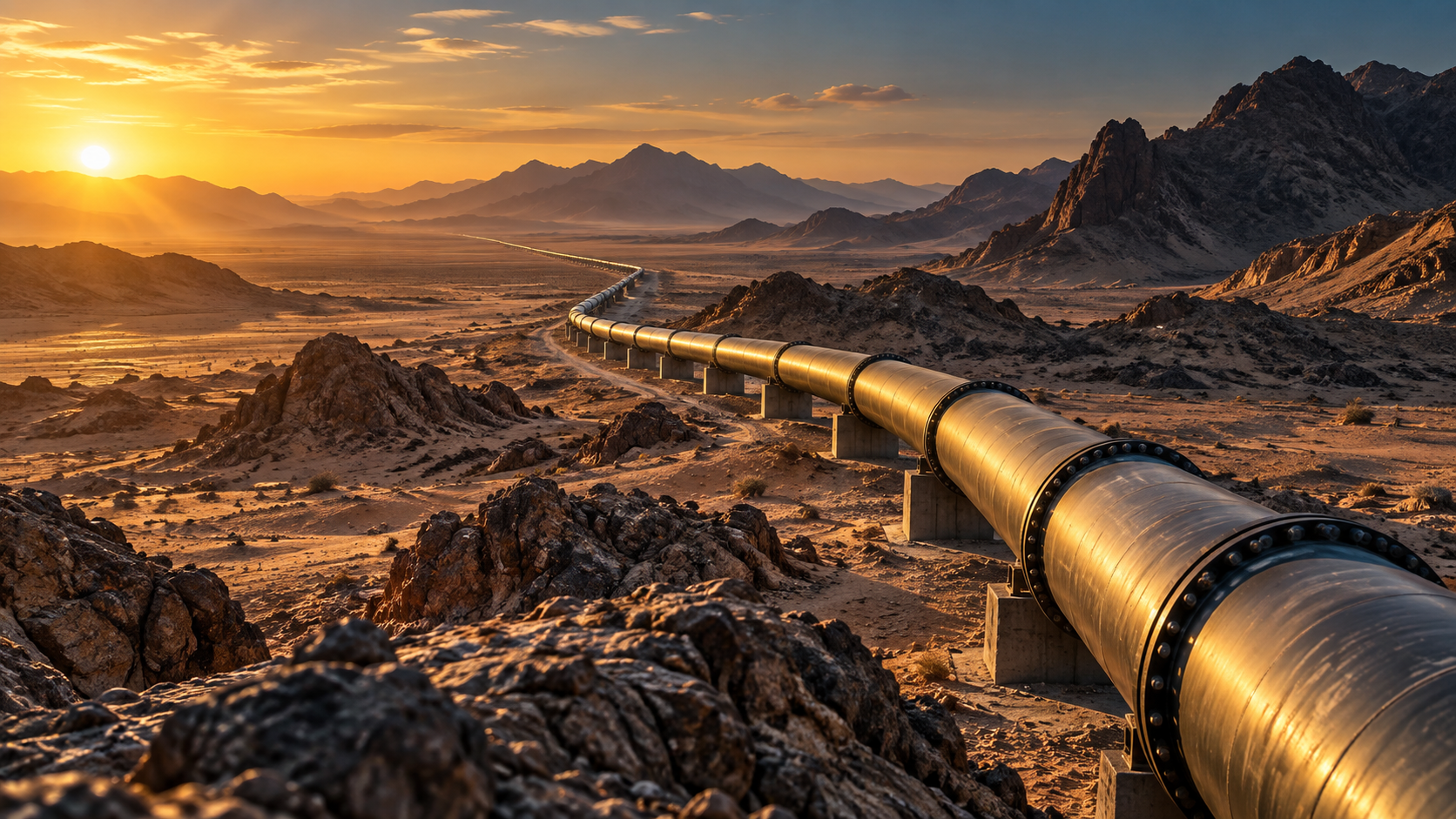
Why the Saudi Pipeline Outage Matters Before Exports Stop
Four Million Barrels a Day: Understanding Saudi Arabia’s Supply Risk
Saudi Arabia’s damaged East-West pipeline has turned a major export alternative into a fresh source of uncertainty for the oil market.
Reuters reported on 13 September that prolonged disruption could endanger flows equivalent to around 4% of world supply. Industry sources put the remaining export buffer at Yanbu at roughly five to seven days, with repair estimates varying.
The warning is conditional. It does not mean 4% of global oil has already disappeared. Its significance is that stored crude can temporarily disguise the consequences of an interrupted pipeline — until the stock available for loading runs down.
Why an Export Buffer Matters
A pipeline and a storage terminal perform different jobs. The pipeline replenishes the terminal. Storage allows exports to continue when incoming flows and outgoing cargoes do not match from hour to hour.
When replenishment stops, the terminal can still look active. Ships may load and depart. That activity does not necessarily mean the underlying problem has been resolved.
Think of a business delivering orders from a warehouse while its factory is closed. The deliveries are real, but they cannot continue indefinitely at the same rate without replacement production or stock from elsewhere.
For oil buyers, the relevant question is therefore not simply whether a ship loaded today. It is whether the next scheduled cargoes can also be supplied, and on what terms.
This is why repair information matters so much before the physical shortage becomes visible. Buyers have to make decisions while some of the most important facts remain uncertain.
What Does the 4% Figure Mean?
The reported exposure is approximately four million barrels a day. Against a round illustrative world supply figure of 100 million barrels a day, that represents four barrels in every hundred.
That comparison describes scale. It does not predict a 4% rise in prices, a 4% reduction in every country’s deliveries or the complete loss of the volume for a fixed period.
The eventual effect depends on how much pumping resumes, how quickly, and what alternative supplies buyers can secure. It also depends on whether demand changes in response to higher costs.
The following arithmetic shows why duration matters. These are gross-flow illustrations before replacement supplies, demand changes or storage releases; they are not forecasts of realised losses.
Illustrative interruption at four million barrels a dayGross flow affectedOne dayFour million barrelsThree daysTwelve million barrelsSeven daysTwenty-eight million barrels
A short interruption and a prolonged outage can therefore produce very different consequences, even when the damaged asset is the same.
A Restart Is Not Necessarily Full Recovery
The word “restart” can conceal several different operating conditions.
A section of a system might resume work while other restrictions remain. Pumping can recover before every customer’s delivery schedule returns to normal. A successful repair can also be followed by inspection, testing or a gradual increase in throughput.
None of those possibilities establishes the current technical condition of this pipeline. They explain why a future announcement needs to be read for its details.
A useful update would specify actual throughput, which routes are available and whether export schedules have changed. A statement that operations are being restored would be encouraging, but less informative without those numbers.
The same discipline applies to repair estimates. An optimistic scenario should not be treated as a guaranteed completion date. A worst-case estimate should not be reported as the expected outcome simply because it makes a more dramatic headline.
Why the Alternative Route Is So Important
The East-West system moves crude towards the Red Sea, providing an alternative to exports through the Strait of Hormuz. That makes the pipeline particularly valuable when Gulf shipping is disrupted.
Its vulnerability exposes a broader problem with contingency planning: an alternative route only provides resilience while its own infrastructure remains usable.
Geographic separation helps, but does not automatically eliminate shared security risks. If an original route and its substitute are both exposed to regional conflict, available flexibility can be much smaller than a map initially suggests.
For the wider market, that means spare production capacity and usable export capacity must be considered separately. Oil that cannot reach a buyer on the required timetable does not fully solve that buyer’s shortage.
What This Could Mean for Consumers
The immediate consequences would fall first on cargo scheduling, replacement purchasing and the cost of moving oil. The effect on retail fuel would depend on how those pressures pass through refining and distribution.
There is no defensible conversion from this outage alone to a specific increase at a British petrol station. Retail prices also reflect existing inventories, exchange rates, tax and business decisions.
The sensible conclusion is narrower: sustained disruption would add pressure to the supply chain, while a rapid and durable recovery could reduce the feared shortfall.
The Numbers That Matter Next
The critical evidence will be actual pumping rates, export availability and confirmed repair progress. These will show whether the storage buffer has bought enough time.
For now, the danger lies in the gap between continued deliveries and interrupted replenishment. A system can keep supplying customers for several days while becoming less able to absorb the next problem.
That is the significance of the Saudi warning. The oil has not all vanished. The room for a delayed repair may be vanishing faster than the outward appearance of normal exports suggests.
Outside the Article
Reuters — Saudi pipeline export risk, 13 September — Industry-source estimates for exposed flows and the stock buffer. Not official confirmation of a fixed repair duration.
IEA — Oil Market Report, September 2026 — Primary market assessment of Russian and Gulf product exports, inventories and refining constraints. Forecasts remain forecasts.
Reuters — Hormuz, Saudi Arabia and shipping, 13 September — Reported incidents and wider route context; attribution is kept separate from observed disruption.
