

Hormuz and Saudi Pipeline Attacks Expose a Wider Threat to the Routes That Keep Oil Moving
The Oil Shipping Problem Beyond a Single Chokepoint
When Backup Routes Struggle
Fresh attacks affecting Gulf shipping and Saudi infrastructure are increasing concern about the reliability of the routes carrying Middle Eastern energy to world markets.
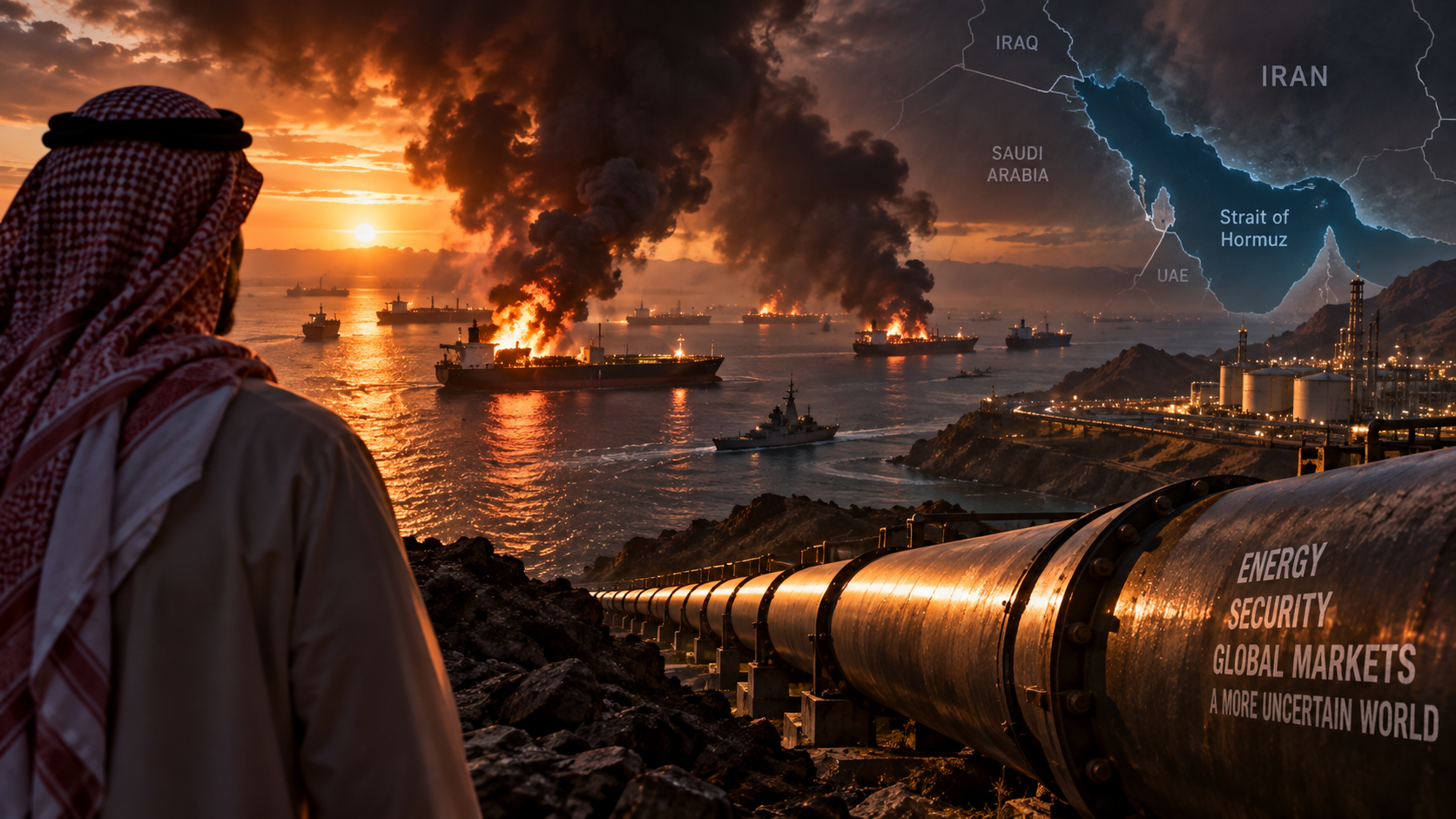
Reuters reported on 13 September that UK Maritime Trade Operations had described a projectile strike causing a vessel fire and evacuation in the Strait of Hormuz. Saudi Arabia’s East-West pipeline was also offline after attacks, while Houthi advances around the entrance to the Red Sea added another source of uncertainty.
The broader problem is not confined to a single damaged asset. It is the possibility that disruption to one route coincides with pressure on the alternatives intended to replace it.
Three Different Parts of the Transport System
Hormuz, the East-West pipeline and Bab el-Mandeb should not be treated as interchangeable names for the same bottleneck.
Hormuz connects the Gulf with the waters beyond it. The Saudi pipeline carries crude across land towards the Red Sea. Bab el-Mandeb lies at the southern entrance to that sea, connecting it with the Gulf of Aden.
Their different locations matter. A ship’s exposure depends on its origin, destination and route. A cargo loaded on the Red Sea for a northern destination does not automatically follow the same path as one travelling south towards the Indian Ocean.
That means a map showing several danger points is the start of the analysis, not its conclusion. The relevant question is which cargoes need to pass through which points, and what alternatives remain available to them.
A Route Can Become Unreliable Before It Is Physically Closed
Total closure is not the only condition that disrupts trade.
A route can remain technically navigable while operators judge it too dangerous or too uncertain for a scheduled voyage. Delays, inspections and altered routing can affect delivery even when some vessels continue to pass.
This is why scattered successful transits do not necessarily establish that normal operations have returned. Equally, an attack on one vessel does not prove that every ship has been stopped.
The useful evidence includes transit volumes, waiting times and the terms under which operators are willing to sail. These describe the functioning of the route more accurately than a simple open-or-closed label.
For a buyer waiting for a particular cargo, reliability matters alongside physical capacity. An uncertain delivery date can create costs even if the oil ultimately arrives.
Why Alternative Routes Can Fail Together
Contingency planning often assumes that an interruption in one place can be managed by using a different route.
That works best when the alternative is exposed to different risks. It works less well when both routes depend on infrastructure threatened by the same regional escalation.
This does not mean every alternative has failed. It means the market needs to test the independence of its backup options, rather than count them as if each were guaranteed to remain available.
Consider a hypothetical buyer choosing between two delivery routes. If each can be disrupted for unrelated reasons, the second provides useful insurance. If the same conflict threatens both, the second may still help, but less than its nominal capacity suggests.
The principle applies beyond oil. Ports, undersea cables and air corridors can all appear diversified while retaining common vulnerabilities.
Attribution Must Remain Separate From the Incident
A vessel being struck, a government naming an attacker and an armed group claiming responsibility are different pieces of evidence.
They may eventually fit together. They should not be collapsed into one fully verified account before that has happened.
The same is true of several incidents occurring over one weekend. Similar timing does not establish that they were ordered by the same organisation or formed part of a single coordinated operation.
For readers, the safest approach is to ask what has been directly reported, who is making each claim and what remains unconfirmed. That is especially important when responsibility could influence military retaliation or diplomatic decisions.
What Would Meaningful De-escalation Look Like?
An announcement of talks would be a diplomatic development. It would not itself restore a damaged pipeline or establish safe passage for merchant vessels.
The practical tests would be more specific: sustained transits, fewer incidents, credible operating arrangements and recovery in the flow of cargoes.
Any shipping agreement would also need to be understood in scope. Which waters does it cover? Which vessels can use it? Who accepts the terms? What happens if an armed actor outside the agreement carries out another attack?
These questions do not make diplomacy pointless. They show the work required to translate diplomatic language into a route that shipowners and crews can rely on.
The Consumer Impact Depends on More Than the Next Headline
For households, the main concern is whether transport disruption sustains pressure on fuel and other costs. For businesses, it is also about timing and continuity of supply.
Neither effect can be calculated from the number of weekend incidents alone. Cargo availability, replacement routes, inventories and the length of disruption all matter.
The most useful next update will therefore combine security information with evidence of actual operations. A decline in alarming headlines would be welcome, but it would not be sufficient proof that the supply chain had recovered.
The current danger is a reduction in dependable choices. When several routes become uncertain at once, the system has fewer ways to absorb the next disruption — even before any one route is completely lost.
