

Saudi Shares Fall as Aramco Drops — Why Higher Oil Prices May Not Protect Producers
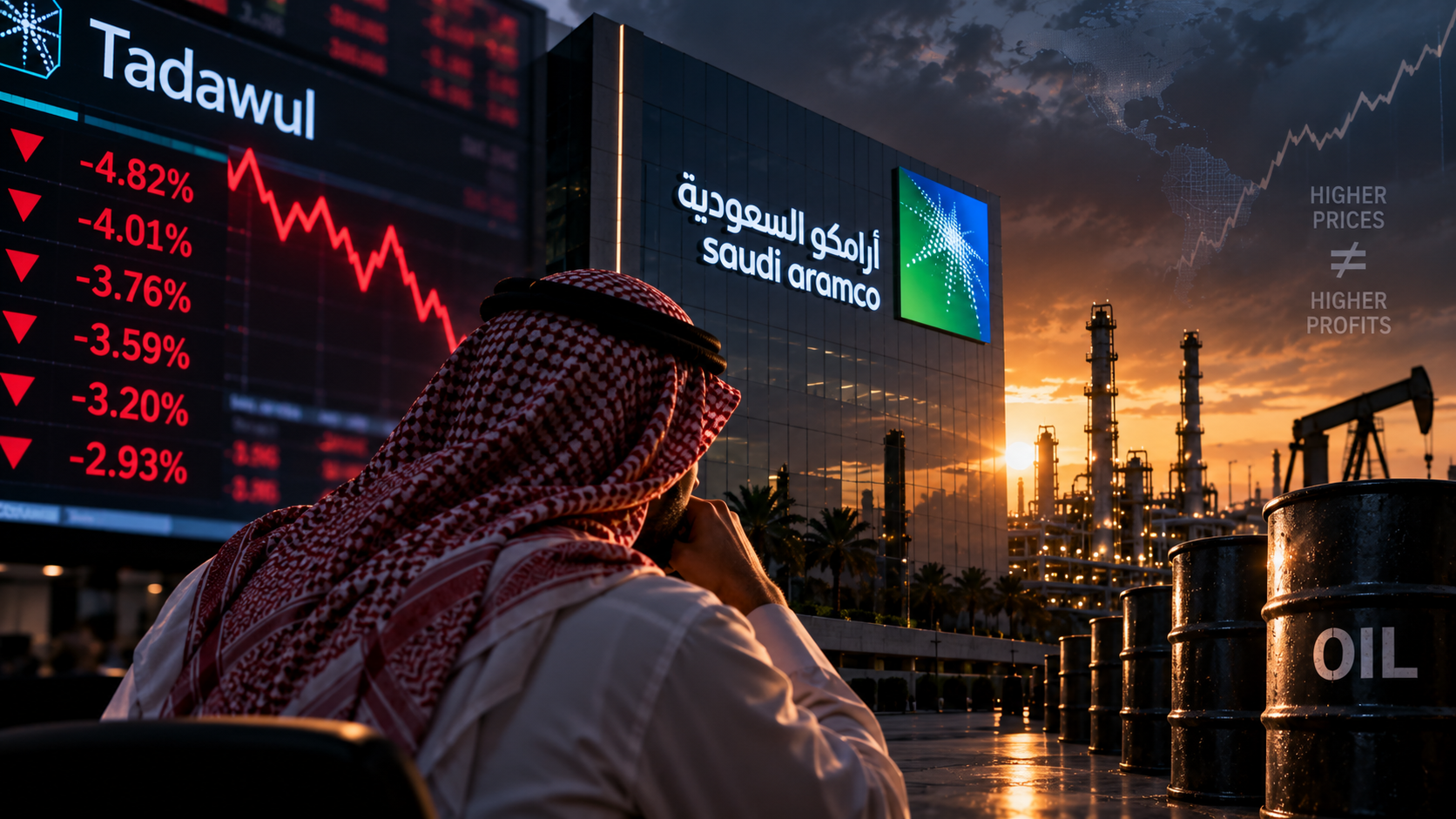
The Export Risk Behind Saudi Arabia’s Market Decline
Price Is Only Half the Story
Saudi equities fell on 13 September as investors assessed the consequences of attacks on energy infrastructure and shipping.
In its updated Sunday report, Reuters put the Saudi benchmark’s decline at 1.3% and Aramco’s fall at 1.6%. These are reported session readings, not a separately verified closing-price dataset.
The reaction illustrates an easily missed distinction: an oil company’s shares do not have to rise simply because disruption threatens to make oil more expensive.
Price Is Only One Part of Revenue
A producer’s revenue depends on both the price it receives and the quantity it can sell.
If the selling price rises while exportable volume falls, those forces work against one another. Which dominates depends on their scale, as well as costs and the duration of the disruption.
Consider a deliberately simplified illustration. A business sells 100 units at £10 each, producing £1,000 of revenue. If its price increases by 10% but its sales volume falls by 20%, revenue becomes 80 multiplied by £11: £880.
The price has risen, yet revenue is 12% lower. This is not an Aramco forecast or a description of its contracts. It demonstrates why a higher commodity price cannot, by itself, establish that a producer benefits from an interruption.
Investors Also Price Uncertainty
The expected duration of a problem can matter as much as its initial scale.
A short interruption with a credible repair schedule differs from an outage with uncertain consequences for deliveries. Investors may also consider the possibility of repeat attacks, additional operating costs and the reliability of alternative export routes.
None of those considerations allows an outsider to identify the precise motivation behind every sale of a share. A market move aggregates decisions made for many reasons.
That is why “shares fell after the attack” is more defensible than claiming to know exactly how much of the decline was caused by one particular piece of damage.
Do Not Confuse Aramco With Luberef
Reuters also reported a much larger fall in Saudi Aramco Base Oil Company, known as Luberef. That is a separate listed company from Saudi Aramco.
The similar names create an obvious headline risk. A percentage associated with Luberef must not be attributed to the much larger oil producer.
The principle is broader than this story: verify the legal company name and security before combining a price movement with a corporate brand. A familiar name does not make two quoted instruments interchangeable.
What Would Change the Picture?
Confirmed operating information would help investors distinguish an interruption from a more persistent constraint. Relevant disclosures include export availability, repair progress and any material change in the company’s outlook.
The next trading session will also supply a fresh price observation. It should not be described in advance as a certain rebound or another inevitable decline.
For readers trying to understand the market, the central lesson is that exposure has two sides. A company can sell a valuable commodity while facing greater difficulty delivering it.
Higher oil prices may help the value of each barrel sold. They do not guarantee the number of barrels sold, the cost of supplying them or the confidence investors place in the next delivery.
Outside the Article
Reuters — Saudi shares and Aramco, updated 13 September — Updated report gives TASI down 1.3% and Aramco down 1.6%. Earlier 1.1% Aramco reading is not used. Not presented as independently verified closing data.
