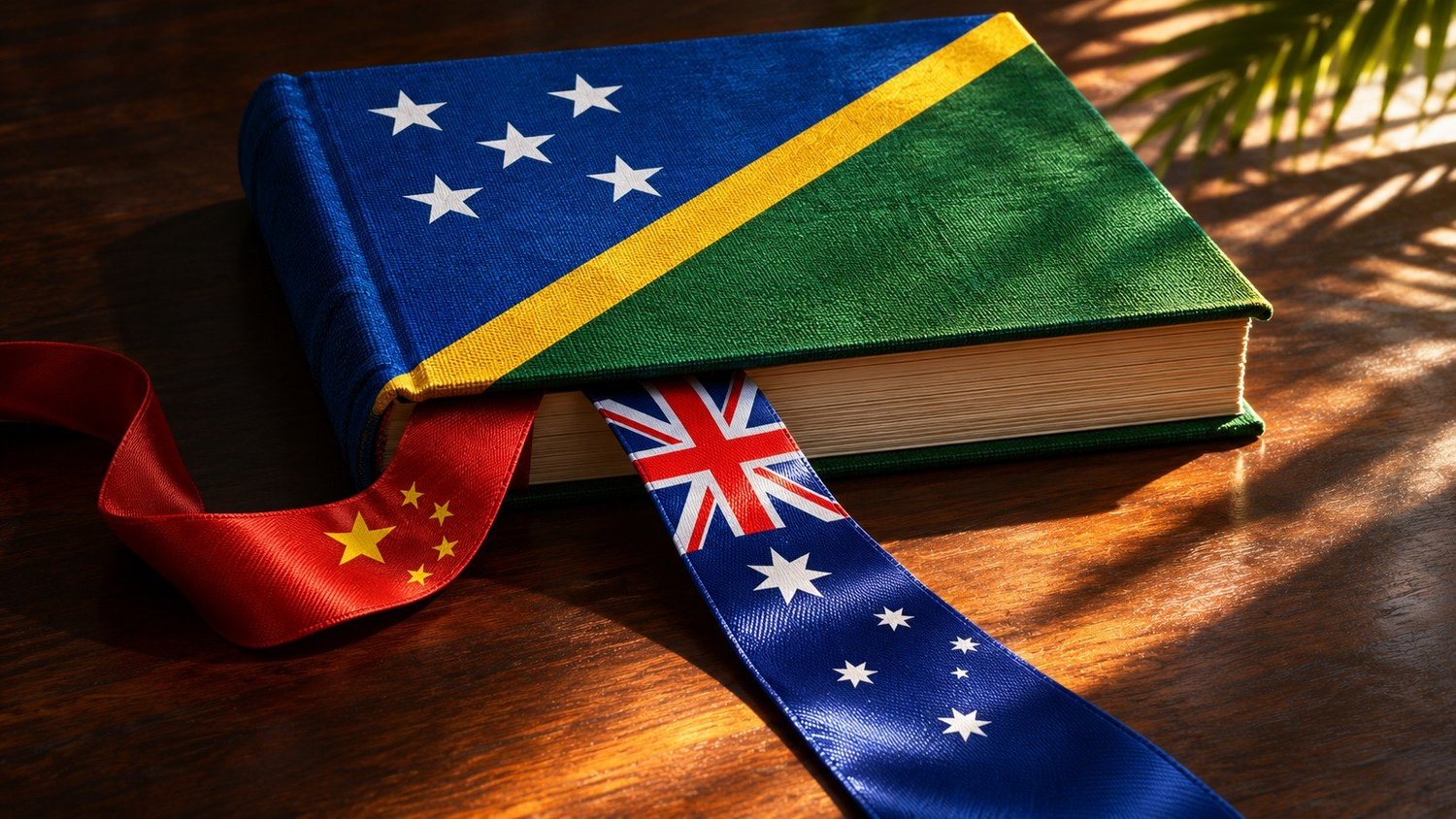
Solomon Islands Drops Its China Security Pact and Signs With Australia: What the Treaty Changes
In April 2022, a short and secret security agreement between Solomon Islands and China set off alarms in Canberra, Washington and Wellington. A leaked draft suggested Chinese warships might one day dock about 1,600 kilometres off Australia's north-east coast. Four and a half years later, that agreement is on its way out.
On Wednesday 25 November, Solomon Islands Prime Minister Matthew Wale and his Australian counterpart, Anthony Albanese, signed the Australia–Solomon Islands Treaty in Canberra. A day earlier, the ABC and the Sydney Morning Herald reported that Honiara had told Beijing it would not renew the 2022 pact when its five-year term ends in April 2027.
Taken together, the two moves are the biggest change in the Pacific security picture since the China deal was first revealed. Here is what has been confirmed, what is still unclear and why it matters well beyond the South Pacific.
What Was Signed in Canberra
Wale arrived in Australia on Tuesday with 15 ministers for talks covering security, infrastructure, education and health, according to AFP. The treaty was signed the following day. A joint statement from the two governments said it "will make Australia, Solomon Islands and the region safer and more prosperous".
According to AFP and Reuters reporting on the joint statement, the treaty:
- names Australia as Solomon Islands' primary security partner, described in the statement as Honiara's "sovereign choice";
- affirms Solomon Islands' sovereign decision that there will be "no foreign military or security base" in the country;
- commits both sides to keep sensitive infrastructure free from militarisation, foreign interference and unauthorised access;
- affirms Solomon Islands' sovereignty and its right to decide its own security needs and partnerships.
The full text has not been officially published. The ABC confirmed that Australia will provide an additional $980 million in support, and reported that leaked texts it had seen included $142 million for Wale's free-education policy and $47.8 million for visa improvements and security requests. Those figures come from documents seen by the broadcaster rather than an official release, and the ABC's report did not spell out how the money will be phased.
Albanese said the treaty would take the relationship to "a next level", adding that Australia was proud to be Solomon Islands' main security partner.
What Happens to the China Pact
The 2022 agreement was signed under Wale's predecessor, Manasseh Sogavare. Its text has never been made public. According to the ABC, it allows China to rotate police training teams through Solomon Islands, with about two dozen Chinese police present at any one time. A leaked draft circulated in 2022 went further, appearing to allow Chinese naval ship visits and the deployment of Chinese forces to protect Chinese personnel and projects. That draft is the main reason Australia and the United States treated the deal as a strategic threat.
Wale said in June that his government would review the pact. The SMH, citing unnamed Solomon Islands sources, reported on 24 November that Honiara had told Beijing it would not renew the agreement, which expires in April 2027. Some reports say Wale gave six months' notice of withdrawal, but AFP described the exact status as unclear. Wale himself said discussions with China were "ongoing" and that a non-disclosure clause stopped him from saying more.
That distinction matters. On the evidence published so far, the China pact is not being torn up overnight. It is being allowed to lapse, or ended under its own notice terms, while the Australian treaty takes effect.
Beijing's response
China's foreign ministry said its ties with Pacific countries are not "geopolitical contests or bloc confrontation", according to AFP. Reuters reported that the Chinese and Australian foreign ministries and the Solomon Islands embassy in Canberra did not immediately respond to requests for comment.
How Solomon Islands Got Here
Australia has long been Solomon Islands' main security partner. From 2003 to 2017 it led the Regional Assistance Mission to Solomon Islands (RAMSI), an international police and military intervention after years of ethnic conflict. A bilateral security treaty followed in 2017, allowing Australian police and troops to deploy at Honiara's request. They did so in November 2021, when riots in the capital burned parts of Chinatown.
Sogavare had switched diplomatic recognition from Taiwan to China in 2019, and the 2022 security pact deepened that relationship. In Australia, the deal became an election issue: Labor argued that the Morrison government had been caught asleep at the wheel. Penny Wong, now foreign minister, has called it Australia's worst Pacific foreign-policy failure since the Second World War, according to the ABC.
The turning point came in May 2026, when Wale, a long-time critic of Beijing's expanding influence, became prime minister. He set an ambitious goal of agreeing a new treaty with Australia by the end of the year. His government has not had a smooth ride. AFP reports that he adjourned parliament indefinitely in September after a no-confidence motion.
The Domestic Politics in Honiara
The treaty is not universally popular in Solomon Islands. Sogavare, now opposition leader, criticised the "fast-tracking" of the deal and warned that the country "must carefully consider what it stands to lose", according to AFP and the ABC. The opposition has also accused Canberra of "chequebook diplomacy", pointing to budget support routed into MPs' constituency development funds.
Wale has been frank about the timing. He described his election as a "rare and perhaps fleeting opportunity" for Australia, adding: "at least for as long as the deal holds". That is an unusually candid admission that the next government in Honiara could take a different view.
Why It Matters: Analysis
This section is Taylor Tailored analysis.
The treaty completes what Australian officials have described as a security arc across the countries to Australia's north. AFP reports that Australia now has security alliances or wide-ranging treaties with five other Pacific island countries. The best-known examples are the Falepili Union with Tuvalu, the treaty with Nauru and the mutual defence treaty with Papua New Guinea. Solomon Islands was the most significant gap, because it was the one country that had already signed a security agreement with Beijing.
The "no foreign military or security base" clause is the strategic core. Mihai Sora of the Lowy Institute told AFP that the 2022 pact had raised the prospect of a persistent Chinese military presence about 1,600 kilometres from Australia's coast. Written into a treaty, that prospect becomes much harder to revive, at least while the treaty stands. Oliver Nobetau, also of the Lowy Institute, called the move a "massive win" for Australia, while Anna Powles of Massey University said it "ties Solomon Islands closer to Australia".
The model also has weaknesses. First, the treaty rests on Wale's political survival, and Solomon Islands has a long history of governments changing on the floor of parliament. Second, large aid packages invite exactly the "chequebook diplomacy" criticism the opposition is already making, and Beijing can match money if it chooses. Third, the treaty settles the security question but not the economic one. China remains a major trading partner and infrastructure builder across the region.
For China, the loss is real but limited. Beijing did not need a base in Solomon Islands to have influence there, and its foreign ministry's response suggests it will continue to frame Pacific relationships as development partnerships rather than strategic competition. The likelier result is a quieter contest over policing, infrastructure, education and elite relationships, rather than a dramatic rupture.
What to Watch Next
- The text: whether the full treaty is published, and how it treats policing and access for third countries.
- April 2027: the expiry date of the China pact, and whether Chinese police training teams leave before then.
- Parliament in Honiara: when it reconvenes, and whether Wale faces another no-confidence motion.
- Beijing's next move: any new Chinese aid, policing or infrastructure offers elsewhere in the Pacific.
- Money: how the reported $980 million package is spent, and whether it reaches constituencies or central government.
A Quiet Reversal With Loud Implications
The 2022 pact was a reminder that a small country can change a region's security calculations with a single signature. This week's treaty is the reverse of that lesson. For now, Solomon Islands has chosen Australia as its security partner and ruled out foreign bases. Whether that choice outlasts the government that made it will decide if this is a lasting realignment or another swing in a long contest.
For the wider picture, read our explainer on why US–China tensions are rising across the Pacific.
Sources
- ABC News: Solomon Islands scraps China security pact in 'massive win' for Australia (24 November 2026)
- AFP (via Free Malaysia Today): Australia, Solomon Islands sign sweeping pact stymieing China (25 November 2026)
- AFP (via Inquirer): Australia, Solomons to sign treaty stymieing China (25 November 2026)
- Taipei Times: Australia, Solomons aim to sign deal to block China (25 November 2026)
- Piq (summarising Reuters and the Sydney Morning Herald): Australia and Solomon Islands sign security pact (25 November 2026)
- AAP (via National Indigenous Times): 'Visionary' Pacific leader hailed for shift from China (25 November 2026)
