Why Trump’s Road to the Xi-Putin Talks Runs Through Manila
Who Gets To Speak To Trump Before He Sits Down With Xi And Putin?
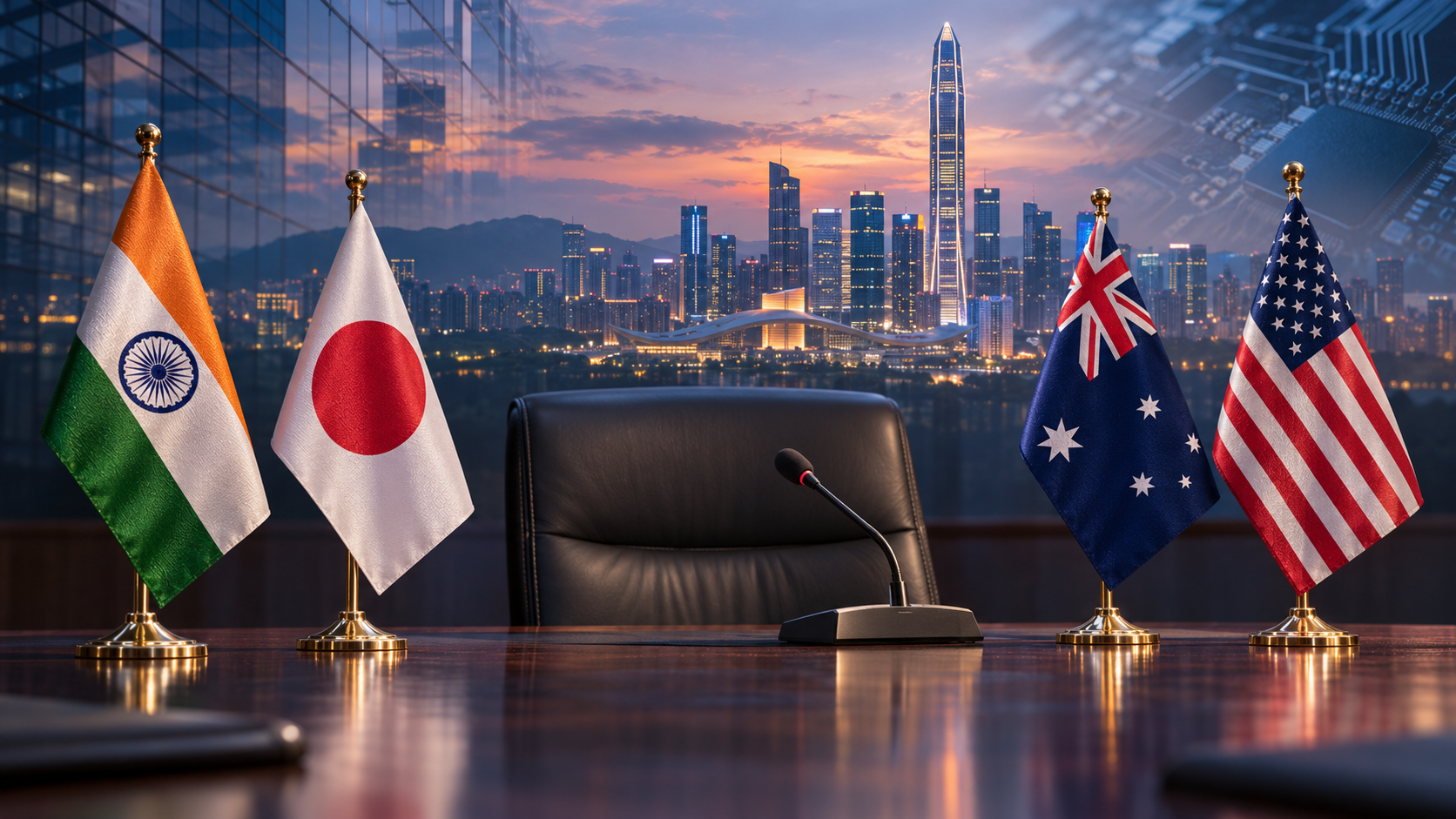
Donald Trump arrived in Manila on Tuesday, 17 November, with two very different meetings on his Asian itinerary. In the Philippines, he is meeting Indian Prime Minister Narendra Modi, Japanese Prime Minister Sanae Takaichi and Australian Prime Minister Anthony Albanese. On Thursday, he is due in the Chinese city of Shenzhen for talks with Xi Jinping and Vladimir Putin.
The order gives India, Japan and Australia something they would lose if Trump visited China first. They can raise concerns about trade restrictions, access to critical minerals and security at sea while the American president still has decisions ahead of him. Afterwards, the same conversation could amount to asking what he had already agreed.
There is a practical reason for the timing, too. The leaders were converging on Manila for a series of Asian summits. Their foreign ministers had already discussed holding another leaders’ meeting. What gives this one political weight is the two-year gap since the four last gathered at this level, and the identity of the two men Trump will see next.
Why These Four Countries Meet as the Quad
The United States, India, Japan and Australia make up the partnership known as the Quad. Its origins lie in a specific emergency. After the Indian Ocean tsunami of December 2004, the four countries helped coordinate relief. Ships, aircraft and supplies from several governments had to reach devastated communities across a vast area. Knowing what another country could deliver had immediate value.
Manila has twice played a part in what followed. Officials from the four countries met in the Philippines in 2007. After a ten-year gap, they reconvened in Manila in November 2017, during Trump’s first presidency. By 2021, under Joe Biden, the partnership had its first leaders’ summit. Biden hosted the most recent one in Wilmington, Delaware, in September 2024.
That history explains an apparent oddity. Trump was president when the Quad resumed consultations, yet Manila is his first meeting with its other three leaders in this format. In the interval between presidential summits, the partnership continued to work. As recently as July, all four foreign ministers met in the same city to discuss maritime security, technology, emergency response and economic risks. What Modi, Takaichi and Albanese gain this week is the chance to hear from Trump himself.
What Japan, India and Australia Bring to the Conversation
Japan has been particularly clear about the economic stakes. In July, its foreign minister raised concerns about export restrictions on critical minerals. In Manila this week, Takaichi again put dependable mineral supplies on the agenda in talks with Southeast Asian countries. A Japanese foreign ministry official also identified export controls, artificial intelligence and maritime security as possible subjects for the Quad leaders.
Consider the question from the perspective of a Japanese manufacturer. A US-China understanding might ease tensions between Washington and Beijing. Its value to a factory in Japan would depend on the terms. Can its supplier obtain an export licence? Does the arrangement cover material destined for Japan? Can the manufacturer plan next year’s production around it? A restriction that looks manageable from Washington can still interrupt an assembly line elsewhere. Takaichi has an opportunity to explain that exposure before Trump discusses trade with Xi.
For India, the setting has a different advantage. Modi can cooperate with Washington on problems in the Indian Ocean and the wider Pacific while retaining control over India’s relations with both China and Russia. The Quad has no collective-defence clause. Agreeing to share information about shipping, for instance, creates no obligation for India to endorse a subsequent US proposal to Putin. That freedom helps explain how the four governments can keep working together across successive changes of leader.
Albanese offered the clearest public account of Australia’s position. Speaking in Manila on Sunday, he welcomed dialogue between the major powers, identified the United States as Australia’s most important ally and said Canberra would await the outcome. Those remarks leave room for two Australian interests that can easily be mistaken for opposites. Australia can want Trump to hear its concerns and also want his conversation with Xi to go well.
What Beijing Sees When the Quad Meets
Xi has viewed the Quad as an attempt to encircle China. The four members say their cooperation serves the wider Indo-Pacific and is directed against no single country. Their work at sea helps explain how the same initiative can look different from Beijing and from a participating coastguard.
At Wilmington in 2024, the leaders agreed to arrange a joint ship-observer mission. In June 2025, personnel from the four countries boarded the US Coast Guard cutter Stratton as it sailed towards Guam. For the officers on board, the benefit was straightforward. They could see how another service operated and get to know colleagues they might otherwise encounter for the first time during an emergency.
From Beijing, the same mission demonstrated that four governments with substantial interests across the Indian and Pacific oceans could move from a written commitment to putting personnel aboard one vessel. That has strategic significance even when the assignment is modest. The distinction matters in Manila, where a declaration about maritime cooperation may sound routine until the participating agencies act on it.
Southeast Asian governments have interests of their own in how that cooperation develops. When the Quad foreign ministers met in July, they issued a joint release on working with the Association of Southeast Asian Nations, or ASEAN. Holding another meeting alongside an ASEAN gathering gives neighbouring governments a chance to judge whether the four countries’ priorities match their own. Disaster response and safer shipping offer grounds for cooperation even where governments differ over China.
What Changes When Putin Joins Trump and Xi?
The planned Thursday meeting brings the American, Chinese and Russian presidents together on the sidelines of the Asia-Pacific Economic Cooperation gathering in Shenzhen. The presence of Putin widens the stakes beyond the US-China trading relationship. Russia’s war against Ukraine and the future of nuclear arms discussions among the three powers give governments far outside Asia reasons to watch.
It also puts a limit on what can reasonably be inferred from Manila. The published case for the Quad meeting centres on the Indo-Pacific. Nothing in its announced purpose gives Trump authority to negotiate with Putin on behalf of the other three members. Nor would a conversation among Trump, Xi and Putin secure Ukraine’s consent to terms affecting its future.
The timing nevertheless matters for a president who will move between both rooms. Washington’s latest restrictions on Chinese access to AI chips have complicated its trade relationship with Beijing. Before discussing that relationship with Xi, Trump can hear directly from partners whose businesses and security interests may be affected by any change in American policy. Whether he carries a particular concern into the Shenzhen talks will be clearer from the terms the governments release afterwards.
The most revealing comparison may come later still. In 2024, the Quad promised an observer mission. In 2025, officers stepped aboard a named ship. If Manila produces a comparable commitment on minerals, shipping or technology, there will be an agency, a project or a deadline that readers can follow long after the photographs from Shenzhen have faded.
Sources
Reuters — Trump arrives in Manila for Quad talks ahead of China visit
Associated Press — White House and Kremlin confirm plans for a joint meeting in Shenzhen
Australian Prime Minister — Anthony Albanese’s Manila press conference, 15 November 2026
Japanese Ministry of Foreign Affairs — Quad foreign ministers’ meeting in Manila, July 2026
Indian Ministry of External Affairs — Origins and development of the Quad
Australian Prime Minister — The four leaders’ Wilmington statement
Indian Ministry of Defence — Launch of the first Quad at-sea observer mission
