The Beijing Gamble: What Starmer Risks—and Wants—from China
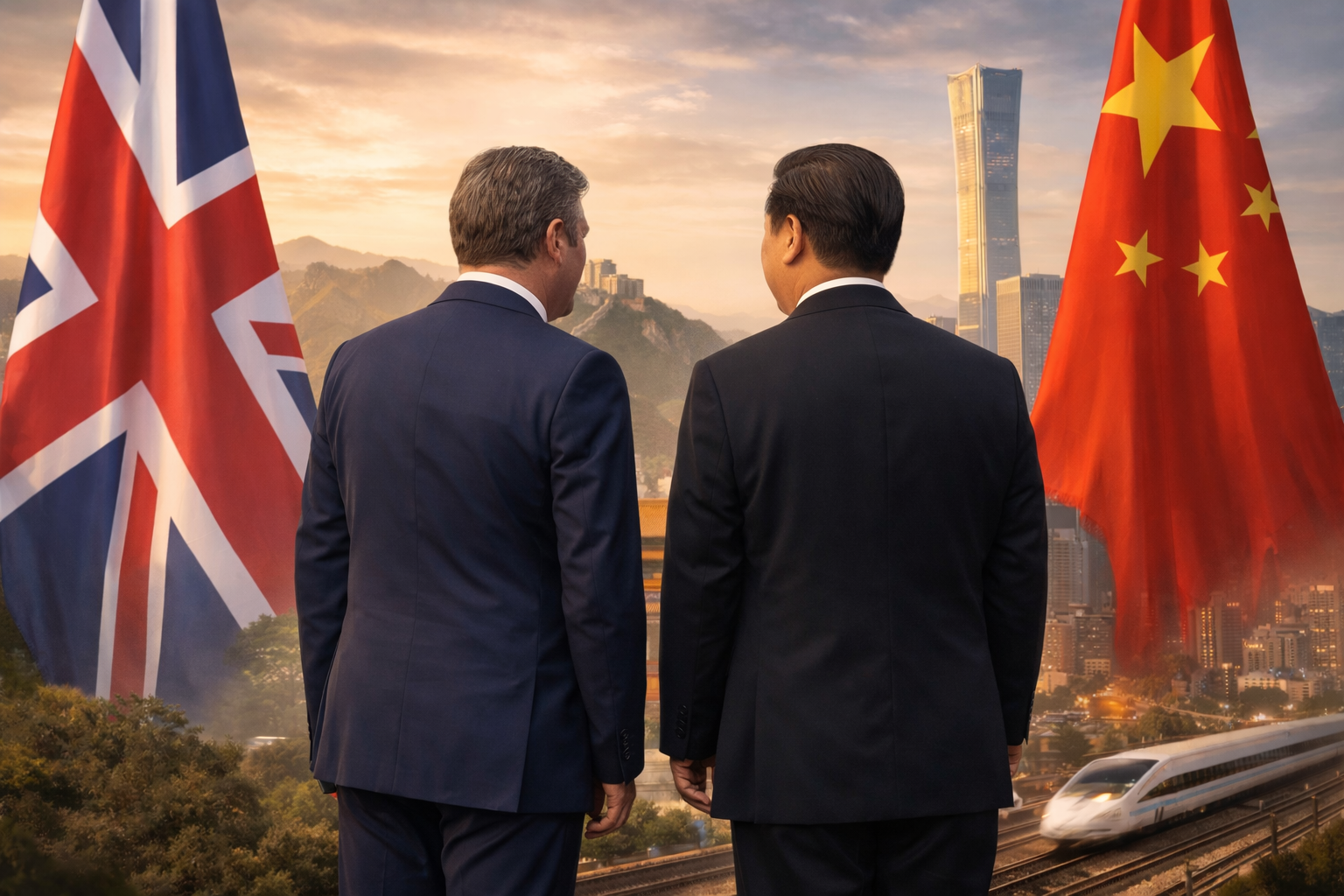
Starmer Meets Xi in Beijing: UK–China Reset and Its Price
Starmer Meets Xi in Beijing: The UK–China Reset Comes With a Price
The latest confirmed update is that U.K. Prime Minister Keir Starmer is in Beijing meeting China’s President Xi Jinping as part of the first U.K. prime-ministerial visit to China in eight years. Both sides are publicly signaling a desire to “deepen” ties, with the U.K. framing it as pragmatic engagement and China framing it as a strategic relationship worth rebuilding.
The headline tension is obvious: trade and investment on one side, security and technology constraints on the other. But the real bargaining space is narrower than it looks. The U.K. can offer a warmer tone, a clearer process, and selective market openings. China can offer commercial wins and diplomatic optics. Neither side can credibly rewrite the hard limits imposed by security services, export controls, and alliance commitments.
The story turns on whether the U.K. can bank economic wins without importing strategic risk.
Key Points
Starmer's visit to Beijing aims to restore previously closed political channels while maintaining the U.K.'s security stance.
The U.K. is bringing a large business and cultural delegation, underlining that growth and commercial access are central to the trip.
A headline deliverable already signaled by the U.K. is a border security agreement aimed at disrupting supply chains for small-boat crossings and tackling serious organized crime.
China's primary demands typically revolve around gaining market access, establishing legitimacy, and reducing restrictions on sensitive technology flows, areas where the U.K.'s agreement is relatively limited.
The U.K.’s red lines are less about rhetoric and more about systems: critical infrastructure, intelligence posture, and technology controls.
The most likely “deal shape” is a package of low-to-medium sensitivity agreements plus a promise of structured dialogue—rather than a sweeping reset.
Background
This is a diplomatic reset attempt after several years in which the U.K. tightened scrutiny of Chinese investment, hardened its public posture on security issues, and faced repeated espionage-related concerns. China, for its part, has pushed Western capitals to move from suspicion to “stable cooperation,” while resisting outside pressure on internal governance and security policies.
Starmer’s government is pitching a consistent approach: engage China because it matters economically, but keep “guardrails” where national security is implicated. In practical terms, that means separating areas where cooperation is politically survivable (trade promotion, financial services, climate and energy transition, selective law enforcement coordination) from areas where it isn’t (advanced tech transfer, critical infrastructure exposure, intelligence vulnerabilities).
Analysis
Why the U.K. is doing this now
The U.K. government is chasing growth in a slow, competitive global economy, and China remains a major node in supply chains and consumer demand. A prime ministerial visit is also a signaling device: it tells markets and multinationals that engagement is back on the table, and it tells Beijing there is a channel for grievances and negotiation short of escalation.
There is also a strategic timing element. Western capitals are recalibrating amid global volatility, and London wants room to maneuver: close alignment with allies on security, without being forced into a binary “choose one” posture on every economic question.
What China wants (and what it cannot easily get)
China’s near-term goals are usually concrete: increased access for Chinese firms and capital, fewer political obstacles to trade, and a more predictable U.K. regulatory environment. There is also an “optics dividend”: a high-profile visit helps Beijing demonstrate that major economies still come to the table.
The harder ask is technology. China benefits when partners loosen constraints around advanced semiconductors, high-end manufacturing tooling, secure communications, and dual-use research. That is precisely where the U.K.’s ability to concede is limited, not only by domestic risk assessments but also by interoperability with allies and the reality that many of the relevant controls sit outside London’s direct authority.
The U.K. maintains clear red lines. security posture beats trade vibes
The U.K.’s effective red lines are structural:
Critical national infrastructure exposure includes telecoms, energy, ports, and sensitive data backbones.
Investment and procurement undergo national security screening, particularly when they are in close proximity to government, defense, or sensitive research.
Technology transfer risk via universities, joint labs, and commercially “civilian” partnerships that can be repurposed.
Alliance commitments and intelligence-sharing arrangements that make certain concessions self-defeating.
This is why the reset, if it succeeds, will look like a set of bounded corridors—not an open door.
The deliverables list outlines what can be announced quickly.
The fastest wins are the ones that do not force either side to concede on core security doctrine.
One prominent deliverable already trailed by the U.K. side is a border security agreement aimed at disrupting supply lines for equipment used in English Channel small-boat crossings, including intelligence sharing and engagement with manufacturers to prevent exploitation by organized crime. The U.K. side frames the same package as bolstering cooperation against serious organized crime, which includes synthetic opioids and precursor chemicals.
Beyond that, the most plausible quick announcements tend to be
A refreshed business dialogue mechanism and sector working groups (finance, life sciences, green energy transition, and advanced manufacturing).
Market-access “process wins” (pilot programs, regulatory cooperation, clearer timelines), which sound technical but matter to firms.
Cultural and educational cooperation is framed as people-to-people ties, with tighter safeguards than in the pre-2020 era.
Anything touching sensitive technology, surveillance, or critical infrastructure is far less likely to appear as a celebratory headline item.
The silent risks: espionage, supply chains, universities, data
The risk profile isn’t just about a single deal; it’s about exposure accumulating through many small, defensible decisions.
Espionage and influence operation risks rise when channels and partnerships multiply faster than oversight capacity.
Supply-chain dependence can deepen quietly, especially in components and intermediate goods that are hard to substitute in a crisis.
Universities may become vulnerable if incentives prioritize grant volume and partnerships over strict dual-use controls.
The modern critical infrastructure problem is data risk: the embedding of sensitive datasets, research pipelines, or vendor relationships makes their reversal costly and politically messy.
Ignoring these layers during a "reset" can lead to future scandals. A reset that explicitly designs around them can be stable—but less dramatic than either side’s rhetoric suggests.
How does Europe fit in, and where does the U.K. diverge?
Europe’s broad direction has been “de-risking” rather than full decoupling: keep trade where possible, harden where necessary. The U.K. sits adjacent to that approach but is not identical.
Where the U.K. converges: investment screening, critical infrastructure caution, and tighter scrutiny of sensitive technology pathways.
Where it can diverge: it can move faster on bespoke commercial deals, niche sector access, and diplomatic symbolism because it is not bound to EU-level consensus-building. The price of that agility is that London must manage second-order effects with partners who watch U.K.–China moves as signals about allied cohesion.
What Most Coverage Misses
The hinge is that this reset will be negotiated inside constraints the leaders do not fully control—especially technology controls, security screening systems, and alliance interoperability.
That changes incentives. It pushes both sides toward “announceable” cooperation in low-sensitivity domains while leaving the highest-stakes disputes unresolved. If Beijing wants real relief on tech constraints and London cannot deliver, China will seek leverage elsewhere: market access as a bargaining chip, selective retaliation risk, or pressure points in education, research, and supply chains.
Two signposts will confirm this fast: first, whether the readouts emphasize mechanisms (dialogues, working groups, and process commitments) more than concrete market openings; second, whether any language appears that implies a softer posture on technology and security screening—or, conversely, a reaffirmation of guardrails paired with economic sweeteners.
What Happens Next
In the next 24–72 hours, the practical story will be in the communiqués, sector-specific announcements, and the business signals that follow.
In the short term, the most affected groups are U.K. exporters and multinationals looking for predictability and U.K. security and research institutions trying to prevent “engagement” from becoming unmanaged exposure. Long-term, the key question is whether the U.K. can establish a stable, transactional relationship with China that can withstand the next security crisis.
The key mechanism is simple: markets reward access and clarity, while states punish vulnerability. A reset works only if it produces commercial predictability without increasing strategic dependency.
Real-World Impact
A mid-sized U.K. manufacturer sees a chance to reopen distribution talks in China, but legal teams insist on stricter IP controls and supply-chain contingency plans.
A university research office tightens collaboration rules for sensitive fields, creating friction with academics who want fewer barriers and faster funding.
A logistics firm adjusts pricing models if improved cooperation reduces cross-border disruption risk while still budgeting for regulatory surprises.
A U.K. tech startup explores China partnerships for scale but finds investor diligence now includes questions about export controls, data handling, and future sanctions exposure.
The Reset’s Likely Shape: A Warmer Door, Not an Open One
If this visit produces a durable outcome, it will look like “reset lite”: more dialogue, targeted commercial wins, and carefully fenced cooperation on issues like law enforcement and climate-adjacent sectors.
A “real reset” would require mutual concessions on sensitive technology and security-adjacent questions that neither side can comfortably make. And “reset collapses” remains a live risk if a security incident, a sanctions move, or a politically explosive case forces London to harden its posture again.
Watch the wording, not the choreography. The historical significance of this moment is that both capitals are testing whether they can cooperate in a world where trust is no longer the default setting.
