The Generator War: Why France’s Generators for Ukraine Turn Electricity Into the Frontline
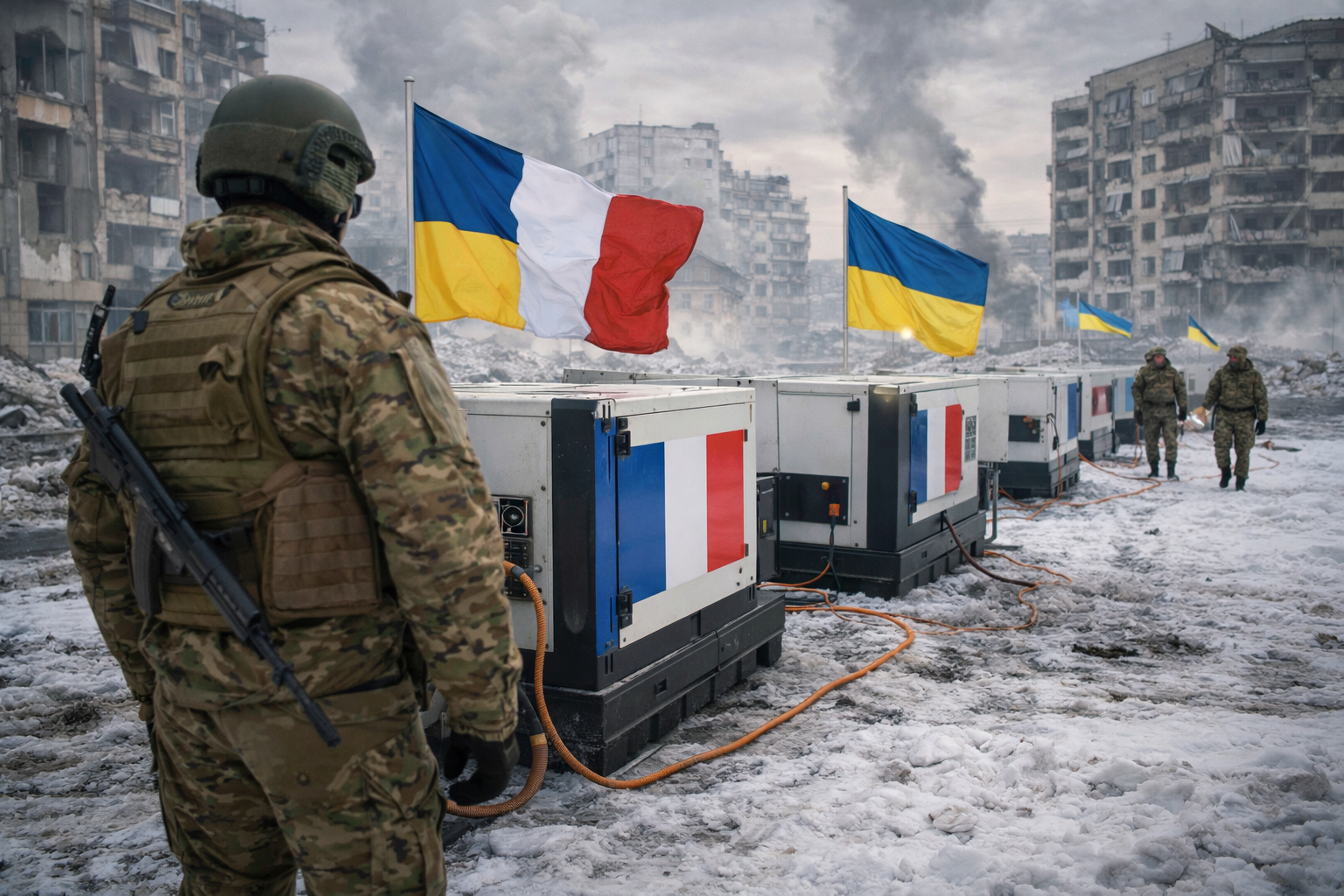
France confirmed generators for Ukraine as winter strikes hit the grid. Here’s what they can and can’t do—and what to watch next.
France has confirmed additional energy support for Ukraine that includes roughly 100 generators and an “equivalent” contribution of about 13 megawatts intended to help replace destroyed power capacity.
The announcement lands in the middle of a winter strike-and-repair cycle where the grid is being hit, patched, and hit again—and civilians are forced to live inside that rhythm.
At first glance, generators look like humanitarian triage: lights, heat, and a way to keep hospitals running. But in a war like this, energy is not a side story. It is the operating system for everything else—communications, water, logistics, production, and the basic civilian stability that keeps a state functioning under pressure.
One line matters more than it seems: these systems do not “solve” the grid. They change the battlefield from national supply to local survivability.
The story turns on whether distributed backup power can stay fueled, maintained, and protected long enough to blunt Russia’s pressure strategy.
Key Points
France has confirmed a new tranche of energy support for Ukraine, including around 100 generators and an “equivalent” contribution of about 13 megawatts aimed at replacing destroyed infrastructure.
Generators are strategic because they keep critical services stable, reduce panic, and preserve the state’s ability to govern and fight during outages.
Their value is highest when deployed to the right nodes: hospitals, heating, water, communications, shelters, rail signaling, and local grid control points.
The hard limits are fuel logistics, maintenance, spare parts, trained operators, and the risk of being targeted once patterns of use become predictable.
Russia’s incentive is clear: striking energy infrastructure can impose recurring costs, disrupt morale, and force Ukraine and its partners into an expensive, perpetual repair loop.
The allied support pipeline increasingly looks like an “energy package,” not a single delivery: generators, mobile power, transformers, switchgear, repair crews, and air defense prioritization around energy assets.
The rest of winter hinges less on how many generators arrive and more on whether Ukraine can sustain them through fuel, parts, and smart deployment under fire.
Background
Ukraine’s energy system has been under sustained pressure since the full-scale invasion, with repeated attacks aimed at generation, transmission, and distribution. Winter amplifies the stakes: electricity is not just lights—it is heat, water pumping, wastewater treatment, mobile networks, and the ability to move people and goods reliably.
A generator is not a substitute for a national grid. It is a localized power source that can keep a specific facility or small cluster functioning when the grid drops. In practice, that turns energy resilience into a node-by-node contest: which parts of society can keep operating during outages, and for how long?
France’s newly confirmed generator support sits alongside broader European moves to push emergency equipment into Ukraine quickly. The public details emphasize capabilities, not granular deployment locations—because where equipment goes is operationally sensitive and can create targeting risk.
Analysis
The new support package: what is confirmed, and what is not
What is confirmed publicly is the category of support (generators) and an approximate scale (around 100 units), framed as an “equivalent” contribution of roughly 13 megawatts intended to replace destroyed capacity. That phrasing matters: it signals intent to restore functionality, but it also hints at the reality that the grid’s losses are far larger than any single package can cover.
What is not publicly confirmed in detail is the deployment map: which oblasts, which facilities, what generator sizes, whether units are containerized, trailer-mounted, or fixed, and how fuel supply is planned. That absence is not unusual. It reflects both security and the fact that deliveries often land in waves, then get allocated based on the week’s damage pattern.
Why generators are strategic, not “humanitarian only”
In an energy war, the civilian and military spheres overlap. Hospitals, railways, water systems, and telecoms are civilian—until the moment they become the backbone of mobilization, logistics, and governance.
Generators do three strategic things at once:
First, they preserve state continuity. If local authorities can keep water pumping, clinics operating, and communications stable, society stays governable through outages.
Second, they compress Russia’s leverage. Blackouts are meant to produce fear, displacement, and political pressure. Backup power dulls that edge, even if living conditions remain harsh.
Third, they protect military endurance indirectly. A military can fight through supply shocks; a society cannot indefinitely. Keeping civilians functioning reduces cascading stress on the armed forces and emergency services.
Where they matter most: critical services and grid nodes
The highest-leverage placements are not always obvious. The best use is rarely “spread evenly.” It is triage for systems that prevent collapse:
Hospitals and emergency care are the first tier: operating theaters, oxygen systems, diagnostics, and cold-chain medicines.
Heat and shelter infrastructure is next: warming centers, municipal buildings, and shelters that stop exposure deaths during outages.
Water and sanitation is often the silent priority: pumps, pressure systems, and wastewater treatment. When power fails here, disease risk rises and neighborhoods become unlivable fast.
Communications and control systems matter more than public debate usually admits: mobile base stations, data centers, municipal dispatch, and local grid management points that allow partial restoration when segments can be “islanded.”
Transport nodes can be decisive: rail signaling, stations used for evacuation and supply, and critical crossings where disruption creates bottlenecks.
Limits: fuel, maintenance, spares, and the targeting problem
Generators are deceptively simple. Their constraint is not electricity. It is everything that comes with electricity.
Fuel is the first choke point. Diesel demand competes with transport, construction machinery, and military logistics. A generator that saves a hospital can also draw fuel away from other essential movement unless the supply chain expands.
Maintenance is the second. Filters clog, injectors fail, and voltage regulators drift. In freezing conditions, breakdown rates rise, and repair capacity becomes as valuable as the machines.
Spare parts are the third. A single missing component can turn a “delivered generator” into dead weight. Standardization helps, but wartime donations tend to be mixed fleets unless deliberately coordinated.
Then comes targeting. Once a generator becomes the reason a facility stays lit, it can become a signature. Fuel deliveries create patterns. Noise and heat can be detected. Even without direct strikes, the risks of sabotage and theft increase when diesel is essential for survival.
In short: generators are resilient only when they are sustained, not when they are delivered.
Russia’s incentive structure: why energy gets hit
Energy strikes offer an attacker a recurring return on investment. If a missile disables a transformer yard, the defender pays repeatedly: repair crews, replacement parts, rerouting, emergency generation, and civilian relief. The attacker also shifts attention and air defenses toward protection of infrastructure, forcing trade-offs elsewhere.
There is also a psychological logic. Outages create uncertainty and fatigue. They erode productivity, complicate schooling and work, and pressure families to relocate. Even limited disruption can feel total when it is unpredictable and repeated.
That is why energy becomes a frontline: it is one of the few targets that can impose nationwide friction without capturing territory.
The allied support pipeline: what else is needed to make generators count
Generators are only one piece of an energy-resilience stack.
Ukraine also needs rapid-repair equipment (switchgear, transformers, cables), mobile substations, and crews trained to reconfigure networks under damage. It needs better protection for key nodes—physical hardening where possible, and air defense prioritization where not.
Coordination matters because mismatched donations create a maintenance nightmare. The most valuable pipeline is the one that treats this as a system: standardized generator classes, fuel planning, parts stockpiles, and training packages bundled together.
Finally, the pipeline needs time discipline. Winter crises move in days, not quarters. Delivery timing can matter more than total volume.
What Most Coverage Misses
The hinge is that generators do not “add power” so much as they change the unit of survival from the nation to the node.
Mechanism: once backup power becomes central, the war shifts into a logistics contest over fuel, spare parts, and predictable operating patterns. That means success is less about how many generators arrive and more about whether Ukraine and its partners can run a disciplined, standardized sustainment system under attack—fuel in, parts in, repairs out—with enough operational secrecy to avoid turning power-on locations into targets.
Signposts to watch: whether partners begin announcing bundled packages that include parts and maintenance support (not just machines), and whether official statements increasingly talk about “critical nodes,” “mobile power,” and “rapid repair” rather than raw generator counts.
What Happens Next
In the next several weeks, the key question is whether this becomes a stabilizing layer or a temporary patch that gets overwhelmed.
In the short term, the most affected will be cities and regions facing repeated damage where generators can keep hospitals, shelters, and water systems running through outages—because continuity prevents humanitarian spillover and mass displacement.
Long term, the effect depends on whether Ukraine can keep building a distributed resilience model that survives repeated strikes—because a country that can function through blackouts is harder to coerce.
The biggest decision points are operational: where to deploy first, which assets to harden, and how to organize fuel and parts without creating predictable patterns. Announcements that mention delivery timelines, maintenance support, and standardization will matter more than vague pledges.
Real-World Impact
A municipal hospital runs on backup power through a 12-hour outage, but the real risk becomes fuel: the generator works, yet the ambulance fleet now competes for the same diesel.
A water utility keeps pumps running with emergency generation, preventing a neighborhood-scale sanitation crisis, but maintenance backlog grows as filters and components wear faster in cold conditions.
A city opens warming centers with reliable power, cutting exposure injuries, but the centers become magnets—crowding increases, security demands rise, and supplies must be replenished daily.
A rail node stays operational during rolling blackouts, preserving evacuation capacity and supply movement, but the predictability of “always-on” infrastructure forces harder choices about concealment and protection.
The Winter Test for Ukraine’s Energy Resilience
France’s generators for Ukraine are not a silver bullet. They are a tool in a grinding contest: Russia tries to make the grid a liability; Ukraine and its partners try to make outages survivable and governance durable.
The fork in the road is simple: either emergency power becomes a managed, sustainable layer that blunts coercion, or it becomes a patchwork that burns fuel and breaks down faster than it can be repaired.
Watch for two things: delivery schedules that land within days rather than weeks, and support packages that treat generators as part of a sustainment system—fuel, parts, maintenance, and protection. In this phase of the war, the side that can keep the lights on at the right nodes shapes the trajectory of everything else.
