The Greenland Tariff Bomb: How Personal Politics Put Europe and the US on Collision Course
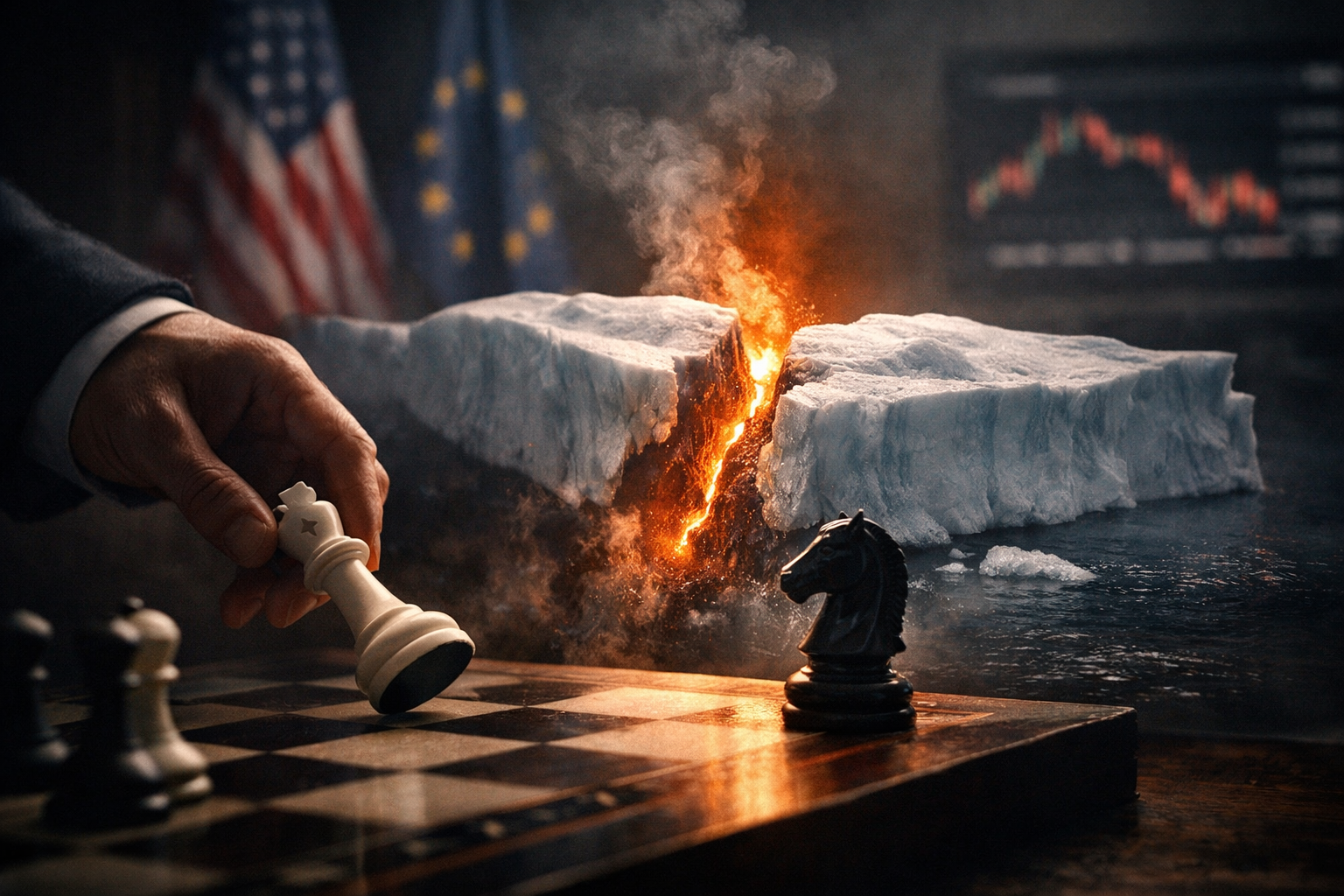
Greenland-linked tariff threats are colliding with EU retaliation tools. Here’s the real timeline, first targets, and UK exposure.
Greenland Tariff Crisis Escalates as Personal Politics Rewrites the Trade Playbook
The Greenland dispute has moved from brutal geopolitics into something messier: tariffs tied to a territorial demand, wrapped in high-visibility personal messaging. The United States has threatened new tariffs on a group of European countries amid the standoff, while European leaders weigh retaliation options that range from fast-acting to slow-but-severe.
The newest accelerant is the messaging layer. Leaked private texts, public taunts, and grievance-style framing are transforming a potentially negotiable trade confrontation into a contest of pride and prestige, one that escalates quickly due to the difficulty of retreating without appearing weak.
The story turns on whether Europe can field credible, fast retaliation—measured in days, not months—without breaking internal unity or triggering a wider rupture in NATO cooperation.
Key Points
The US has threatened new import tariffs on Denmark, France, Germany, the Netherlands, Finland, Sweden, Norway, and Great Britain, with a stated schedule that begins February 1 and escalates again June 1.
EU leaders are discussing a revival of a pre-prepared retaliation package targeting about €93 billion of US imports, which could be activated quickly because much of the work is already done.
Europe is also weighing the Anti-Coercion Instrument (“trade bazooka”), but its procedure is measured in weeks-to-months, not overnight impact.
The personal-political hook—leaking leaders’ messages and tying policy to grievance narratives—raises volatility because it shifts the payoff from “economic outcomes” to “status wins.”
The near-term market and UK/Europe spillover risk are less about Greenland’s economy and more about tariff sequencing, business uncertainty, and retaliation timing across major trade lanes.
Decision points cluster fast: Davos messaging this week, an EU leaders’ meeting Thursday, then the February 1 tariff start line—followed by potential EU counters soon after.
Background
Greenland is a self-governing territory within the Kingdom of Denmark, and it sits at the intersection of Arctic security, basing rights, and strategic geography. This presents a challenge to Denmark's sovereignty and a test of trust for allies who purport to uphold territorial integrity.
The dispute has intensified due to the use of the tariff threat as leverage, not as a narrow trade remedy, but as a connection to Greenland. In other words, this is trade policy being used as coercion signaling, not a standard tariff dispute.
Europe’s immediate challenge is that its most powerful tools come in different “speed classes.” Some are designed to bite quickly (tariffs on a prepared list). Others are designed to be legally durable and expansive (the Anti-Coercion Instrument), but they take time to activate.
Analysis
The Escalation Ladder (With Real Timelines)
The mechanics are more important than the rhetoric because markets respond to pricing schedules.
First rung: US tariff activation. The US tariff threat has been framed with a start date of February 1, with a second ramp on June 1. That creates a countdown effect: companies must decide whether to front-run shipments, revise contracts, or pause orders well before any tariff is actually collected.
Second rung: EU rapid-response tariffs. Europe’s fastest credible answer is not an abstract “we have options,” but a specific list already built for retaliation—reported at roughly €93 billion of US imports—because it can be switched on with comparatively limited extra process.
Third rung: the “policy widening.” If the dispute keeps escalating, it stops being about goods tariffs and becomes about broader market access—procurement, services pressure, and regulatory friction—because that is where Europe can impose pain on high-value US sectors without mirroring tariffs dollar-for-dollar.
Fourth rung: institutional rupture risk. The longer the tariff fight runs, the more it bleeds into NATO trust, Arctic coordination, and “do we still share the same rules” questions—especially if the messaging keeps shifting from policy demands to personal dominance contests.
Europe’s Retaliation Tools: Fast Bites vs Slow Power
Europe has three broad categories of retaliation tools, and only one category reliably bites in days.
Fast (days): ready-to-implement tariff lists. If the EU revives a previously prepared package, the key advantage is operational: customs can collect tariffs as soon as the legal switch flips and the codes go live. The first targets typically prioritize political salience and substitution ease—goods that can be sourced elsewhere while hitting influential constituencies. Reports have pointed to items like soybeans and motorcycles as classic early targets because they combine symbolism with supply flexibility.
Medium (weeks): tailored countermeasures with fresh legal steps. These include new tariff schedules that are still being prepared or narrowly engineered actions aimed at specific sectors. They can be swift by government standards, but not fast by market standards.
Slow (weeks to months): the Anti-Coercion Instrument (ACI). The ACI is designed for systemic coercion cases and offers a wide menu of potential countermeasures. But the process involves an assessment phase and council decision points that inherently take time. The EU itself has described a multi-month investigative window before formal determinations, followed by further steps before measures fully apply.
Therefore, it is important to understand that while the EU's "bazooka" is credible due to its broad scope, it is not the first step towards implementation. The first punch is the tariff list.
The “Personal Grievance” Messaging Hook Raises Volatility
This dispute is not being communicated like a standard trade negotiation. The US president has publicly shared private messages involving European leaders and has tied Greenland's posture to highly personal framing and spectacle-style posting.
That matters because it changes incentives:
Compromise becomes reputationally expensive. If your public posture is “there can be no going back,” backing down is not a policy adjustment—it is a personal loss.
Counter-signaling becomes tempting. European leaders then feel pressure to “prove” they will not be blackmailed, which narrows the space for quiet de-escalation.
Miscalculation risk rises. Public politics can lead each side to prioritize their domestic audience over achieving a stable outcome.
The net effect is a higher chance of rapid ladder-climbing: both sides avoid looking like they blinked, not because either side wants maximal economic damage.
First Targets: What Gets Hit Early (And Why)
The first targets in any tariff standoff are rarely chosen for macroeconomic efficiency. They are chosen for leverage.
Europe’s early tariff targets, when it wants swift political pressure, tend to cluster around:
iconic US consumer brands that can be swapped out,
politically sensitive export categories,
These are goods that generate domestic headlines while maintaining the integrity of EU supply chains.
This explains the frequent appearance of reported examples like soybeans and motorcycles in discussions, as they are easily readable, symbolic, and purposefully designed to convey a message.
The US side, meanwhile, can choose targets with high emotional resonance in Europe (luxury, autos, signature national exports) to maximize pressure and media impact.
UK Exposure: Where the Pain Lands First
Britain is explicitly in the US tariff-threat grouping, which matters because the UK is heavily exposed to the US as a trade partner—especially in services—while tariffs mainly hit goods.
Goods exposure is concentrated. UK government trade guidance lists top UK goods exports to the US, including cars and medicinal/pharmaceutical products, alongside metals, generators, and instruments. Because margins, model cycles, and supplier contracts are based on predictable landed costs, these categories often face tariff sensitivity.
There is also a recent reminder effect: the ONS has noted periods where UK goods exports to the US remained relatively low after earlier tariff introductions, and it has specifically pointed to declines linked to chemicals and medicinal/pharmaceutical products in recent monthly data. That is exactly the kind of “already bruised” baseline that makes a new tariff shock hit harder.
UK decision-makers face a three-way constraint:
Keeping a balance between US pressure and EU coordination is crucial.
protecting export industries exposed to US tariffs,
preventing a broader spillover of investment and confidence.
What Most Coverage Misses
The hinge is not whether Europe has powerful retaliation options—it is whether Europe has alternatives that can be activated on the same clock the market is using.
The mechanism is timing credibility. A threat that takes months to implement is not a deterrent in a dispute where tariff start dates are weeks away. That is why the “ready list” of retaliatory tariffs is the real near-term lever, while the ACI is the medium-term credibility backstop.
Two signposts to watch in the next days and weeks:
Whether EU leaders move from “options are on the table” to publicly anchoring a concrete activation date for a retaliation package tied to the February 1 schedule.
The shift from rhetoric to formal procedural steps (Commission assessment language and Council timeline framing) in the ACI talk could indicate Europe's preparation for a longer confrontation.
What Happens Next
In the next 24–72 hours, the key dynamic is diplomatic compression: leaders meeting on the margins of global gatherings, while domestic messaging escalates. Davos becomes a stage for signaling, and every public line hardens future negotiating space.
Over the next weeks, the calendar takes over:
February 1 is the first US tariff start line. Firms will react before then, not after.
Europe’s ability to answer quickly depends on whether it leans on prepared retaliation rather than slower instruments.
June 1 is the escalation cliff that forces a second round of corporate planning and political risk pricing.
The main consequence is uncertainty compounding, because tariffs are not just taxes; they are also a signal that contracts, supply chains, and alliance assumptions are now contingent.
Real-World Impact
A UK auto exporter revises its US pricing, then pauses a shipment window because the buyer refuses to absorb tariff risk without renegotiating the contract.
A pharmaceutical supplier faces a procurement dilemma: ship now to beat the start date, or hold inventory and risk getting stuck with higher landed costs and slower demand.
A European importer switches suppliers for a US-branded product line, not because the product is unavailable, but because the tariff headline creates whiplash in retail pricing.
A logistics firm adds contingency clauses and “tariff-trigger” fees, raising costs for small businesses that cannot hedge currency and trade policy shifts.
The New Arctic Problem: When Trade Timelines Outrun Alliance Repair
This crisis is no longer just “about Greenland.” It is about whether transatlantic relationships can survive when trade tools are deployed on political clocks and amplified through personal messaging.
The fork in the road is clear: either both sides build an off-ramp fast—before tariffs lock in corporate behavior—or they slide into a tariff cycle where each new measure becomes the justification for the next.
Watch the dates, not the drama: whether February 1 arrives with tariffs in force, whether Europe counters with a ready package soon after, and whether June 1 is treated as a bluff—or as the moment the rupture becomes structural.
