

What Happens If Trump Invades Greenland—and NATO Has to Choose Sides
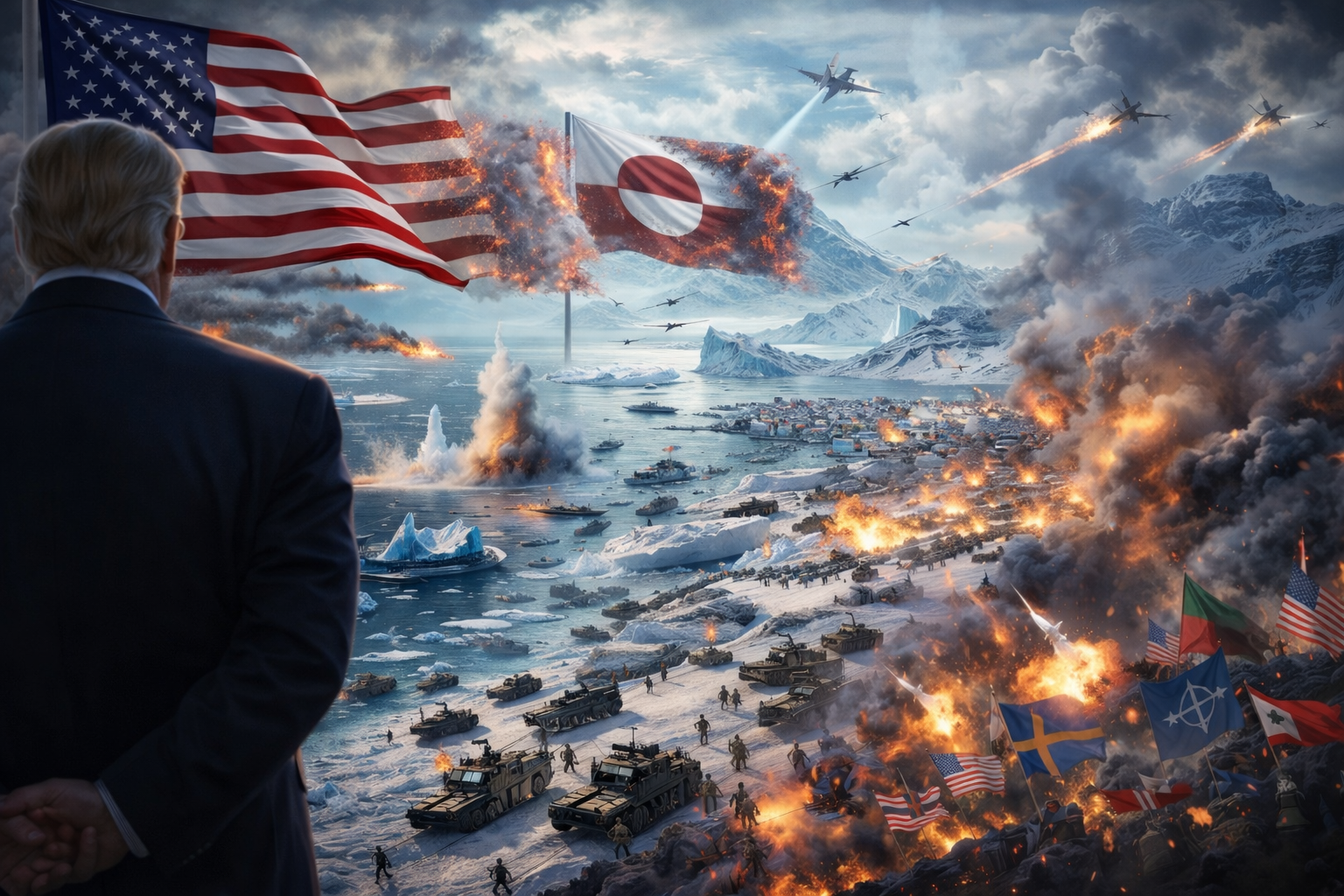
What If Trump Invades Greenland? Global Retaliation Map
If Trump Invades Greenland, the World’s Retaliation Starts Before the First Shot
The latest confirmed update is that President Donald Trump has escalated pressure on European allies over Greenland, including tariff threats tied to U.S. demands, while Denmark and Greenland are pushing NATO to formalize a stronger Arctic posture. No invasion has occurred.
But if Trump did order an invasion—meaning U.S. forces moved to seize territory, ports, airfields, government facilities, or communications nodes against Danish and Greenlandic consent—the reaction would be immediate, global, and unusually dangerous. This is not due to Greenland's large population but rather to its strategic location at the intersection of alliance credibility, Arctic military geometry, and a rules-based system that cannot withstand selective enforcement.
It's important to note that the most challenging aspect would not be the landing itself. It would be the moment allies must decide whether a NATO member has “attacked” NATO.
The story turns on whether NATO can respond to aggression when the aggressor is inside the alliance.
Key Points
A U.S. invasion of Greenland would be treated by Denmark as an armed attack on Danish territory, forcing an emergency NATO decision and a fast-moving legitimacy crisis.
The first wave of retaliation would likely be economic and legal: sanctions, export controls, and coordinated trade measures—because military escalation against the U.S. is the option nobody wants to touch first.
Europe’s most powerful lever would be market access: targeting U.S. firms’ ability to sell, invest, bid on contracts, and operate across Europe, rather than symbolic tariffs alone.
Global markets would likely react as if a major war risk just entered the system: risk-off moves, tighter credit, insurance and shipping shocks, and rapid repricing of defense and energy expectations.
Russia and China would gain strategically even without intervening, because the invasion would fracture Western unity and weaken deterrence narratives worldwide.
Greenland itself would become a political battlefield: sovereignty, self-determination, and local consent would shape international alignment and long-term stability.
Background
Greenland is a self-governing territory within the Kingdom of Denmark. It runs many domestic affairs, while core responsibilities like foreign policy, defense, and security remain anchored to Copenhagen. That structure matters because an invasion wouldn’t be a “dispute with Greenland.” It would be a confrontation with Denmark as a state.
Greenland’s strategic value is real and rising: Arctic access, proximity to North Atlantic routes, surveillance and early-warning infrastructure, and resource potential. The U.S. already has a longstanding military presence and defense arrangements tied to Greenland, which makes an invasion even more destabilizing: it would convert cooperation into coercion overnight.
Meanwhile, Europe has built newer instruments to respond to economic pressure from major powers. Those tools were designed for “trade coercion,” but the logic would be the same: deter, punish, and isolate the coercer without triggering a shooting war.
Analysis
The First 24 Hours: Denmark’s Call, NATO’s Dilemma
The first response would be diplomatic but urgent: Denmark would call emergency consultations and seek immediate collective action. In parallel, it would move to establish clear facts—what was seized, whether shots were fired, whether Danish personnel were detained or harmed, and whether Greenlandic institutions were displaced.
Three plausible paths emerge quickly. In one, Denmark pushes for a full collective-defense posture and gets broad political backing, but allies keep the military response limited to defensive deployments and air/sea presence. The signpost is a unified NATO statement that frames the act as an attack on allied territory and announces concrete protective measures.
In a second path, NATO stalls—not because allies doubt the gravity, but because the U.S. is central to NATO’s machinery. Decision-making becomes a procedural battlefield. The signpost is an emergency meeting that produces only vague language, pushing key countries to coordinate outside NATO structures.
In a third path, the U.S. tries to relabel the operation as a “security stabilization mission” to preempt legal triggers. The signpost is Washington issuing a narrow legal justification that claims consent or necessity, paired with information control and restrictions on access.
Europe’s Retaliation Ladder: From Tariffs to the “Bazooka”
Europe's most credible retaliation does not involve a military counterattack. It’s the ability to impose severe economic and regulatory pain while keeping escalation controllable.
One scenario is rapid, coordinated sanctions-style action: travel bans, asset freezes, restrictions on sensitive technologies, and tightened export licensing—paired with targeted trade measures. The signpost is a synchronized set of announcements from major capitals and European institutions within 48–72 hours, aimed at specific sectors rather than blanket tariffs.
A second scenario is a market-access squeeze: limiting U.S. firms’ participation in procurement, scrutinizing investment flows, and applying regulatory pressure where European jurisdiction is strong. The signpost is a shift from “punishment” rhetoric to “risk management” language—compliance notices, procurement exclusions, enhanced screening, and enforcement guidance to companies.
A third scenario is a phased ladder: diplomacy first, then escalating commercial countermeasures if U.S. forces do not withdraw. The signpost is the creation of explicit deadlines—withdraw by X date, or face step-two measures—designed to force an off-ramp.
Markets and Money: Why This Turns Into a Systemic Shock
Investors would read a Greenland invasion less as a regional crisis and more as a structural break: if the transatlantic alliance can fracture into coercion, risk premia rise everywhere.
A “fast panic” scenario looks like a classic risk-off event: equities down, volatility up, safe-haven demand, and widening credit spreads. The signpost is not one dramatic headline but compounding signals—airspace advisories, shipping insurance repricing, and corporations pausing Arctic operations.
A “slow bleed” scenario is arguably worse: not a crash, but a persistent repricing of the cost of doing business across the Atlantic. The signpost is sustained regulatory fragmentation—countermeasures that force firms to pick compliance regimes and restructure supply chains.
A “policy overreaction” scenario adds inflation risk: broad tariffs, energy disruption, and retaliatory restrictions. The signpost is governments choosing sweeping measures for political signaling rather than calibrated pressure.
Operations and Geography: Greenland Makes Occupation Expensive
Greenland is huge, harsh, and logistically unforgiving. Control isn’t about planting a flag; it’s about sustaining communications, fuel, runway access, local services, and supply flows through extreme weather and limited infrastructure.
One scenario is a “node seizure”: the U.S. focuses on a small number of strategic sites—airfields, ports, radar/communications, key government facilities—aiming to make the situation feel irreversible. The signpost is rapid movement on infrastructure rather than broad territorial control.
Another scenario is “local non-cooperation”: Greenlandic institutions refuse to cooperate, Denmark coordinates civil resistance measures, and legitimacy erodes even if the U.S. holds tactical ground. The signpost is disruption in everyday governance—administration, logistics contracting, and service delivery—paired with a diplomatic campaign centered on consent.
A third scenario is “Arctic bottleneck”: allies don’t fight the U.S. directly, but they restrict enabling support—overflight permissions, refueling arrangements, intelligence sharing, and logistics coordination—raising the operational cost. The signpost indicates quiet policy changes that make it more difficult to maintain a military presence without a single public threat.
Russia and China benefit strategically without engaging in direct conflict.
Russia benefits from both the narrative it creates and the distractions it causes: If the aggressor is the U.S., it becomes more difficult for the West to sustain its condemnation of territorial aggression. Meanwhile, China gains a template that combines coercion, economic leverage, and mutual understanding.
One scenario is opportunistic pressure elsewhere—more gray-zone actions, more boundary tests, and more “we’re just protecting security” arguments. The signpost is synchronized messaging and increased activity in contested spaces that force the West to split attention.
Another scenario involves diplomatic exploitation, where Russia and China actively promote UN debates, aware that the U.S. could face isolation or awkward veto politics. Resolutions, blocs, and coordinated condemnation signify a rapid shift to legitimacy warfare.
What Most Coverage Misses
The hinge is simple: NATO is built to deter outsiders, not to police an insider.
Mechanism: if the U.S. is the aggressor, the alliance’s normal deterrence model breaks. Decision-making becomes contested, and allies may shift coordination into ad hoc coalitions and economic instruments where Washington has no vote. That changes the timeline: retaliation can be immediate even if formal NATO processes stall.
Two signposts would confirm the scenario quickly. First: if allied leaders start announcing coordinated measures outside NATO formats. Second: if Europe’s response centers on market access, procurement, investment screening, and regulatory enforcement rather than military posturing.
What Happens Next
In the short term (24–72 hours), the most affected actors would be Denmark and Greenland’s institutions, NATO’s credibility, and global markets sensitive to geopolitical risk. The main consequence would be a rapid move toward economic retaliation because it is the fastest way to impose costs without triggering direct military escalation against the U.S.
Over weeks, the crisis would turn into a test of endurance: whether U.S. forces withdraw, whether Europe can stay unified, and whether global businesses begin to treat the Atlantic as a political boundary again. The decisions to watch are formal NATO communiqués, European countermeasure packages, and any declared timelines for withdrawal or escalation.
Over months, the most profound impact would be systemic: deterrence norms, alliance architecture, and the global willingness to trust security guarantees. Pressure can rewrite borders, increasing the danger of every contested territory as each actor learns the same lesson.
Real-World Impact
A logistics executive in Northern Europe pauses Arctic routing and re-prices winter shipping contracts because insurance costs spike and regulatory risk becomes unpredictable.
A U.S. tech supplier that sells into Europe faces new compliance hurdles, delayed procurement decisions, and investor questions about “Europe exposure,” not because of tariffs alone, but because legal risk hardens.
A defense contractor sees sudden demand signals—but also political risk: procurement becomes tied to sovereignty politics, and cross-border supply chains face new scrutiny.
Second-order effects are felt by a household in Europe: fuel prices become more volatile, travel advisories change, and consumer goods costs shift if broad trade measures extend beyond targeted retaliation.
The Arctic Precedent That Would Rewrite the Decade
An invasion of Greenland wouldn’t be remembered as an Arctic dispute. It would be remembered as the moment the West tested whether power still answers to rules when it’s inconvenient.
The crisis could either conclude with withdrawal and a reconstructed framework for Arctic security, or it could lead to the normalization of coercion within alliances, where everyone adheres to the treaties but lacks trust in them.
Watch for three concrete signals: whether allied coordination moves outside NATO channels, whether Europe escalates from tariffs to market-access restrictions, and whether Washington offers any credible off-ramp that restores consent and sovereignty. The historical significance is that Greenland would serve as a proof case for determining whether the postwar order still constrains powerful nations.
