The World Gathers in London to Reopen Hormuz — But Where Is America?
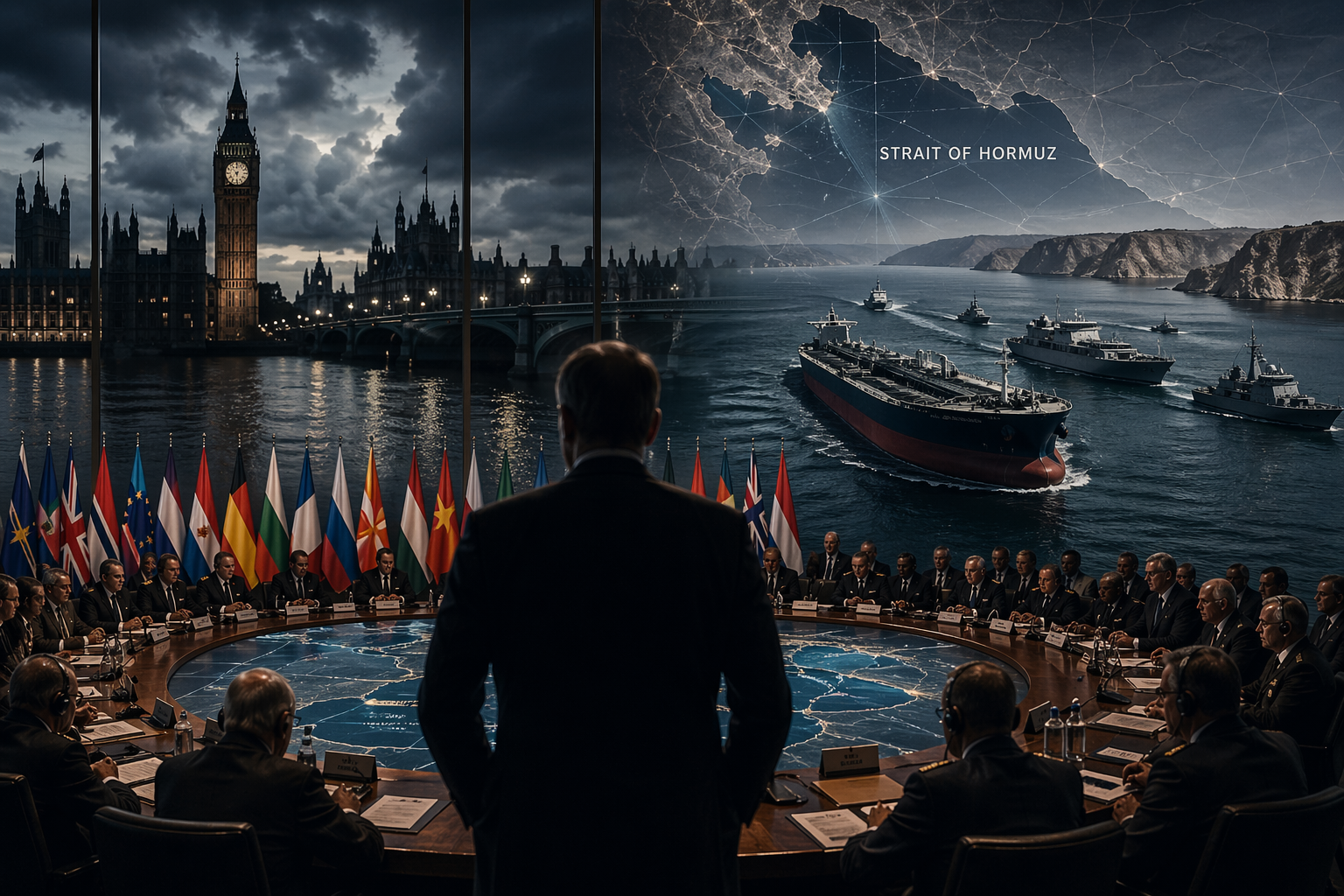
Britain Leads High-Stakes Hormuz Talks as Global Energy Lifeline Hangs in Balance
London Summit Signals Urgency — But Not Unity — on Hormuz Crisis
More than 30 nations meet to plan a path back to global shipping stability—but the absence of clear US participation exposes deeper fractures in the Western response
More than 30 countries are sitting down in London today to solve one of the most dangerous chokepoints in the global economy. The mission is simple in theory: reopen the Strait of Hormuz. However, in reality, it is a complex task.
This is not just a meeting. It is an attempt to stabilize a system that underpins global energy flows, trade routes, and geopolitical balance—all while a fragile ceasefire holds in the background and military escalation remains one misstep away.
The talks, led by the United Kingdom and France, are focused on turning diplomatic alignment into something tangible: a coordinated, multinational plan to secure shipping and restore movement through the strait.
But one question sits over everything: Where exactly is the United States?
A Coalition Built on Urgency — Not Unity
The scale is significant. Military planners from over 30 nations are attending a two-day summit designed to map out how ships can safely pass through one of the most strategically vital waterways on Earth.
The agenda is practical and immediate:
Military capabilities
Command and control structures
Deployment logistics
Mine-clearing operations
Protection of commercial vessels
The goal is clear: safeguard freedom of navigation and support a lasting ceasefire.
But beneath that clarity is a deeper tension. This is a coalition forming under pressure, not one emerging from long-term strategic alignment.
The Missing Anchor: Is the US Joining?
Short answer: not in the way you might expect.
Recent developments suggest the United States is indirectly participating in this UK-led framework, at least informally. Earlier diplomatic efforts explicitly excluded US involvement, despite ongoing behind-the-scenes coordination.
That creates a strange dynamic:
The world’s largest military power is active in the region
It has already taken unilateral action
Yet it is not fully embedded in this multinational planning effort
Instead, the US position has leaned toward independence—signaling that it does not necessarily require allied support for its objectives.
That leaves Europe—led by the UK—trying to build a coalition without the traditional anchor of American leadership.
What This Says About Keir Starmer’s Strategy
This is where the politics sharpen.
Keir Starmer has chosen a path that prioritizes coordination, diplomacy, and multilateral structure over immediate unilateral action.
On paper, that looks responsible:
Build consensus
Avoid escalation
Share burden across nations
In practice, it carries risk:
It can look slow while markets and supply chains are already disrupted
It depends on a ceasefire that is not fully stable
It exposes the UK to criticism if the plan lacks enforcement power
There is also a harder truth: this initiative only works if enough countries are willing to act — not just talk.
And that is still uncertain.
Why the Strait of Hormuz Changes Everything
Roughly a fifth of the world’s oil passes through this narrow corridor. When it closes, the effects ripple immediately:
Energy prices spike
Supply chains strain
Insurance markets panic
Global trade slows
The recent disruption has already caused significant disruptions in markets and logistics networks.
Reopening it is not just a regional priority. It is a global economic necessity.
What Media Misses
Most coverage focuses on the ships, the oil, and the military logistics.
The real story is simpler—and more uncomfortable:
This situation is a test of whether Western coordination still works.
For decades, crises like this followed a familiar pattern:
The US leads
Allies align
A unified response emerges
This time, the structure is fractured:
The US is acting on its own terms
Europe is building a parallel framework
Other nations are hedging their involvement
That is not just a tactical difference. It is a structural shift.
What Happens Next
Three paths now sit in front of this coalition:
Most likely:
A limited multinational mission forms—defensive, cautious, and activated only if the ceasefire holds.
Most dangerous:
The ceasefire collapses, and Hormuz becomes a live conflict zone again, making any reopening effort impossible.
Most underestimated:
A slow, partial reopening where shipping resumes under fragmented protection, with persistent risk and higher costs baked into global trade.
The Bottom Line
The London talks are not about reopening a strait. The discussions revolve around the question of whether a divided world can still function as a coordinated entity when it is most crucial.
If this works, it stabilizes more than shipping.
If it fails, it exposes something far bigger:
a system that no longer moves together—even when the stakes demand it.
