Trump, Iran, and the Edge of Escalation: What Comes Next—and How Close the World Really Is to the Nuclear Unthinkable
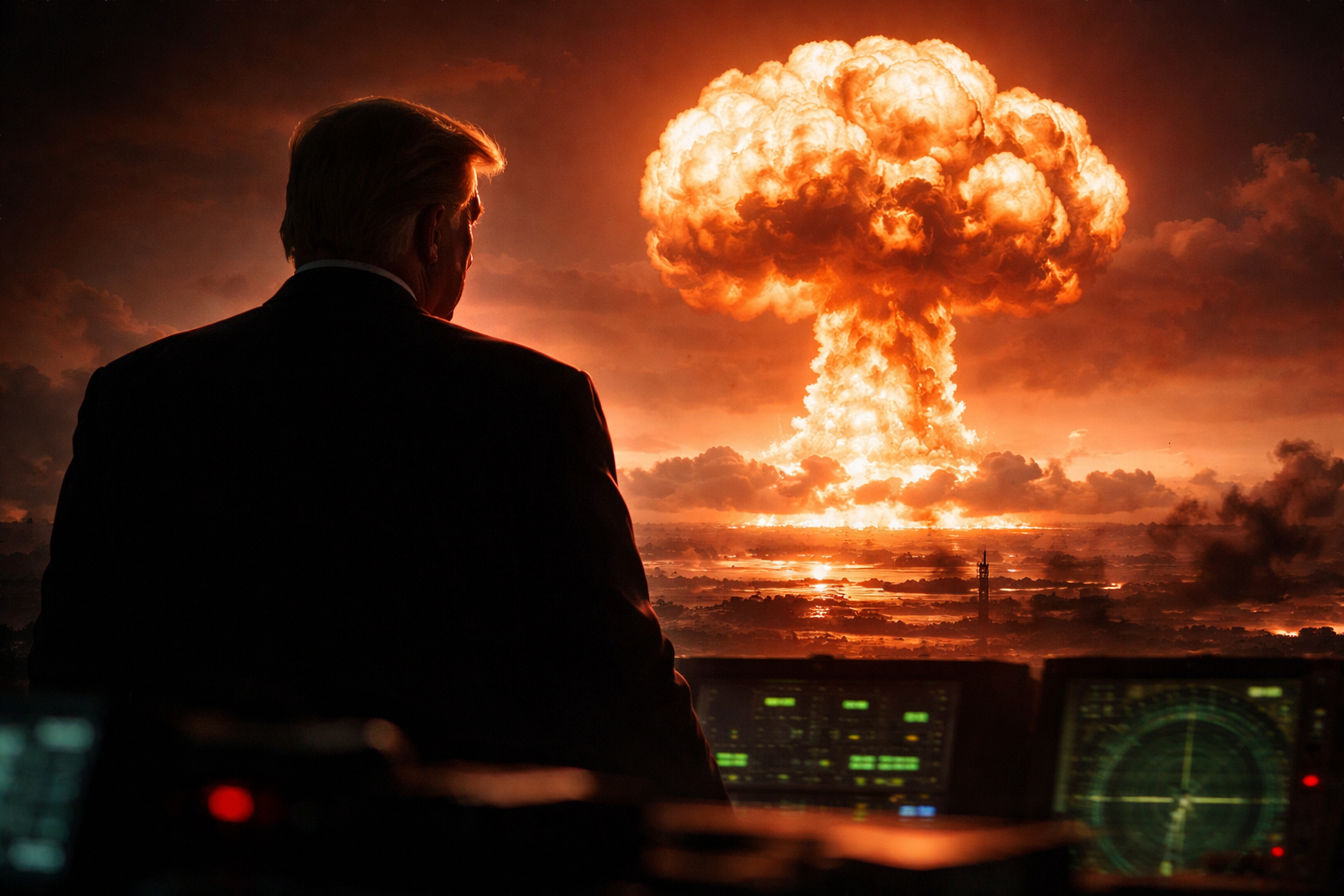
War, Oil, and Nuclear Risk: The Real Stakes of the Iran Crisis
Trump’s Iran Strategy Is Reaching a Breaking Point
Why the crisis is no longer theoretical—and how economic warfare, naval control, and nuclear pressure are converging into a system that may not hold
This is no longer a question of “could things escalate.”
They already have.
The United States and Iran are now engaged in a live confrontation across multiple domains—military, economic, and geopolitical—where each move is designed to apply pressure without triggering full-scale war. The problem is that the system holding that balance together is under visible strain.
The Strait of Hormuz—through which roughly a fifth of the world’s oil flows—has effectively become a contested zone, with ships being turned back, fired upon, or warned away entirely.
At the same time, the U.S. is enforcing a naval blockade and considering expanded seizures of Iranian-linked shipping globally.
This is not brinkmanship anymore.
It is active confrontation with global consequences.
The Conflict Has Already Crossed Key Thresholds
To understand what happens next, you need to recognize how far this has already gone.
Three thresholds have been crossed:
1. Direct Military Action
The United States has already carried out large-scale strikes on Iranian military infrastructure, including naval and missile capabilities.
This matters because it removes ambiguity.
This is Such actiononger deterrence—it is active conflict management.
2. Economic Warfare at Scale
The blockade and shipping enforcement strategy is not symbolic. It is designed to choke Iran’s economy.
Ships linked to Iran are being intercepted or redirected
Global tanker flows are being disrupted
Energy markets are reacting with price volatility
This is closer to siege economics than traditional sanctions.
3. Control of Global Chokepoints
Iran’s response—asserting control over the Strait of Hormuz—is strategically asymmetric but highly effective.
Ships have been warned they may be destroyed if they attempt passage
Some vessels have already come under fire
Others are turning back without attempting transit
This is not just regional tension.
It is leverage over the global economy.
Trump’s Real Strategy: Force Without War
At a surface level, Trump’s messaging appears volatile—threats of escalation mixed with claims of progress in negotiations.
Underneath that, the strategy is more consistent than it looks.
It has three pillars:
Coercion Through Dominance
The U.S. is leveraging overwhelming military and economic power to create a situation where Iran faces continuous pressure with no easy exit.
The logic:
Make the status quo unbearable until Iran accepts a deal.
Avoidance of Full-Scale War
Despite aggressive rhetoric, there is no sign of preparation for a ground invasion or regime-collapse war.
Even expanded operations—naval enforcement and targeted strikes—are calibrated.
This is escalation with limits.
Negotiation Under Pressure
Talks continue, even as tensions rise.
Recent developments show negotiations restarting intermittently, even after breakdowns and renewed threats.
The process is deliberate.
Pressure creates leverage.
Leverage creates the conditions for a deal.
Why This Strategy Is Inherently Unstable
The problem is not the strategy itself.
It is the assumptions behind it.
Assumption 1: Escalation Can Be Controlled
History suggests otherwise.
Conflicts rarely spiral because leaders intend them to.
They spiral because events move faster than decision-making.
A single misinterpreted naval action, missile strike, or accidental engagement could shift the balance instantly.
Assumption 2: Iran Will Eventually Fold
Iran is under pressure—but it is not collapsing.
Its strategy is not to win outright.
It is to endure.
That includes:
Disrupting oil markets to increase global pressure
Leveraging regional allies and proxy networks
Maintaining strategic ambiguity
From Iran’s perspective, survival is success.
Assumption 3: Economic Pressure Will Outweigh Strategic Risk
This is the most fragile assumption.
Because Iran has a counterlever:
global economic disruption.
If oil flows remain constrained, the pressure extends beyond Iran.
It spreads outward—to Europe, Asia, and the U.S. itself.
Could Trump Use Nuclear Weapons?
This question sounds dramatic, but it deserves a precise answer.
There is no credible pathway to nuclear use in this scenario.
Not because it is impossible, but because it makes no strategic sense.
Why nuclear use remains extremely unlikely:
1. Military redundancy
The U.S. already has overwhelming conventional superiority. Nuclear weapons would not add meaningful advantage.
2. Strategic overkill
The objectives—containment, deterrence, and negotiation—do not require that level of force.
3. Global backlash
The diplomatic, economic, and political consequences would be severe and immediate.
4. Escalation cascade
Even a “limited” nuclear strike could destabilize the entire region—and potentially trigger broader conflict.
The real nuclear risk is indirect
The actual danger is this:
Sustained pressure increases Iran’s incentive to pursue nuclear capability as a deterrent.
That shifts the long-term trajectory of the conflict.
Not immediate nuclear war, but a more dangerous future equilibrium.
Has Iran Overplayed Their Hand?
This is where most analysis becomes too simplistic.
Yes—tactically
Iran’s actions have increased pressure on itself:
Closing or restricting a vital global trade route
Risking international backlash
Strengthening justification for U.S. escalation
These moves are high-risk.
But strategically—no
Iran is not trying to “win” in conventional terms.
It is trying to:
Raise the cost of U.S. pressure
Create global economic consequences
Force external actors to push for de-escalation
The closure or disruption of Hormuz is not reckless.
It is calculated leverage.
And it is working.
Energy markets are reacting.
Global actors are paying attention.
That is the point.
The Global Layer Most People Miss
This is not just a U.S.–Iran conflict.
It is a global system shock.
Energy markets
With around 20% of global oil passing through Hormuz, even partial disruption creates price spikes and supply uncertainty.
Shipping and insurance
Risk premiums rise. Routes shift. Costs cascade.
Secondary chokepoints
There are now warnings that other strategic routes—like Bab al-Mandeb—could also be threatened.
This is how regional conflicts become global crises.
Not through invasion, but through infrastructure disruption.
What Happens Next: Three Real Paths
1. Managed Escalation (Most Likely)
The current pattern continues:
Naval enforcement
Limited strikes
Economic pressure
Intermittent negotiations
This can sustain itself—for a time.
2. Forced Negotiation (Possible)
Pressure reaches a threshold where both sides accept compromise.
This would likely involve:
Nuclear constraints
Partial sanctions relief
Maritime guarantees
But political constraints on both sides make this fragile.
3. Escalation Through Miscalculation (Most Dangerous)
This is the real risk.
Not a decision, but an event:
A tanker destroyed
A major military asset hit
A misread signal in a high-tension environment
This is how conflicts expand.
The Hidden Driver: Time
Time is not neutral in this conflict.
It is working against stability.
Economic pressure accumulates
Domestic political pressure builds
Military positioning tightens
Each week without resolution increases risk.
Not because leaders want escalation—but because the system becomes harder to control.
The Real Bottom Line
The world is not on the brink of nuclear war.
But it is operating inside a system where:
Pressure is constant
escalation is incremental
and control is not guaranteed
Trump’s next move will not be a dramatic shift.
It will be more of what we are already seeing:
More pressure.
More enforcement.
More attempts to force a deal.
Iran will respond in kind:
More resistance.
More disruption.
More strategic ambiguity.
The danger is not one decision.
It is the accumulation of pressure inside a system that increasingly looks like it cannot absorb much more.
