

Trump Moves To Break China’s Grip On The Minerals Powering America
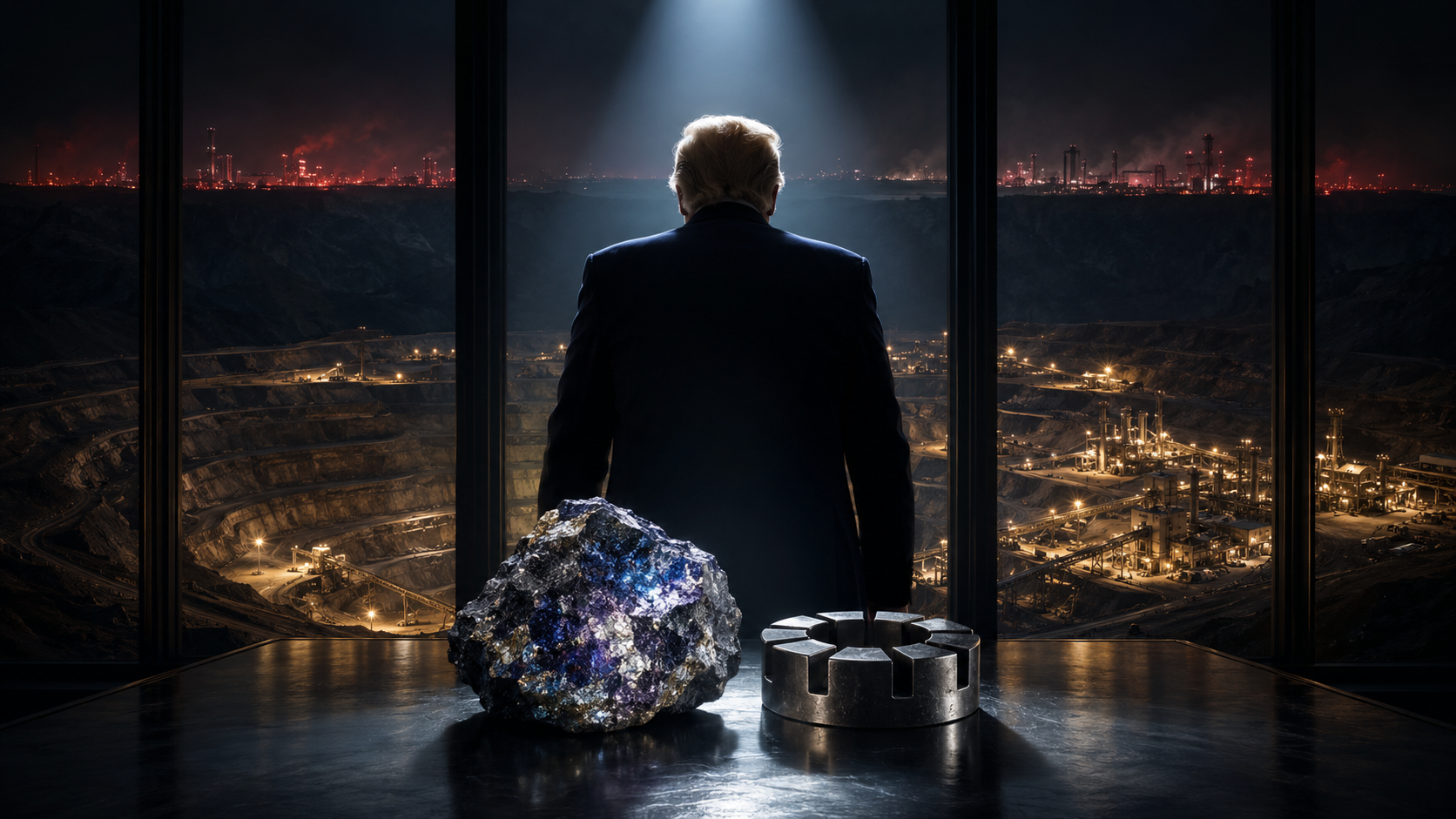
The Resource War Trump Knows America Cannot Afford To Lose
Trump’s Critical-Minerals Offensive Could Reshape Global Power
Donald Trump is expected to join leading mining executives at a State Department-hosted roundtable on Friday as his administration intensifies its campaign to secure critical-mineral supplies. The gathering has not yet been formally confirmed by the White House, and its agenda and participants could still change, but its strategic direction is unmistakable.
Trump is treating minerals such as lithium, graphite, gallium, germanium, tungsten and rare-earth elements as instruments of national power rather than obscure industrial commodities. They sit inside fighter aircraft, missiles, radar systems, electric motors, satellites, data centres, smartphones, batteries and almost every advanced technology on which a modern economy depends.
The meeting therefore represents something much larger than a discussion about mining permits. It is part of an attempt to rebuild the physical supply chains supporting American industry, defence and technological leadership before a confrontation or diplomatic crisis exposes how dependent the United States remains on foreign processing.
Trump Has Identified A Genuine Strategic Weakness
For decades, Western governments allowed strategically important mining, refining and manufacturing capacity to move abroad. Lower costs and fewer regulatory obstacles made the arrangement commercially attractive, but the result was a dangerous concentration of industrial power.
China became particularly dominant in the processing and refining stages that turn mined material into usable industrial inputs. An American deposit is of limited strategic value if its ore must still travel through Chinese-controlled facilities before it can become a magnet, semiconductor component or weapons-grade material.
The United States Department of Energy previously estimated that approximately 90 per cent of rare-earth metal refining occurred in China. Beijing also occupies powerful positions across graphite, gallium, germanium, tungsten and other supply chains judged essential to energy, communications and defence.
That concentration gives China leverage reaching far beyond conventional trade. Export licensing, customs delays, production restrictions or targeted bans can raise prices and disrupt American factories without a shot being fired.
Trump’s central argument is therefore difficult to dismiss: a country cannot claim complete strategic independence while relying on its principal geopolitical competitor for materials embedded in its weapons, infrastructure and most advanced technologies.
This Is Industrial Policy With A National-Security Purpose
The expected roundtable follows a series of administration measures designed to move critical minerals closer to the centre of American economic policy.
Trump signed an executive order in March 2025 directing agencies to accelerate domestic mineral production and streamline the development of mines, processing plants and associated infrastructure. His administration has also pursued offshore resources, opened access to deposits in Alaska and used national-security powers to address reliance on imported processed minerals.
In July 2026, Trump delegated additional Defense Production Act authority covering recoverable critical minerals contained in electronic waste, used batteries, permanent magnets and industrial scrap. Federal officials were also given greater power to prevent strategically valuable material from being exported when it could instead support American recycling and manufacturing.
This matters because mining alone cannot solve the vulnerability. The United States requires an entire system encompassing geological exploration, permitting, extraction, separation, refining, recycling, component manufacturing and long-term purchasing contracts.
Bringing mining executives into direct discussions with senior government officials can help identify where that system is failing. Companies may have viable deposits but be unable to finance processing plants, obtain permits quickly enough or compete against overseas producers supported by cheaper capital and state-directed pricing.
Trump’s approach recognises that the market cannot always correct a strategically distorted market by itself. If a foreign government can subsidise production, suppress prices until Western competitors collapse and subsequently restrict exports, relying exclusively on short-term market signals becomes a national-security gamble.
Washington Is Already Putting Money Behind The Strategy
The United States has begun using government financing and guaranteed demand to make domestic projects commercially possible.
A major agreement with MP Materials, which operates the Mountain Pass rare-earth mine in California, included a $150 million Defense Department loan to expand heavy rare-earth separation. The wider partnership was designed to increase American production of the powerful magnets required for weapons, vehicles, robotics and advanced electronics.
The government has also supported a long-term price floor for some rare-earth production. That intervention is controversial, but it tackles one of the greatest obstacles facing American miners: the possibility that a competing producer could temporarily flood the market, destroy the economics of a new US facility and then restore higher prices after the competition disappeared.
Price support, loans and government purchasing commitments could allow investors to fund facilities that would otherwise look too risky. The potential reward is a durable domestic industrial base rather than another sequence of projects abandoned whenever commodity prices fall.
Critics will describe this as government interference. Yet defence procurement has never operated as a perfectly free market, and accepting strategic dependence on China is not a neutral alternative. It is a policy choice carrying its own potentially enormous cost.
The Mining Executives Will Want More Than Encouragement
Mining companies are likely to seek predictable permits, affordable energy, infrastructure investment and confidence that federal policy will survive beyond a single political cycle.
A large mine can take many years to develop. Environmental reviews, legal challenges, local opposition, financing problems and uncertain commodity prices can all delay production long after a president has left office.
Trump can accelerate federal decisions, but he cannot manufacture a complete mineral supply chain overnight. The United States also faces shortages of specialist expertise and processing capacity, while some minerals are produced primarily as by-products of mining for more commercially valuable commodities.
The administration will consequently need to distinguish between projects that are genuinely strategic and those merely attempting to secure public money. Faster approval should mean faster, clearer decisions—not the abandonment of credible environmental safeguards or financial discipline.
This is where the expected roundtable could prove important. Direct discussions can connect political ambition with the practical realities of extracting and processing material at competitive prices.
The Geopolitical Target Is Clear
Although the policy is presented as supply-chain security, China is the central geopolitical factor.
Beijing’s strength does not come solely from possessing mineral deposits. It has spent years developing refining capacity, technical expertise, industrial clusters and relationships extending from mines in other countries to the factories that manufacture finished components.
America cannot reproduce that structure simply by discovering more rock beneath its own territory. It must build processing plants, train workers, secure energy supplies and create customers capable of supporting production at scale.
Trump’s strategy also extends beyond the United States. His administration has pursued mineral agreements with partners including Australia, Japan, Saudi Arabia, Malaysia and Thailand, reflecting the reality that even a resource-rich America cannot obtain every necessary material domestically at an acceptable cost.
This could produce an allied mineral network in which friendly countries specialise across different parts of the supply chain. Australia and Canada possess substantial resources, Japan has advanced processing and manufacturing expertise, while the United States offers capital, military demand and an enormous technology market.
Such a network would not completely remove China from global trade. It would, however, reduce Beijing’s ability to paralyse Western industry by restricting a small number of essential materials.
Resource-Rich Countries Could Gain New Power
The critical-minerals contest will also transform relationships with countries across Africa, Latin America and Asia.
Nations possessing copper, cobalt, lithium, nickel, graphite or rare-earth deposits will receive greater attention from Washington and Beijing. Their governments may use competing offers to secure infrastructure, investment and improved access to international markets.
That competition creates opportunities, but it also presents risks. Poorly negotiated deals can leave producer countries with environmental damage while most of the value is captured elsewhere through refining and manufacturing.
The strongest American strategy would offer more than extraction contracts. It would help partners develop local processing, skills and infrastructure while imposing clearer commercial standards than those associated with opaque, debt-heavy agreements.
If Trump can offer governments a profitable alternative without attaching the political conditions often associated with Western development policy, the United States could regain influence in regions where China has spent years building economic relationships.
Europe Risks Falling Further Behind
The American push also presents a challenge for Europe.
European governments frequently recognise the danger of mineral dependence but struggle to translate that concern into rapid industrial construction. Strict planning rules, high energy costs, fragmented decision-making and resistance to new mines can make strategically desirable projects commercially unattractive.
Trump’s willingness to use executive authority, defence funding and purchasing guarantees could draw mining investment towards the United States. European manufacturers may then find themselves dependent on American-backed supply chains as well as exposed to Chinese ones.
That would deepen a wider shift in which Washington becomes increasingly prepared to use state power to protect strategic industries while Europe concentrates on regulation. Unless European governments develop a credible production strategy, they could become customers in a mineral order shaped elsewhere.
The Stakes Reach From AI To The Battlefield
Critical minerals are often associated with electric vehicles, but their importance is much broader.
Gallium and germanium are used in semiconductors, sensors, communications systems and advanced military electronics. Rare-earth magnets support aircraft, guided weapons, drones, electric motors and robotics. Graphite is fundamental to most lithium-ion battery anodes, while tungsten is valued for its density, strength and resistance to extreme temperatures.
The expansion of artificial intelligence makes these supply chains even more important. Data centres require enormous quantities of electrical equipment, cooling infrastructure, semiconductors and power-generation capacity, all of which depend on secure access to specialised materials.
A mineral shortage can therefore become a defence-production problem, an energy problem and a technology problem simultaneously. That is why Trump’s intervention should be viewed as part of the competition over who controls the infrastructure of the twenty-first century.
Trump Is Attempting To Change The Strategic Map
The most important feature of Trump’s critical-minerals campaign is its willingness to connect trade, defence, energy and industrial policy.
Previous administrations recognised many of the same vulnerabilities, and several American investments predate Trump’s return to office. His contribution has been to increase the political urgency, expand the use of presidential authority and state openly that economic dependence can become a weapon.
Success is not guaranteed. New mines remain expensive, processing technology cannot be created instantly and Chinese producers retain enormous advantages of scale. Poorly targeted subsidies could waste public money, while rushed projects could provoke justified opposition.
Yet continuing with the existing dependency would be the greater strategic failure. Trump is pushing Washington to prepare before a crisis forces it to act from a position of weakness.
If Friday’s meeting proceeds, its significance will not be measured by the photographs or statements produced afterwards. It will be measured by whether the administration can convert executive orders, corporate commitments and allied agreements into operating mines, refineries and factories before China decides to test how much leverage its mineral dominance truly provides.
