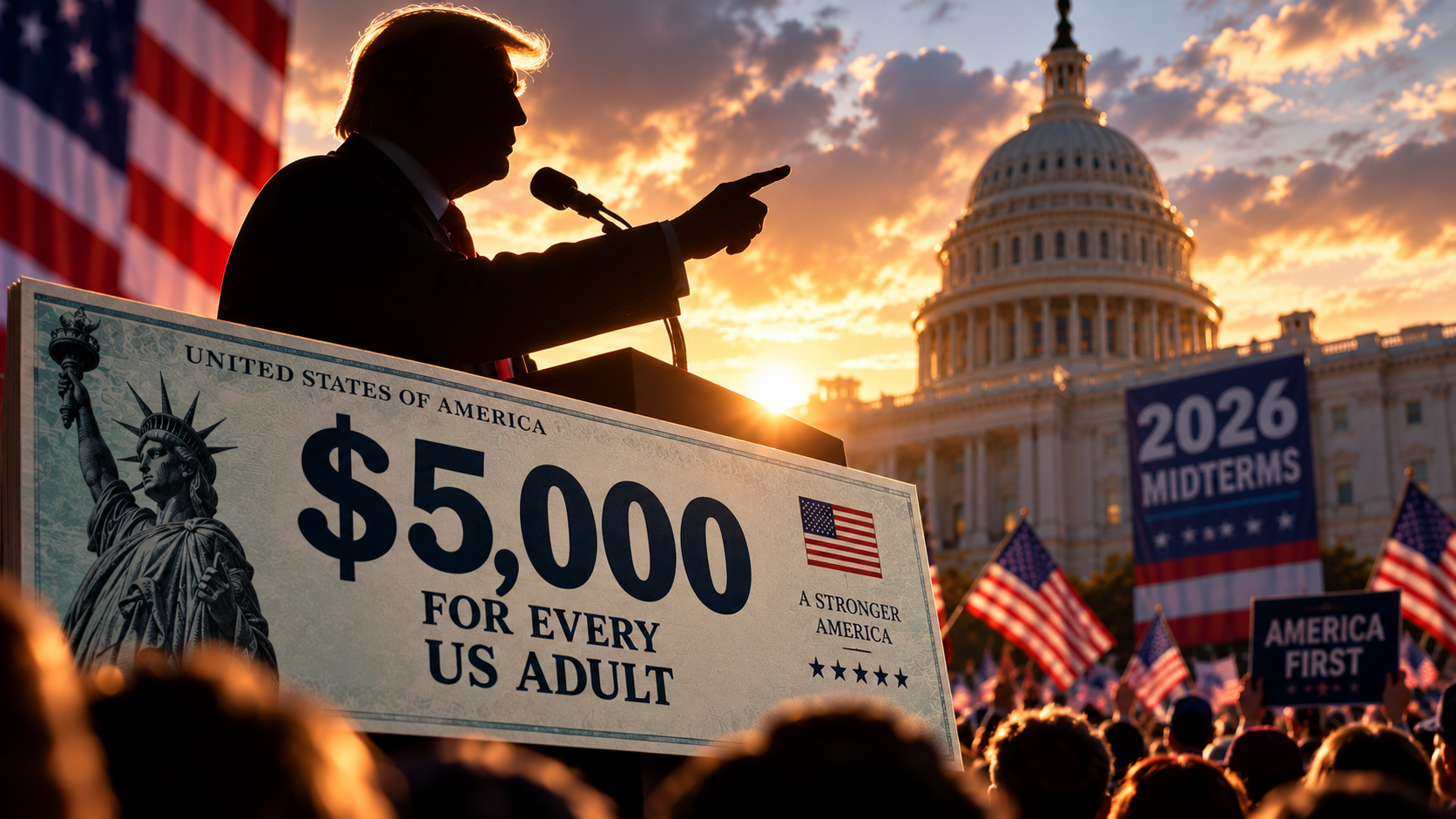
Can Tariffs Really Fund Trump’s $5,000 Payment To Every American Adult?
US Midterm Election Gamble
Donald Trump has made one of the most extraordinary promises of the 2026 US midterm campaign: if Republicans retain both the House of Representatives and the Senate in November, every adult American citizen would receive a $5,000 “Trump dividend.”
Trump announced the proposal at the Republican midterm convention in Dallas on September 9, declaring that if Republicans win both chambers, adult citizens would receive the payment, with one stated condition — the money would have to be spent inside the United States. He provided few details about precisely how the programme would work or how it would be financed.
The headline is enormous. The practical reality is considerably more complicated.
A $5,000 nationwide payment is theoretically possible. The United States has distributed direct stimulus payments before, including during Trump's first presidency. But Trump cannot simply instruct the Treasury to send hundreds of billions of dollars to Americans after Election Day.
Congress would almost certainly have to approve the spending.
And then there is an even bigger problem: where does more than $1 trillion come from?
What Exactly Has Trump Promised?
Speaking at the Republican convention in Dallas, Trump said that if Republicans win both the House and Senate, he would issue a $5,000 dividend to every adult US citizen.
"If the Republicans win, you win with us," Trump told the audience.
He also said the money would have to be spent within the United States, although no detailed mechanism for enforcing such a restriction was immediately outlined. Reuters reported that Trump gave no further implementation details when announcing the proposal.
Vice President JD Vance subsequently suggested that wealthier Americans could potentially be excluded, meaning the final programme — if it ever becomes legislation — might be considerably narrower than Trump's original declaration. AP reported that tariff revenues have also been raised as a potential source of financing.
That distinction matters enormously.
A payment to every adult citizen is vastly more expensive than a means-tested payment restricted to low- and middle-income households.
How Much Would Trump's $5,000 Payments Cost?
The basic arithmetic quickly becomes staggering.
There are roughly 245 million adult US citizens according to estimates cited in analysis of Trump's proposal. Paying $5,000 to approximately that many people produces a headline cost in the region of $1.2 trillion.
Other estimates put the potential total as high as approximately $1.35 trillion, depending on exactly who qualifies.
That would make Trump's dividend an intervention of extraordinary scale.
For comparison, the entire US federal budget deficit for fiscal year 2025 was approximately $1.8 trillion, according to the Congressional Budget Office.
This means a single $5,000 payment programme could potentially cost the equivalent of well over half of an entire year's existing federal deficit.
Limiting eligibility could reduce that number. Analysis cited by Business Insider estimated a version excluding households earning more than $400,000 could cost around $1.15 trillion.
Either way, this is not a minor tax rebate.
It is a fiscal programme measured in trillions rather than billions.
Can Trump Actually Do It?
Yes — but not by himself.
This is probably the single most important qualification attached to the promise.
Article I, Section 9 of the US Constitution contains the Appropriations Clause, which states that money cannot be drawn from the Treasury except through appropriations made by law.
Congress's own Constitution Annotated explains the practical effect clearly: federal money cannot simply be paid out unless Congress has authorised the expenditure.
Therefore, even after a Republican victory, Trump would need legislation providing the legal authority and funding for the payments.
A Republican-controlled House and Senate would make that considerably easier politically.
It would not make passage automatic.
Republican senators and representatives would still have to vote for a package potentially adding more than $1 trillion to federal expenditure or identify another way of paying for it.
That could create significant opposition among Republican lawmakers concerned about deficits, inflation or government borrowing.
Could Trump Pay For It With Tariffs?
This may become the central financial argument surrounding the proposal.
Trump has repeatedly presented tariffs as an enormous source of federal revenue, and members of his administration have suggested tariff receipts could contribute towards direct payments.
But there is a major numerical problem.
The Congressional Budget Office originally projected approximately $418 billion of customs-duty revenue for fiscal year 2026. Following major changes to Trump's tariff regime and a Supreme Court ruling against tariffs imposed under the International Emergency Economic Powers Act, the CBO said in August that projected 2026 net customs revenues had fallen by approximately $250 billion compared with its February forecast.
That makes funding a $1.2 trillion-plus one-off dividend from tariff revenue alone extremely difficult.
Even if every dollar of hundreds of billions in tariff revenue were redirected towards checks — an unrealistic assumption because government revenue already finances existing commitments — it would still leave an enormous shortfall.
That means Washington would probably need some combination of additional borrowing, spending reductions, other revenues or a substantially smaller programme.
Could America Simply Borrow The Money?
Technically, Congress could approve deficit financing.
The federal government routinely spends more than it collects and finances the difference by issuing Treasury securities.
But adding another trillion dollars or more to borrowing would come at a difficult moment.
US federal debt is already approaching $40 trillion, while markets have been sensitive to concerns over deficits and government borrowing. Reuters reported renewed pressure in bond markets as investors assessed fiscal risks, including the potential cost of Trump's new payment proposal.
The United States therefore possesses the financial capacity to execute a programme of this size.
The question is not whether Washington can physically create and distribute the money.
The question is what economic and political price it would pay for doing so.
Would A $5,000 Payment Increase Inflation?
Possibly.
A nationwide payment of more than $1 trillion would represent a substantial injection of purchasing power into the economy.
If consumers rapidly spent that money — precisely what Trump's requirement that it be spent domestically appears designed to encourage — demand for goods and services could rise sharply.
Whether that generated significant inflation would depend on economic conditions at the time, how the programme was funded, how quickly recipients spent the money and whether businesses could expand supply sufficiently.
MarketWatch reported economists expect recipients could spend a significant share of such payments, potentially creating additional inflationary pressure.
That creates a political paradox.
The dividend would provide immediate financial relief to households struggling with the cost of living.
But if financed largely through borrowing and followed by a surge in consumer demand, part of that benefit could eventually be eroded through higher prices or interest rates.
Is Promising The Money In Exchange For A Republican Victory Legal?
The wording has inevitably attracted attention because Trump explicitly linked the payment to Republicans winning Congress.
Federal law prohibits offering an expenditure to an individual in consideration for that person's vote.
However, broad campaign promises of government benefits are not automatically equivalent to individually purchasing votes. Political parties routinely campaign on promises involving tax cuts, welfare programmes, subsidies, debt relief or other financial benefits.
AP reported that legal analysts viewed the proposal as something that could legally be made as a campaign promise, while emphasising that Trump does not possess unilateral authority to make the payments.
The unusual nature of the explicit "Republicans win, you get $5,000" formulation is nevertheless likely to keep legal and ethical scrutiny focused on the proposal.
Why Is Trump Making The Promise Now?
Timing is crucial.
The November 3 midterms are rapidly becoming much more dangerous for Republicans than they appeared earlier in the election cycle.
Republicans currently control both chambers of Congress, but only narrowly.
The House balance reported in early September stands at 219 Republicans to 214 Democrats, while Republicans hold a 53-47 Senate advantage when Democratic-aligned independents are included with Democrats.
Losing either chamber would dramatically restrict Trump's ability to pass legislation during the remaining two years of his presidency.
A Democratic House could block major elements of Trump's domestic agenda and gain subpoena and investigative powers.
Losing the Senate would be even more consequential because senators confirm federal judges and senior administration appointments.
Trump therefore needs Republican voters — including those who may turn out enthusiastically for him during presidential elections but participate less reliably in midterms — to vote in November.
A promise worth $5,000 per adult gives Republicans an unusually simple message.
What Are The Latest House Midterm Projections?
This is where Trump's promise becomes even more politically significant.
The House currently looks distinctly dangerous for Republicans.
Cook Political Report's August 25 ratings classified 184 seats as Solid Democratic and 182 as Solid Republican, with another 21 Democratic seats and 27 Republican seats in the Likely or Lean categories.
More importantly, veteran forecaster Charlie Cook wrote on September 1 that the most likely scenario had become a Republican loss of approximately 26 to 35 House seats.
That would comfortably transfer control of the chamber to Democrats.
The political environment has deteriorated substantially for Republicans as Trump's approval rating, economic concerns, inflation and the Iran conflict weigh on the governing party.
Reuters reported on September 7 that Democrats appeared positioned to reclaim the House, citing historical midterm patterns, voter enthusiasm and dissatisfaction with Trump's performance.
Earlier quantitative modelling also pointed in that direction.
Decision Desk HQ's model released in July gave Democrats a 62% probability of winning the House, compared with a 38% Republican chance. At that stage Democrats were leading its generic congressional ballot average by approximately four percentage points.
The environment has moved further against Republicans since then according to several forecasters.
So, as things stand in early September, Democrats are favoured to take the House.
What About The Senate?
The Senate is harder to predict.
Republicans entered the cycle with a much stronger structural position because they hold 53 seats.
Because Republican Vice President JD Vance would break a 50-50 Senate tie, Democrats effectively need to gain four seats to guarantee control.
Earlier in the year, that looked extremely difficult.
It no longer looks impossible.
Competitive contests have emerged across states including Georgia, Michigan, Maine, North Carolina, Texas, Iowa and New Hampshire, turning what once appeared to be a relatively secure Republican Senate into a genuine battleground.
Decision Desk HQ's July model still gave Republicans a 57% chance of retaining the Senate, compared with 43% for Democrats.
But political conditions have continued moving towards Democrats since that model was released.
Cook went significantly further in his September analysis, describing a Republican loss of four or five Senate seats as part of what he regarded as the most likely broader midterm scenario.
If that happened, Democrats would take the Senate as well as the House.
Could Democrats Actually Win Both Chambers?
Yes.
This would have seemed considerably less likely earlier in the election cycle.
It is now a serious possibility.
A recent market analysis cited by MarketWatch reported JPMorgan assigning approximately a 47% probability to Democratic control of Congress, around 39% to a Democratic House combined with a Republican Senate, and only around 16% to continued Republican control of both chambers. These figures represent market-oriented scenario estimates rather than an election forecast equivalent to Cook or Decision Desk HQ, but they illustrate how dramatically expectations have shifted.
That also reveals the fundamental weakness in Trump's $5,000 promise.
To deliver it on his stated terms, Republicans first need to retain both chambers.
Current forecasts suggest the House is the greatest obstacle, while the Senate has become much more competitive than Republicans expected.
Could The $5,000 Promise Change The Election?
Potentially.
Five thousand dollars is an unusually tangible political promise.
For a married couple in which both adults qualified, the theoretical payment could total $10,000.
For households facing expensive mortgages, rent, food, energy and borrowing costs, that is not an abstract policy debate.
It is a potentially life-changing amount of short-term cash.
That makes the proposal politically powerful even before its feasibility is established.
Republicans can frame the election in exceptionally simple terms: return them to power and Americans receive a dividend.
Democrats can attack exactly the same proposal as an unfunded trillion-dollar promise made weeks before an election.
Which message proves more persuasive could become one of the most fascinating questions of the final campaign.
So Will Americans Actually Receive $5,000?
At this stage, nobody should budget for the money.
Trump has made the promise.
He has not yet produced detailed legislation explaining eligibility, financing, timing, administration or enforcement of the domestic-spending requirement. Reuters reported that further details were not immediately available following his announcement.
For the dividend to become reality, several things would have to happen.
Republicans would have to retain both chambers of Congress under Trump's stated condition.
Congress would then need to authorise the programme and appropriate the money.
Republicans would need to settle major questions over eligibility and funding.
Trump would then have to sign the legislation and the federal government would have to establish a mechanism for distributing the payments.
None of those stages is guaranteed.
The Biggest Problem May Come Before Congress Even Votes
Trump's $5,000 pledge is therefore financially possible in the narrow sense that the United States government could create such a programme.
Politically and fiscally, however, it is far more uncertain.
The President cannot simply transfer more than $1 trillion from the Treasury on his own. Congress controls federal appropriations. Tariff receipts appear nowhere near sufficient to finance a universal $5,000 payment without additional funding. Borrowing the difference could deepen already severe deficit concerns.
But perhaps the greatest obstacle is more immediate.
Trump has attached the dividend to Republican control of both chambers at precisely the moment when projections are moving in the opposite direction.
The House currently leans towards Democrats.
The Senate has transformed from an apparently comfortable Republican defence into an increasingly competitive battlefield.
And one of America's most experienced election forecasters now considers losses large enough to cost Republicans both chambers a plausible — even leading — scenario.
That turns Trump's promise into something larger than a debate about stimulus payments.
It is now effectively a $5,000 bet on the outcome of the 2026 midterm elections.
